EUROPE
7601 articles
USA
0 articles
DIGITAL
15677 articles (à imprimer)
Partitions Digitales
Partitions à imprimer
15677 partitions trouvées


A Clarinet,Piano - Level 1 - Digital Download SKU: A0.1160386 Composed by Ludwig van Beethoven. Arranged by Ander. Classical,Instructional,March,Opera,Romantic Period. Score and part. 6 pages. Woods Only, Arrangements #760669. Published by Woods Only, Arrangements (A0.1160386). This arrangement adapted for clarinet in A and piano was written keeping the characteristics of the original work, that is, inspiring and significant to the already known choral symphony by Beethoven, indicated to be performed by young music students, who want to enter the symphonic music, moreover, it can also be used by professional musicians, for recitals, repertoire, academic presentations and didactic material. As much as it is a funeral march, it is well suited for any musical performance occasion. The transcription is faithful to the structure, with only one change in key, so that it is comfortable for all instruments in the formation, thus maintaining the essence of the striking melody, as well as using it for ensemble practice among musicians of different traditions.Beethoven's Ninth Symphony Op. 125 incorporates part of the poem An die Freude (To Joy), a hymn written by Friedrich Schiller, with the text sung by soloists and a choir in its last movement. It was the first example of a major composer using the human voice as prominently as the instruments in a symphony, thus creating a far-reaching work that set the tone for the symphonic form that was to be adopted by Romantic composers. This is the last complete symphony composed by Ludwig van Beethoven. The choral symphony, better known as the Ninth Symphony or The Ninth, is one of the best known works in the Western repertoire, considered both an icon and predecessor of Romantic music, and one of Beethoven's great masterpieces, where it was first performed on May 7, 1824, the same year it was completed, at the Kärntnertortheater in Vienna, Austria. The conductor was Michael Umlauf, the theater's music director, and Beethoven - dissuaded from conducting by the advanced stage of his deafness - was given a special place on the stage next to the conductor. It was later rearranged by Herbert von Karajan to become the anthem of the European Union in 1972, the national anthem of Rhodesia from 1974 until 1979, Rise, O Voices of Rhodesia, used the tune Ode to Joy..
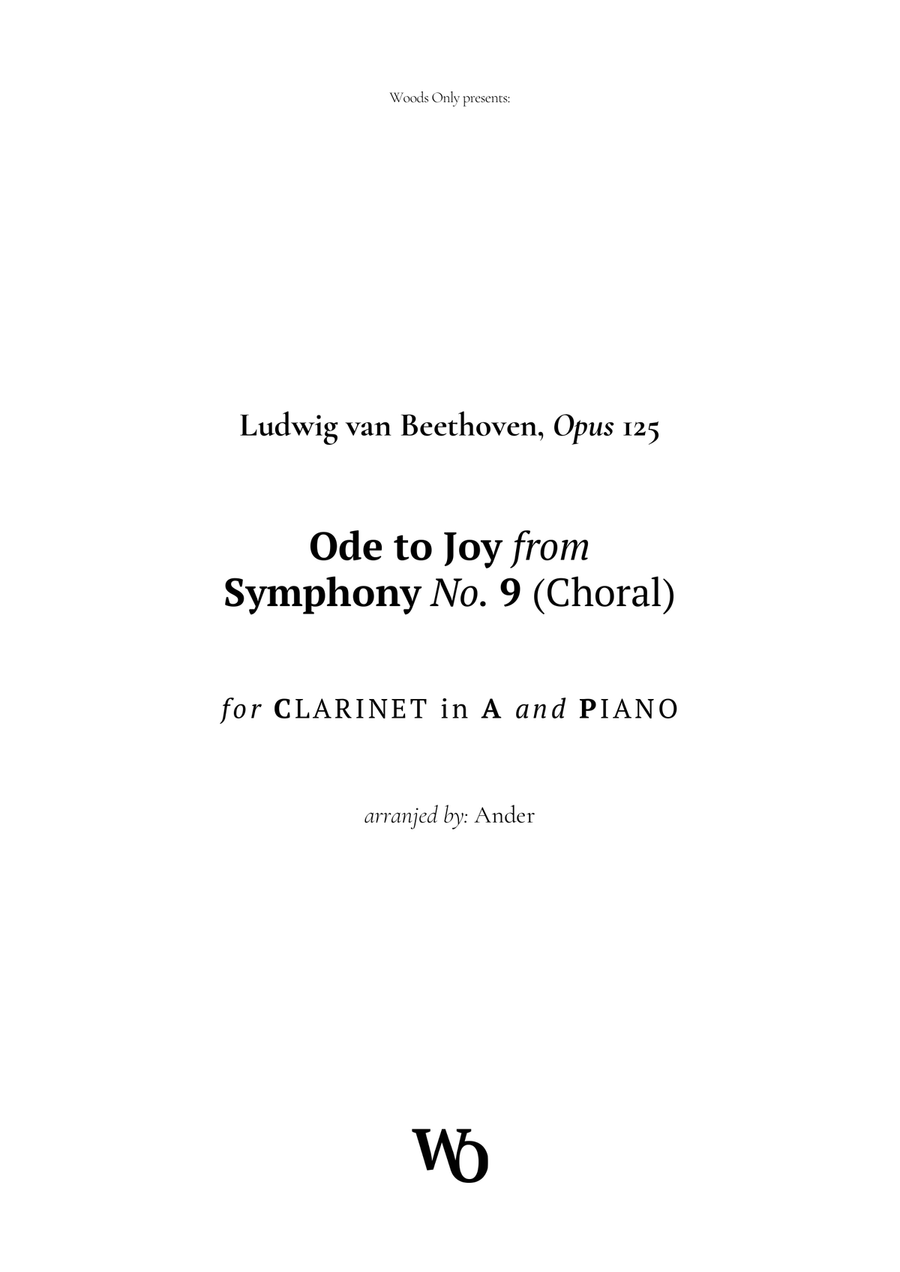
Ode to Joy by Beethoven for Clarinet in A
Clarinette et Piano

$1.99 1.71 € Clarinette et Piano PDF SheetMusicPlus

Trombone Quartet - Level 2 - Digital Download SKU: A0.1264239 Composed by Ludwig van Beethoven. Arranged by Ander. 19th Century,Classical,March,Opera,Romantic Period. 11 pages. Woods Only, Arrangements #857102. Published by Woods Only, Arrangements (A0.1264239). This trombone quartet arrangement was written to maintain the characteristics of the original work, inspiring and significant to Beethoven’s well-known choral symphony. Suitable for young music students and professional musicians, for recitals, repertoire, academic presentations, and didactic material. The transcription is faithful to the structure, with only one key change, maintaining the essence of the striking melody. Beethoven’s Ninth Symphony Op. 125 incorporates part of the poem An die Freude (“To Joyâ€), a hymn written by Friedrich Schiller, with the text sung by soloists and a choir in its last movement. It was the first example of a major composer using the human voice as prominently as instruments in a symphony, creating a far-reaching work that set the tone for the symphonic form adopted by Romantic composers. This is Ludwig van Beethoven’s last complete symphony. The choral symphony, better known as the Ninth Symphony or The Ninth, is one of the best-known works in the Western repertoire, considered an icon and predecessor of Romantic music and one of Beethoven’s great masterpieces. It was first performed on May 7, 1824 at the Kärntnertortheater in Vienna, Austria.
Ode to Joy by Beethoven for Trombone Quartet
Quatuor de cuivres: 4 trombones

$7.99 6.88 € Quatuor de cuivres: 4 trombones PDF SheetMusicPlus

Chorus - Digital Download SKU: AX.00-PO-0003075 Ashokan Farewell (from The Civil War, a Film by Ken Burns) - SATB. Composed by Jay Ungar. Arranged by Carole Stephens. Choral. 8 pages. Alfred Music - Digital Sheet Music #00-PO-0003075. Published by Alfred Music - Digital Sheet Music (AX.00-PO-0003075). UPC: 029156905038. Grian McGregor.Almost everyone recognizes the superb melody of Jay Ungar's Ashokan Farewell that was featured so prominently in the Ken Burns Civil War film. Now, finally a choral setting with a lyric that skillfully paints a most beautiful picture of Americana. Music that will warm the hearts of choirs and audiences everywhere! Available for SATB, SAB, Acc. Cassette.
Ashokan Farewell (from "The Civil War," a Film by Ken Burns)
Chorale SATB

$2.25 1.94 € Chorale SATB PDF SheetMusicPlus

Brass Quintet - Level 2 - Digital Download SKU: A0.1252412 Composed by Ludwig van Beethoven. Arranged by Ander. 19th Century,Classical,March,Opera,Romantic Period. 14 pages. Woods Only, Arrangements #846382. Published by Woods Only, Arrangements (A0.1252412). This arrangement adapted for brass quintet was written keeping the characteristics of the original work, that is, inspiring and significant to the already known choral symphony by Beethoven, indicated to be performed by young music students, who want to enter the symphonic music, moreover, it can also be used by professional musicians, for recitals, repertoire, academic presentations and didactic material. As much as it is a funeral march, it is well suited for any musical performance occasion. The transcription is faithful to the structure, with only one change in key, so that it is comfortable for all instruments in the formation, thus maintaining the essence of the striking melody, as well as using it for ensemble practice among musicians of different traditions.Beethoven's Ninth Symphony Op. 125 incorporates part of the poem An die Freude (To Joy), a hymn written by Friedrich Schiller, with the text sung by soloists and a choir in its last movement. It was the first example of a major composer using the human voice as prominently as the instruments in a symphony, thus creating a far-reaching work that set the tone for the symphonic form that was to be adopted by Romantic composers. This is the last complete symphony composed by Ludwig van Beethoven. The choral symphony, better known as the Ninth Symphony or The Ninth, is one of the best known works in the Western repertoire, considered both an icon and predecessor of Romantic music, and one of Beethoven's great masterpieces, where it was first performed on May 7, 1824, the same year it was completed, at the Kärntnertortheater in Vienna, Austria. The conductor was Michael Umlauf, the theater's music director, and Beethoven - dissuaded from conducting by the advanced stage of his deafness - was given a special place on the stage next to the conductor. It was later rearranged by Herbert von Karajan to become the anthem of the European Union in 1972, the national anthem of Rhodesia from 1974 until 1979, Rise, O Voices of Rhodesia, used the tune Ode to Joy..
Ode to Joy by Beethoven for Brass Quintet
Quintette de Cuivres: 2 trompettes, Cor, trombone, tuba

$9.99 8.61 € Quintette de Cuivres: 2 trompettes, Cor, trombone, tuba PDF SheetMusicPlus

Brass Quintet Horn,Trombone,Trumpet,Tuba - Level 4 - Digital Download SKU: A0.1033565 By The Beatles. By John Lennon and Paul McCartney. Arranged by Ray Thompson. Film/TV,Pop,Rock,Standards. 9 pages. RayThompsonMusic #638875. Published by RayThompsonMusic (A0.1033565). Arranged standard brass quintet When I'm Sixty-Four is a song by the English rock band the Beatles, written by Paul McCartney (credited to Lennon–McCartney) and released on their 1967 album Sgt. Pepper's Lonely Hearts Club Band. It was one of the first songs written by McCartney, who wrote it when he was 14. The song was recorded in a different key than the final recording; it was sped up at the request of McCartney to make his voice sound younger. It prominently features a trio of clarinets (two regular clarinets and one bass clarinet) throughout.
When I'm Sixty-four
Quintette de Cuivres: 2 trompettes, Cor, trombone, tuba
The Beatles
$19.95 17.19 € Quintette de Cuivres: 2 trompettes, Cor, trombone, tuba PDF SheetMusicPlus

Concert Band - Level 5 - Digital Download SKU: A0.1454822 By Kylie Minogue. By Matt Aitken and Mike Stock. Arranged by Rusty Toots. 20th Century,Classical,Comedy,Contemporary,Pop. 73 pages. Russell Ward #1033890. Published by Russell Ward (A0.1454822). The 2nd instalment from the Stock Aitken and Waterman Re-imagined Suite for Symphonic Winds by Rusty Toots, this lively re-arrangement of Kylie Minogue's I Should Be So Lucky opens with a irreverant nod to Pachelbel's canon and Big Ben's famous Westminster Quarters tune, before taking off in a quirky romp with title tune.  Some colorful additions to the percussion section (chimes, ratchet, woodblocks, triangle) help to create a very playful atmosphere, with xylophone featuring prominently throughout.  Listeners may also recognise another well-known sexy brit-pop tune sneakily introduced by the bassoon at one point.  While technically challenging at times, the playful and irreverant spirit of this movement is sure to please audiences and players alike.
I Should Be So Lucky
Orchestre d'harmonie
Kylie Minogue
$70.00 60.32 € Orchestre d'harmonie PDF SheetMusicPlus

Small Ensemble Baritone Horn BC,Bass Clef Instrument,Bass Trombone,Euphonium,Tenor Trombone,Trombone/Baritone B.C.,Tuba - Level 3 - Digital Download SKU: A0.961202 Composed by Oscar Rasbach. Arranged by Robert Coil. 20th Century,Folk,Romantic Period,Sacred. Score and parts. 11 pages. Polished Brass #6320605. Published by Polished Brass (A0.961202). This setting for trombone quintet of the melody by Oscar Rasbach has the upper 4 voices playing primarily block chords with the melody always carried prominently by the first part. A secure upper register to c2 is required. The bass trombone part has a contrasting line that consists of ascending and descending arpeggios, which should be played smoothly, and especially so when marked with slurs.   The lyrics for the poem Trees were created by Joyce Kilmer around 1913. This piece can be used appropriately as part of a church service or in a program where a reference to Arbor Day is desired. The arranger, Bob Coil, is a graduate of the University of Cincinnati College-Conservatory of music, where he studied bass trombone with Betty Glover. Dr. Coil is the leader of the Bones of Cincinnatus trombone ensemble in Cincinnati, OH.
Trees (Trombone quintet)

$9.99 8.61 € PDF SheetMusicPlus

Recorder - Level 1 - Digital Download SKU: A0.1129692 Composed by Ludwig van Beethoven. Arranged by Ander. Classical,Instructional,March,Opera,Romantic Period. Recorder Ensemble. 15 pages. Woods Only, Arrangements #730103. Published by Woods Only, Arrangements (A0.1129692). This arrangement adapted for recorder quintet was written keeping the characteristics of the original work, that is, inspiring and significant to the already known choral symphony by Beethoven, indicated to be performed by young music students, who want to enter the symphonic music, moreover, it can also be used by professional musicians, for recitals, repertoire, academic presentations and didactic material. As much as it is a funeral march, it is well suited for any musical performance occasion. The transcription is faithful to the structure, with only one change in key, so that it is comfortable for all instruments in the formation, thus maintaining the essence of the striking melody, as well as using it for ensemble practice among musicians of different traditions. Beethoven's Ninth Symphony Op. 125 incorporates part of the poem An die Freude (To Joy), a hymn written by Friedrich Schiller, with the text sung by soloists and a choir in its last movement. It was the first example of a major composer using the human voice as prominently as the instruments in a symphony, thus creating a far-reaching work that set the tone for the symphonic form that was to be adopted by Romantic composers. This is the last complete symphony composed by Ludwig van Beethoven. The choral symphony, better known as the Ninth Symphony or The Ninth, is one of the best known works in the Western repertoire, considered both an icon and predecessor of Romantic music, and one of Beethoven's great masterpieces, where it was first performed on May 7, 1824, the same year it was completed, at the Kärntnertortheater in Vienna, Austria. The conductor was Michael Umlauf, the theater's music director, and Beethoven - dissuaded from conducting by the advanced stage of his deafness - was given a special place on the stage next to the conductor. It was later rearranged by Herbert von Karajan to become the anthem of the European Union in 1972, the national anthem of Rhodesia from 1974 until 1979, Rise, O Voices of Rhodesia, used the tune Ode to Joy..

Ode to Joy by Beethoven for Recorder Quintet
5 Flûtes à bec

$9.99 8.61 € 5 Flûtes à bec PDF SheetMusicPlus

Woodwind Ensemble Flute - Level 3 - Digital Download SKU: A0.736289 Composed by Phyllis Avidan Louke, ASCAP. 20th Century,Contemporary. 62 pages. Louke Publishing #4405244. Published by Louke Publishing (A0.736289). For Flute Choir Cloud Images By Phyllis Avidan Louke Cloud Images is a programmatic work in five movements for Flute Choir dedicated to Albert Weatherly of Sankyo Flutes, USA. The inspiration for this piece came from the beauty of the cloud formations observed during a long plane flight.  Movement 1, Rising Above the Clouds, features a soaring melody played first by the bass and alto flute over an ostinato played by the flutes. The piccolo adds a countermelody which contributes to the feeling of being above the clouds. (1:30)  Movement 2, Billowing Clouds, features a melody in 7/8 time, alternating with another in 6/8 time, to convey the the shape and roundness of clouds.   (2:00) Movement 3, Oh Look! There’s an Alligator!, is a whimsical look at the different shapes that can be found in clouds. A running bass line in the bass flute supports a jaunty melody which seems to be on the prowl to find various shapes in the clouds. Several different animal shapes are seen: a hippo, an elephant, and finally, an alligator. Vocals can also be utilized in this movement to better communicate these animal shapes to the audience. (2:20)  Movement 4, With Your Head in the Clouds, is in a light-hearted soft shoe style. The melodies describe the feeling of skipping through life, not having a care in the world. For a Lawrence Welk ending, one of the players with rests can blow bubbles during the last measure. (1:40)  Movement 5, Through a Sea of Clouds, has a dream-like quality imagining what it would be like to travel through a sea of clouds and touch their whispy softness. The bass flute is prominently featured, and later joined by the alto flute. The piccolo adds the frosting on top. (2:30)   Phyllis Avidan Louke is a flutist and award-winning composer and arranger with more than 70 published pieces to her credit. www.phyllislouke.com    
Cloud Images for Flute choir
Ensemble de Flûtes
Phyllis Avidan Louke

Cloud Images is a programmatic work in five movements for Flute Choir dedicated to Albert Weatherly of Sankyo Flutes, USA The inspiration for this piece came from the beauty of the cloud formations observed during a long plane flight
$18.00 15.51 € Ensemble de Flûtes PDF SheetMusicPlus

Horn Quintet - Level 2 - Digital Download SKU: A0.1252414 Composed by Ludwig van Beethoven. Arranged by Ander. 19th Century,Classical,March,Opera,Romantic Period. 14 pages. Woods Only, Arrangements #846384. Published by Woods Only, Arrangements (A0.1252414). This arrangement adapted for Horn in F quintet was written keeping the characteristics of the original work, that is, inspiring and significant to the already known choral symphony by Beethoven, indicated to be performed by young music students, who want to enter the symphonic music, moreover, it can also be used by professional musicians, for recitals, repertoire, academic presentations and didactic material. As much as it is a funeral march, it is well suited for any musical performance occasion. The transcription is faithful to the structure, with only one change in key, so that it is comfortable for all instruments in the formation, thus maintaining the essence of the striking melody, as well as using it for ensemble practice among musicians of different traditions.Beethoven's Ninth Symphony Op. 125 incorporates part of the poem An die Freude (To Joy), a hymn written by Friedrich Schiller, with the text sung by soloists and a choir in its last movement. It was the first example of a major composer using the human voice as prominently as the instruments in a symphony, thus creating a far-reaching work that set the tone for the symphonic form that was to be adopted by Romantic composers. This is the last complete symphony composed by Ludwig van Beethoven. The choral symphony, better known as the Ninth Symphony or The Ninth, is one of the best known works in the Western repertoire, considered both an icon and predecessor of Romantic music, and one of Beethoven's great masterpieces, where it was first performed on May 7, 1824, the same year it was completed, at the Kärntnertortheater in Vienna, Austria. The conductor was Michael Umlauf, the theater's music director, and Beethoven - dissuaded from conducting by the advanced stage of his deafness - was given a special place on the stage next to the conductor. It was later rearranged by Herbert von Karajan to become the anthem of the European Union in 1972, the national anthem of Rhodesia from 1974 until 1979, Rise, O Voices of Rhodesia, used the tune Ode to Joy..

Ode to Joy by Beethoven for French Horn Quintet
Ensemble de Cors

$9.99 8.61 € Ensemble de Cors PDF SheetMusicPlus

Saxophone Quartet,Woodwind Ensemble Baritone Saxophone - Level 2 - Digital Download SKU: A0.1140801 Composed by Ludwig van Beethoven. Arranged by Ander. Classical,Instructional,March,Opera,Romantic Period. 12 pages. Woods Only, Arrangements #741057. Published by Woods Only, Arrangements (A0.1140801). This arrangement adapted for baritone sax quartet was written keeping the characteristics of the original work, that is, inspiring and significant to the already known choral symphony by Beethoven, indicated to be performed by young music students, who want to enter the symphonic music, moreover, it can also be used by professional musicians, for recitals, repertoire, academic presentations and didactic material. As much as it is a funeral march, it is well suited for any musical performance occasion. The transcription is faithful to the structure, with only one change in key, so that it is comfortable for all instruments in the formation, thus maintaining the essence of the striking melody, as well as using it for ensemble practice among musicians of different traditions. Beethoven's Ninth Symphony Op. 125 incorporates part of the poem An die Freude (To Joy), a hymn written by Friedrich Schiller, with the text sung by soloists and a choir in its last movement. It was the first example of a major composer using the human voice as prominently as the instruments in a symphony, thus creating a far-reaching work that set the tone for the symphonic form that was to be adopted by Romantic composers. This is the last complete symphony composed by Ludwig van Beethoven. The choral symphony, better known as the Ninth Symphony or The Ninth, is one of the best known works in the Western repertoire, considered both an icon and predecessor of Romantic music, and one of Beethoven's great masterpieces, where it was first performed on May 7, 1824, the same year it was completed, at the Kärntnertortheater in Vienna, Austria. The conductor was Michael Umlauf, the theater's music director, and Beethoven - dissuaded from conducting by the advanced stage of his deafness - was given a special place on the stage next to the conductor. It was later rearranged by Herbert von Karajan to become the anthem of the European Union in 1972, the national anthem of Rhodesia from 1974 until 1979, Rise, O Voices of Rhodesia, used the tune Ode to Joy..

Ode to Joy by Beethoven for Baritone Sax Quartet
Quatuor de Saxophones: 4 saxophones

$7.99 6.88 € Quatuor de Saxophones: 4 saxophones PDF SheetMusicPlus


Partitions Gratuites
Acheter des Partitions Musicales
Acheter des Partitions Digitales à Imprimer
Acheter des Instruments de Musique

© 2000 - 2026

Accueil - Version intégrale


