EUROPE
7219 articles
USA
0 articles
DIGITAL
15199 articles (à imprimer)
Partitions Digitales
Partitions à imprimer
15199 partitions trouvées


Piano - Digital Download SKU: LV.9406 Composed by P. A. Kreusser. Ballroom dancing, Courtship, Orchestras, Round dancing, Manners & customs. Lester S. Levy Collection. 3 pages. Published by Johns Hopkins University Sheridan Libraries (LV.9406). Waltzes, Cotillions, Dances, Etc. From the works of the most eminent Composers. Waltz. No. 2. Composed by P.A. Kreusser. Published [n.d.] by Bourne, Broadway in New York. Composition of sectional with piano instrumentation. Subject headings for this piece include Ballroom dancing, Courtship, Orchestras, Round dancing, Manners & customs. About The Lester S. Levy CollectionThe Lester S. Levy Collection of Sheet Music consists of over 29,000 pieces of American popular music. Donated to Johns Hopkins University Sheridan Libraries, the collection's strength is its thorough documentation of nineteenth-century American through popular music. This sheet music has been provided by Project Gado, a San Francisco Bay Area startup whose mission is to digitize and share the world's visual history.WARNING: These titles are provided as historical documents. Language and concepts within reflect the opinions and values of the time and may be offensive to some.
Waltz. No. 2
Piano seul

$5.99 5.2 € Piano seul PDF SheetMusicPlus

High Voice,Vocal Solo - Level 2 - Digital Download SKU: A0.868787 Composed by Francesco CAVALLI (1602 – 1676). Arranged by Sergei PICHUGIN. Baroque,Concert,Instructional,Standards. 6 pages. Really Good Music, LLC. #4580925. Published by Really Good Music, LLC. (A0.868787). La speme di goder is an aria from Solo cantata VI Tu vaneggi, written by the eminent Italian composer Francesco CAVALLI (1602 – 1676). The realization of the aria for voice and piano, made by Sergei Pichugin, is based on the manuscript, including twelve of Cavalli’s cantatas for voice solo and basso continuo. The aria may be an invaluable addition to the repertoire of vocal teachers and students. It is available in the original key of C minor (F#4 – G5) for high voice.
CAVALLI Francesco: La speme di goder, aria from the cantata, arranged for Voice and Piano (C minor)
Voix haute

$5.95 5.16 € Voix haute PDF SheetMusicPlus

Choral Choir (SATB) - Level 4 - Digital Download SKU: A0.939656 Composed by Richard St. Clair. 20th Century,A Cappella,Christian. Octavo. 38 pages. Richard St. Clair #3000253. Published by Richard St. Clair (A0.939656). This Latin Mass on all 5 movements of the Mass Ordinarium (Kyrie - Gloria - Credo - Sanctus/Beneductus - Agnus Dei) owes its title to the fact that with one exception every syllable of the Latin text receives one note of sung music. Of this work, eminent musicologist Willem Elders has commented It's interesting to see how you have been dealing with a text that in the past has been set by countless composers. It is what could be called a real 'Missa brevis', and I suppose that the cardinals of the Council of Trent in the 16th century might have been very happy with it, apart then from its harmonies, to which they were not yet used. The sound clip is of the first two movements. Stylistically, the music is mostly tonal with some more contemporary pandiatonic harmonies, and the rhythms are quite straightforward.
Missa Syllabica (1990) Latin Mass Ordinarium for mixed Chorus a Capella
Chorale SATB

$16.99 14.74 € Chorale SATB PDF SheetMusicPlus

Piano,Trombone - Level 1 - Digital Download SKU: A0.548503 Composed by Traditional. Arranged by James M. Guthrie, ASCAP. Christian,Christmas. Score and part. 4 pages. Jmsgu3 #3387395. Published by jmsgu3 (A0.548503). The First Noel arranged for Trombone & Piano with new harmony for the final verse.Origins The First Noel is an English Christmas carol. Even more, it was probably written in the late Cornish Renaissance period. While other versions spell the title as Nowell, this is just a colloquial variation. Furthermore, Noel is an older word meaning Christmas. Therefore the First Noel translates as the First Christmas. First of all, Gilbert and Sandy published the earliest version. As a result, this version appears in the Carols Ancient and Modern songbook of 1823. William Sandy edited and arranged the book. Similarly, his partner Davies Gilbert edited and added the familiar extra verses. The First Noel: Trombone Version comes with new harmony in final verse for more energy and drive. Stainer Organist and composer Sir John Stainer published the most noteworthy customary arrangement in the 1870’s.  Stainer is above all famous for his songbook entitled: Christmas Carols New and Old (1871). This volume served as an important catalyst for reviving the English Christmas carol.  Other famous Stainer arrangements from this book are such titles as What Child Is This, God Rest Ye Merry Gentlemen, Good King Wenceslas, and I Saw Three Ships. Diatonic Function The melodic structure in the First Noel is uncommon among English folk tunes. It simply repeats one phrase twice then follows a variation refrain. All three phrases of the song end on the mediant scale degree. This is unusual because the diatonic function of the mediant is non-final compared to the more usual tonic or even dominant degrees. Consequently, this gives the song as kind of open-ended feeling – like maybe it never really ends. Political Context The Catholic clergy sang carols outside of the church in Latin. After the Protestant Reformation, the reformers thought it would be better for everyone to sing carols. They decided to bring music back to the common folk. So, they translated the lyrics from Latin into common language. Moreover, the Protestants wanted more control over the music in church than what the Vatican allowed. Protestant composers such as William Byrd composed complex polyphonic Christmas music that they called carols. Nonetheless, some famous folk carols were composed in this era. Eminent composers in the nineteenth century began to revise and adapt them. Consequently, they revived the English carol.  Register for free lifetime updates and revisions at www.jamesguthrie.com  
The First Noel for Trombone & Piano
Trombone et Piano

$24.95 21.65 € Trombone et Piano PDF SheetMusicPlus

Flute,Harp,Instrumental Duet - Level 4 - Digital Download SKU: A0.1190441 Composed by Ottorino Respighi. Arranged by Jennifer Grady and Karen Almquist. 20th Century,Chamber,Classical. 9 pages. HarpSong, Jennifer Grady and Karen Almquist #790016. Published by HarpSong, Jennifer Grady and Karen Almquist (A0.1190441). Ottorino Respighi, an eminent Italian composer, teacher, director, and musician, was born in Bologna July 9, 1879 and died April 18, 1936. Respighi's style of composition is a highly sucessful blend of songful melodies with full and rich harmonies; he was one of the best masters of modern Italian music. His power of evocation of the Italian scene and his ability to sustain interest without prolixity is incontestable. His many works include operas, ballets, choral works, orchestral works, and chamber works. Notturno, which he composed in 1905, came from a set of six solo piano pieces, Notturno being #3. This arrangement, for flute and harp, was arranged from his piano solo of Notturno, which shows signs of Impressionism.
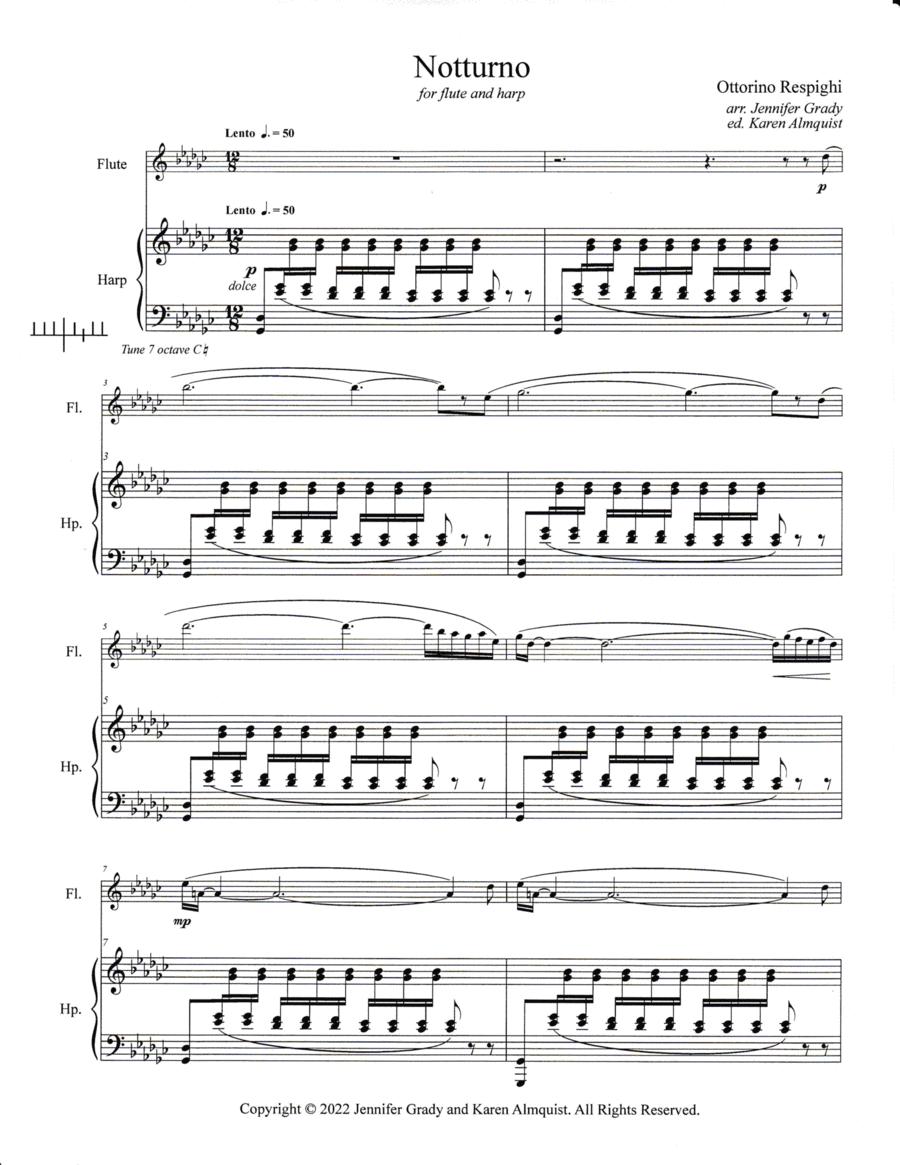
Notturno
Harpe, Flûte (duo)

$10.99 9.54 € Harpe, Flûte (duo) PDF SheetMusicPlus

Piano,Vocal,Voice - Level 2 - Digital Download SKU: A0.868757 Composed by Francesco CAVALLI (1602 – 1676). Arranged by Sergei PICHUGIN. Baroque,Concert,Instructional,Standards. Score. 5 pages. Really Good Music, LLC. #4580839. Published by Really Good Music, LLC. (A0.868757). Oh Dio, non far ch’io mora is an aria from Solo cantata I Ferma deh, ferma omai, written by the eminent Italian composer Francesco CAVALLI (1602 – 1676). The realization of the aria for voice and piano, made by Sergei Pichugin, is based on the manuscript, including twelve of Cavalli’s cantatas for voice solo. Ferma deh, ferma omai is the only cantata in the collection, composed for alto and basso continuo. The aria may be an invaluable addition to the repertoire of vocal teachers and students. It is available in the key of F minor (Eb4 – Eb5) for high voice.
CAVALLI Francesco: Oh Dio, non far ch’io mora, aria from the cantata, arranged for Voice and Piano
Piano, Voix

$5.95 5.16 € Piano, Voix PDF SheetMusicPlus

Piano,Vocal,Voice - Level 2 - Digital Download SKU: A0.868826 Composed by Francesco CAVALLI (1602 – 1676). Arranged by Sergei PICHUGIN. Baroque,Concert,Instructional,Standards. Score. 6 pages. Really Good Music, LLC. #4596977. Published by Really Good Music, LLC. (A0.868826). Luce cara di vaga speranza is an aria from Solo cantata XII Tengo un lampo di speme, written by the eminent Italian composer Francesco CAVALLI (1602 – 1676). The realization of the aria for voice and piano, made by Sergei Pichugin, is based on the manuscript, including twelve of Cavalli’s cantatas for voice solo and basso continuo. The aria may be an invaluable addition to the repertoire of vocal teachers and students. It is available in the key of G major (D4 – E5) for low voice.
CAVALLI Francesco: Luce cara di vaga speranza, aria from the cantata, arranged for Voice and Piano (
Piano, Voix

$5.95 5.16 € Piano, Voix PDF SheetMusicPlus

Medium Voice,Vocal Solo - Level 2 - Digital Download SKU: A0.868821 Composed by Francesco CAVALLI (1602 – 1676). Arranged by Sergei PICHUGIN. Baroque,Concert,Instructional,Standards. 5 pages. Really Good Music, LLC. #4596971. Published by Really Good Music, LLC. (A0.868821). Tengo un lampo di speme is an initial aria from Solo cantata XII, written by the eminent Italian composer Francesco CAVALLI (1602 – 1676). The realization of the aria for voice and piano, made by Sergei Pichugin, is based on the manuscript, including twelve of Cavalli’s cantatas for voice solo and basso continuo. The aria may be an invaluable addition to the repertoire of vocal teachers and students. It is available in the key of G major (B3 – E5) for low voice.
CAVALLI Francesco: Tengo un lampo di speme, aria from the cantata, arranged for Voice and Piano (G m
Voix moyenne, Piano

$5.95 5.16 € Voix moyenne, Piano PDF SheetMusicPlus

Medium Voice,Vocal Solo - Level 2 - Digital Download SKU: A0.868812 Composed by Francesco CAVALLI (1602 – 1676). Arranged by Sergei PICHUGIN. Baroque,Concert,Instructional,Standards. 5 pages. Really Good Music, LLC. #4596851. Published by Really Good Music, LLC. (A0.868812). Tu sei finta is an aria from Solo cantata X Bellissima Dorsibe, written by the eminent Italian composer Francesco CAVALLI (1602 – 1676). The realization of the aria for voice and piano, made by Sergei Pichugin, is based on the manuscript, including twelve of Cavalli’s cantatas for voice solo and basso continuo. The aria may be an invaluable addition to the repertoire of vocal teachers and students. It is available in the key of E minor (B3 – E5) for low voice.
CAVALLI Francesco: Tu sei finta, aria from the cantata, arranged for Voice and Piano (E minor)

$5.95 5.16 € PDF SheetMusicPlus

Piano - Digital Download SKU: LV.9499 Composed by Various. Folk dancing, Couples, Native dress. Lester S. Levy Collection. 5 pages. Published by Johns Hopkins University Sheridan Libraries (LV.9499). A Collection of the most admired Polkas by the most eminent European composers, in Six Numbers. No. 4. La Favorite. Also La Fiancee Des Vents Polka. (1) by E. Wolff. (2) by J. Prochazka. Published [n.d.] by A. Fiot, No. 196 Chesnut Street in Philadelphia. Composition of da capo with trio with piano instrumentation. Subject headings for this piece include Folk dancing, Couples, Native dress. About The Lester S. Levy CollectionThe Lester S. Levy Collection of Sheet Music consists of over 29,000 pieces of American popular music. Donated to Johns Hopkins University Sheridan Libraries, the collection's strength is its thorough documentation of nineteenth-century American through popular music. This sheet music has been provided by Project Gado, a San Francisco Bay Area startup whose mission is to digitize and share the world's visual history.WARNING: These titles are provided as historical documents. Language and concepts within reflect the opinions and values of the time and may be offensive to some.
La Favorite. Also La Fiancee Des Vents Polka
Piano seul

$5.99 5.2 € Piano seul PDF SheetMusicPlus

Piano,Tuba - Level 1 - Digital Download SKU: A0.548505 Composed by Traditional. Arranged by James M. Guthrie, ASCAP. Christian,Christmas. Score and part. 4 pages. Jmsgu3 #3387403. Published by jmsgu3 (A0.548505). The First Noel arranged for Tuba & Piano with new harmony for the final verse.Origins The First Noel is an English Christmas carol. Even more, it was probably written in the late Cornish Renaissance period. While other versions spell the title as Nowell, this is just a colloquial variation. Furthermore, Noel is an older word meaning Christmas. Therefore the First Noel translates as the First Christmas. First of all, Gilbert and Sandy published the earliest version. As a result, this version appears in the Carols Ancient and Modern songbook of 1823. William Sandy edited and arranged the book. Similarly, his partner Davies Gilbert edited and added the familiar extra verses. The First Noel: Tuba Version comes with new harmony in final verse for more energy and drive. Stainer Organist and composer Sir John Stainer published the most noteworthy customary arrangement in the 1870’s.  Stainer is above all famous for his songbook entitled: Christmas Carols New and Old (1871). This volume served as an important catalyst for reviving the English Christmas carol.  Other famous Stainer arrangements from this book are such titles as What Child Is This, God Rest Ye Merry Gentlemen, Good King Wenceslas, and I Saw Three Ships. Diatonic Function The melodic structure in the First Noel is uncommon among English folk tunes. It simply repeats one phrase twice then follows a variation refrain. All three phrases of the song end on the mediant scale degree. This is unusual because the diatonic function of the mediant is non-final compared to the more usual tonic or even dominant degrees. Consequently, this gives the song as kind of open-ended feeling – like maybe it never really ends. Political Context The Catholic clergy sang carols outside of the church in Latin. After the Protestant Reformation, the reformers thought it would be better for everyone to sing carols. They decided to bring music back to the common folk. So, they translated the lyrics from Latin into common language. Moreover, the Protestants wanted more control over the music in church than what the Vatican allowed. Protestant composers such as William Byrd composed complex polyphonic Christmas music that they called carols. Nonetheless, some famous folk carols were composed in this era. Eminent composers in the nineteenth century began to revise and adapt them. Consequently, they revived the English carol.  Register for free lifetime updates and revisions at www.jamesguthrie.com  
The First Noel for Tuba & Piano
Tuba et Piano

$24.95 21.65 € Tuba et Piano PDF SheetMusicPlus


Partitions Gratuites
Acheter des Partitions Musicales
Acheter des Partitions Digitales à Imprimer
Acheter des Instruments de Musique

© 2000 - 2026

Accueil - Version intégrale





