EUROPE
7219 articles
USA
0 articles
DIGITAL
15194 articles (à imprimer)
Partitions Digitales
Partitions à imprimer
15194 partitions trouvées


Chorus - Digital Download SKU: AX.00-PO-0003547 Ashokan Farewell (from The Civil War, a Film by Ken Burns) - SAB. Composed by Jay Ungar. Arranged by Carole Stephens. Choral. 8 pages. Alfred Music - Digital Sheet Music #00-PO-0003547. Published by Alfred Music - Digital Sheet Music (AX.00-PO-0003547). UPC: 029156905045. Grian McGregor.Almost everyone recognizes the superb melody of Jay Ungar's 'Ashokan Farewell' that was featured so prominently in Ken Burns' television film 'The Civil War'. Now, finally, a choral setting comes alive with lyrics that skillfully paint a beautiful picture of Americana. This is music that will warm the hearts of choirs and audiences everywhere! This title is available in Music Prodigy.Recorded Acc. Available.
Ashokan Farewell (from "The Civil War," a Film by Ken Burns)
Chorale 3 parties

$2.00 1.74 € Chorale 3 parties PDF SheetMusicPlus

Woodwind Ensemble,Woodwind Quartet - Level 1 - Digital Download SKU: A0.1140783 Composed by Ludwig van Beethoven. Arranged by Ander. Classical,Instructional,March,Opera,Romantic Period. 12 pages. Woods Only, Arrangements #741037. Published by Woods Only, Arrangements (A0.1140783). This arrangement adapted for woodwind quartet was written keeping the characteristics of the original work, that is, inspiring and significant to the already known choral symphony by Beethoven, indicated to be performed by young music students, who want to enter the symphonic music, moreover, it can also be used by professional musicians, for recitals, repertoire, academic presentations and didactic material. As much as it is a funeral march, it is well suited for any musical performance occasion. The transcription is faithful to the structure, with only one change in key, so that it is comfortable for all instruments in the formation, thus maintaining the essence of the striking melody, as well as using it for ensemble practice among musicians of different traditions. Beethoven's Ninth Symphony Op. 125 incorporates part of the poem An die Freude (To Joy), a hymn written by Friedrich Schiller, with the text sung by soloists and a choir in its last movement. It was the first example of a major composer using the human voice as prominently as the instruments in a symphony, thus creating a far-reaching work that set the tone for the symphonic form that was to be adopted by Romantic composers. This is the last complete symphony composed by Ludwig van Beethoven. The choral symphony, better known as the Ninth Symphony or The Ninth, is one of the best known works in the Western repertoire, considered both an icon and predecessor of Romantic music, and one of Beethoven's great masterpieces, where it was first performed on May 7, 1824, the same year it was completed, at the Kärntnertortheater in Vienna, Austria. The conductor was Michael Umlauf, the theater's music director, and Beethoven - dissuaded from conducting by the advanced stage of his deafness - was given a special place on the stage next to the conductor. It was later rearranged by Herbert von Karajan to become the anthem of the European Union in 1972, the national anthem of Rhodesia from 1974 until 1979, Rise, O Voices of Rhodesia, used the tune Ode to Joy..
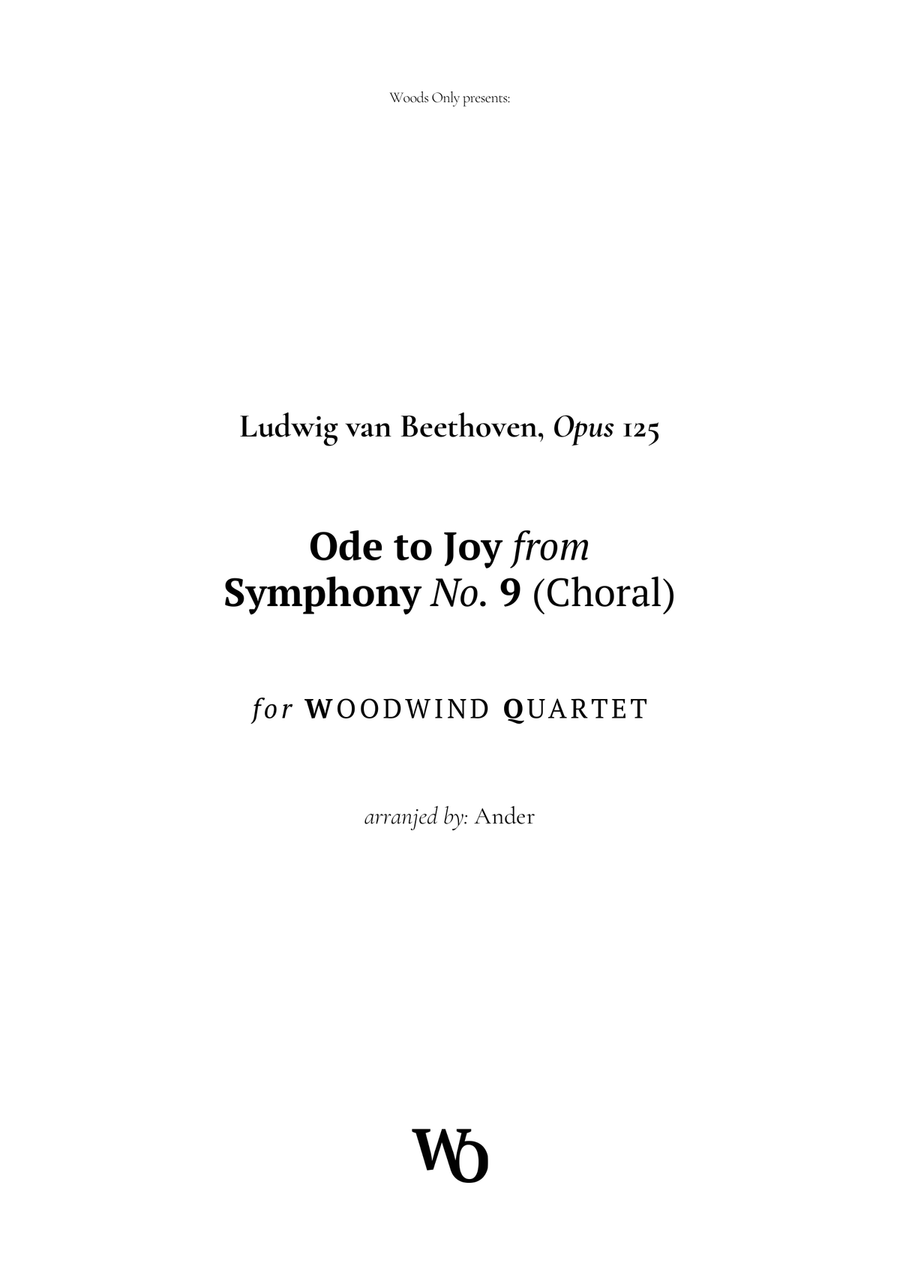
Ode to Joy by Beethoven for Woodwind Quartet
Flûte, Hautbois, Clarinette, Basson

$7.99 6.95 € Flûte, Hautbois, Clarinette, Basson PDF SheetMusicPlus

Saxophone Quartet,Woodwind Ensemble Alto Saxophone,Baritone Saxophone,Soprano Saxophone,Tenor Saxophone - Level 3 - Digital Download SKU: A0.1283701 By The Beatles. By John Lennon and Paul McCartney. Arranged by Kayleigh Huelin. Pop,Rock. 13 pages. Kayleigh Huelin #874896. Published by Kayleigh Huelin (A0.1283701). Showcasing the Beatles' versatility as composers, 'Lady Madonna' is a boogie-woogie piano-based track which prominently features saxophones - so it's a great choice for any saxophone quartet! Guaranteed to please an audience, this is a great track for formal and informal performances. Arranged for S(A)AT(A)B(T) quartet.Like this? Why not check out my website for more saxophone arrangements: www.khuelinmusic.co.uk.
Lady Madonna
Quatuor de Saxophones: 4 saxophones
The Beatles
$19.99 17.39 € Quatuor de Saxophones: 4 saxophones PDF SheetMusicPlus

Piano,Trumpet in D - Level 2 - Digital Download SKU: A0.1267276 Composed by Ludwig van Beethoven. Arranged by Ander. 19th Century,Classical,March,Opera,Romantic Period. Score and part. 5 pages. Woods Only, Arrangements #859916. Published by Woods Only, Arrangements (A0.1267276). This D Trumpet and Piano arrangement was created to preserve the characteristics of the original work, inspiring and significant to Beethoven’s well-known choral symphony. It is suitable for young music students and professional musicians, for recitals, repertoire, academic presentations, and didactic material. The transcription is faithful to the structure, with only one key change, maintaining the essence of the striking melody. Beethoven’s Ninth Symphony Op. 125 incorporates part of the poem An die Freude (“To Joyâ€), a hymn written by Friedrich Schiller, with the text sung by soloists and a choir in its last movement. It was the first example of a major composer using the human voice as prominently as instruments in a symphony, creating a far-reaching work that set the tone for the symphonic form adopted by Romantic composers. This is Ludwig van Beethoven’s last complete symphony. The choral symphony, better known as the Ninth Symphony or The Ninth, is one of the best-known works in the Western repertoire, considered an icon and predecessor of Romantic music and one of Beethoven’s great masterpieces. It was first performed on May 7, 1824 at the Kärntnertortheater in Vienna, Austria.
Ode to Joy by Beethoven for Trumpet in D and Piano
Trompette, Piano

$1.99 1.73 € Trompette, Piano PDF SheetMusicPlus

Piano,Tenor Saxophone - Level 5 - Digital Download SKU: A0.1201702 Composed by Brandon Nelson. 20th Century,Classical,Contemporary,Contest,Festival,Multicultural,World. Score and part. 24 pages. Brandon Nelson #800317. Published by Brandon Nelson (A0.1201702). Jogo de Cartas is Portuguese for “card game.†I opted for the Portuguese to honor my patron for this piece, tenor saxophonist Philippe Trovão of Lisbon.In this work, I celebrate four favorite card games.War is a relatively simple game in which each player is dealt half of the deck. The players play one card and the player with the larger card value wins the “battle.†If both players play an identical value, a “war†is started. There are variations on the game at this point, but in one popular version, each player places three cards face down then play another card face up—whichever player has the highest card takes all the cards. The object is to win all of the cards in the deck. In this musical setting, the sax and piano are each a “player,†and each plays cards (translated into rhythmic values) with the conflict and victory painted in dynamic, sometimes dissonant vitality.In Solitaire, the sax plays alone as one plays this game alone. And, just as in the game, each phrase (or suit-based pile) becomes longer, more complex, and ends in an excited flurry of activity as “victory “ is achieved!The third movement, Blackjack, illustrates the deceptively-simple game of chance, with gradually ebbing and flowing tension until, in this case, the (sax) player takes the hand. The number 21 features prominently in the construction principles of the movement as a hand totaling 21 is considered the best in the game.The finale is a wild ride portraying a newer card game called Egyptian Rat Screw. In this colorful and fast-paced game, players flip one card up in turn, continuing to do so until one player puts down a face card. The next player then has several chances (based on the specific face card played) to match or beat that card. In a interesting quirk, if two players play cards of equal rank, the player who “slaps†the card pile first wins all of the cards in the pile. This unique game was fertile ground for musical interplay, illustrating both the back-and-forth and the more aggressive aspects of play!
Jogo de Cartas (for Tenor Sax and Piano)
Saxophone Tenor et Piano

$10.99 9.56 € Saxophone Tenor et Piano PDF SheetMusicPlus

Piano Solo - Level 5 - Digital Download SKU: A0.973026 Composed by Francis Kayali. 20th Century,Concert,Contemporary. Score. 26 pages. Francis Kayali #5718759. Published by Francis Kayali (A0.973026). Composed between January and March 2003, the Suite for Piano was written for a recital by pianist Qi Liu (1976-2017), at Stony Brook University, in March of 2003.The opening of the first movement evokes bells, not unlike those in Rachmaninoff’s Rus­sian Easter (the finale of his First Suite for Two Pianos). This is contrasted with a short and murky rising gesture. The middle section incorporates pianistic patterns (some reminiscent of Debussy), a yearning Ibe­rian melody, and a barely-recogniz­able snippet of Chopin used for a climax. The murky gesture eventually returns, introducing a triumphant state­ment of the opening bells.Early on, I had decided the piece should include references to the other pieces on the re­cital’s program: Beethoven’s Piano Sonata No. 18 (op. 31, No. 3) and Brahms’s F minor So­nata (op. 5). As soon as I had word from Qi that she was going to play the Beethoven, I immedi­ately wanted to hear it. I wasn’t familiar with the piece, and since I didn’t have a score or a re­cording of it at home, I decided to download it in MIDI format from the internet. Unbeknownst to me, the computer’s rendition transformed the lively sec­ond movement scherzo into a slow-moving hymn which reminded me of the Ode to Joy. I was quite sur­prised the next morn­ing when I went to the mu­sic library and listened to a re­cording played by a human. Nonetheless, I was drawn to the melody, and I found the slow effect interesting, so I de­cided to base my middle movement (the slow movement) around the theme of Beetho­ven’s scherzo, making it the hid­den theme for a short set of variations. The end of the movement also contains less direct refer­ences to the music of Brahms (very short allu­sions to the Sonata and to the Variations on a Theme by Haydn).The last movement explores fast and light fingerwork, in a sort of toccata or capriccio, pro­viding a flashy ending to the piece. As in the first movement, the form is A-B-A. Before the return of the first section, a little dance evokes the opening of the piece. (The murky gesture from the first movement also finds its way into this last movement).Each of the three movements experiments at one point with using the sustain pedal in order to create a wash of sound. This effect is used most prominently in the second movement.Movement I: https://www.youtube.com/watch?v=n-NKcs076UIMovement II: https://www.youtube.com/watch?v=XSxkOcdlpiYMovement III: https://www.youtube.com/watch?v=CntmWYdOA9Y
Suite for Piano
Piano seul

$12.00 10.44 € Piano seul PDF SheetMusicPlus

Piano Solo - Level 4 - Digital Download SKU: A0.1335915 By Engelbert Humperdinck. By Barry Mason, D. Pace, M. Panzeri, and R. Livraghi. Arranged by John Fries. 20th Century,Film/TV,Pop,Standards. Score. 4 pages. John Fries #921746. Published by John Fries (A0.1335915). Please contact me by email at jfries@ptd.net to make a special request or to find out all that I have to offer and to express your comments or concerns.  You can also type John Fries in the searchbar to see all I have to offer.  When, When, When is an Italian pop song from 1962, in the bossa nova style. The song was used prominently in the 1962 Italian movie The Easy Life and was used in the movie The Blues Brothers (1980): when the main protagonists Jake and Elwood first encounter Murph and The Magictones, In the extended cut of the Ivan Reitman film Stripes (1981), Bill Murray begins singing this to avoid being killed by Colombian mercenaries. In the 2006 film Superman Returns, the theme is performed by The Drifters in the elevator scene when Clark Kent and Lois Lane are in the middle of several people reading about the Man of Steel's return in the Daily Planet.
A Man Without Love (quando M'innamoro)
Piano seul
Engelbert Humperdinck
$5.99 5.21 € Piano seul PDF SheetMusicPlus

Alto Saxophone Duet Alto Saxophone - Level 2 - Digital Download SKU: A0.1152452 Composed by Ludwig van Beethoven. Arranged by Ander. Classical,Instructional,March,Opera,Romantic Period. 2 scores. 7 pages. Woods Only, Arrangements #752678. Published by Woods Only, Arrangements (A0.1152452). This arrangement adapted for alto sax duo was written keeping the characteristics of the original work, that is, inspiring and significant to the already known choral symphony by Beethoven, indicated to be performed by young music students, who want to enter the symphonic music, moreover, it can also be used by professional musicians, for recitals, repertoire, academic presentations and didactic material. As much as it is a funeral march, it is well suited for any musical performance occasion. The transcription is faithful to the structure, with only one change in key, so that it is comfortable for all instruments in the formation, thus maintaining the essence of the striking melody, as well as using it for ensemble practice among musicians of different traditions. Beethoven's Ninth Symphony Op. 125 incorporates part of the poem An die Freude (To Joy), a hymn written by Friedrich Schiller, with the text sung by soloists and a choir in its last movement. It was the first example of a major composer using the human voice as prominently as the instruments in a symphony, thus creating a far-reaching work that set the tone for the symphonic form that was to be adopted by Romantic composers. This is the last complete symphony composed by Ludwig van Beethoven. The choral symphony, better known as the Ninth Symphony or The Ninth, is one of the best known works in the Western repertoire, considered both an icon and predecessor of Romantic music, and one of Beethoven's great masterpieces, where it was first performed on May 7, 1824, the same year it was completed, at the Kärntnertortheater in Vienna, Austria. The conductor was Michael Umlauf, the theater's music director, and Beethoven - dissuaded from conducting by the advanced stage of his deafness - was given a special place on the stage next to the conductor. It was later rearranged by Herbert von Karajan to become the anthem of the European Union in 1972, the national anthem of Rhodesia from 1974 until 1979, Rise, O Voices of Rhodesia, used the tune Ode to Joy..
Ode to Joy by Beethoven for Alto Sax Duet
2 Saxophones (duo)

$3.99 3.47 € 2 Saxophones (duo) PDF SheetMusicPlus

Tuba - Level 2 - Digital Download SKU: A0.1265522 Composed by Luigi Boccherini. Arranged by Ander. 19th Century,Classical,March,Opera,Romantic Period. 9 pages. Woods Only, Arrangements #858323. Published by Woods Only, Arrangements (A0.1265522). This Tuba Trio arrangement was created to preserve the characteristics of the original work, inspiring and significant to Beethoven’s well-known choral symphony. It is suitable for young music students and professional musicians, for recitals, repertoire, academic presentations, and didactic material. The transcription is faithful to the structure, with only one key change, maintaining the essence of the striking melody. Beethoven’s Ninth Symphony Op. 125 incorporates part of the poem An die Freude (“To Joyâ€), a hymn written by Friedrich Schiller, with the text sung by soloists and a choir in its last movement. It was the first example of a major composer using the human voice as prominently as instruments in a symphony, creating a far-reaching work that set the tone for the symphonic form adopted by Romantic composers. This is Ludwig van Beethoven’s last complete symphony. The choral symphony, better known as the Ninth Symphony or The Ninth, is one of the best-known works in the Western repertoire, considered an icon and predecessor of Romantic music and one of Beethoven’s great masterpieces. It was first performed on May 7, 1824 at the Kärntnertortheater in Vienna, Austria.
Ode to Joy by Beethoven for Tuba Trio
3 Tubas (trio)

$5.99 5.21 € 3 Tubas (trio) PDF SheetMusicPlus

Concert Band - Level 5 - Digital Download SKU: A0.1454822 By Kylie Minogue. By Matt Aitken and Mike Stock. Arranged by Rusty Toots. 20th Century,Classical,Comedy,Contemporary,Pop. 73 pages. Russell Ward #1033890. Published by Russell Ward (A0.1454822). The 2nd instalment from the Stock Aitken and Waterman Re-imagined Suite for Symphonic Winds by Rusty Toots, this lively re-arrangement of Kylie Minogue's I Should Be So Lucky opens with a irreverant nod to Pachelbel's canon and Big Ben's famous Westminster Quarters tune, before taking off in a quirky romp with title tune.  Some colorful additions to the percussion section (chimes, ratchet, woodblocks, triangle) help to create a very playful atmosphere, with xylophone featuring prominently throughout.  Listeners may also recognise another well-known sexy brit-pop tune sneakily introduced by the bassoon at one point.  While technically challenging at times, the playful and irreverant spirit of this movement is sure to please audiences and players alike.
I Should Be So Lucky
Orchestre d'harmonie
Kylie Minogue
$70.00 60.88 € Orchestre d'harmonie PDF SheetMusicPlus

Brass Quintet Horn,Trombone,Trumpet,Tuba - Level 4 - Digital Download SKU: A0.1033565 By The Beatles. By John Lennon and Paul McCartney. Arranged by Ray Thompson. Film/TV,Pop,Rock,Standards. 9 pages. RayThompsonMusic #638875. Published by RayThompsonMusic (A0.1033565). Arranged standard brass quintet When I'm Sixty-Four is a song by the English rock band the Beatles, written by Paul McCartney (credited to Lennon–McCartney) and released on their 1967 album Sgt. Pepper's Lonely Hearts Club Band. It was one of the first songs written by McCartney, who wrote it when he was 14. The song was recorded in a different key than the final recording; it was sped up at the request of McCartney to make his voice sound younger. It prominently features a trio of clarinets (two regular clarinets and one bass clarinet) throughout.
When I'm Sixty-four
Quintette de Cuivres: 2 trompettes, Cor, trombone, tuba
The Beatles
$19.95 17.35 € Quintette de Cuivres: 2 trompettes, Cor, trombone, tuba PDF SheetMusicPlus

Trumpet Quartet - Level 2 - Digital Download SKU: A0.1264234 Composed by Ludwig van Beethoven. Arranged by Ander. 19th Century,Classical,March,Opera,Romantic Period. 11 pages. Woods Only, Arrangements #857098. Published by Woods Only, Arrangements (A0.1264234). This trumpet quartet arrangement was written to maintain the characteristics of the original work, inspiring and significant to Beethoven’s well-known choral symphony. Suitable for young music students and professional musicians, for recitals, repertoire, academic presentations, and didactic material. The transcription is faithful to the structure, with only one key change, maintaining the essence of the striking melody. Beethoven’s Ninth Symphony Op. 125 incorporates part of the poem An die Freude (“To Joyâ€), a hymn written by Friedrich Schiller, with the text sung by soloists and a choir in its last movement. It was the first example of a major composer using the human voice as prominently as instruments in a symphony, creating a far-reaching work that set the tone for the symphonic form adopted by Romantic composers. This is Ludwig van Beethoven’s last complete symphony. The choral symphony, better known as the Ninth Symphony or The Ninth, is one of the best-known works in the Western repertoire, considered an icon and predecessor of Romantic music and one of Beethoven’s great masterpieces. It was first performed on May 7, 1824 at the Kärntnertortheater in Vienna, Austria.
Ode to Joy by Beethoven for Trumpet Quartet
Quatuor de cuivres: 4 trompettes

$7.99 6.95 € Quatuor de cuivres: 4 trompettes PDF SheetMusicPlus

Trumpet Duet Trumpet - Level 2 - Digital Download SKU: A0.1266552 Composed by Ludwig van Beethoven. Arranged by Ander. 19th Century,Classical,March,Opera,Romantic Period. Score. 6 pages. Woods Only, Arrangements #859227. Published by Woods Only, Arrangements (A0.1266552). This Trumpet Duet arrangement was created to preserve the characteristics of the original work, inspiring and significant to Beethoven’s well-known choral symphony. It is suitable for young music students and professional musicians, for recitals, repertoire, academic presentations, and didactic material. The transcription is faithful to the structure, with only one key change, maintaining the essence of the striking melody. Beethoven’s Ninth Symphony Op. 125 incorporates part of the poem An die Freude (“To Joyâ€), a hymn written by Friedrich Schiller, with the text sung by soloists and a choir in its last movement. It was the first example of a major composer using the human voice as prominently as instruments in a symphony, creating a far-reaching work that set the tone for the symphonic form adopted by Romantic composers. This is Ludwig van Beethoven’s last complete symphony. The choral symphony, better known as the Ninth Symphony or The Ninth, is one of the best-known works in the Western repertoire, considered an icon and predecessor of Romantic music and one of Beethoven’s great masterpieces. It was first performed on May 7, 1824 at the Kärntnertortheater in Vienna, Austria.
Ode to Joy by Beethoven for Trumpet Duet
2 Trompettes (duo)

$3.99 3.47 € 2 Trompettes (duo) PDF SheetMusicPlus


Partitions Gratuites
Acheter des Partitions Musicales
Acheter des Partitions Digitales à Imprimer
Acheter des Instruments de Musique

© 2000 - 2026

Accueil - Version intégrale





