EUROPE
7219 articles
USA
0 articles
DIGITAL
15198 articles (à imprimer)
Partitions Digitales
Partitions à imprimer
15198 partitions trouvées


Jazz Ensemble - Digital Download SKU: AX.00-PC-0017135_TB1 Tuba. Composed by Sammy Fain. Arranged by Greg Yasinitsky. Jazz; Swing. Part. 2 pages. Alfred Music - Digital Sheet Music #00-PC-0017135_TB1. Published by Alfred Music - Digital Sheet Music (AX.00-PC-0017135_TB1). UPC: 038081319520.This up-tempo, swinging version of a great standard features trombones on the melody and a written solo for 1st trombone. There is also a prominent saxophone soli, roaring ensemble chorus and a big ending making this chart an ideal closer for festivals and concerts. Lead trumpet range is to A-flat above the staff. Arranger Greg Yasinitsky is consistently an excellent writer and Secret Love is no exception. (4:38)Closer.
Secret Love: Tuba
Tuba (partie séparée)

$3.00 2.6 € Tuba (partie séparée) PDF SheetMusicPlus

Instrumental Duet Flute,Instrumental Duet,Oboe - Level 3 - Digital Download SKU: A0.589614 Composed by Traditional. Arranged by David McKeown. Jewish,Multicultural,Wedding,World. Score and parts. 4 pages. David McKeown #6082267. Published by David McKeown (A0.589614). Ale Brider is a Yiddish Folk song, often performed by Klezmer musicians. This version is arranged as a duet for one Flute and one Oboe.The music for Ale Brider is a traditional East European melody of unknown origin. The lyrics were written by Morris Winchevsky, a Lithuanian writer who became a prominent socialist/communist in early twentieth century London and New York. The title Ale Brider, (We Are All Brothers), reflected his socialist beliefs.Ale Brider is simply arranged in a key and range best suited to the instruments. The melody is in two sections and is played three times with constant variations in the accompaniment. Ale Brider is suitable for players at an intermediate level and above. With a performance time of three minutes, this version of Ale Brider is perfect for concert performances, both formal and informal. Click the link above to listen to a full Youtube performance of the Clarinet version of this duet.There are many more top quality arrangements and compositions by David McKeown for you to browse at http://www.sheetmusicplus.com/publishers/david-mckeown/6203   
Ale Brider, Jewish Klezmer song for Flute and Oboe Duet
Hautbois, Flûte

$3.99 3.46 € Hautbois, Flûte PDF SheetMusicPlus

Piano - difficult - Digital Download SKU: S9.Q16512 Seven Pieces. Composed by Rodion Shchedrin. This edition: Sheet music. Downloadable. Duration 11 minutes. Schott Music - Digital #Q16512. Published by Schott Music - Digital (S9.Q16512). With his five piano concertos, sonatas and 24 preludes and fugues Rodion Shchedrin is one of the most prominent composers for piano of our time. A gifted pianist, he has given the first performances of most of his works himself. With the seven pieces in this Journal Shchedrin has created a cycle for piano reflecting his own life as a composer and pianist. These are remarkable confessions by the Russian musician who wrote his first major compositions as a twenty year-old student at the Moscow Conservatoire and who has been greatly involved in the international music scene in the post-soviet era. Using modern composition techniques the work combines traditional and modern forms in jottings that are like diary entries - a musical autobiography in miniature.
Diary
Piano seul

$15.99 13.88 € Piano seul PDF SheetMusicPlus

Concert Band - Digital Download SKU: AX.00-PC-0017437_BC B-flat Bass Clarinet. Composed by Chris M. Bernotas. Instructional. Part. 1 pages. Alfred Music - Digital Sheet Music #00-PC-0017437_BC. Published by Alfred Music - Digital Sheet Music (AX.00-PC-0017437_BC). UPC: 038081517551.Here they come marching two by two---it's a robot brigade! This dramatic piece for beginning band uses only the first six notes students learn. It is full of meaningful teachable moments that include call-and-response, minor mode, dynamics, and much more. The low brass and low winds play a prominent role throughout and everyone in the band will stay engaged. Students will surely practice this one! (2:25)Concert/Contest; Festival.
March of the Robot Brigade: B-flat Bass Clarinet
Orchestre d'harmonie

$3.00 2.6 € Orchestre d'harmonie PDF SheetMusicPlus

Four-part choir of equal voices (SSAA) and organ - intermediate to advanced - Digital Download SKU: S9.Q6321 Missa Sancti Martini. Composed by Vytautas Miskinis. This edition: choral score. Downloadable, Choral score. Duration 20 minutes. Schott Music - Digital #Q6321. Published by Schott Music - Digital (S9.Q6321). Latin.The Latvian composer Vytautas Miškinis (*1954) has become one of the internationally most prominent composers of the middle generation from the Baltic States. Initially, 'Missa brevis', which is subtitled 'Missa Sancti Martini' in honour of the patron saint of the Mainz Cathedral, was originally commissioned by the girls' choir of the Cathedral and of St. Quintin's Church in Mainz. The world premiere, however, did not take place until this year as part of the international choral festival 'Europa Cantat' in Mainz. With regard to form and duration, the composition follows the traditional form of the Latin missa brevis without credo. A tonally extremely charming and touching, and technically quite undemanding work for church service and concert.Formal und in der zeitlichen Ausdehnung folgt die Missa brevis der traditionellen Form der lateinischen Kurzmesse ohne Credo. Ein klanglich außerordentlich apartes und berührendes, dabei technisch nicht allzu schweres Werk für Gottesdienst und Konzert.
Missa brevis

$12.99 11.28 € PDF SheetMusicPlus

Piano Solo - Level 5 - Digital Download SKU: A0.1281191 Composed by Wanda Landowska. Arranged by Zellev. 20th Century,Classical,Contemporary,Folk,New Age. Score. 7 pages. Zellev Music #872533. Published by Zellev Music (A0.1281191). Key Signature: Fâ?¯ minorTime Signature: 3/4Tempo: Allegro vivace (143)Difficulty: AdvancedWanda Landowska (July 5, 1879 - August 16, 1959) was a Polish harpsichordist and composer who led the revival of the popularity of the harpsichord in the early 1900s. She was one of the earliest advocates and scholars on historically informed performance practices, and she made the first-ever recording of J.S. Bach's Goldberg Variations on the harpsichord.Landowska was born in Warsaw in 1879 and started playing the piano when she was four years old. As a child, she studied with Jan KleczyÅ?ski and then Aleksander Michalowski. Kleczynski noticed in her lessons that she had an affinity for older Baroque music, and he didn't want to impose his sensibilities onto the already apparent musical prodigy. Consequently, her mother decided that Kleczynski was too lenient of a teacher and sent her to study with the stricter Michalowski, who was a Chopin specialist. When she was 16 years old, Landowska moved to Berlin to study composition with Heinrich Urban, but was discouraged by the rigid curriculum. However, while in Berlin she composed songs and orchestral works, and she met her future husband, Henry Lew. In 1900, the young couple moved to Paris and got married. There she became associated with the Schola Cantorum, and was introduced to Vincent D'Indy, Albert Schweitzer, and other prominent performers and musicologists of the era.Throughout the next ten years, Landowska toured Europe and Russia, and dedicated herself to researching the authentic performance practices of older music. Her husband assisted her in this research, and they often utilized libraries that they encountered while touring. She concluded that it's more appropriate to play Baroque keyboard music on the harpsichord rather than on the piano. By 1909, Landowska and her husband published the book Musique Ancienne, which was the culmination of all of their research regarding the performance practices of Baroque music. She also started teaching harpsichord classes in 1913 at the Hochschule für Musik in Berlin.Ten years later, Landowska made her debut in the United States, performing with the Philadelphia Orchestra conducted by Stokowski. Also in 1923, she performed in the world premiere of Manuel de Falla's El retablo de maese Pedro, where she met Francis Poulenc and asked him to write a harpsichord concerto for her. She also commissioned a concerto from Falla in 1925, which would prove to be a modern masterpiece. In 1929, Landowska performed the premiere of Poulenc's Concert champêtre in Paris. By this time, she had settled in a town north of Paris, and was teaching from her school L'Ã?cole de Musique Ancienne, which she established in 1925. She offered private and group courses and an annual summer concert series that was very popular. Landowska taught and performed in this capacity until 1940, when she had to abandon the school, her extensive library, and her home because of World War II. With the assistance of her student Denise Restout, she escaped to Portugal and then sailed to the United States, and eventually settled in Lakeville, Connecticut. She continued to perform and teach in the U.S., and at the age of 70 she recorded the complete Well-Tempered Clavier, which was highly acclaimed. Landowska was 80 years old when she passed away in Lakeville in 1959.
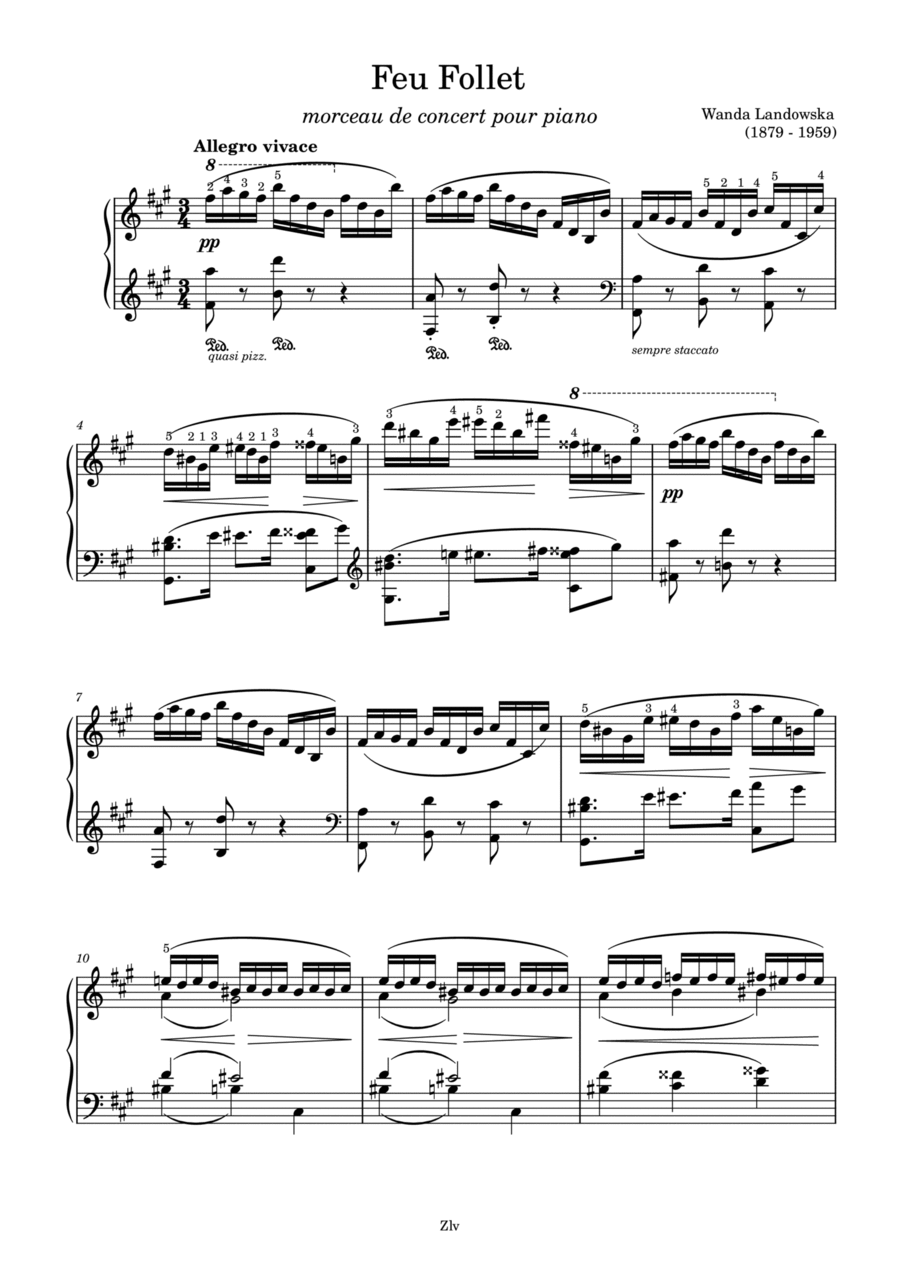
Feu follet
Piano seul
1909, Landowska and her husband published the book Musique Ancienne, which was the culmination of all of their research regarding the performance practices of Baroque music She also started teaching harpsichord classes in 1913 at the Hochschule für Musik in Berlin
$3.79 3.29 € Piano seul PDF SheetMusicPlus

Digital Download SKU: A0.1469312 By Arturo Escorza. By Tomás de Torrejón y Velasco. Arranged by Arturo Escorza. Baroque,Chamber,Early Music,Historic,Sacred. 8 pages. Arturo Escorza #1047344. Published by Arturo Escorza (A0.1469312). Explore the delicate charm of Tomás de Torrejón y Velasco's Es mi Rosa Bella, a dúo composed in dedication to Santa Rosa de Lima. This rare piece, written for three voices (Soprano 1, Soprano 2, Tenor) and continuo, is a testament to the composer’s mastery and is an exquisite addition to the repertoire of early music ensembles and advanced vocalists.Tomás de Torrejón y Velasco, a prominent Spanish composer, is renowned for creating the first opera in the Americas, La Púrpura de la Rosa, in Lima, Peru. This edition of Es mi Rosa Bella offers meticulously transcribed notation, providing clarity and accuracy for performers and scholars alike. Experience the historical significance and melodic beauty of this work, brought to life through the vibrant harmonies and expressive lines characteristic of Torrejón y Velasco's compositions.
"Es mi Rosa Bella" by Tomás de Torrejón y Velasco - Dúo a 3 for SST and Continuo - Score Only
Arturo Escorza
$10.00 8.68 € PDF SheetMusicPlus

Chamber Orchestra - Level 2 - Digital Download SKU: A0.931479 Arranged by N. Marasco. Christmas,Classical,Holiday,Sacred. Score and parts. 7 pages. Pubblicato da Nicola Marasco #6430227. Published by Pubblicato da Nicola Marasco (A0.931479). O du fröhliche is a German Christmas carol. The author of the original text was the prominent Weimar orphan father Johannes Daniel Falk (1768–1826).In late 1815, he dedicated this song to the children of the orphanage. The melody was taken from the anonymous Catholic hymn O Sanctissima (also known as Sicilian Mariners Hymn), which he found in the posthumous edition of J.G. Herder's Stimmen der Völker in Liedern after hearing it sung by Pietro Granucci, an Italian foundling under his care. In Falk's original text, the song was titled Allerdreifeiertagslied (A song for three holidays), highlighting the three major festivals of Christianity: Christmas, Easter and Pentecost.
O du Fröhliche - Full Score
Orchestre de chambre

$9.99 8.67 € Orchestre de chambre PDF SheetMusicPlus

B-Flat Clarinet,Piano - Level 3 - Digital Download SKU: A0.1472464 By Rimsky Korsakoff. By Rimsky Korsakoff. Arranged by Ian Fitze. 19th Century,Contest,Festival,Folk,Instructional. Score and part. 8 pages. Ian Fitze #1050114. Published by Ian Fitze (A0.1472464). Visit my website at IAN FITZE MUSICAL ARRANGEMENTS for a complete catalogue of my works including FREE DOWNLOADS.This is a moderately challenging piece adapted for instrumental solo with Piano accompaniment. From Wikipedia: The Mazurka (Polish: mazurek) is a Polish musical form based on stylised folk dances in triple meter, usually at a lively tempo, with character defined mostly by the prominent mazur's strong accents unsystematically placed on the second or third beat.Rimsky Korsakoff makes good use of melodies and counter-melodies throughout.A fun piece for both soloist and accompanist to put together.
Mazurka Op. 38 no. 2
Clarinette et Piano
Rimsky Korsakoff
$1.99 1.73 € Clarinette et Piano PDF SheetMusicPlus

Cello Solo - Level 2 - Digital Download SKU: A0.1117302 By Jorge Anckermann. By Jorge Anckermann. Arranged by Vanessa Baez Menendez. 20th Century,Historic,Latin,Multicultural,Traditional,World. Individual part. 2 pages. Madeleine Duba / Watusi Dance co ltd #718876. Published by Madeleine Duba / Watusi Dance co ltd (A0.1117302). Music notes featuring Cuban 20th century Cello Duets available to print and play instantly. A wide range from 1900's - 1960's of Cuban genres like Bolero's, Cha Cha's, Danzon's and Son's, shop our newest and most popular two cellos sheet music such as Besame Mucho (1941) - Cello Duet, QuizaÌs, QuizaÌs, QuizaÌs (1947) - Cello Duet and Frenesi (1939) - Cello Duet, Con tigo Aprendi (1967) - Cello Duet, Besame Mucho (1941) - Cello Duet, Sabor a Mi (1959) - Cello Duet and others. . . . . . . . . . . . . . . . . . . . . . . . . . . . . . . . . . . . . . . . . . . . . . . . . . . . . . . . . . . . . . . . . . . . . . . . . . . . . . . . . . . . . . . . . . . . . . . . . . . . . . . . . . . . . . . . . . . . . . . . . . . . . . . . . . . . . . . . . . . . . . . . . . About the Composer and the song: Jorge Anckermann (22 March 1877 – 3 February 1941) was a Cuban pianist, composer and bandleader. Havana-born, he started in music at eight with his father. At age ten he was able to substitute in a trio. In 1892, he went to Mexico as musical director of the bufo company of Nachos Lopez, visiting various Mexican states, and touring California.[1] Anckermann lived in Mexico City for a number of years, teaching music. In Cuba, he was for many years the musical director of leading theatres. He composed and produced pieces for zarzuelas, reviews and comedies. He also composed boleros, and was apparently the originator of the guajira. The grand theatre Alhambra was the scene of his greatest hits, such as La isla de cotorras. Famous pieces include El arroyo que murmura; El quitrín; Flor de Yumurí; Un bolero en la noche.[2] His father, Carlos Anckermann, and his brother, Fernando Anckermann, were also prominent composers and musicians.
Flor de Yumuri (1937)
Violoncelle
Jorge Anckermann
$5.99 5.2 € Violoncelle PDF SheetMusicPlus

Woodwind Ensemble,Woodwind Trio Alto Flute - Level 2 - Digital Download SKU: A0.1270939 Composed by Solage. Arranged by James M. Guthrie. Chamber,Contest,Early Music,Festival,Historic,Medieval. 13 pages. Jmsgu3 #863314. Published by jmsgu3 (A0.1270939). INSTRUMENTATION: 2 Concert Flutes, 1 Alto FluteSources suggest that the song is a love ballad that praises the beauty and virtues of a woman named Calextone, who was a lady from the town of Arouse. The lyrics describe her as having great value and worth, and her beauty and grace are compared to smoke and mist. The composer of the song, Solage, also refers to himself in the refrain with a double meaning, using the spelling soulage. The song is considered a representative example of French secular music from the late fourteenth century. It is not known whether Calextone was a real person or a fictional character created by the composer. Some sources suggest that the song may have been composed for a wedding, possibly that of Jeanne de Boulogne, and that Solage may have been in the service of Gaston Fébus, compte de Foix, who had a financial interest in the marriage.The composer of the song, Solage, was a prominent figure in the Ars subtilior movement, which was characterized by complex rhythms, intricate melodies, and highly stylized notation. The song is considered a representative example of this musical style, which flourished in France during the late medieval period. The song's use of acrostics and double meanings in the lyrics, as well as its intricate musical structure, demonstrate the sophistication and complexity of the Ars subtilior style. Overall, Calextone qui fut dame d'Arouse is an important example of medieval French music and its evolution over time.
Solage: Calextone qui fut dame for Flute Trio
Trio de Flûtes: 3 flûtes

$24.95 21.66 € Trio de Flûtes: 3 flûtes PDF SheetMusicPlus

Cello Solo - Level 4 - Digital Download SKU: A0.547674 Composed by James M. Guthrie. Contemporary,Instructional. Individual part. 9 pages. Jmsgu3 #3031709. Published by jmsgu3 (A0.547674). Dardanus Variations for Solo Cello is a set of variations on a thematic fragment from Dardanus, a tragédie-lyrique by J.P. Rameau (1683-1764). Each variation depicts a different scene from the opera.I: Entrance of Dardanus: Son of Electra and JupiterII: King Teucer proposes the marriage of his daughter Iphise to King AnténorIII: King Anténor accepts Iphise to become his brideIV: Ismenor the Wizard introduces Iphise to DardanusV: Dardanus encounters the sea monsterVI: The Sea Monster creates havoc for King AnténorVII: Dardanus falls in love with IphiseVIII: Dardanus slays the Sea Monster, saving King Anténor's lifeIX: King Teucer and Dardanus make peaceX: King Teucer permits for Dardanus to marry IphiseXI: The Proposal of DardanusXII: Iphise rejects the proposalXIII: The Second Proposal of DardanusIXV: Wedding Dance Dardanus is connected to the Trojan War through his lineage and the founding of the royal house of Troy. The Dardanoi, the descendants of Dardanus, formed a contingent among Troy's allies in the Trojan War. The House of Dardanus, of which Dardanus was the founder, played a significant role in the lead-up to the war. The city of Troy, founded by Dardanus's descendant, Ilus, was central to the myths surrounding the Trojan War. Additionally, Aeneas, a prominent figure in the Trojan War, was referred to as a Dardanian and was destined to save the House of Dardanus from extinction. Therefore, Dardanus's lineage and the founding of Troy are the critical connections between Dardanus and the Trojan War.Ancestry and Founder: Dardanus was the son of Zeus and the Pleiad Electra. He was the mythical founder of Dardania on the Hellespont and the ancestor of the Dardanians of the Troad and, through Aeneas, of the Romans.Migration and Settlement: According to mythology, Dardanus fled from Arcadia to the island of Samothrace and then to the Troad, where Teucer, the ruler of Phrygia, hospitably received him. He married Teucer's daughter Bateia and became the founder of the royal house of Troy.Family and Descendants: Dardanus married Chryse, with whom he fathered two sons, Idaeus and Deimas. He later married Batea and had several children, including Erichthonius, who became the ancestor of many famous individuals in the Troad, including Tros, Ganymede, Laomedon, and Priam.Cultural Depictions: Dardanus has been the subject of various operas by composers such as Jean-Philippe Rameau, Carl Stamitz, and Antonio Sacchini, reflecting the enduring influence of his mythological story.Legacy: Dardanus lives on in the Dardanelles, the narrow strait separating Asia and Europe, once known as the Hellespont, a name also linked to Greek mythology.These facts highlight Dardanus's role as a critical figure in the foundation of Dardania and the royal house of Troy and his rich and enduring mythological legacy.
Guthrie: Dardanus Variations for Solo Cello
Violoncelle

$24.95 21.66 € Violoncelle PDF SheetMusicPlus


Partitions Gratuites
Acheter des Partitions Musicales
Acheter des Partitions Digitales à Imprimer
Acheter des Instruments de Musique

© 2000 - 2026

Accueil - Version intégrale





