EUROPE
44549 articles
USA
0 articles
DIGITAL
40447 articles (à imprimer)
Partitions Digitales
Partitions à imprimer
40447 partitions trouvées


String Quartet Cello,String Quartet,Viola,Violin - Level 4 - Digital Download SKU: A0.1295690 Composed by Jan Pieterszoon Sweelinck. Arranged by James M. Guthrie. Chamber,Contest,Early Music,Festival,Historic,Renaissance. 29 pages. Jmsgu3 #885988. Published by jmsgu3 (A0.1295690). Jan Pieterszoon Sweelinck was a Dutch organist and composer who lived from April 1562 to October 16, 1621. He was born and died in Amsterdam, Netherlands. Sweelinck's first published works date from around 1592-94, and he composed a variety of music, including chansons and keyboard music. He was known for his keyboard playing and was a teacher to German composers Samuel Scheidt and Heinrich Scheidemann. Sweelinck's Echo Fantasias are significant for several reasons:Innovative composition: Echo Fantasias were a unique form of composition during Sweelinck's time, blending elements of traditional fantasias with passages dedicated to echo effects. This experimental approach showcased Sweelinck's creativity and willingness to push the boundaries of musical expression. Emphasis on the moment: Unlike Sweelinck's larger fantasias, the construction of Echo Fantasias was less strict, focusing more on the immediate musical experience rather than the overall design. This emphasis on the moment allowed for greater freedom and spontaneity in the performance of these pieces. Stylistic range: Echo Fantasias encompassed a wide range of styles, juxtaposing fantasia-like elements with passages dedicated to echo effects. This stylistic diversity added depth and complexity to Sweelinck's compositions, making them engaging and intriguing for both performers and listeners.
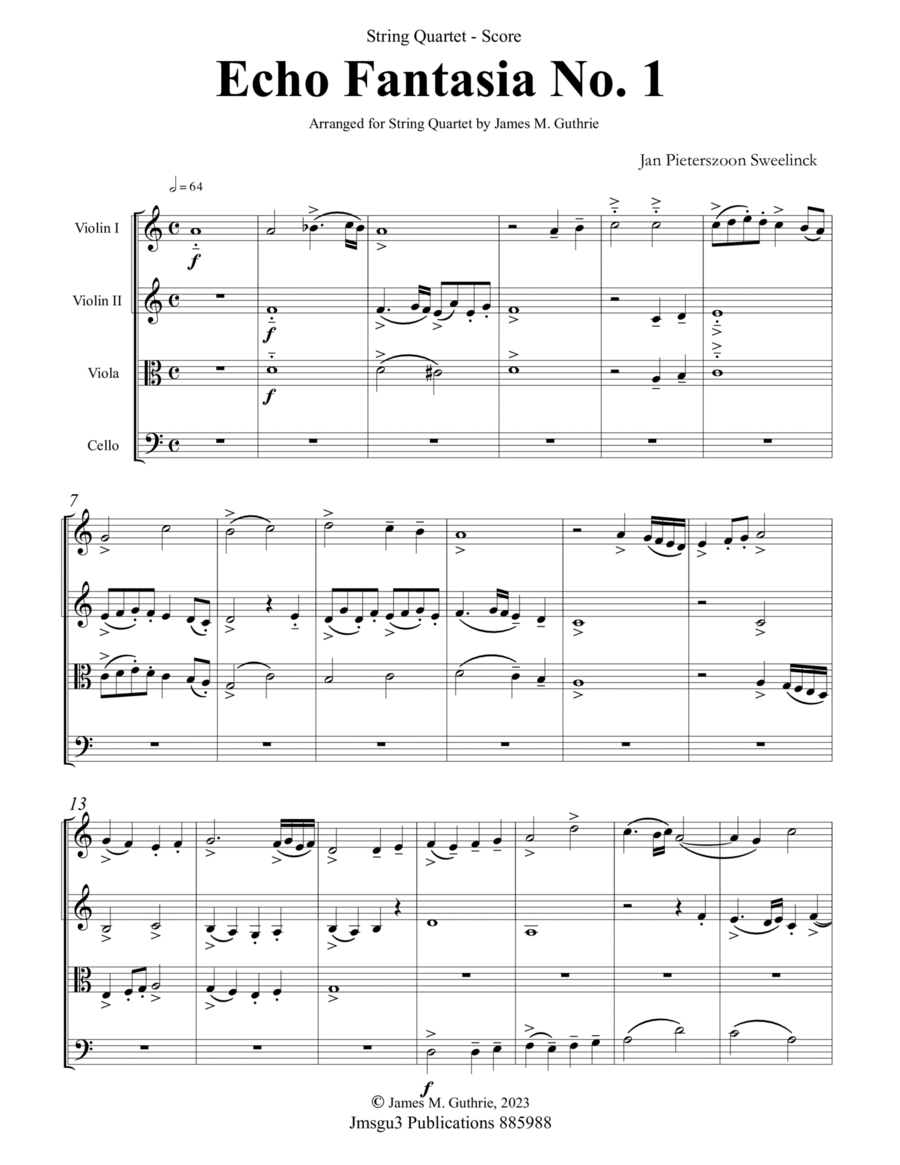
Sweelinck: Echo Fantasia No. 1 for String Quartet
Quatuor à cordes: 2 violons, alto, violoncelle

$28.95 24.73 € Quatuor à cordes: 2 violons, alto, violoncelle PDF SheetMusicPlus

Saxophone in Eb and piano - Digital Download SKU: S9.Q20909 Composed by Erik Satie. Arranged by Wolfgang Birtel. This edition: Sheet music. Edition Schott - Single Edition. Downloadable. Schott Music - Digital #Q20909. Published by Schott Music - Digital (S9.Q20909). Mit einem Paukenschlag wurde die Musikwelt auf Erik Satie (1866-1925) aufmerksam: Als am 18. Mai 1817 sein Ballett „Parade“ uraufgeführt wurde, kam es zum Skandal. Die Produktion, an der auch Sergei Djagilew mit seinen „Ballets Russes“, Pablo Picasso (Bühnenbild und Kostüme), Jean Cocteau (Handlung) sowie Léonide Massine (Choreographie) beteiligt waren, entzweite die Pariser Musikwelt, machte den Komponisten aber weithin bekannt. Satie, der kaum eine fundierte musikalische Ausbildung genossen hatte und fast zeit seines Lebens in Paris lebte, entwickelte einen neuen musikalischen Stil, in bewusster Abkehr vom „Wagnérisme“ seiner Zeit. Klassische Formmodelle, neue Harmonik, Leichtigkeit im Stil, Meditatives und Clowneskes verschmolzen originell. Zum Musterbeispiel dafür sind seine „3 Gymnopédies“ von 1888 geworden, deren erste hier für ein Soloinstrument mit Klavierbegleitung arrangiert wurde: Das Musizieren dieser berühmtesten Miniatur von Satie wird damit auch Nicht-Pianisten ermöglichst – die einfache Spielbarkeit erlaubt den Einsatz auch für pädagogische Zwecke.
Gymnopédie No. 1

$4.99 4.26 € PDF SheetMusicPlus


Partitions Gratuites
Acheter des Partitions Musicales
Acheter des Partitions Digitales à Imprimer
Acheter des Instruments de Musique

© 2000 - 2026

Accueil - Version intégrale





