EUROPE
553 articles
USA
0 articles
DIGITAL
6277 articles (à imprimer)
Partitions Digitales
Partitions à imprimer
6277 partitions trouvées


Piano,Tenor Saxophone - Level 3 - Digital Download SKU: A0.587623 Composed by Various. Arranged by David McKeown. Baroque,Concert,Romantic Period,Standards,Wedding. Score and part. 24 pages. David McKeown #4594681. Published by David McKeown (A0.587623). The Wedding Album is a collection of four beautiful and timeless wedding favourites, arranged for Solo Tenor Saxophone with Piano accompaniment. Whether for that Special Day, for a recital, or for your own entertainment, these arrangements are ideal for players at an intermediate level or higher. The 24-page file includes the piano accompaniments and the separate solo parts at the end. Ave Maria was written by Franz Schubert in 1825 as the sixth song in his song cycle based on Walter Scott’s poem The Lady of the Lake. It is perhaps the best known of all his melodies, adapted for piano by Franz Liszt, and for orchestra many times since. It is often sung with the Latin lyrics of the Catholic hymn of the same name and has been heard everywhere from the Disney movie Fantasia to the funeral of J.F. Kennedy. The Bridal March was written by Richard Wagner in 1850, scored for orchestra and chorus, and opening the third act of his opera, Lohingren. It is best known in the English-speaking world as Here Comes the Bride. Queen Victoria’s daughter used the music for her marriage in 1858, and its popularity has endured ever since.The Prince of Denmark’s March is better known nowadays as the Trumpet Voluntary and is often used in wedding ceremonies. It was in fact written for organ, with the melody played on thetrumpet stop.  Written around 1700, for many years this piece was mistakenly attributed to Henry Purcell. Only recently has it been established that the composer was Jeremiah Clarke, organist at St Paul’s Cathedral. It is somewhat ironic that this composer of a wedding mainstay was himself a victim of unrequited love. He consequently shot himself in the cathedral graveyard. Felix Mendelssohn’s Wedding March was originally written in 1842 as incidental music to Shakespeare’s famousplay, Midsummer Night’s Dream. When Queen Victoria’s daughter used the music for her marriage in 1858, it became instantly popular and has remained a wedding favourite ever since.These four arrangements are also available as single titles for $3.99 each. You can find these along with many more top quality arrangements and compositions by David McKeown at http://www.sheetmusicplus.com/publishers/david-mckeown/6203 
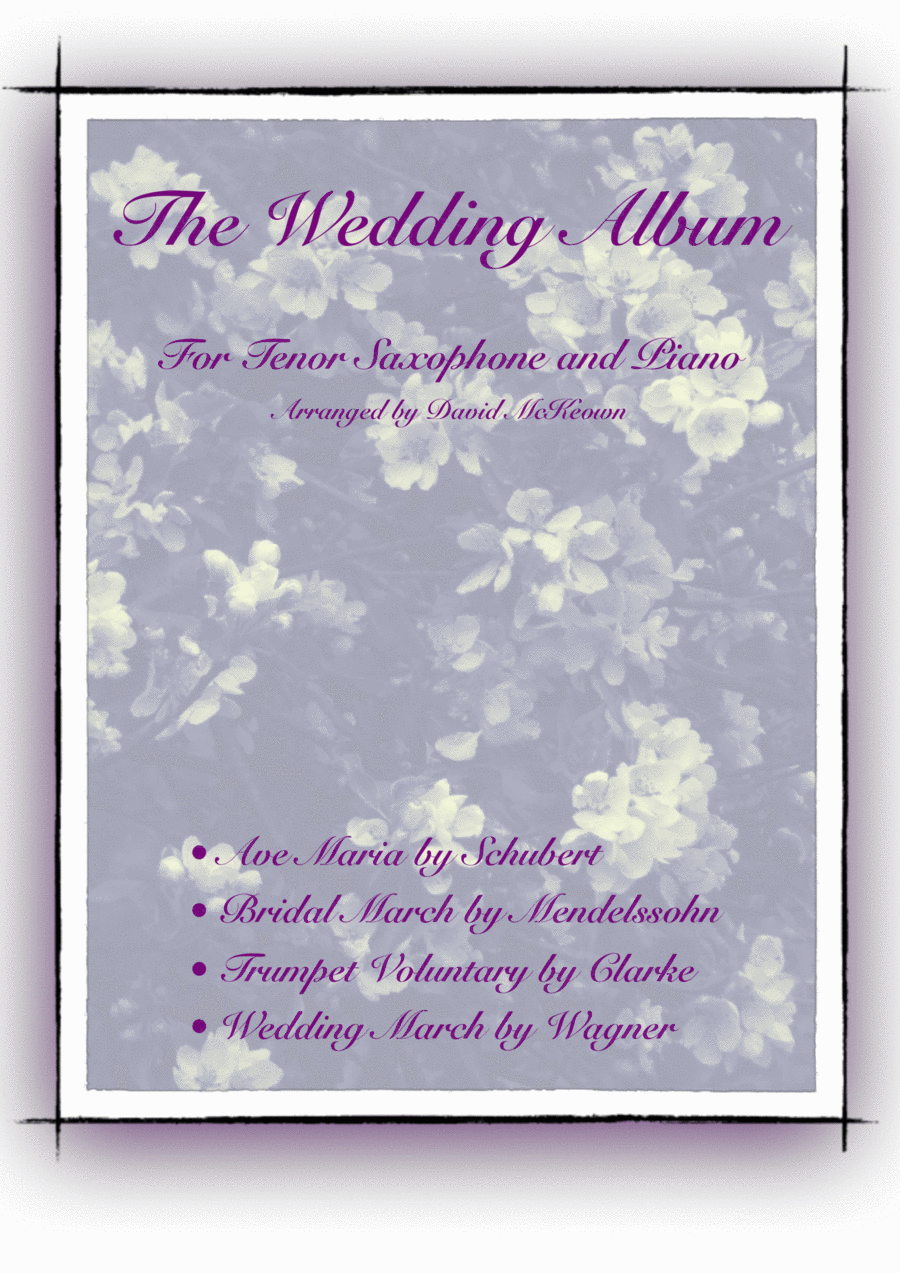
The Wedding Album, for Solo Tenor Saxophone and Piano
Saxophone Tenor et Piano

$9.99 8.58 € Saxophone Tenor et Piano PDF SheetMusicPlus

Flute,Piano - Level 3 - Digital Download SKU: A0.587625 Composed by Various. Arranged by David McKeown. Baroque,Concert,Romantic Period,Standards,Wedding. Score and part. 24 pages. David McKeown #4594685. Published by David McKeown (A0.587625). The Wedding Album is a collection of four beautiful and timeless wedding favourites, arranged for Solo Flute with Piano accompaniment. Whether for that Special Day, for a recital, or for your own entertainment, these arrangements are ideal for players at an intermediate level or higher. The 24-page file includes the piano accompaniments and the separate solo parts at the end. Ave Maria was written by Franz Schubert in 1825 as the sixth song in his song cycle based on Walter Scott’s poem The Lady of the Lake. It is perhaps the best known of all his melodies, adapted for piano by Franz Liszt, and for orchestra many times since. It is often sung with the Latin lyrics of the Catholic hymn of the same name and has been heard everywhere from the Disney movie Fantasia to the funeral of J.F. Kennedy. The Bridal March was written by Richard Wagner in 1850, scored for orchestra and chorus, and opening the third act of his opera, Lohingren. It is best known in the English-speaking world as Here Comes the Bride. Queen Victoria’s daughter used the music for her marriage in 1858, and its popularity has endured ever since.The Prince of Denmark’s March is better known nowadays as the Trumpet Voluntary and is often used in wedding ceremonies. It was in fact written for organ, with the melody played on thetrumpet stop.  Written around 1700, for many years this piece was mistakenly attributed to Henry Purcell. Only recently has it been established that the composer was Jeremiah Clarke, organist at St Paul’s Cathedral. It is somewhat ironic that this composer of a wedding mainstay was himself a victim of unrequited love. He consequently shot himself in the cathedral graveyard. Felix Mendelssohn’s Wedding March was originally written in 1842 as incidental music to Shakespeare’s famousplay, Midsummer Night’s Dream. When Queen Victoria’s daughter used the music for her marriage in 1858, it became instantly popular and has remained a wedding favourite ever since.These four arrangements are also available as single titles for $3.99 each. You can find these along with many more top quality arrangements and compositions by David McKeown at http://www.sheetmusicplus.com/publishers/david-mckeown/6203 
The Wedding Album, for Solo Flute and Piano
Flûte traversière et Piano

$9.99 8.58 € Flûte traversière et Piano PDF SheetMusicPlus

Clarinet,Piano - Level 3 - Digital Download SKU: A0.587626 Composed by Various. Arranged by David McKeown. Baroque,Concert,Romantic Period,Standards,Wedding. Score and part. 24 pages. David McKeown #4594689. Published by David McKeown (A0.587626). The Wedding Album is a collection of four beautiful and timeless wedding favourites, arranged for Solo Clarinet with Piano accompaniment. Whether for that Special Day, for a recital, or for your own entertainment, these arrangements are ideal for players at an intermediate level or higher. The 24-page file includes the piano accompaniments and the separate solo parts at the end. Ave Maria was written by Franz Schubert in 1825 as the sixth song in his song cycle based on Walter Scott’s poem The Lady of the Lake. It is perhaps the best known of all his melodies, adapted for piano by Franz Liszt, and for orchestra many times since. It is often sung with the Latin lyrics of the Catholic hymn of the same name and has been heard everywhere from the Disney movie Fantasia to the funeral of J.F. Kennedy. The Bridal March was written by Richard Wagner in 1850, scored for orchestra and chorus, and opening the third act of his opera, Lohingren. It is best known in the English-speaking world as Here Comes the Bride. Queen Victoria’s daughter used the music for her marriage in 1858, and its popularity has endured ever since.The Prince of Denmark’s March is better known nowadays as the Trumpet Voluntary and is often used in wedding ceremonies. It was in fact written for organ, with the melody played on thetrumpet stop.  Written around 1700, for many years this piece was mistakenly attributed to Henry Purcell. Only recently has it been established that the composer was Jeremiah Clarke, organist at St Paul’s Cathedral. It is somewhat ironic that this composer of a wedding mainstay was himself a victim of unrequited love. He consequently shot himself in the cathedral graveyard. Felix Mendelssohn’s Wedding March was originally written in 1842 as incidental music to Shakespeare’s famousplay, Midsummer Night’s Dream. When Queen Victoria’s daughter used the music for her marriage in 1858, it became instantly popular and has remained a wedding favourite ever since.These four arrangements are also available as single titles for $3.99 each. You can find these along with many more top quality arrangements and compositions by David McKeown at http://www.sheetmusicplus.com/publishers/david-mckeown/6203 

The Wedding Album, for Solo Clarinet and Piano
Clarinette et Piano

$9.99 8.58 € Clarinette et Piano PDF SheetMusicPlus

Piano,Trombone - Level 3 - Digital Download SKU: A0.587630 Composed by Various. Arranged by David McKeown. Baroque,Concert,Romantic Period,Standards,Wedding. Score and part. 24 pages. David McKeown #4594699. Published by David McKeown (A0.587630). The Wedding Album is a collection of four beautiful and timeless wedding favourites, arranged for Solo Trombone with Piano accompaniment. Whether for that Special Day, for a recital, or for your own entertainment, these arrangements are ideal for players at an intermediate level or higher. The 24-page file includes the piano accompaniments and the separate solo parts at the end. Ave Maria was written by Franz Schubert in 1825 as the sixth song in his song cycle based on Walter Scott’s poem The Lady of the Lake. It is perhaps the best known of all his melodies, adapted for piano by Franz Liszt, and for orchestra many times since. It is often sung with the Latin lyrics of the Catholic hymn of the same name and has been heard everywhere from the Disney movie Fantasia to the funeral of J.F. Kennedy. The Bridal March was written by Richard Wagner in 1850, scored for orchestra and chorus, and opening the third act of his opera, Lohingren. It is best known in the English-speaking world as Here Comes the Bride. Queen Victoria’s daughter used the music for her marriage in 1858, and its popularity has endured ever since.The Prince of Denmark’s March is better known nowadays as the Trumpet Voluntary and is often used in wedding ceremonies. It was in fact written for organ, with the melody played on thetrumpet stop.  Written around 1700, for many years this piece was mistakenly attributed to Henry Purcell. Only recently has it been established that the composer was Jeremiah Clarke, organist at St Paul’s Cathedral. It is somewhat ironic that this composer of a wedding mainstay was himself a victim of unrequited love. He consequently shot himself in the cathedral graveyard. Felix Mendelssohn’s Wedding March was originally written in 1842 as incidental music to Shakespeare’s famousplay, Midsummer Night’s Dream. When Queen Victoria’s daughter used the music for her marriage in 1858, it became instantly popular and has remained a wedding favourite ever since.These four arrangements are also available as single titles for $3.99 each. You can find these along with many more top quality arrangements and compositions by David McKeown at http://www.sheetmusicplus.com/publishers/david-mckeown/6203 

The Wedding Album, for Solo Trombone and Piano
Trombone et Piano

$9.99 8.58 € Trombone et Piano PDF SheetMusicPlus

Piano,Violin - Level 3 - Digital Download SKU: A0.587635 Composed by Various. Arranged by David McKeown. Baroque,Concert,Romantic Period,Standards,Wedding. 24 pages. David McKeown #4594713. Published by David McKeown (A0.587635). The Wedding Album is a collection of four beautiful and timeless wedding favourites, arranged for Solo Violin with Piano accompaniment. Whether for that Special Day, for a recital, or for your own entertainment, these arrangements are ideal for players at an intermediate level or higher. The 24-page file includes the piano accompaniments and the separate solo parts at the end. Ave Maria was written by Franz Schubert in 1825 as the sixth song in his song cycle based on Walter Scott’s poem The Lady of the Lake. It is perhaps the best known of all his melodies, adapted for piano by Franz Liszt, and for orchestra many times since. It is often sung with the Latin lyrics of the Catholic hymn of the same name and has been heard everywhere from the Disney movie Fantasia to the funeral of J.F. Kennedy. The Bridal March was written by Richard Wagner in 1850, scored for orchestra and chorus, and opening the third act of his opera, Lohingren. It is best known in the English-speaking world as Here Comes the Bride. Queen Victoria’s daughter used the music for her marriage in 1858, and its popularity has endured ever since.The Prince of Denmark’s March is better known nowadays as the Trumpet Voluntary and is often used in wedding ceremonies. It was in fact written for organ, with the melody played on thetrumpet stop.  Written around 1700, for many years this piece was mistakenly attributed to Henry Purcell. Only recently has it been established that the composer was Jeremiah Clarke, organist at St Paul’s Cathedral. It is somewhat ironic that this composer of a wedding mainstay was himself a victim of unrequited love. He consequently shot himself in the cathedral graveyard. Felix Mendelssohn’s Wedding March was originally written in 1842 as incidental music to Shakespeare’s famousplay, Midsummer Night’s Dream. When Queen Victoria’s daughter used the music for her marriage in 1858, it became instantly popular and has remained a wedding favourite ever since.These four arrangements are also available as single titles for $3.99 each. You can find these along with many more top quality arrangements and compositions by David McKeown at http://www.sheetmusicplus.com/publishers/david-mckeown/6203 

The Wedding Album, for Solo Violin and Piano
Violon et Piano

$9.99 8.58 € Violon et Piano PDF SheetMusicPlus

Oboe,Piano - Level 3 - Digital Download SKU: A0.587628 Composed by Various. Arranged by David McKeown. Baroque,Concert,Romantic Period,Standards,Wedding. Score and part. 24 pages. David McKeown #4594695. Published by David McKeown (A0.587628). The Wedding Album is a collection of four beautiful and timeless wedding favourites, arranged for Solo Oboe with Piano accompaniment. Whether for that Special Day, for a recital, or for your own entertainment, these arrangements are ideal for players at an intermediate level or higher. The 24-page file includes the piano accompaniments and the separate solo parts at the end. Ave Maria was written by Franz Schubert in 1825 as the sixth song in his song cycle based on Walter Scott’s poem The Lady of the Lake. It is perhaps the best known of all his melodies, adapted for piano by Franz Liszt, and for orchestra many times since. It is often sung with the Latin lyrics of the Catholic hymn of the same name and has been heard everywhere from the Disney movie Fantasia to the funeral of J.F. Kennedy. The Bridal March was written by Richard Wagner in 1850, scored for orchestra and chorus, and opening the third act of his opera, Lohingren. It is best known in the English-speaking world as Here Comes the Bride. Queen Victoria’s daughter used the music for her marriage in 1858, and its popularity has endured ever since.The Prince of Denmark’s March is better known nowadays as the Trumpet Voluntary and is often used in wedding ceremonies. It was in fact written for organ, with the melody played on thetrumpet stop.  Written around 1700, for many years this piece was mistakenly attributed to Henry Purcell. Only recently has it been established that the composer was Jeremiah Clarke, organist at St Paul’s Cathedral. It is somewhat ironic that this composer of a wedding mainstay was himself a victim of unrequited love. He consequently shot himself in the cathedral graveyard. Felix Mendelssohn’s Wedding March was originally written in 1842 as incidental music to Shakespeare’s famousplay, Midsummer Night’s Dream. When Queen Victoria’s daughter used the music for her marriage in 1858, it became instantly popular and has remained a wedding favourite ever since.These four arrangements are also available as single titles for $3.99 each. You can find these along with many more top quality arrangements and compositions by David McKeown at http://www.sheetmusicplus.com/publishers/david-mckeown/6203 

The Wedding Album, for Solo Oboe and Piano
Hautbois, Piano (duo)

$9.99 8.58 € Hautbois, Piano (duo) PDF SheetMusicPlus

Piano,Trombone - Level 3 - Digital Download SKU: A0.587631 Composed by Various. Arranged by David McKeown. Baroque,Concert,Romantic Period,Standards,Wedding. Score and part. 24 pages. David McKeown #4594701. Published by David McKeown (A0.587631). The Wedding Album is a collection of four beautiful and timeless wedding favourites, arranged for Solo Trombone in Bb (Treble Clef) with Piano accompaniment. Whether for that Special Day, for a recital, or for your own entertainment, these arrangements are ideal for players at an intermediate level or higher. The 24-page file includes the piano accompaniments and the separate solo parts at the end. Ave Maria was written by Franz Schubert in 1825 as the sixth song in his song cycle based on Walter Scott’s poem The Lady of the Lake. It is perhaps the best known of all his melodies, adapted for piano by Franz Liszt, and for orchestra many times since. It is often sung with the Latin lyrics of the Catholic hymn of the same name and has been heard everywhere from the Disney movie Fantasia to the funeral of J.F. Kennedy. The Bridal March was written by Richard Wagner in 1850, scored for orchestra and chorus, and opening the third act of his opera, Lohingren. It is best known in the English-speaking world as Here Comes the Bride. Queen Victoria’s daughter used the music for her marriage in 1858, and its popularity has endured ever since.The Prince of Denmark’s March is better known nowadays as the Trumpet Voluntary and is often used in wedding ceremonies. It was in fact written for organ, with the melody played on thetrumpet stop.  Written around 1700, for many years this piece was mistakenly attributed to Henry Purcell. Only recently has it been established that the composer was Jeremiah Clarke, organist at St Paul’s Cathedral. It is somewhat ironic that this composer of a wedding mainstay was himself a victim of unrequited love. He consequently shot himself in the cathedral graveyard. Felix Mendelssohn’s Wedding March was originally written in 1842 as incidental music to Shakespeare’s famousplay, Midsummer Night’s Dream. When Queen Victoria’s daughter used the music for her marriage in 1858, it became instantly popular and has remained a wedding favourite ever since.These four arrangements are also available as single titles for $3.99 each. You can find these along with many more top quality arrangements and compositions by David McKeown at http://www.sheetmusicplus.com/publishers/david-mckeown/6203 

The Wedding Album, for Solo Trombone in Bb (Treble Clef) and Piano
Trombone et Piano

$9.99 8.58 € Trombone et Piano PDF SheetMusicPlus

Piano,Soprano Saxophone - Level 3 - Digital Download SKU: A0.587622 Composed by Various. Arranged by David McKeown. Baroque,Concert,Romantic Period,Standards,Wedding. Score and part. 24 pages. David McKeown #4594677. Published by David McKeown (A0.587622). The Wedding Album is a collection of four beautiful and timeless wedding favourites, arranged for Solo Soprano Saxophone with Piano accompaniment. Whether for that Special Day, for a recital, or for your own entertainment, these arrangements are ideal for players at an intermediate level or higher. The 24-page file includes the piano accompaniments and the separate solo parts at the end. Ave Maria was written by Franz Schubert in 1825 as the sixth song in his song cycle based on Walter Scott’s poem The Lady of the Lake. It is perhaps the best known of all his melodies, adapted for piano by Franz Liszt, and for orchestra many times since. It is often sung with the Latin lyrics of the Catholic hymn of the same name and has been heard everywhere from the Disney movie Fantasia to the funeral of J.F. Kennedy. The Bridal March was written by Richard Wagner in 1850, scored for orchestra and chorus, and opening the third act of his opera, Lohingren. It is best known in the English-speaking world as Here Comes the Bride. Queen Victoria’s daughter used the music for her marriage in 1858, and its popularity has endured ever since.The Prince of Denmark’s March is better known nowadays as the Trumpet Voluntary and is often used in wedding ceremonies. It was in fact written for organ, with the melody played on thetrumpet stop.  Written around 1700, for many years this piece was mistakenly attributed to Henry Purcell. Only recently has it been established that the composer was Jeremiah Clarke, organist at St Paul’s Cathedral. It is somewhat ironic that this composer of a wedding mainstay was himself a victim of unrequited love. He consequently shot himself in the cathedral graveyard. Felix Mendelssohn’s Wedding March was originally written in 1842 as incidental music to Shakespeare’s famousplay, Midsummer Night’s Dream. When Queen Victoria’s daughter used the music for her marriage in 1858, it became instantly popular and has remained a wedding favourite ever since.These four arrangements are also available as single titles for $3.99 each. You can find these along with many more top quality arrangements and compositions by David McKeown at http://www.sheetmusicplus.com/publishers/david-mckeown/6203 

The Wedding Album, for Solo Soprano Saxophone and Piano
Saxophone Soprano et Piano

$9.99 8.58 € Saxophone Soprano et Piano PDF SheetMusicPlus

Alto Saxophone,Piano - Level 3 - Digital Download SKU: A0.587624 Composed by Various. Arranged by David McKeown. Baroque,Concert,Romantic Period,Standards,Wedding. Score and part. 24 pages. David McKeown #4594683. Published by David McKeown (A0.587624). The Wedding Album is a collection of four beautiful and timeless wedding favourites, arranged for Solo Alto Saxophone with Piano accompaniment. Whether for that Special Day, for a recital, or for your own entertainment, these arrangements are ideal for players at an intermediate level or higher. The 24-page file includes the piano accompaniments and the separate solo parts at the end. Ave Maria was written by Franz Schubert in 1825 as the sixth song in his song cycle based on Walter Scott’s poem The Lady of the Lake. It is perhaps the best known of all his melodies, adapted for piano by Franz Liszt, and for orchestra many times since. It is often sung with the Latin lyrics of the Catholic hymn of the same name and has been heard everywhere from the Disney movie Fantasia to the funeral of J.F. Kennedy. The Bridal March was written by Richard Wagner in 1850, scored for orchestra and chorus, and opening the third act of his opera, Lohingren. It is best known in the English-speaking world as Here Comes the Bride. Queen Victoria’s daughter used the music for her marriage in 1858, and its popularity has endured ever since.The Prince of Denmark’s March is better known nowadays as the Trumpet Voluntary and is often used in wedding ceremonies. It was in fact written for organ, with the melody played on thetrumpet stop.  Written around 1700, for many years this piece was mistakenly attributed to Henry Purcell. Only recently has it been established that the composer was Jeremiah Clarke, organist at St Paul’s Cathedral. It is somewhat ironic that this composer of a wedding mainstay was himself a victim of unrequited love. He consequently shot himself in the cathedral graveyard. Felix Mendelssohn’s Wedding March was originally written in 1842 as incidental music to Shakespeare’s famousplay, Midsummer Night’s Dream. When Queen Victoria’s daughter used the music for her marriage in 1858, it became instantly popular and has remained a wedding favourite ever since.These four arrangements are also available as single titles for $3.99 each. You can find these along with many more top quality arrangements and compositions by David McKeown at http://www.sheetmusicplus.com/publishers/david-mckeown/6203 
The Wedding Album, for Solo Alto Saxophone and Piano
Saxophone Alto et Piano

$9.99 8.58 € Saxophone Alto et Piano PDF SheetMusicPlus

Piano,Viola - Level 3 - Digital Download SKU: A0.587634 Composed by Various. Arranged by David McKeown. Baroque,Concert,Romantic Period,Standards,Wedding. Score and part. 24 pages. David McKeown #4594711. Published by David McKeown (A0.587634). The Wedding Album is a collection of four beautiful and timeless wedding favourites, arranged for Solo Viola with Piano accompaniment. Whether for that Special Day, for a recital, or for your own entertainment, these arrangements are ideal for players at an intermediate level or higher. The 24-page file includes the piano accompaniments and the separate solo parts at the end. Ave Maria was written by Franz Schubert in 1825 as the sixth song in his song cycle based on Walter Scott’s poem The Lady of the Lake. It is perhaps the best known of all his melodies, adapted for piano by Franz Liszt, and for orchestra many times since. It is often sung with the Latin lyrics of the Catholic hymn of the same name and has been heard everywhere from the Disney movie Fantasia to the funeral of J.F. Kennedy. The Bridal March was written by Richard Wagner in 1850, scored for orchestra and chorus, and opening the third act of his opera, Lohingren. It is best known in the English-speaking world as Here Comes the Bride. Queen Victoria’s daughter used the music for her marriage in 1858, and its popularity has endured ever since.The Prince of Denmark’s March is better known nowadays as the Trumpet Voluntary and is often used in wedding ceremonies. It was in fact written for organ, with the melody played on thetrumpet stop.  Written around 1700, for many years this piece was mistakenly attributed to Henry Purcell. Only recently has it been established that the composer was Jeremiah Clarke, organist at St Paul’s Cathedral. It is somewhat ironic that this composer of a wedding mainstay was himself a victim of unrequited love. He consequently shot himself in the cathedral graveyard. Felix Mendelssohn’s Wedding March was originally written in 1842 as incidental music to Shakespeare’s famousplay, Midsummer Night’s Dream. When Queen Victoria’s daughter used the music for her marriage in 1858, it became instantly popular and has remained a wedding favourite ever since.These four arrangements are also available as single titles for $3.99 each. You can find these along with many more top quality arrangements and compositions by David McKeown at http://www.sheetmusicplus.com/publishers/david-mckeown/6203 
The Wedding Album, for Solo Viola and Piano
Alto, Piano

$9.99 8.58 € Alto, Piano PDF SheetMusicPlus

Piano Solo - Level 4 - Digital Download SKU: A0.1516160 Composed by Jules Massenet. Arranged by Thomas Ling. 19th Century,Opera,Romantic Period,Wedding. Score. 4 pages. Thomas Swee Chin #1090390. Published by Thomas Swee Chin (A0.1516160). One of the most famous moments from the opera Thaïs is the Méditation, an instrumental intermezzo for solo violin and orchestra. The Méditation is performed between scenes in Act II, during a pivotal moment in the narrative when Thaïs begins to contemplate her spiritual transformation. It is a lyrical and introspective piece that symbolizes Thaïs' inner turmoil and her journey towards redemption. The serene, meditative quality of the music contrasts with the intensity of the surrounding drama, making it one of the most beloved and frequently performed works for violin.The sublime melody played on the piano with the damper pedal has an evocative charm that is not matched by any other instrument on their own. It is one of the most endearing melodies in the romantic repertoire. And it is not too difficult technically.
“Méditation” from Thaïs
Piano seul

$6.00 5.15 € Piano seul PDF SheetMusicPlus

Piano,Vocal,Voice - Level 3 - Digital Download SKU: A0.869031 Composed by Antonio CALDARA (1670 – 1736). Arranged by Sergei PICHUGIN. Baroque,Concert,Instructional,Opera,Standards. Score. 5 pages. Really Good Music, LLC. #6404033. Published by Really Good Music, LLC. (A0.869031). Sebben crudele is an aria from the Opera Pastorale La costanza in amor vince l'inganno (Faithfulness in love conquers treachery), composed by Antonio CALDARA (1670 – 1736) in 1710 for the public theater in Macerata and revised in 1716 for the Imperial Court in Vienna. It was arranged for voice and piano by Sergei Pichugin. The aria may be an invaluable addition to the repertoire of vocal teachers and students. It is available in the original key of E minor (E4 – F#5) for high voice.
CALDARA Antonio: Sebben crudele, aria from the opera "La costanza in amor vince l'inganno", arranged
Piano, Voix

$5.95 5.11 € Piano, Voix PDF SheetMusicPlus

Piano,Vocal,Voice - Level 3 - Digital Download SKU: A0.869039 Composed by Antonio CALDARA (1670 – 1736). Arranged by Sergei PICHUGIN. Baroque,Concert,Instructional,Opera,Standards. Score. 4 pages. Really Good Music, LLC. #6444151. Published by Really Good Music, LLC. (A0.869039). Selve amiche is an aria from the Opera-Pastorale La costanza in amor vince l'inganno (Faithfulness in love conquers treachery), composed by Antonio CALDARA (1670 – 1736) in 1710 for the public theater in Macerata and revised in 1716 for the Imperial Court in Vienna. It was arranged for voice and piano by Sergei Pichugin. The aria may be an invaluable addition to the repertoire of vocal teachers and students. It is available in the key of F minor (C4 – C5) for low voice.
CALDARA Antonio: Selve, amiche, aria from the "Opera-Pastorale" "La costanza in amor vince l'inganno
Piano, Voix

$5.95 5.11 € Piano, Voix PDF SheetMusicPlus


Partitions Gratuites
Acheter des Partitions Musicales
Acheter des Partitions Digitales à Imprimer
Acheter des Instruments de Musique

© 2000 - 2026

Accueil - Version intégrale