EUROPE
553 articles
USA
0 articles
DIGITAL
6277 articles (ŕ imprimer)
Partitions Digitales
Partitions à imprimer
6277 partitions trouvées


Piano Solo - Level 4 - Digital Download SKU: A0.914970 Composed by Georges Bizet. Arranged by ROBERT VAN HORNE. Classical,Film/TV,Instructional,Opera,Romantic Period. Score. 10 pages. White Piano International Publishing #6403327. Published by White Piano International Publishing (A0.914970). MEDLEY FROM THE OPERA CARMEN Arranged for Piano by Robert Van Horne Advanced Intermediate Level 10 Pages This is Robert's imaginative and alluring advanced intermediate piano arrangement of four colorful and memorable melodies from the Opera CARMEN - a story that takes place in Spain in the 1800's. The piano medley begins with the haunting melody Habanera and concludes with the famous Toreador Song. The score is clearly and carefully notated with dynamic marks, phrasing, pedal indications, suggested fingerings, chord identifications, and appropriate musical terms for playing. This is a wonderful recital and encore piano piece that will delight audiences...ideal for both students and professionals. Duration time is a little over 4 minutes (with repeats). An original Youtube video from 2009: http://www.youtube.com/watch?v=xjZCRbtvGVs
Medley From The Opera "CARMEN" Arranged for Solo Piano
Piano seul

$6.99 6.05 € Piano seul PDF SheetMusicPlus

Alto Voice,Vocal Solo - Level 4 - Digital Download SKU: A0.868955 Composed by Antonio VIVALDI (1678 – 1741). Arranged by Sergei PICHUGIN. Baroque,Concert,Instructional,Opera,Standards. 6 pages. Really Good Music, LLC. #5309909. Published by Really Good Music, LLC. (A0.868955). Al tribunal d'amore is a mezzo-soprano aria from the opera Il Farnace, composed by Antonio VIVALDI (1678 – 1741). The realization of the aria for voice and piano, made by Sergei Pichugin, is based on the score manuscript of the late version of Il Farnace from 1738. The music of the aria was largely borrowed by composer from the aria of the same title from his earlier opera L’Atenaide (1729); its score manuscript is written in in E flat major and contains significant textural and rhythmic differences (e. g., common time signature) from the late version of Il Farnace. The aria may be an invaluable addition to the repertoire of vocal teachers and students. It is available in the original key of D major (D4 – D5) for low voice.
VIVALDI Antonio: Al tribunal d'amore, an aria from the opera "Il Farnace", arranged for Voice and Pi
Voix Alto, Piano

$5.95 5.15 € Voix Alto, Piano PDF SheetMusicPlus

Soprano voice,Vocal Solo - Level 4 - Digital Download SKU: A0.868693 Composed by Antonio VIVALDI (1678 – 1741). Arranged by Sergei PICHUGIN. Baroque,Concert,Instructional,Opera,Standards. 7 pages. Really Good Music, LLC. #4403476. Published by Really Good Music, LLC. (A0.868693).  Sposa son disprezzata is an aria, originally composed by Geminiano Giacomelli (1692 – 1740) for his opera La Merope (1734) and borrowed by Antonio VIVALDI (1678 – 1741) for the pasticcio Bajazet, composed – and compiled – in 1735. Most existing publications of voice and piano arrangement of Sposa son disprezzata date back to the version (far enough from the original), first published in the 1880s. On the contrary, the proposed publication has been realized and arranged by Sergei Pichugin for voice and piano directly from the score manuscript of the opera. The aria may be an invaluable addition to the repertoire of vocal teachers and students. It is available in the key of F minor (C4 – G5) for high voice.
VIVALDI Antonio: Sposa son disprezzata, aria from the opera "Bajazet", arranged for Voice and Piano
Voix Soprano, Piano

$5.95 5.15 € Voix Soprano, Piano PDF SheetMusicPlus

Piano,Soprano Flute - Level 1 - Digital Download SKU: A0.1311257 Composed by G F Handel. Arranged by Colin Kirkpatrick. Baroque,Historic,Instructional,Opera. Score and part. 6 pages. Colin Kirkpatrick Publications #900255. Published by Colin Kirkpatrick Publications (A0.1311257). This piece is probably Handel’s best-known melody, although it began life as an operatic aria. The opera was called Xerxes, sometimes written Serses and pronounced something like “ZERT-sees”. It was commissioned by The King’s Theatre in London and composed by Handel (who had become naturalized British and lived in London at the time) around 1737 and 1738. The opera is loosely based on the real historical figure King Xerxes, who ruled from around 522-486 BC and was the fourth king of the Achaemenid Empire, a vast region that covered most of the present-day Middle East including modern Turkey.  The melody is often known simply as Handel’s Largo (despite being marked “Larghetto” in the musical score) and is the opening aria in the opera. Known by its opening line Ombra mai fu the aria is sung by Xerxes to a plane tree: “Tender and beautiful fronds of my beloved plane tree, let fate smile upon you...”Although the melody has survived over the years, the opera itself was a complete failure when it was first performed at the King’s Theatre in London’s Haymarket in 1738. The style of the opera was not appreciated by London opera-goers and it generally received poor reviews. The audience may have been confused by the innovative nature of the work because Handel introduced unexpected comic elements into the plot.This arrangement for flute and piano is in G major and uses the lower register of the instrument thus making the arrangement suitable for elementary players.  The lowest note is the D just below the treble staff and the highest note is the G just above the top line. The piano part has been kept as simple as possible. Being so well-known, this piece would make a suitable encore.  
Handel: Largo (from Xerxes) for flute and piano
Flűte traversičre et Piano

$4.95 4.28 € Flűte traversičre et Piano PDF SheetMusicPlus

B-Flat Trumpet,Piano - Level 2 - Digital Download SKU: A0.1311223 Composed by G F Handel. Arranged by Colin Kirkpatrick. Baroque,Historic,Instructional,Opera. Score and part. 6 pages. Colin Kirkpatrick Publications #900215. Published by Colin Kirkpatrick Publications (A0.1311223). This piece is probably Handel’s best-known melody, although it began life as an operatic aria. The opera was called Xerxes, sometimes written Serses and pronounced something like “ZERT-sees”. It was commissioned by The King’s Theatre in London and composed by Handel (who had become naturalized British and lived in London at the time) around 1737 and 1738. The opera is loosely based on the real historical figure King Xerxes, who ruled from around 522-486 BC and was the fourth king of the Achaemenid Empire, a vast region that covered most of the present-day Middle East including modern Turkey.  The melody is often known simply as Handel’s Largo (despite being marked “Larghetto” in the musical score) and is the opening aria in the opera. Known by its opening line Ombra mai fu the aria is sung by Xerxes to a plane tree: “Tender and beautiful fronds of my beloved plane tree, let fate smile upon you...”Although the melody has survived over the years, the opera itself was a complete failure when it was first performed at the King’s Theatre in London’s Haymarket in 1738. The style of the opera was not appreciated by London opera-goers and it generally received poor reviews. The audience may have been confused by the innovative nature of the work because Handel introduced unexpected comic elements into the plot.This arrangement for trumpet (or cornet) and piano is in concert E flat major (F major for solo part). In the transposed solo part, the lowest note is the C just below the treble staff and the highest note is the F on the top line of the staff. The piano part has been kept as simple as possible. Being so well-known, this piece would make a suitable encore.  
Handel: Largo (from Xerxes) for trumpet (or cornet) and piano
Trompette, Piano

$4.95 4.28 € Trompette, Piano PDF SheetMusicPlus

French Horn,Piano - Level 2 - Digital Download SKU: A0.1311533 Composed by G F Handel. Arranged by Colin Kirkpatrick. Baroque,Historic,Instructional,Opera. Score and part. 6 pages. Colin Kirkpatrick Publications #900540. Published by Colin Kirkpatrick Publications (A0.1311533). This piece is probably Handel’s best-known melody, although it began life as an operatic aria. The opera was called Xerxes, sometimes written Serses and pronounced something like “ZERT-sees”. It was commissioned by The King’s Theatre in London and composed by Handel (who had become naturalized British and lived in London at the time) around 1737 and 1738. The opera is loosely based on the real historical figure King Xerxes, who ruled from around 522-486 BC and was the fourth king of the Achaemenid Empire, a vast region that covered most of the present-day Middle East including modern Turkey.  The melody is often known simply as Handel’s Largo (despite being marked “Larghetto” in the musical score) and is the opening aria in the opera. Known by its opening line Ombra mai fu the aria is sung by Xerxes to a plane tree: “Tender and beautiful fronds of my beloved plane tree, let fate smile upon you...”Although the melody has survived over the years, the opera itself was a complete failure when it was first performed at the King’s Theatre in London’s Haymarket in 1738. The style of the opera was not appreciated by London opera-goers and it generally received poor reviews. The audience may have been confused by the innovative nature of the work because Handel introduced unexpected comic elements into the plot.This arrangement for Horn in F (French horn) and piano is in B flat major. The lowest note in the horn part is the C just below the treble staff and the highest note is the F on the top line. The piano part has been kept as simple as possible.  
Largo (from Xerxes) for horn in F and piano
Cor et Piano

$3.25 2.81 € Cor et Piano PDF SheetMusicPlus

B-Flat Clarinet,Piano - Level 2 - Digital Download SKU: A0.1313805 Composed by G F Handel. Arranged by Colin Kirkpatrick. Baroque,Historic,Instructional,Opera. Score and part. 6 pages. Colin Kirkpatrick Publications #902523. Published by Colin Kirkpatrick Publications (A0.1313805). This piece is probably Handel’s best-known melody, although it began life as an operatic aria. The opera was called Xerxes, sometimes written Serses and pronounced something like “ZERT-sees”. It was commissioned by The King’s Theatre in London and composed by Handel (who had become naturalized British and lived in London at the time) around 1737 and 1738. The opera is loosely based on the real historical figure King Xerxes, who ruled from around 522-486 BC and was the fourth king of the Achaemenid Empire, a vast region that covered most of the present-day Middle East including modern Turkey.  The melody is often known simply as Handel’s Largo (despite being marked “Larghetto” in the musical score) and is the opening aria in the opera. Known by its opening line Ombra mai fu the aria is sung by Xerxes to a plane tree: “Tender and beautiful fronds of my beloved plane tree, let fate smile upon you...”Although the melody has survived over the years, the opera itself was a complete failure when it was first performed at the King’s Theatre in London’s Haymarket in 1738. The style of the opera was not appreciated by London opera-goers and it generally received poor reviews. The audience may have been confused by the innovative nature of the work because Handel introduced unexpected comic elements into the plot.This arrangement for clarinet in B flat and piano is in E flat major. The lowest note in the clarinet part is written C just below the treble staff and the highest note is written F on the top line. The piano part has been kept as simple as possible.
Largo (from Xerxes) for B flat clarinet and piano
Clarinette et Piano

$3.25 2.81 € Clarinette et Piano PDF SheetMusicPlus

Medium Voice,Vocal Solo - Level 4 - Digital Download SKU: A0.868947 Composed by Antonio Vivaldi. Arranged by Sergei PICHUGIN. Baroque,Concert,Instructional,Opera,Standards. 6 pages. Really Good Music, LLC. #5292329. Published by Really Good Music, LLC. (A0.868947). Se lascio d’adorare is a mezzo-soprano (baritone) aria from the opera-pasticcio La virtĂą trionfante dell’amore e dell’odio, ovvero Il Tigrane (1724). Antonio VIVALDI (1678 – 1741) composed the music of the second act of the opera. The aria has been realized from the score manuscript of the opera and arranged by Sergei Pichugin for voice and piano. The aria may be an invaluable addition to the repertoire of vocal teachers and students. It is available in the original key of G minor (C4 – E5) for low voice.
VIVALDI Antonio: Se lascio d’adorare, an aria from the opera "Il Tigrane", arranged for Voice and
Voix moyenne, Piano

$5.95 5.15 € Voix moyenne, Piano PDF SheetMusicPlus

High Voice,Vocal Solo - Level 4 - Digital Download SKU: A0.868952 Composed by Antonio Vivaldi. Arranged by Sergei PICHUGIN. Baroque,Concert,Instructional,Opera,Standards. 6 pages. Really Good Music, LLC. #5292337. Published by Really Good Music, LLC. (A0.868952). Se lascio d’adorare is a mezzo-soprano (baritone) aria from the opera-pasticcio La virtù trionfante dell’amore e dell’odio, ovvero Il Tigrane (1724). Antonio VIVALDI (1678 – 1741) composed the music of the second act of the opera. The aria has been realized from the score manuscript of the opera and arranged by Sergei Pichugin for voice and piano. The aria may be an invaluable addition to the repertoire of vocal teachers and students. It is available in the key of B minor (E4 – G#5) for high voice.
VIVALDI Antonio: Se lascio d’adorare, an aria from the opera "Il Tigrane", arranged for Voice and
Voix haute

$5.95 5.15 € Voix haute PDF SheetMusicPlus

Bassoon,Piano - Level 3 - Digital Download SKU: A0.1311222 Composed by G F Handel. Arranged by Colin Kirkpatrick. Baroque,Historic,Instructional,Opera. Score and part. 8 pages. Colin Kirkpatrick Publications #900214. Published by Colin Kirkpatrick Publications (A0.1311222). This piece is probably Handel’s best-known melody, although it began life as an operatic aria. The opera was called Xerxes, sometimes written Serses and pronounced something like “ZERT-sees”. It was commissioned by The King’s Theatre in London and composed by Handel (who had become naturalized British and lived in London at the time) around 1737 and 1738. The opera is loosely based on the real historical figure King Xerxes, who ruled from around 522-486 BC and was the fourth king of the Achaemenid Empire, a vast region that covered most of the present-day Middle East including modern Turkey.  The melody is often known simply as Handel’s Largo (despite being marked “Larghetto” in the musical score) and is the opening aria in the opera. Known by its opening line Ombra mai fu the aria is sung by Xerxes to a plane tree: “Tender and beautiful fronds of my beloved plane tree, let fate smile upon you...”Although the melody has survived over the years, the opera itself was a complete failure when it was first performed at the King’s Theatre in London’s Haymarket in 1738. The style of the opera was not appreciated by London opera-goers and it generally received poor reviews. The audience may have been confused by the innovative nature of the work because Handel introduced unexpected comic elements into the plot.This arrangement for bassoon is in E flat major. In the solo part, the lowest note is the B flat on the second line of the bass clef and the highest note is the E flat just above the bass staff. The piano part has been kept as simple as possible. Being so well-known, this piece would make a suitable encore.  
Handel: Largo (from Xerxes) for bassoon and piano
Basson, Piano (duo)

$4.95 4.28 € Basson, Piano (duo) PDF SheetMusicPlus

Alto Voice,Vocal Solo - Level 4 - Digital Download SKU: A0.868840 Composed by Antonio VIVALDI (1678 – 1741). Arranged by Sergei PICHUGIN. Baroque,Concert,Instructional,Opera,Standards. 7 pages. Really Good Music, LLC. #4624057. Published by Really Good Music, LLC. (A0.868840).  Da quel ferro is a contralto version of the aria from the opera Il Farnace, composed by Antonio VIVALDI (1678 – 1741) in 1727 and revised several times for its following productions. The realization of the aria for voice and piano, made by Sergei Pichugin, is based on the score manuscript of the late version of the opera from 1738. The aria may be an invaluable addition to the repertoire of vocal teachers and students. It is available in the key of F minor (E4 – Gb5) for high voice.
VIVALDI Antonio: Da quel ferro, aria from the opera "Il Farnace", arranged for Voice and Piano (F mi
Voix Alto, Piano

$5.95 5.15 € Voix Alto, Piano PDF SheetMusicPlus

Alto Voice,Vocal Solo - Level 4 - Digital Download SKU: A0.868837 Composed by Antonio VIVALDI (1678 – 1741). Arranged by Sergei PICHUGIN. Baroque,Concert,Instructional,Opera,Standards. 7 pages. Really Good Music, LLC. #4624055. Published by Really Good Music, LLC. (A0.868837). Da quel ferro is a contralto version of the aria from the opera Il Farnace, composed by Antonio VIVALDI (1678 – 1741) in 1727 and revised several times for its following productions. The realization of the aria for voice and piano, made by Sergei Pichugin, is based on the score manuscript of the late version of the opera from 1738. The aria may be an invaluable addition to the repertoire of vocal teachers and students. It is available in the original key of E minor (D#4 – F5) for high voice.
VIVALDI Antonio: Da quel ferro, aria from the opera "Il Farnace", arranged for Voice and Piano (E mi
Voix Alto, Piano

$5.95 5.15 € Voix Alto, Piano PDF SheetMusicPlus

Alto Voice,Vocal Solo - Level 4 - Digital Download SKU: A0.868842 Composed by Antonio VIVALDI (1678 – 1741). Arranged by Sergei PICHUGIN. Baroque,Concert,Instructional,Opera,Standards. 7 pages. Really Good Music, LLC. #4624059. Published by Really Good Music, LLC. (A0.868842). Da quel ferro is a contralto version of the aria from the opera Il Farnace, composed by Antonio VIVALDI (1678 – 1741) in 1727 and revised several times for its following productions. The realization of the aria for voice and piano, made by Sergei Pichugin, is based on the score manuscript of the late version of the opera from 1738. The aria may be an invaluable addition to the repertoire of vocal teachers and students.It is available in the key of D minor (C#4 – Eb5) for low voice.
VIVALDI Antonio: Da quel ferro, aria from the opera "Il Farnace", arranged for Voice and Piano (D mi
Voix Alto, Piano

$5.95 5.15 € Voix Alto, Piano PDF SheetMusicPlus

Cello,Piano - Level 3 - Digital Download SKU: A0.1205904 Composed by Pietro Mascagni. Arranged by Sandy McIntire. 19th Century,Classical,Contest,Festival,Instructional,Opera. Score and part. 5 pages. Sandy McIntire #804094. Published by Sandy McIntire (A0.1205904). The Intermezzo from the Italian opera, Cavalleria Rusticana, (1890) has become a much loved musical interlude that is more often performed starting on radio and then in movies, such as Raging Bull and The Godfather Part III, than the opera it comes from. Originally an orchestral piece, the Intermezzo in this arrangement is an Intermediate Cello Solo with piano accompaniment. It is an excellent piece for recital programs and contests. A solo sheet for the Cello accompanies the score. Other similar arrangements for cello by McIntire include In the Hall of the Mountain King by Grieg, Chanson Triste by Tchaikovsky and Gavotte by Francois Gossec, all available at this web site.
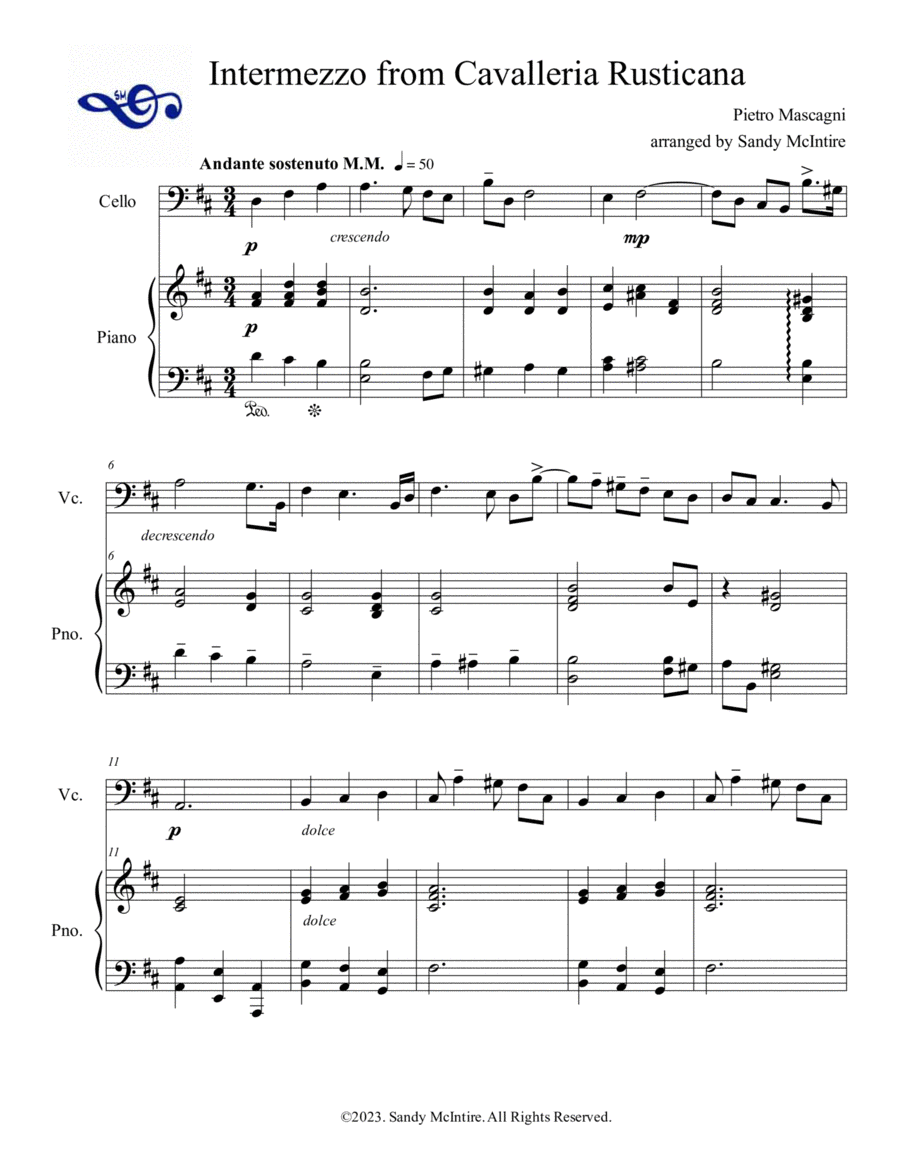
Intermezzo from Cavalleria Rusticana
Violoncelle, Piano

$5.50 4.76 € Violoncelle, Piano PDF SheetMusicPlus


Partitions Gratuites
Acheter des Partitions Musicales
Acheter des Partitions Digitales à Imprimer
Acheter des Instruments de Musique

© 2000 - 2026

Accueil - Version intégrale





