EUROPE
170205 articles
USA
0 articles
DIGITAL
986225 articles (à imprimer)
Partitions Digitales
Partitions à imprimer
986225 partitions trouvées


Instrumental Duet,Piano Cello,Instrumental Duet,Piano,Violin - Level 2 - Digital Download SKU: A0.1012276 Composed by Anne S. Murphy. Arranged by Sylvia Hung. Christian,Gospel,Praise & Worship,Sacred. Score and parts. 15 pages. Notes of Delight #6382903. Published by Notes of Delight (A0.1012276). This all time Christian hymn was arranged for piano, violins and cello. Perfect for all church occasions, hymnal presentation or regular worship.  The performance duration is around 3:10Constantly Abiding (Anne E.Murphy)There’s a peace in my heart that the world never gave,A peace it cannot take away; Though the trials of lifemay surround like a cloud, I’ve a peace that has come here to stay !All the world seemed to sing  of a Saviour and King,When peace sweetly came to my heart; Troubles all fled away and my night turned to day,Blessed Jesus, how glorious Thou art!This treasure I have in a temple of clay, While here on His footstool I roam; But He’s coming to take me some glorious day, Over there to my heavenly home!Refrain:Constantly abiding, Jesus is mine; Constantly abiding, rapture divine; He never leaves me lonely, whispers, oh, so kind:I will never leave thee Jesus is mine.About Sylvia Hung / Notes of Delight MusicSylvia Hung is a Toronto-based Christian Church composer/arranger/pianist, she has been arranging and composing numerous pieces for various choir group and ensembles over the past 20 years, including weddings, hymnal services presentation and performances on special occasion. She has also served in church as a pianist /choir conductor/ ensemble director. Please visit her music at https://sylviahungmusic.ca
Constantly Abiding (for violins, cello and piano)
Piano Trio: piano, violon, violoncelle

$6.99 6.07 € Piano Trio: piano, violon, violoncelle PDF SheetMusicPlus

Euphonium,Piano - Level 3 - Digital Download SKU: A0.549503 Composed by Felix Mendelssohn (1809 –1847). Arranged by James M. Guthrie, ASCAP. Instructional,Romantic Period,Sacred,Standards. Score and part. 20 pages. Jmsgu3 #3501871. Published by jmsgu3 (A0.549503). Score: 11 pages, solo part: 3 pages, piano part: 5 pages. Duration: 4:20. This is a popular recital piece that would work well also in church or school programs. Mendelssohn Background Felix Mendelssohn (1809 –1847) was, by all means, a German mastermind composer, musician, and orchestra conductor of the Romantic period. Consequently, Mendelssohn composed in the usual forms of the time - symphonies, concertos, oratorios, piano music, and chamber music. To summarize, his most famous works include his music for A Midsummer Night's Dream, the Italian Symphony, the Scottish Symphony, The Hebrides Overture, his later Concerto for Violin & Orchestra, and his Octet for Strings. His most well-known piano pieces, by and large, are the Songs Without Words.  Artistic Standing  Musical tastes change from time to time. Moreover, just such a change occurred in the late 19th and early 20th centuries. This plus rampant antisemitism brought a corresponding amount of undue criticism. Fortunately, however, his artistic inventiveness has indeed been critically re-evaluated. As a result, Mendelssohn is once again among the most prevalent composers of the Romantic era. Early Family Life Mendelssohn was, in fact, born into a prominent Jewish family. His grandfather was, notably, the philosopher Moses Mendelssohn. Felix was, in fact, raised without religion. At the age of seven, he was suddenly baptized as a Reformed Christian. He was, moreover, a child musical prodigy. Nevertheless, his parents did not attempt to exploit his talent. Early Adulthood Mendelssohn was, in general, successful in Germany. He conducted, in particular, a revival of the music of Johann Sebastian Bach, specifically with his presentation of the St Matthew Passion in 1829. Felix was truly in demand throughout Europe as a composer, conductor, and soloist. For example, he visited Britain ten times. There, he premiered, namely, many of his significant works. His taste in music was. To be sure, inventive and well-crafted yet markedly conservative. This conservatism separated him by all means from more audacious musical colleagues like Liszt, Wagner, and Berlioz. Mendelssohn founded the Leipzig Conservatoire which, to clarify, became a defender of this conservative viewpoint. Mature Adulthood Schumann notably wrote that Mendelssohn was the Mozart of the nineteenth century, the most brilliant musician, the one who most clearly sees through the contradictions of the age and for the first time reconciles them. This observation points to a couple of features in particular that illustrate Mendelssohn's works and his artistic procedure. Musical Features In the first place, his musical style was fixed in his systematic mastery of the style of preceding masters. This being said, he certainly recognized and even developed early romanticism from the music of Beethoven and Weber. Secondly, it indicates that Mendelssohn sought to strengthen his inherited musical legacy rather than to exchange it with new forms and styles or replace it with exotic orchestration. Consequently, he diverged his contemporaries in the romantic period, such as Wagner, Berlioz, and Liszt. Mendelssohn revered Liszt's virtuosity at the keyboard but found his music rather insubstantial.
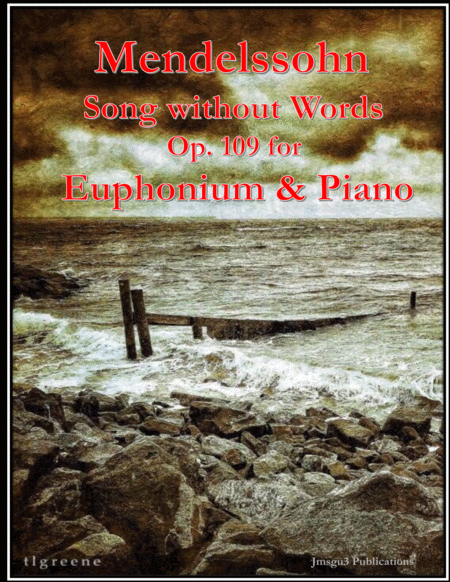
Mendelssohn: Song Without Words Op. 109 for Euphonium & Piano
Euphonium, Piano (duo)

$32.95 28.61 € Euphonium, Piano (duo) PDF SheetMusicPlus

Instrumental Duet,Piano Cello,Instrumental Duet,Piano,Violin - Level 3 - Digital Download SKU: A0.617115 Composed by TRADITIONAL, JOHN STAFFORD SMITH. Arranged by Gary Lanier. Folk,Holiday,Patriotic. Score and parts. 18 pages. The Lanier Company #4603609. Published by The Lanier Company (A0.617115). PATRIOTIC FREEDOM MEDLEY is an arrangement for Violin and Cello with Piano of My Country, ‘Tis of Thee & The Star-Spangled Banner. It works great for offertories, special music where Patriotism or God and Country is emphasized... or for the joy of playing an inspiring medley about America (18 pages including cover).
PATRIOTIC FREEDOM MEDLEY (Violin and Cello with Piano/Score and Parts)
Piano Quatuor: piano, 2 violons, violoncelle

$9.99 8.67 € Piano Quatuor: piano, 2 violons, violoncelle PDF SheetMusicPlus

Piano,Soprano Saxophone - Level 3 - Digital Download SKU: A0.549556 Composed by Edvard Grieg. Arranged by James M. Guthrie, ASCAP. Concert,Instructional,Romantic Period,Standards,World. Score and part. 16 pages. Jmsgu3 #3507669. Published by jmsgu3 (A0.549556). Duration: ca. 3:20, Score: 10 pages, solo part: 2 pages, piano part: 3 pages. A delicate masterpiece, not very difficult - suitable for a recital encore. Grieg Background In the first place, Edvard Grieg (1843 –1907) was a Norwegian composer as well as a concert pianist. As a matter of fact, most music historians consider him one of the foremost Romantic era composers. Consequently, his music is part of the international standard classical repertoire. Grieg moreover used Norwegian folk music in his own compositions.  Consequently, he ushered Norwegian music to transnational consciousness. Furthermore, he forged a national musical identity for Norway. It is important to realize that he did this in a manner similar to Jean Sibelius in Finland, and BedÅ™ich Smetana in Bohemia. Legacy Grieg is especially celebrated in the city of Bergen. For example, the city has erected numerous statues depicting Grieg. Specifically, the city has named a concert hall (Grieg Hall), a music school (Grieg Academy) and a professional choir (Edvard Grieg Kor) after him. As a matter of fact, there is also a museum located at his former home in Troldhaugen. Peer Gynt Suite No. 1 (Op. 46) Grieg wrote incidental music for the purpose of illustrating a play by Ibsen known as Peer Gynt. The play includes, in particular, the famous selection entitled, In the Hall of the Mountain King. In this composition, Grieg indeed depicts the exploits of the scoundrel, Peer Gynt. In one famous episode, for example, Peer steals a bride at her wedding. For this reason, the people chase him, but soon Peer falls, thereupon striking his skull on a boulder. He wakens forthwith in a highland bounded by angry gnomes. Consequently, the music of In the Hall of the Mountain King represents the mad gnomes taunting Peer. Therefore, each time the theme repeats it gets louder and faster. In the end, Peer surprisingly escapes from the mountain. Holberg Suite and Misc. Summary It must be remembered that Grieg originally wrote his Holberg Suite for the piano. In other words, he only later arranged it for strings. Further, Grieg composed by and large many songs with lyrics by famous writers such as Heine, Goethe, Ibsen, Hans Christian Andersen, Rudyard Kipling, and others. On balance, Norwegian pianist Eva Knardahl recorded altogether Grieg’s whole piano catalog on LP in 1980. These recordings were released again on CD in 2006. In any event, Grieg himself performed and recorded the bulk of these pieces toward the end of his life.Register for free lifetime revisions and updates at www.jamesguthrie.com
Grieg: Anitra's Dance from Peer Gynt Suite for Soprano Sax & Piano
Saxophone Soprano et Piano

$24.95 21.66 € Saxophone Soprano et Piano PDF SheetMusicPlus

Piano,Trombone - Level 3 - Digital Download SKU: A0.1376054 Composed by Richard Wagner. Arranged by Benzaiten Editions. 19th Century,Classical,Romantic Period,Traditional,Wedding. Score and part. 6 pages. Benzaiten Editions #960636. Published by Benzaiten Editions (A0.1376054). Hey there, fellow musician! Ready to master Richard Wagner's timeless Bridal Chorus (Here Comes the Bride)? Unlock the magic with our trombone with piano accompaniment sheet music edition! 🎵Richard Wagner • Here Comes the Bride (Bridal Chorus) from Lohengrin | trombone & piano sheet music Benzaiten Editions' edition By purchasing our edition, You'll be able to download: Full score (trombone and piano accompaniment) Trombone part sheet music About the song Wagner's Bridal Chorus, famously known as Here Comes the Bride, has become an iconic staple in wedding ceremonies worldwide. Composed in the mid-19th century, its jubilant melody has gracefully accompanied countless brides down the aisle, symbolizing love, joy, and the beginning of a new chapter in life.
Wagner • Here Comes the Bride (Bridal Chorus) from Lohengrin | trombone & piano sheet music
Trombone et Piano
purchasing our edition, You'll be able to download:
  • Full score (trombone and piano accompaniment)
  • Trombone part sheet music

About the song

Wagner's Bridal Chorus, famously known as Here Comes the Bride, has become an iconic staple in wedding ceremonies worldwide Composed in the mid-19th century, its jubilant melody has gracefully accompanied countless brides down the aisle, symbolizing love, joy, and the beginning of a new chapter in life
$4.99 4.33 € Trombone et Piano PDF SheetMusicPlus


Partitions Gratuites
Acheter des Partitions Musicales
Acheter des Partitions Digitales à Imprimer
Acheter des Instruments de Musique

© 2000 - 2026

Accueil - Version intégrale





