EUROPE
170204 articles
USA
0 articles
DIGITAL
985005 articles (à imprimer)
Partitions Digitales
Partitions à imprimer
985005 partitions trouvées


Instrumental Duet,Piano B-Flat Trumpet,Instrumental Duet,Piano - Level 3 - Digital Download SKU: A0.1489658 Composed by William B. Bradbury, Charlotte Elliott, Gaetano Donizetti. Arranged by John A. Dempsey. Christian,Easter,Praise and Worship,Sacred,Traditional. 16 pages. John A. Dempsey #1066530. Published by John A. Dempsey (A0.1489658). This trio for two Bb trumpets and piano sets a prayerful tone for traditional church services and other worship events.  Especially effective as an invitation, this music is also recommended as accompaniment for quiet meditation and silent prayer as well as a prelude and an offertory.  Donizetti composed the incidental music. 12 pages of music (that includes separate two-page parts for trumpet 1 and trumpet 2).  Concert Key: C major.  Trumpet Level: Intermediate.  Piano Level: Late Intermediate
Just As I Am (Trio for Two Trumpets and Piano)
2 Trompettes, Clavier (piano ou orgue)

$11.99 10.36 € 2 Trompettes, Clavier (piano ou orgue) PDF SheetMusicPlus

Oboe,Piano - Level 3 - Digital Download SKU: A0.549488 Composed by Felix Mendelssohn (1809 –1847). Arranged by James M. Guthrie, ASCAP. Instructional,Romantic Period,Sacred,Standards. Score and part. 20 pages. Jmsgu3 #3500659. Published by jmsgu3 (A0.549488). Score: 11 pages, solo part: 3 pages, piano part: 5 pages. Duration: 4:20. This is a popular recital piece that would work well also in church or school programs. Mendelssohn Background Felix Mendelssohn (1809 –1847) was, by all means, a German mastermind composer, musician, and orchestra conductor of the Romantic period. Consequently, Mendelssohn composed in the usual forms of the time - symphonies, concertos, oratorios, piano music, and chamber music. To summarize, his most famous works include his music for A Midsummer Night's Dream, the Italian Symphony, the Scottish Symphony, The Hebrides Overture, his later Concerto for Violin & Orchestra, and his Octet for Strings. His most well-known piano pieces, by and large, are the Songs Without Words.  Artistic Standing  Musical tastes change from time to time. Moreover, just such a change occurred in the late 19th and early 20th centuries. This plus rampant antisemitism brought a corresponding amount of undue criticism. Fortunately, however, his artistic inventiveness has indeed been critically re-evaluated. As a result, Mendelssohn is once again among the most prevalent composers of the Romantic era. Early Family Life Mendelssohn was, in fact, born into a prominent Jewish family. His grandfather was, notably, the philosopher Moses Mendelssohn. Felix was, in fact, raised without religion. At the age of seven, he was suddenly baptized as a Reformed Christian. He was, moreover, a child musical prodigy. Nevertheless, his parents did not attempt to exploit his talent. Early Adulthood Mendelssohn was, in general, successful in Germany. He conducted, in particular, a revival of the music of Johann Sebastian Bach, specifically with his presentation of the St Matthew Passion in 1829. Felix was truly in demand throughout Europe as a composer, conductor, and soloist. For example, he visited Britain ten times. There, he premiered, namely, many of his significant works. His taste in music was. To be sure, inventive and well-crafted yet markedly conservative. This conservatism separated him by all means from more audacious musical colleagues like Liszt, Wagner, and Berlioz. Mendelssohn founded the Leipzig Conservatoire which, to clarify, became a defender of this conservative viewpoint. Mature Adulthood Schumann notably wrote that Mendelssohn was the Mozart of the nineteenth century, the most brilliant musician, the one who most clearly sees through the contradictions of the age and for the first time reconciles them. This observation points to a couple of features in particular that illustrate Mendelssohn's works and his artistic procedure. Musical Features In the first place, his musical style was fixed in his systematic mastery of the style of preceding masters. This being said, he certainly recognized and even developed early romanticism from the music of Beethoven and Weber. Secondly, it indicates that Mendelssohn sought to strengthen his inherited musical legacy rather than to exchange it with new forms and styles or replace it with exotic orchestration. Consequently, he diverged his contemporaries in the romantic period, such as Wagner, Berlioz, and Liszt. Mendelssohn revered Liszt's virtuosity at the keyboard but found his music rather insubstantial.
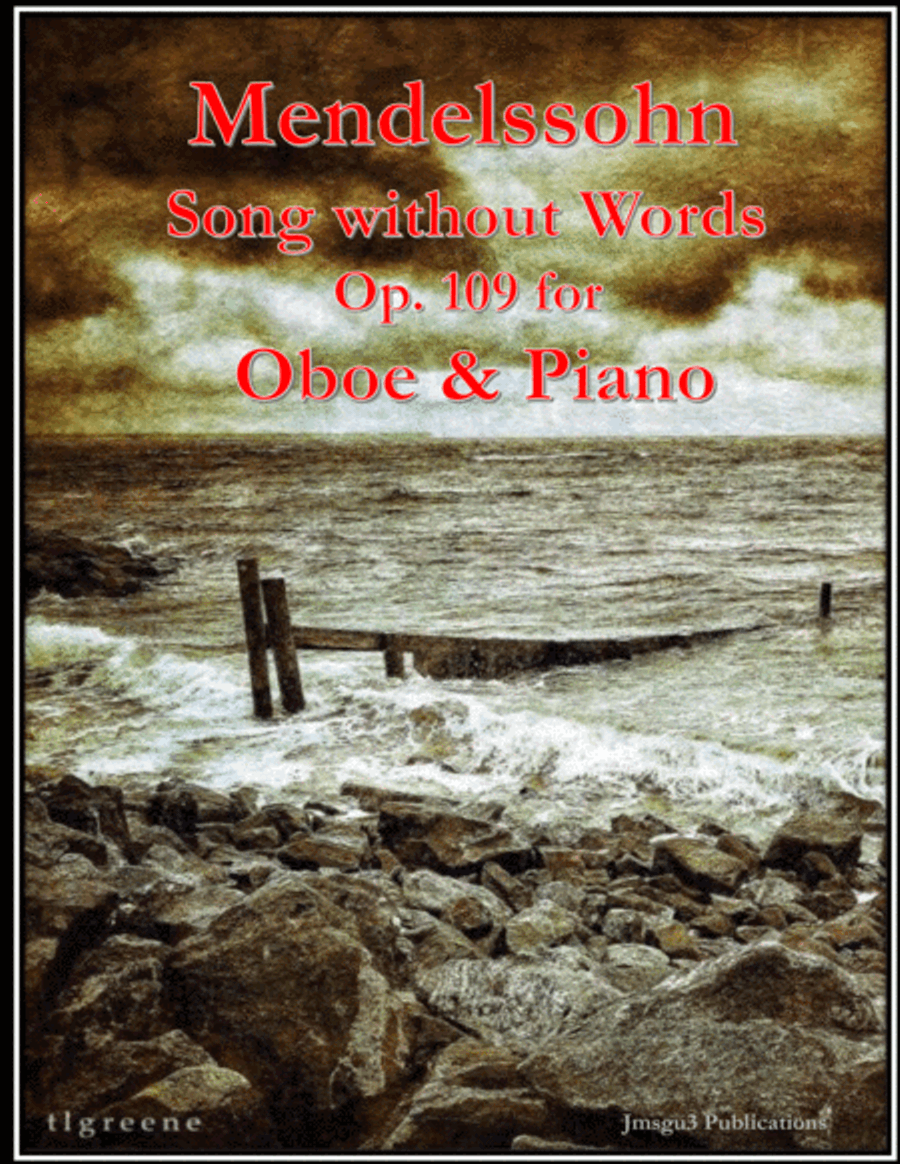
Mendelssohn: Song Without Words Op. 109 for Oboe & Piano
Hautbois, Piano (duo)

$32.95 28.47 € Hautbois, Piano (duo) PDF SheetMusicPlus

Piano,Viola - Level 3 - Digital Download SKU: A0.845327 Composed by Z Noskowski. Arranged by Phil Beaman. Concert,Romantic Period,Wedding. Score and part. 7 pages. Phil Beaman #6759355. Published by Phil Beaman (A0.845327). In 1897 the great Polish composer Zygmund Noskowski composed four characteristic pieces for piano, each piece evoking a different spring flower. This duet between an Instrumental Solo and piano is my arrangement of Rose from Fleurs du Printemps, Op 48 (Rose, from Flowers of Spring).It is expressive, portraying the beauty of the Rose. I have added considerable markings of articulation and dynamics and phrasing to bring out this expressiveness. I have also changed the tempos to create more emotional variety between the thematic sections and I wrote a new ending with an Instrumental cadenza. The solo instrument plays the various melodic themes while I created a new piano part based on the original chords. The melody contains many accidentals as is typical in the Romantic period.  Accessible for the average player yet with enough markings and nuances to satisfy expert players with the results. Definitely a concert or audition piece to show musicianship.  Also well suited for Wedding music. Solo range - nearly 2 octaves (14th)5 page score, 2 page part2:35 minutes
Rose-Noskowski- Viola-Piano
Alto, Piano

$5.99 5.18 € Alto, Piano PDF SheetMusicPlus

Piano - Digital Download SKU: A0.1068234 Composed by John Henry Newton. Arranged by Nick Raspa. Christmas,Praise & Worship,Sacred. Accompaniment. Duration 120. NJR Music #4822027. Published by NJR Music (A0.1068234). This is the backing track for the Trombone & Piano arrangement of Amazing Grace. The sheet music for the trombone part is available separately at:Sheet Music Plus https://www.sheetmusicplus.com/title/amazing-grace-trombone-piano-trombone-part-digital-sheet-music/21420799Sheet Music Direct https://www.sheetmusicdirect.com/en-US/se/ID_No/850884/Product.aspxThere is also a complete set that includes the score and parts available at:Sheet Music Plus https://www.sheetmusicplus.com/title/amazing-grace-trombone-piano-digital-sheet-music/21420446Sheet Music Direct https://www.sheetmusicdirect.com/en-US/se/ID_No/850872/Product.aspx ASCAP.
Amazing Grace (Trombone & Piano) - backing track
Piano seul

$3.99 3.45 € Piano seul PDF SheetMusicPlus

Flute,Piano - Level 3 - Digital Download SKU: A0.572616 Composed by Johannes Brahms. Arranged by James Michael Stevens. 20th Century,Children,New Age,Sacred,Standards. Score and part. 8 pages. James M Stevens Music ASCAP #3680135. Published by James M Stevens Music ASCAP (A0.572616). This is an original arrangement of Brahms Lullaby for flute and piano in a quiet and romantic style. There is a separate flute part in the score and the piano can serve as a stand alone solo. The track as heard is available under Brahms Lullaby Piano Track. James Michael Stevens is a prolific composer residing in Nashville, TN and serves as the music department chairman of Welch College. 2018 Holiday Contest Entry https://www.youtube.com/watch?v=e17NuIDnW0I
Brahms Lullaby - Flute & Piano
Flûte traversière et Piano

$6.99 6.04 € Flûte traversière et Piano PDF SheetMusicPlus


Partitions Gratuites
Acheter des Partitions Musicales
Acheter des Partitions Digitales à Imprimer
Acheter des Instruments de Musique

© 2000 - 2026

Accueil - Version intégrale





