EUROPE
170031 articles
USA
0 articles
DIGITAL
985030 articles (à imprimer)
Partitions Digitales
Partitions à imprimer
985030 partitions trouvées


Piano,Tenor Saxophone - Level 3 - Digital Download SKU: A0.1118289 Composed by Scott Joplin. Arranged by David McKeown. 20th Century,Jazz,Ragtime. Score and part. 33 pages. David McKeown #719807. Published by David McKeown (A0.1118289). Scott Joplin is celebrated as the United States’ first well-known black composer, making his name as a writer of piano rags. His life was a constant struggle with adversity, and Joplin died relatively young in 1917, at the dawn of the recording age. Few remembered Joplin’s music until a revival in the 1970s brought The Entertainer and others to the world’s attention. Nowadays Scott Joplin has taken his rightful place in the gallery of great American composers. The Rags included in this collection are, The Entertainer, The Maple Leaf Rag, The Easy Winners, The Elite Syncopations and The Favorite. They have been arranged as solos for one Tenor Saxophone with piano accompaniment, and include all sections of the original compositions. You will download one pdf file that contains both 22 pages of piano score and the 10 page solo part. These pieces are suitable for players at an intermediate and advanced intermediate level. Musicians will find these Ragtime solos ideal for formal and informal performances, light and fun, yet still a serious and vitally important part of the American musical heritage. The overall performance time for all five is around 25 minutes. Teachers will enjoy using these arrangements as a fun way to help with phrasing, syncopated rhythms and light articulation.  Click on the YouTube link to see and hear samples from the collection. There are many more top quality arrangements and compositions by David McKeown for you to browse at http://www.sheetmusicplus.com/publishers/david-mckeown/6203
Five Ragtime Solos by Scott Joplin for Tenor Saxophone and Piano
Saxophone Tenor et Piano

$9.99 8.62 € Saxophone Tenor et Piano PDF SheetMusicPlus

Piano,Tenor Saxophone - Level 4 - Digital Download SKU: A0.1090791 Composed by Scott Joplin. Arranged by David McKeown. 20th Century,Folk,Jazz,Ragtime. Score and part. 7 pages. David McKeown #694921. Published by David McKeown (A0.1090791). The Elite Syncopations was one of many solo piano rags written by Scott Joplin in the wake of his success with Maple Leaf Rag. Published in 1903, The Elite Syncopations followed the classic four part structure that Joplin had developed with earlier compositions. In 1974 the Royal Ballet in London produced a ballet based on ragtime music using The Elite Syncopations as both the title and main theme.  This arrangement of The Elite Syncopations is arranged as a solo for one Tenor Saxophone with piano accompaniment. Both the piano and the separate solo part are included in the one downloadable pdf file. Musicians at an advanced intermediate level and above will find this ideal for formal and informal performances. The overall performance time, with repeats, is around five minutes. Teachers will enjoy using this arrangement as a fun way to help with phrasing, syncopated rhythms and light articulation.  Click the YouTube link to hear a full performance of the clarinet version of this arrangement. There are many more top quality arrangements and compositions by David McKeown for you to browse at http://www.sheetmusicplus.com/publishers/david-mckeown/6203
The Elite Syncopations for Solo Tenor Saxophone and Piano
Saxophone Tenor et Piano

$3.99 3.44 € Saxophone Tenor et Piano PDF SheetMusicPlus

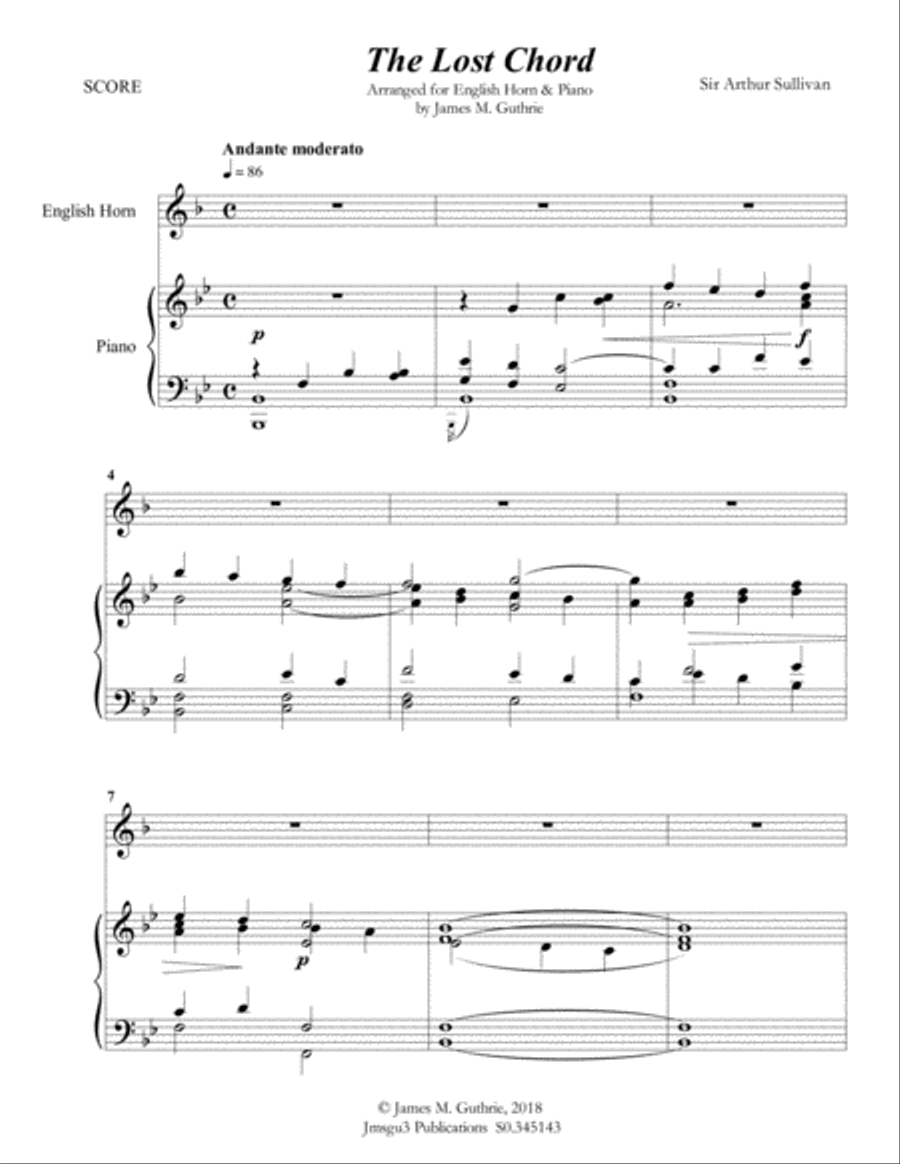
English Horn,Piano - Level 4 - Digital Download SKU: A0.549455 Composed by Sir Arthur Seymour Sullivan. Arranged by James M. Guthrie, ASCAP. Instructional,Romantic Period,Sacred,Standards. Score and part. 15 pages. Jmsgu3 #3497229. Published by jmsgu3 (A0.549455). Score: 10 pages, solo part: 2 pages, piano part: 3 pages. Duration: 4:25. Not difficult, but requires sensitivity & dynamic control. Suitable for recitals, church meditations, or school programs. School Years First of all, Sullivan attended music school at the Royal Academy of Music. Because Sullivan was so talented, the Academy awarded him the Mendelssohn Scholarship for two years in a row. He, therefore, studied with John Goss, who studied with Thomas Atwood, who in turn studied with Mozart. Sullivan similarly studied the piano at the Academy with Arthur O’Leary. Study Abroad During his first year, he also earned money by singing solos in the Chapel Royal. At the end of his second year, the Academy consequently continued his scholarship and sent him to study at the Leipzig Conservatoire. He certainly studied composition, and likewise counterpoint and piano. Hence, during his final year in Leipzig, Sullivan finally completed his graduation composition project: Incidental Music for Shakespeare’s The Tempest. Association with Gilbert It seems like Sullivan built the bulk of his composing career largely in the 1860s. As a result, he became famous for his incidental music for the Tempest and his Irish Symphony. He, therefore, began collaborating with the poet W. S. Gilbert in the 1870s. Rather than focus on serious opera, Gilbert and Sullivan, in contrast, concentrated on comic opera such as H. M. S. Pinafore, the Pirates of Penzance, and the Mikado. Therefore, certainly as a result of his education and experience, Sullivan composed a total of 24 operas, 11 symphonic works, 10 choral pieces. Even more, he wrote a large number of noteworthy hymns such as Onward Christian Soldiers. Lost Chord The general style of his music is maybe similar to Mendelssohn, Schumann, and perhaps Liszt. It seems like Sullivan was fond of writing distinct melodies for each character in his operettas. His melodies combine together as the characters did. Furthermore, he was a master orchestrator, and therefore played the flute, clarinet, trumpet, and trombone fluently. The Lost Chord Sullivan wrote his most noteworthy song the Lost Chord in 1877. As a result, it was a great success and was certainly performed all over the world by a variety of singers such as Enrico Caruso. Because Sullivan was the most famous composer in England, the Lost Chord became the most famous of all British or American songs of the 1870s and 1890s. Consequently, in 1888 Thomas Edison recorded The Lost Chord for the phonograph. It was one of the first songs ever recorded. Furthermore, Queen Victoria knighted Sullivan in 1883.  
Sullivan: The Lost Chord for English Horn & Piano
Cor anglais, Piano

$26.95 23.24 € Cor anglais, Piano PDF SheetMusicPlus


Partitions Gratuites
Acheter des Partitions Musicales
Acheter des Partitions Digitales à Imprimer
Acheter des Instruments de Musique

© 2000 - 2026

Accueil - Version intégrale