EUROPE
3230 articles
USA
0 articles
DIGITAL
2113 articles (à imprimer)
Partitions Digitales
Partitions à imprimer
2113 partitions trouvées


Unison voices or SA choir, optional Orff instruments - Medium - Digital Download SKU: MQ.50-1810-E Composed by Michael Burkhardt. Christmas. 22 pages. MorningStar Music Publishers - Digital Sheet Music #50-1810-E. Published by MorningStar Music Publishers - Digital Sheet Music (MQ.50-1810-E). Five songs for children (Unison to Three Part Treble Voices) and Orff Instruments. May be used independently or with children's Christmas worship service included in publication.Includes:Savior of the Nations, ComeNUN KOMM, DER HEIDEN HEILANDWhat You Gonna Call Your Pretty Little Baby?African-American spiritualSing LullabyCzech CarolCome, Now, All You ShepherdsColumbian CarolCome, All You ShepherdsBohemian CarolLet Our Gladness Have No EndNARODIL SE KRISTUS PÁN.
Christmas Songs from Around the World (Downloadable)

$3.00 2.6 € PDF SheetMusicPlus

Small Ensemble Bassoon,Cello,Clarinet,Flute,Oboe - Level 3 - Digital Download SKU: A0.811719 Composed by Joseph Bodin De Boismortier (1689 - 1755). Arranged by Edited & arranged by Pat Spence. Baroque,Concert,Graduation,Standards,Wedding. Score and parts. 22 pages. Piper Publications #5213745. Published by Piper Publications (A0.811719). The sonata is the first of a set of six published in Paris in 1725 by L’Auteur & Boivin ‘Avec Privilege du Roy.1725.’ The title page described them as ‘SONATES EN TRIO pour Trois Flûtes Transversieres sans Basse Par MR BOISMORTIER. OEVRE SEPTIÈME.’The publication consisted of a set of parts each with the title page followed by a copy of the  Privilége granted by King Louis to Boismortier to print and sell his music.The fourth sonata has been arranged for flute or oboe, clarinet & bassoon or cello. The four movements are Doucement, Courante, Allemande and a pair of minuets. Players of intermediate standard and above will enjoy the independent part writing. Obvious mistakes and omissions have been corrected without comment, trills have been added where there is for e.g. a sequence where only the first trill has been indicated or a similar passage has a trill in that part or another part. The more modern tr has been substituted for + and the mordant used on shorter notes retained. The only dynamics included in the original are Doucement (softly) at the beginning of the first movement and Doux , an indication to play softly from bar/measure 49 to the end of the first movement, and none have been added.  Players should feel free to add their own. For the arrangement some changes of register have been made to accommodate the ranges of the oboe and clarinet and additional slurs have been added (dashed lines). Players are free to retain the ‘feel’ of early eighteenth century style whilst playing modern instruments.The original publication used the, now defunct, soprano clef (with G on the bottom line of the stave) and this edition has been transcribed into the modern treble clef. In the eighteenth century it was quite usual for wind players to play several instruments. The use of the soprano clef would have made it easier to switch between flute and bassoon.
BOISMORTIER SONATA IN D MINOR OPUS 7 No. 4 for flute or oboe, clarinet & bassoon or cello

$12.00 10.41 € PDF SheetMusicPlus

Woodwind Ensemble Bassoon,Double Reed Quintet,English Horn,Oboe - Level 4 - Digital Download SKU: A0.1512248 By George Job Elvey. By George Job Elvey. Arranged by Andrew Lamb. Christmas. 22 pages. Andrew Lamb #1087299. Published by Andrew Lamb (A0.1512248). Presenting Christmas Bells, a heartwarming Double-Reed Quintet arrangement inspired by the classic composition of Englishman George Job Elvey. Originally crafted as an Introductory Voluntary for church services, this arrangement infuses new life into the timeless melodies, perfectly suited for the festive season and beyond.Featuring a lineup of 2 Oboes, English Horn and 2 Bassoons, this arrangement offers an intermediate level of difficulty, making it an accessible and engaging choice for a variety of double-reed instruments. The blend of voices beautifully captures the enchanting spirit of the holiday season.Ideal for concerts, recitals, and educational purposes, Christmas Bells conjures an atmosphere of joy and celebration. Whether performing on stage or as part of a Christmas service, this arrangement resonates with the warmth of tradition and the exuberance of shared musical experiences.Step into the world of Christmas Bells and relish the harmonious collaboration of double-reed instruments Its melodies, originally intended to usher in a sacred moment, now echo with the spirit of togetherness and the magic of Christmas. Share this arrangement with your double-reed quintet and make every performance a memorable occasion.
George Job Elvey | Christmas Bells | for Double-Reed Quintet
George Job Elvey
$10.00 8.68 € PDF SheetMusicPlus

Oboe,Piano - Level 5 - Digital Download SKU: A0.1276462 Composed by Robert Schumann. Arranged by Zellev. 19th Century,Christmas,Classical,Romantic Period,Wedding. Score and part. 22 pages. Zellev Music #868187. Published by Zellev Music (A0.1276462). The Three Romances for Oboe and Piano, Op. 94 (German: Drei Romanzen) is a composition by Robert Schumann, his only composition for oboe. It was composed in December 1849. The work consists of three short pieces in A-B-A form, and it was written during what was speculated to be one of Schumann's manic episodes.An average full performance lasts roughly 12 minutes.The Romances were written in December 1849, one of the most productive years of Schumann's entire career. Previously that year, Schumann had written two other works for wind instruments and piano: the Adagio and Allegro, op. 70, for French Horn and piano, and the Fantasy Pieces for Clarinet and Piano, op. 73. According to Schumann himself, the pieces were written on December 7, 11, and 12th in Dresden., Unlike many other oboes, works at the time, the pieces were not the result of a commission by a prominent soloist of the day. Schumann gave the pieces to his wife Clara Schumann, whom he once described as his own right hand, as a Christmas present, calling them his hundredth opusculum. Schumann's mental health was quickly deteriorating during the time of the pieces' writing; shortly afterward, he moved from Dresden to Düsseldorf, where he was admitted to and eventually died in an asylum.On November 2, 1850, the pieces were first performed privately as a piano and violin piece with Clara Schumann on piano and François Schubert on violin. The works were first performed several years after Schumann's death, in 1863; the performances took place on January 24 and February 14 in the Gewandhaus, featuring Emilius Lund on oboe and Carl Reinecke on piano.The piece was dedicated to Wilhelm Joseph von Wasielewski. The original edition was published by N. Simrock. The publication date is unknown, but it is estimated to have been anywhere from December 1850 to February 1851. Nikolaus Simrock wrote a letter to Schumann on November 19, 1850, asking whether or not Schumann would agree if we were to print on the title page: 'for oboe and pianoforte' and on this with a violin 'for violin and pianoforte' and on the third 'for clarinet and pianoforte,' since it is not looked upon with favor when several instruments appear on the title page. However, Schumann denied the request, replying, If I had originally written the work for violin or clarinet, it would have become a completely different piece. I regret not being able to comply with your wishes, but I can do no other. Two copies of the original printing exist Schumann's copy and Wasielewski's dedication copy (both either in museums or private collections).Disobeying Schumann's wishes, Simrock published alternate violin and oboe parts in the first edition. In her compilation of Robert's works post-mortem, Clara only included the violin transcription, possibly due to her only playing the piece with violinists. There have been several recordings of the music, including a recent one along with other Schumann oboe works by Oboe Classics. The romances are now a standard part of the oboe repertoire and often considered the best piece of romantic repertoire for the oboe.
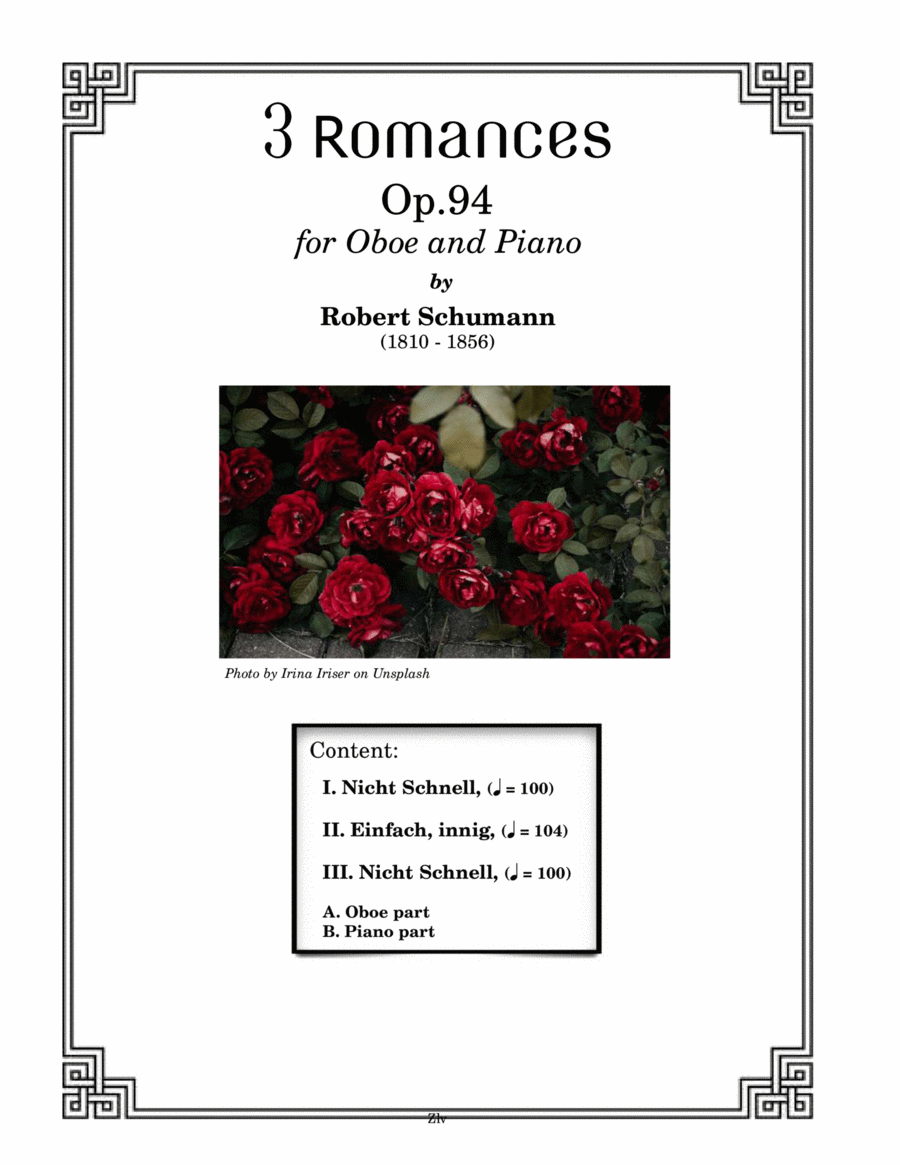
3 Romances, Op. 94 for Oboe and Piano - Robert Schumann
Hautbois, Piano (duo)

$20.00 17.35 € Hautbois, Piano (duo) PDF SheetMusicPlus


Partitions Gratuites
Acheter des Partitions Musicales
Acheter des Partitions Digitales à Imprimer
Acheter des Instruments de Musique

© 2000 - 2026

Accueil - Version intégrale





