EUROPE
56975 articles
USA
0 articles
DIGITAL
579793 articles (à imprimer)
Partitions Digitales
Partitions à imprimer
579793 partitions trouvées


Saxophone Ensemble,Woodwind Ensemble Alto Saxophone,Baritone Saxophone,Tenor Saxophone - Level 4 - Digital Download SKU: A0.813445 Composed by Johann Pachelbel. Arranged by Regis Bookshar. Baroque,Multicultural,Standards,Wedding,World. 35 pages. Regis Bookshar #6260489. Published by Regis Bookshar (A0.813445). Canon (Pachelbel) (Bb) (Saxophone Octet - 4 Alto, 3 Tenor, 1 Bari) - Advanced/Intermediate - Digital Download. This selection, Johann Pachelbel's celebrated Canon, is perhaps the most famous canon ever written and has been one of my favorite compositions to arrange. A canon is a polyphonic device in which several voices play the same music, entering in sequence. Pachelbel's Canon, was originally written in the key of D Major and was scored for three violins arranged in canon, accompanied by a basso continuo which repeats the same harmonic progression throughout the entire piece. The common musical term for this is ostinato or ground bass. Regis Bookshar has now arranged this music for a Saxophone Octet consisting of 4 Alto Saxophones, 3 Tenor Saxophones and 1 Baritone Saxophone. The three Tenor Saxophones play the melody in canon while the ostinato accompaniment is played by the other five instruments. This arrangement is suitable for high school and college students but could also be performed by professional performers. It is perfect for concerts and church services, especially for Weddings, but could be performed for any occasion. Included are a score and a complete set of parts (35 pages). This version is written in the key of Bb Major, to make it a little easier for some younger performers, but another version is also available in the key of D Major if you would prefer. Other versions of Pachelbel's Canon have also been arranged by Regis Bookshar and are available for a wide variety of instrumental Quintets and Octets, in both the keys of D Major and Bb Major. I think that String players would probably prefer to play the versions in the key of D Major while the Brass and Woodwind musicians might prefer to play the Bb Major versions. I hope you take the time to compare the different versions to find the right version for you. To help you decide which version, or versions, you may want to choose, I have included several musical samples for you to listen to and to hear what these arrangements may sound like and so that you may compare the various arrangements. Also, just to let you know, the Octets written in the key of Bb Major have full-length recordings while the Octets in D Major and all Quintets have only the first 25 measures, or so, available to hear. Please feel free to search for other arrangements by Regis Bookshar which are also available. There are quite a few other arrangements in a variety of styles and I'm certain you will find something else which might interest you as well. Please keep checking because I plan to continue to add new arrangements as often as I can. I'm certain that this exciting arrangement of Pachelbel's Canon will be a challenge to some performers but will continue to entertain both performers and audiences alike for years to come.
Canon (Pachelbel) (Bb) (Saxophone Octet - 4 Alto, 3 Tenor, 1 Bari) (3 Tenor lead)
Ensemble de saxophones

$28.00 24.37 € Ensemble de saxophones PDF SheetMusicPlus

Woodwind Ensemble,Woodwind Quintet Clarinet,English Horn,Flute,Oboe - Level 3 - Digital Download SKU: A0.1473315 Composed by Frederic Chopin. Arranged by Ray Thompson. 19th Century,Romantic Period,Wedding. 10 pages. RayThompsonMusic #1051126. Published by RayThompsonMusic (A0.1473315). Étude Op. 10, No. 3, in E major, is a study for solo piano composed by Frédéric Chopin in 1832. It was first published in 1833 in France,Germany,and England as the third piece of his Études Op. 10. This is a slow cantabile study for polyphonic and expressive legato playing. In fact, Chopin himself believed the melody of the piece to be the most beautiful one he ever composed. It became famous through numerous popular arrangements.Although this étude is sometimes identified by the names Tristesse (Sadness) or Farewell (L'Adieu), neither is a name given by Chopin, but rather his critics.Arranged wind quintet.I have transposed it from E major to F major to aid the players.It is NOT the complete study, rather it is of the opening theme, a small selection from the development and the reprise of the theme.The melody is taken mainly the the oboe and flute, the clarinet takes the broken arpeggios, the bassoon the bass line, and the horn adds sustaining notes.Check out my other Chopin arrangements of some of his Preludes (including Raindrop) and of Nocturne No.2.
Chopin: Étude No.3 in E "Tristesse" Op.10 No.3 - wind quintet

$17.95 15.62 € PDF SheetMusicPlus

Saxophone Ensemble,Woodwind Ensemble Alto Saxophone,Tenor Saxophone - Level 4 - Digital Download SKU: A0.1110937 Composed by Wolfgang Amadeus Mozart. Arranged by Regis Bookshar. Chamber,Christian,Classical,Instructional,Religious. 28 pages. Regis Bookshar #713203. Published by Regis Bookshar (A0.1110937). Recordare (from Requiem (K. 626) - Wolfgang Amadeus Mozart/Franz Xaver Sussmayr - Saxophone Sextet - Advanced/Intermediate - Digital Download. Hauntingly beautiful is how the Recordare from Mozart's Requiem is often described. Originally written for an orchestra and four vocal soloists, it has now been transcribed by Regis Bookshar for a Saxophone Sextet, consisting of 3 Alto Saxophones and 3 Tenor Saxophones, and would be a wonderful addition to any music library. This arrangement will provide students with the opportunity to practice breath control because of its long, sustained phrases, This selection could be performed for concerts, recitals and church services and is suitable for high school and college students but professional musicians would also enjoy playing this arrangement. Included are a score and a complete set of parts (28 pages). The Regis Bookshar Trumpet Ensemble has performed the Trumpet Quintet version of the Recordare for funerals, providing beautiful, introspective music for the occasion. There is some controversy surrounding the circumstances of the Requiem's composition because Mozart died before he could complete it. Count Franz von Walsegg had commissioned a Requiem Mass but Mozart had received only half of the payment in advance. So, upon his death on December 5th, 1791, his widow, Constanze, wished to have the work completed secretly by someone else and submit it to the count as having been completed by Mozart to collect the final payment. Joseph von Eybler was one of the first composers to be asked to complete the score and had worked on a number of movements but felt unable to complete the remainder and gave the manuscript back to Constanze Mozart. The task was then given to another composer, Franz Xaver Sussmayr. Sussmayr borrowed some of Eybler's work in making his completion, added his own orchestration to other movements and added several new movements which a Requiem Mass would normally comprise. He then added a final section by adapting the opening two movements which Mozart had written to the different words which finish the Requiem Mass, which according to both Sussmayr and Mozart's wife, was done according to Mozart's directions. The completed score, initially by Mozart but largely finished by Sussmayr, was then dispatched to Count Walsegg complete with a counterfeited signature of Mozart dated 1792. Despite the controversy over how much of the music is actually Mozart's, the commonly performed Sussmayr version has become widely accepted by the public, and is considered one of Mozart's finest compositions. The Recordare is considered by many people to be one of the most beautiful compositions in Mozart's entire catalogue. Regis Bookshar, a trumpet player, has performed the Requiem in concert with a full orchestra, soloists and a chorus and felt that other musicians should have the opportunity to play the hauntingly beautiful Recordare as well. So, in addition to this arrangement for a Saxophone Sextet, he has made quite a few other arrangements of this beautiful composition. There are Quintets, Sextets, Septets and Octets readily available for a wide variety of instrumental ensembles. Please take the time to look for other versions of this composition. You may fine something else which may also suit your needs. I would also encourage you to search for other arrangements by Regis Bookshar as well, as there are numerous arrangements in a variety of styles, also available for purchase. You may find something else which might interest you. Please continue to check periodically because new arrangements are being added as often as possible. I'm certain that this beautiful arrangement of Mozart's Recordare, will continue to entertain both performers and audiences alike for years to come.
Recordare (from "Requiem") (F) (Saxophone Sextet - 3 Alto, 3 Ten)
Ensemble de saxophones

$32.00 27.85 € Ensemble de saxophones PDF SheetMusicPlus

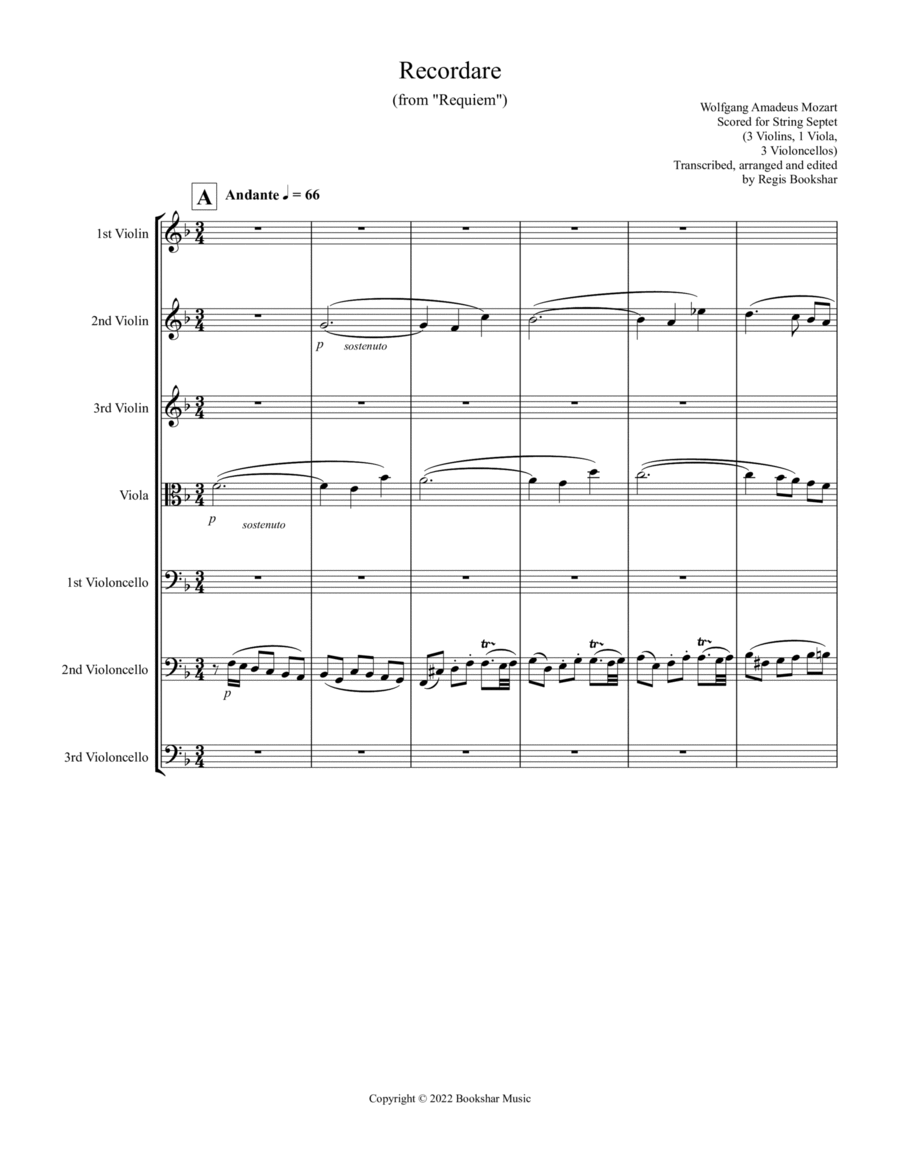
String Ensemble Cello,Viola,Violin - Level 4 - Digital Download SKU: A0.1112138 Composed by Wolfgang Amadeus Mozart. Arranged by Regis Bookshar. Chamber,Christian,Classical,Instructional,Religious. 41 pages. Regis Bookshar #714324. Published by Regis Bookshar (A0.1112138). Recordare (from Requiem (K. 626) - Wolfgang Amadeus Mozart/Franz Xaver Sussmayr - String Septet - Advanced/Intermediate - Digital Download. Hauntingly beautiful is how the Recordare from Mozart's Requiem is often described. Originally written for an orchestra and four vocal soloists, it has now been transcribed by Regis Bookshar for a String Sextet, consisting of 3 Violins, 1 Viola and 3 Violoncellos, and would be a wonderful addition to any music library. This arrangement will provide students with the opportunity to play this beautiful composition, something which they may not have had the opportunity to do, otherwise. This selection could be performed for concerts, recitals and church services and is suitable for high school and college students but professional musicians would also enjoy playing this arrangement. Included are a score and a complete set of parts (41 pages). The Regis Bookshar Trumpet Ensemble has performed the Trumpet Quintet version of the Recordare for funerals, providing beautiful, introspective music for the occasion. There is some controversy surrounding the circumstances of the Requiem's composition because Mozart died before he could complete it. Count Franz von Walsegg had commissioned a Requiem Mass but Mozart had received only half of the payment in advance. So, upon his death on December 5th, 1791, his widow, Constanze, wished to have the work completed secretly by someone else and submit it to the count as having been completed by Mozart to collect the final payment. Joseph von Eybler was one of the first composers to be asked to complete the score and had worked on a number of movements but felt unable to complete the remainder and gave the manuscript back to Constanze Mozart. The task was then given to another composer, Franz Xaver Sussmayr. Sussmayr borrowed some of Eybler's work in making his completion, added his own orchestration to other movements and added several new movements which a Requiem Mass would normally comprise. He then added a final section by adapting the opening two movements which Mozart had written to the different words which finish the Requiem Mass, which according to both Sussmayr and Mozart's wife, was done according to Mozart's directions. The completed score, initially by Mozart but largely finished by Sussmayr, was then dispatched to Count Walsegg complete with a counterfeited signature of Mozart dated 1792. Despite the controversy over how much of the music is actually Mozart's, the commonly performed Sussmayr version has become widely accepted by the public, and is considered one of Mozart's finest compositions. The Recordare is considered by many people to be one of the most beautiful compositions in Mozart's entire catalogue. Regis Bookshar, a trumpet player, has performed the Requiem in concert with a full orchestra, soloists and a chorus and felt that other musicians should have the opportunity to play the hauntingly beautiful Recordare as well. So, in addition to this arrangement for a String Septet, he has made quite a few other arrangements of this beautiful composition. There are Quintets, Sextets, Septets and Octets readily available for a wide variety of instrumental ensembles. Please take the time to look for other versions of this composition. You may fine something else which may also suit your needs. I would also encourage you to search for other arrangements by Regis Bookshar as well, as there are numerous arrangements in a variety of styles, also available for purchase. You may find something else which might interest you. Please continue to check periodically because new arrangements are being added as often as possible. I'm certain that this beautiful arrangement of Mozart's Recordare, will continue to entertain both performers and audiences alike for years to come.
Recordare (from "Requiem") (F) (String Septet - 3 Violins, 1 Viola, 3 Cellos)
Trio à Cordes: violon, alto, violoncelle

$36.00 31.33 € Trio à Cordes: violon, alto, violoncelle PDF SheetMusicPlus

Woodwind Ensemble Bassoon,Clarinet,Flute,Horn,Oboe - Level 4 - Digital Download SKU: A0.814508 Composed by Johann Pachelbel. Arranged by Regis Bookshar. Baroque,Multicultural,Standards,Wedding,World. 36 pages. Regis Bookshar #6266525. Published by Regis Bookshar (A0.814508). Canon in D (Pachelbel) (D) (Woodwind Octet - 3 Flute, 1 Oboe, 2 Clar, 1 Hrn, 1 Bassoon) - Advanced/Intermediate - Digital Download. This selection, Johann Pachelbel's celebrated Canon in D, is perhaps the most famous canon ever written and has been one of my favorite compositions to arrange. A canon is a polyphonic device in which several voices play the same music, entering in sequence. Pachelbel's Canon in D, was originally written in the key of D Major and was scored for three violins arranged in canon, accompanied by a basso continuo which repeats the same harmonic progression throughout the entire piece. The common musical term for this is ostinato or ground bass. Regis Bookshar has now arranged this music for a Woodwind Octet consisting of 3 Flutes, 1 Oboe, 2 Clarinets, 1 French Horn and 1 Bassoon. The three Flutes play the melody in canon while the ostinato accompaniment is played by the other five instruments. This arrangement is suitable for high school and college students but could also be performed by professional performers. It is perfect for concerts and church services, especially for Weddings, but could be performed for any occasion. Included are a score and a complete set of parts (36 pages). This version is written in the key of D Major, as is the original version, but, if you prefer, another version, written in the key of Bb Major, to make it a little easier for some younger performers, is also available. Other versions of Pachelbel's Canon in D have also been arranged by Regis Bookshar and are available for a wide variety of instrumental Quintets and Octets, in both the keys of D Major and Bb Major. I think that String players would probably prefer to play the versions in the key of D Major while the Brass and Woodwind musicians might prefer to play the Bb Major versions. I hope you take the time to compare the different versions to find the right version for you. To help you decide which version, or versions, you may want to choose, I have included several musical samples for you to listen to and to hear what these arrangements may sound like and so that you may compare the various arrangements. Also, just to let you know, the Octets written in the key of Bb Major have full-length recordings while the Octets in D Major and all Quintets have only the first 25 measures, or so, available to hear. Please feel free to search for other arrangements by Regis Bookshar which are also available. There are quite a few other arrangements in a variety of styles and I'm certain you will find something else which might interest you as well. Please keep checking because I plan to continue to add new arrangements as often as I can. I'm certain that this exciting arrangement of Pachelbel's Canon in D will be a challenge to some performers but will continue to entertain both performers and audiences alike for years to come.

Canon in D (Pachelbel) (D) (Woodwind Octet - 3 Flute, 1 Oboe, 2 Clar, 1 Hrn, 1 Bassoon) (3 Flute lea

$28.00 24.37 € PDF SheetMusicPlus

Horn,Trumpet - Level 4 - Digital Download SKU: A0.1344008 Composed by William Byrd. Arranged by Regis Bookshar. Chamber,Early Music,Historic,Instructional,Renaissance. 27 pages. Regis Bookshar #929490. Published by Regis Bookshar (A0.1344008). Sing Joyfully - William Byrd - Brass Sextet - Advanced/Intermediate - Digital Download.William Byrd was the greatest British composer of the late Renaissance, and just maybe, the greatest British composer ever. He wrote a huge body of choral music, some of it profound and timeless. He also composed brilliant, virtuous pieces and his motet-like anthem, Sing Joyfully, a polyphonic setting of Psalm 81, writtem in 1590, is perhaps his best-known one. It is enchanting to listen to and fun to sing. Regis Bookshar thought that instrumental performers should have the same opportunity that singers have had for years, so he has now transribed, edited and arranged this wonderful composition for a variety of instrumental ensembles, including this one for a Brass Sextet, consisting of 3 Bb Trumpets and 3 French Horns.Since no tempo is indicated and there are no writtten dynamic or phrase markings in William Byrd's original score, Regis Bookshar has taken the liberty to add them in order to provide direction and life to the piece. This arrangement is suitable for high school and college students, and perhaps even some younger students. It is perfect for concerts, recitals and church services, but could be performed for any occasion. Included are a score and a complete set of parts (27 pages).Please take the time to look for other versions of this composition. You may find something else that may also suit your needs. Also, please feel fee to search for other arrangements by Regis Bookshar as there are numerous selections in a variety of styles also available for purchase. You may find something else which might interest you. Please continue to check back periodically because new arrangements are being added as often as possible. I'm certain that this wonderful arrangement of William Byrd's magnificent anthem, Sing Joyfully, will continue to delight both performers and audiences alike for many years to come.
Sing Joyfully (Eb) ( Brass Sextet) (3 Trp, 3 Hrn)

$30.00 26.11 € PDF SheetMusicPlus

Woodwind Ensemble Bassoon,Clarinet,Flute,Horn,Oboe - Level 4 - Digital Download SKU: A0.813455 Composed by Johann Pachelbel. Arranged by Regis Bookshar. Baroque,Multicultural,Standards,Wedding,World. 36 pages. Regis Bookshar #6260539. Published by Regis Bookshar (A0.813455). Canon (Pachelbel) (Bb) (Woodwind Octet - 2 Flute, 1 Oboe, 3 Clar, 1 Hrn, 1 Bassoon) - Advanced/Intermediate - Digital Download. This selection, Johann Pachelbel's celebrated Canon, is perhaps the most famous canon ever written and has been one of my favorite compositions to arrange. A canon is a polyphonic device in which several voices play the same music, entering in sequence. Pachelbel's Canon, was originally written in the key of D Major and was scored for three violins arranged in canon, accompanied by a basso continuo which repeats the same harmonic progression throughout the entire piece. The common musical term for this is ostinato or ground bass. Regis Bookshar has now arranged this music for a Woodwind Octet consisting of 2 Flutes, 1 Oboe, 3 Clarinets, 1 French Horn and 1 Bassoon. The three Clarinets play the melody in canon while the ostinato accompaniment is played by the other five instruments. This arrangement is suitable for high school and college students but could also be performed by professional performers. It is perfect for concerts and church services, especially for Weddings, but could be performed for any occasion. Included are a score and a complete set of parts (36 pages). This version is written in the key of Bb Major, to make it a little easier for some younger performers, but another version is also available in the key of D Major if you would prefer. Other versions of Pachelbel's Canon have also been arranged by Regis Bookshar and are available for a wide variety of instrumental Quintets and Octets, in both the keys of D Major and Bb Major. I think that String players would probably prefer to play the versions in the key of D Major while the Brass and Woodwind musicians might prefer to play the Bb Major versions. I hope you take the time to compare the different versions to find the right version for you. To help you decide which version, or versions, you may want to choose, I have included several musical samples for you to listen to and to hear what these arrangements may sound like and so that you may compare the various arrangements. Also, just to let you know, the Octets written in the key of Bb Major have full-length recordings while the Octets in D Major and all Quintets have only the first 25 measures, or so, available to hear. Please feel free to search for other arrangements by Regis Bookshar which are also available. There are quite a few other arrangements in a variety of styles and I'm certain you will find something else which might interest you as well. Please keep checking because I plan to continue to add new arrangements as often as I can. I'm certain that this exciting arrangement of Pachelbel's Canon will be a challenge to some performers but will continue to entertain both performers and audiences alike for years to come.

Canon (Pachelbel) (Bb) (Woodwind Octet - 2 Flute, 1 Oboe, 3 Clar, 1 Hrn, 1 Bassoon) (3 Clar lead)

$28.00 24.37 € PDF SheetMusicPlus


Partitions Gratuites
Acheter des Partitions Musicales
Acheter des Partitions Digitales à Imprimer
Acheter des Instruments de Musique

© 2000 - 2026

Accueil - Version intégrale



