EUROPE
29502 articles
USA
0 articles
DIGITAL
4350 articles (à imprimer)
Partitions Digitales
Partitions à imprimer
4350 partitions trouvées


Piano,Viola - Level 5 - Digital Download SKU: A0.551447 Composed by Antonio Vivaldi. Arranged by James M. Guthrie, ASCAP. Baroque,Concert,Instructional,Standards,Wedding. Score and part. 191 pages. Jmsgu3 #5205031. Published by jmsgu3 (A0.551447). Antonio Vivaldi (1676-1741) The Four Seasons Complete, Op. 8 No. 1-4Contents:SPRINGSpring from the Four Seasons (RV269; Op. 8, No. 1) Score: 23 pages. Duration ca. 10:42I. Allegro - Spring has returned. Song of the Birds. All is gay, and the birds sing happily.FLOWING FOUNTAINS: Fountains play in the breeze, constantly moving.THUNDER: The skies are dark; lightning flashes and thunder roars.SONG OF THE BIRDS: After the storm, the birds return with their song.II. Largo - THE SLEEPING GOATHERD: On the flowered meadow, the goatherd and his dog roam among the blossoming trees. The Barking DogsIII. Allegro - PASTORAL DANCE: Nymphs and shepherds dance to the bagpipes under the beautiful skies of spring.SUMMERVivaldi: Summer from the Four Seasons, Op. 8 No. 2 (RV315) Score: 31 pages, Duration: ca 10:00, 3 movements
Vivaldi: The Four Seasons Complete for Viola & Piano
Alto, Piano

$49.95 43.23 € Alto, Piano PDF SheetMusicPlus

Concert Band - Level 5 - Digital Download SKU: A0.1463453 Composed by Franz Liszt. Arranged by Michael Barrera. 19th Century,Classical,Romantic Period. 42 pages. Michael Barrera #1042149. Published by Michael Barrera (A0.1463453). Https://www.michaelbarreraflute.com/shop/p/mephisto-waltz1-band-scoreTwo Episodes from Lenau’s Faust | Mephisto Waltz No. 1Program NotesFranz Liszt’s first Mephisto Waltz is a programmatic work based on an episode from Nikolaus Lenau’s 1836 verse drama Faust.  The program note that appears in the original printed score is noted here:There is a wedding feast in progress in the village inn, with music, dancing, carousing.  Mephistopheles and Faust pass by, and Mephistopheles induces Faust to enter and take part in the festivities.  Mephistopheles snatches the fiddle from the hands of a lethargic fiddler and draws from it indescribably seductive and intoxicating strains.  The amorous Faust whirls about with a full-blooded village beauty in a wild dance; they waltz in mad abandon out of the room, into the open, away into the woods.  The sounds of the fiddle grow softer and softer, and the nightingale warbled his love-laden song. Mephisto Waltz No. 1 is paired with a work preceding it, Midnight Procession (Der Nächtliche Zug), however this piece is not as widely performed.  Liszt later transcribed the waltz into a piano duet and a virtuosic solo piano work.  Each of these versions were written around the same time, roughly 1859-62.  The orchestral version also has an alternate ending, which is softer and fades away.  This arrangement features both endings. This work was then followed by three more Mephisto Waltzes.  No. 2 was also written as both an orchestral and piano work, while Nos. 3 and 4 were for piano only.  Of the four, the first is the most popular, although the third is also praised as highly musically. InstrumentationWritten for Wind Ensemble of any size (Number indicates how many parts - some parts include divisi)1 Piccolo (doubles Flute 3)                                              2 Flutes2 Oboes2 Bassoons1 Clarinet (E flat)3 Clarinets (B flat)1 Bass Clarinet (B flat)1 Contrabass Clarinet (B flat)2 Alto Saxophones1 Tenor Saxophone1 Baritone Saxophone3 Trumpets (B flat)4 Horns (F)2 Trombones1 Bass Trombone1 Euphonium1 Tuba1 String BassTimpaniMarimbaCymbalTriangle.
Der Tanz in der Dorfschenke | Mephisto Waltz No. 1 (Score) - Score Only
Orchestre d'harmonie

$29.99 25.95 € Orchestre d'harmonie PDF SheetMusicPlus

Choir - Digital Download SKU: A0.1071144 Composed by Greg Bartholomew. Christian,Contemporary,Jewish,Sacred. Full Performance. Duration 301. Burke & Bagley #2880409. Published by Burke & Bagley (A0.1071144). This is the first of Greg Bartholomew's three choral settings of text From the Odes of Solomon, as recorded by the Ars Brunensis Chorus.  The Odes of Solomon are believed to have been written around the year 100 A.D., and include strong parallels to the Dead Sea Scrolls. Scholars have debated whether the Odes should be considered Jewish, Christian or Gnostic, and whether they were first written in Greek, Hebrew or Syriac. Early Christian writings refer to and quote from them. A Syriac manuscript containing the text of most of the Odes was discovered in 1909 by the English scholar J. Rendel Harris, and other partial texts in various languages have also been found. There are 42 Odes. Some fragments are still missing from Odes I and III, and no part of Ode II has yet been found. For these choral settings, I selected text from four of the Odes of Solomon which I found particularly compelling. From the Odes of Solomon was premiered in concert on June 2, 2002, by the Ars Brunensis Chorus under the direction of conductor Roman Valek and choirmaster Dan Kalousek at the Husov Sbor, in Brno, Czech Republic.Watch a score video here:  https://youtu.be/tEHr8Q-Rg6Y?list=PLfOoI8O24sbw_30-GpKg6qkyT5tpYKNbB  For more information:  www.gregbartholomew.com/odesindex.html 
From Odes 1 & 3 of the Odes of Solomon

$1.99 1.72 € PDF SheetMusicPlus

Concert Band - Level 2 - Digital Download SKU: A0.1208594 Composed by Jack Marshall. Arranged by Kyle L. McKinzey. Contest,Festival,Film/TV,Holiday. Score and Parts. 42 pages. KyleMac Music #806702. Published by KyleMac Music (A0.1208594). THE MUNSTERS†was an American sitcom airing on CBS from 1964 to 1966. It depicted the home life of a family of benign monsters. The series was a satire of American suburban life, the wholesome television family fare of the era and traditional monster movies. The music, by Jack Marshall, was described by writer Jon Burlingame as a Bernard-Herrmannmeets-Duane-Eddy sound. This arrangement has fun bass lines, so they will enjoy this and need to work on it sounding creepy. Though not marked throughout, the bass line should be separated and emulate a picked electric bass articulation throughout. The rest of the winds is more suitable for 1st & 2nd-year players. Ex. The 2nd clarinets do not cross the break. The percussion is written for a drum set but can be separated as a traditional part for concert band. As usual, I have included plenty of percussion parts to go around. The tom part can be ad-libbed by a drumkit player if you go with that option. The part itself is optional but does help if splitting the drum part. There are three different mallet parts with the xylophone and marimba carrying the load. Bells can be optional. There are lots of sound effects in the accessories part. Ratchet, Cowbell, Vibra-slap, Tambourine, Whistle, Siren whistle. These can be easily substituted with what you have on hand. I hope your students and audiences (and you) have fun with this piece. I appreciate all comments, questions, and criticisms. KyleMac Music
The Munsters Theme
Orchestre d'harmonie

$49.99 43.26 € Orchestre d'harmonie PDF SheetMusicPlus

Brass Ensemble Horn,Trombone,Trumpet,Tuba - Level 4 - Digital Download SKU: A0.1130062 Composed by English Folk Song by way of American Appalachians. Arranged by F. Leslie Smith. Celtic,Children,Folk,Irish,Traditional,Wedding. Score and parts. 28 pages. Sweetwater Brass Press #730439. Published by Sweetwater Brass Press (A0.1130062). The origins of this lullaby can be traced back to 15th-century England. Pioneers from the British Isles brought it with them to the American Appalachians. Written in three verses, its lyrics tell of four seemingly impossible gifts the singer gave my love. The first verse describes each gift: cherry that has no stone, a chicken that has no bone. a story that has no end and a baby with no cryin'. The second verse poses the riddle: how can such items exist? The third provides the answers: A cherry when it's bloomin', it has no stone. A chicken when it's pippin', it has no bone. The story of I love you, it has no end. A baby when it's sleepin', has no cryin'. This Riddle Song has enjoyed somewhat of a revival since mid-20th century, making appearances in various movies, TV shows and recordings. In 1956, Jerry Livingston and Paul Francis adapted The Riddle Song tune, added an original bridge and created new lyrics; Johnny Mathis recorded it as The Twelfth of Never, giving the haunting melody probably its greatest surge in popularity. This arrangement is in G major and opens with an upbeat introduction. For the first statement of the melody, tempo slows and Trumpets alternate the lead. On the second time through, tempo speeds up slightly and tuba takes the lead. For the third, tempo is back to the opening speed and Horn in F plays the melody. On the fourth time through, Trumpets and Trombone frame the tune in a call-and-response form. In the fifth, Trombone takes the lead. In the sixth and final statement, Horn in F and Trombone play melody at half speed while Trumpets play a fairly complicated counterpoint (at what may seem like double speed!). This, until the last phrase (A baby when it's sleepin'), when the melody switches over to Trumpets and Trombone takes the counterpoint. Trumpet 1 plays its A above the staff a number of times. Tuba's lowest note is its F down below the staff. Otherwise, notes for all instruments are well within normal playing range. Because of the recommended tempo, the countermelody at measures 68-83 could be problematic for Trumpets and Trombone and may require a little extra work. Completed in 2022, performance time runs about 3 minutes, 42 seconds. The arranger, Les Smith, will be happy to provide substitute parts (for example, treble clef baritone for trombone) at no charge. He would like to receive your suggestions, comments, corrections and criticisms. For more arrangements by Les, enter Sweetwater Brass Press (without the quotation marks) in the Sheet Music Plus or Sheet Music Direct search box. (Also, purchase of this piece entitles you to your choice of another of his arrangements at no charge; send a copy of your purchase receipt directly to him at lessmith61@bellsouth.net.)
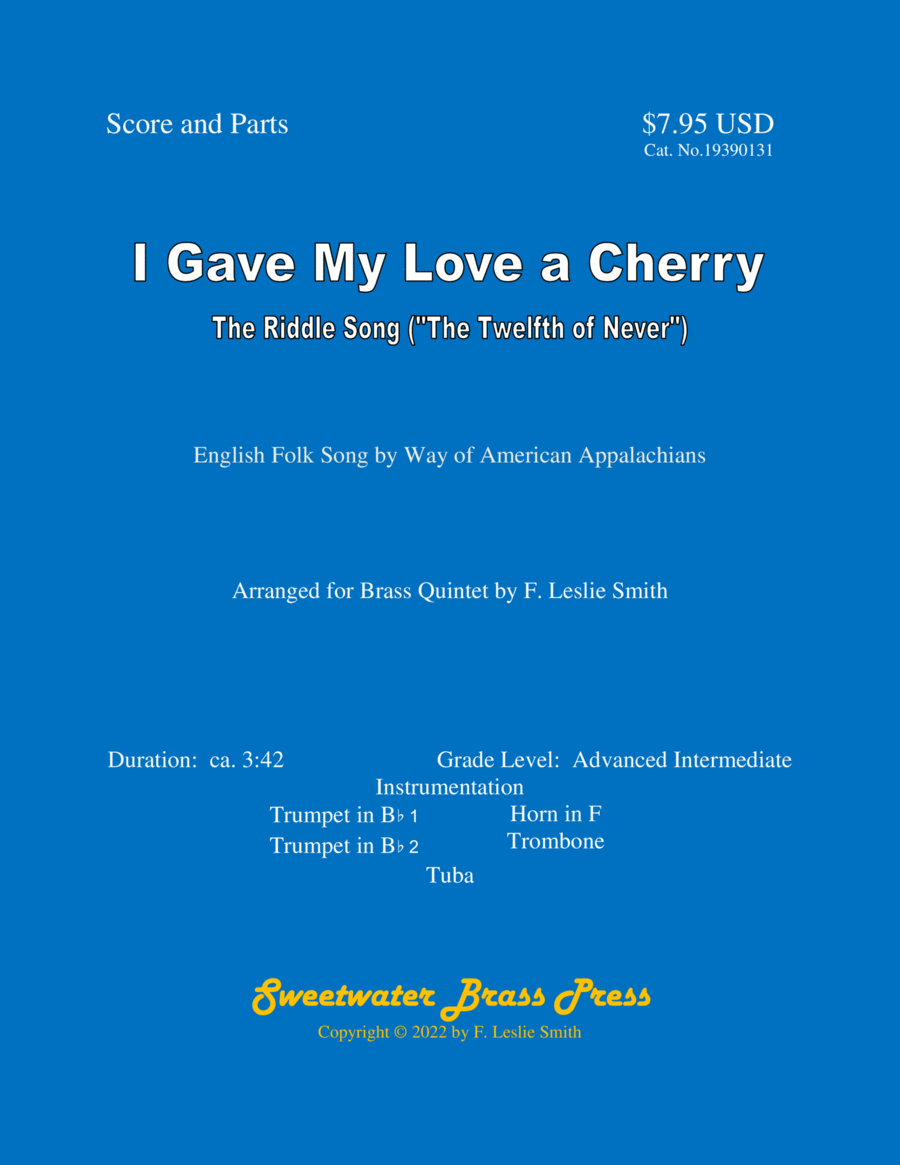
I Gave My Love a Cherry (The Riddle Song ["The Twelfth of Never"])
Quatuor de Cuivres : 2 trompettes, trombone, tuba

$7.95 6.88 € Quatuor de Cuivres : 2 trompettes, trombone, tuba PDF SheetMusicPlus


Partitions Gratuites
Acheter des Partitions Musicales
Acheter des Partitions Digitales à Imprimer
Acheter des Instruments de Musique

© 2000 - 2026

Accueil - Version intégrale





