EUROPE
185 articles
USA
0 articles
DIGITAL
117 articles (à imprimer)
Partitions Digitales
Partitions à imprimer
117 partitions trouvées


Piano,Violin - Level 4 - Digital Download SKU: A0.549723 Composed by Gabriel Faure. Arranged by James M. Guthrie, ASCAP. Contemporary,Multicultural,Romantic Period,Standards,World. 22 pages. Jmsgu3 #3531355. Published by jmsgu3 (A0.549723). Duration: ca. 7:00, Score: 12 pages, solo part: 2 pages, piano: 7 pages. An epic choice for a recital or funeral. Fauré Background: In the first place, Gabriel Fauré 1845 –1924) was a famous French composer, musician, and educator. Furthermore, his musical ideas influenced numerous 20th-century composers. Therefore, historians regard him as one of the leading French composers of his time. Famous Works: Among his most famous compositions, by and large, are the Pavane, Elegie (op. 24), Requiem, Sicilienne, Nocturnes for piano and the songs Après un rêve and Clair de lune. Inasmuch as his early works are well-known and relatively easy to perform, Faure’s music seems to have become gradually more difficult during his later life. In other words, his later works are somewhat esoteric and complex. Early Home Life: Fauré was in fact born into a well-cultivated family. His aptitude for music became particularly clear early on - when he was still a boy. Under these circumstances, his parents sent him to a music institution in Paris. Consequently, the training he received there prepared him for a career as a church organist and choirmaster. Middle Life: It is important to realize that Fauré studied music composition with the French musical mastermind Camille Saint-Saëns, who became his lifelong friend. Fauré eventually graduated from college and earned a living as an organist and educator. During this period, he had, on the whole, little time to compose. He consequently became more successful in his middle age, becoming organist of the Église de la Madeleine and director of the Paris Conservatoire. However, he still needed time on balance for composing. Therefore, given these points, he withdrew to the countryside during the summer to focus on composing. Later Life: Fauré was, in the final analysis, recognized in France as the foremost French composer of his time. The French government held a national musical tribute particularly for him in Paris. The French President notably headed the ceremony. Elsewhere, on the contrary, Fauré's music was slow to become accepted, except of course, in England. Legacy: Historians often describe Fauré's music in general as a transition between the end of Romanticism and the beginning of modernism. As an illustration, when Fauré was born, Chopin was still composing. However, by the time of Fauré's death, jazz and atonal music, in particular, had come to fruition. Fauré, by all means, suffered from increasing deafness in his later years. Some musicologists believe this to be indeed the cause of the esoteric nature of Faure’s final works.
Fauré: Élégie Op. 24 for Violin & Piano
Violon et Piano

$32.95 28.69 € Violon et Piano PDF SheetMusicPlus

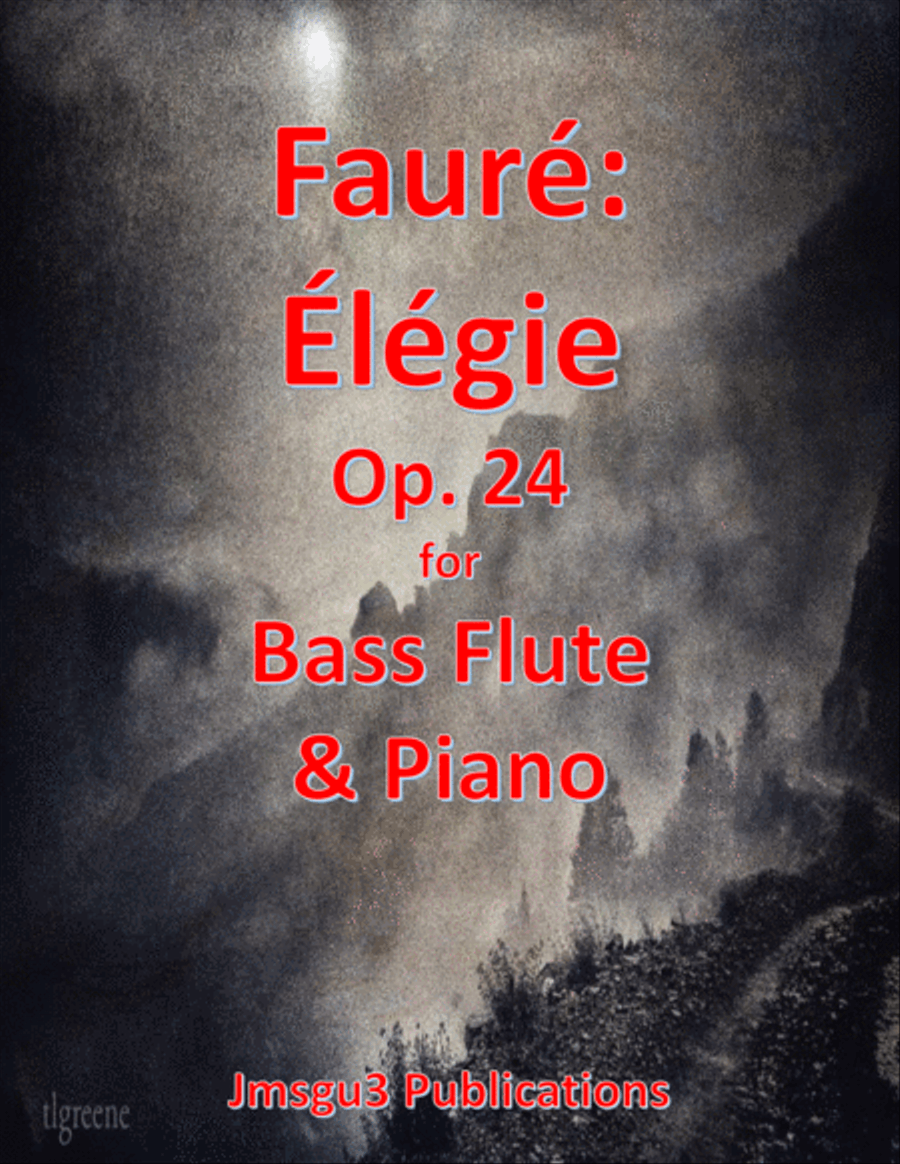
Bass Flute,Instrumental Solo,Piano - Level 4 - Digital Download SKU: A0.549731 Composed by Gabriel Faure. Arranged by James M. Guthrie, ASCAP. Contemporary,Multicultural,Romantic Period,Standards,World. Score and individual part. 22 pages. Jmsgu3 #3531443. Published by jmsgu3 (A0.549731). Duration: ca. 7:00, Score: 12 pages, solo part: 2 pages, piano: 7 pages. An epic choice for a recital or funeral. Fauré Background In the first place, Gabriel Fauré 1845 –1924) was a famous French composer, musician, and educator. Furthermore, his musical ideas influenced numerous 20th-century composers. Therefore, historians regard him as one of the leading French composers of his time. Famous Works Among his most famous compositions, by and large, are the Pavane, Elegie (op. 24), Requiem, Sicilienne, Nocturnes for piano and the songs Après un rêve and Clair de lune. Inasmuch as his early works are well-known and relatively easy to perform, Faure’s music seems to have become gradually more difficult during his later life. In other words, his later works are somewhat esoteric and complex. Early Home Life Fauré was in fact born into a well-cultivated family. His aptitude for music became particularly clear early on - when he was still a boy. Under these circumstances, his parents sent him to a music institution in Paris. Consequently, the training he received there prepared him for a career as a church organist and choirmaster. Middle Life It is important to realize that Fauré studied music composition with the French musical mastermind Camille Saint-Saëns, who became his lifelong friend.  Fauré eventually graduated from college and earned a living as an organist and educator. During this period, he had, on the whole, little time to compose. He consequently became more successful in his middle age, becoming organist of the Église de la Madeleine and director of the Paris Conservatoire. However, he still needed time on balance for composing. Therefore, given these points, he withdrew to the countryside during the summer to focus on composing. Later Life Fauré was, in the final analysis, recognized in France as the foremost French composer of his time. The French government held a national musical tribute particularly for him in Paris. The French President notably headed the ceremony. Elsewhere, on the contrary, Fauré's music was slow to become accepted, except of course, in England. Legacy Historians often describe Fauré's music in general as a transition between the end of Romanticism and the beginning of modernism. As an illustration, when Fauré was born, Chopin was still composing. However, by the time of Fauré's death, jazz and atonal music, in particular, had come to fruition. Fauré, by all means, suffered from increasing deafness in his later years. Some musicologists believe this to be indeed the cause of the esoteric nature of Faure’s final works.
Fauré: Élégie Op. 24 for Bass Flute & Piano

$32.95 28.69 € PDF SheetMusicPlus

Piano Quartet - Level 4 - Digital Download SKU: A0.549720 Composed by Gabriel Faure. Arranged by James M. Guthrie, ASCAP. Contemporary,Multicultural,Romantic Period,Standards,World. 33 pages. Jmsgu3 #3531235. Published by jmsgu3 (A0.549720). It's an epic choice for a recital or funeral. Fauré Background: In the first place, Gabriel Fauré 1845 –1924) was a famous French composer, musician, and educator. Furthermore, his musical ideas influenced numerous 20th-century composers. Therefore, historians regard him as one of the leading French composers of his time. Famous Works: Among his most famous compositions, by and large, are the Pavane, Elegie (op. 24), Requiem, Sicilienne, Nocturnes for piano, and the songs Après un rêve and Clair de lune. Since his early works are well-known and relatively easy to perform, Faure's music seems to have become gradually more difficult during his later life. In other words, his later works are somewhat esoteric and complex. Early Home Life: Fauré was born into a well-cultivated family. His aptitude for music became particularly clear early on - when he was still a boy. Under these circumstances, his parents sent him to a music institution in Paris. Consequently, his training there prepared him for a church organist and choirmaster career. Middle Life: It is essential to realize that Fauré studied music composition with the French musical mastermind Camille Saint-Saëns, who became his lifelong friend. Fauré eventually graduated from college and earned a living as an organist and educator. During this period, he had, on the whole, little time to compose. He became more successful in his middle age, becoming organist of the Église de la Madeleine and director of the Paris Conservatoire. However, he still needed time to balance his composing. Therefore, given these points, he withdrew to the countryside during the summer to focus on composing. Later Life: Fauré was, in the final analysis, recognized in France as the foremost French composer of his time. The French government held a national musical tribute in Paris, particularly for him. The French President notably headed the ceremony. Elsewhere, on the contrary, Fauré's music was slow to become accepted, except, of course, in England. Legacy: Historians often describe Fauré's music, in general, as a transition between the end of Romanticism and the beginning of modernism. As an illustration, when Fauré was born, Chopin was still composing. However, by Fauré's death, jazz and atonal music had mainly come to fruition. Fauré, by all means, suffered from increasing deafness in his later years. Some musicologists believe this to be the cause of the esoteric nature of Faure's final works.
Fauré: Élégie Op. 24 for Piano Quartet
Piano Quatuor: piano, violon, alto, violoncelle

$42.95 37.4 € Piano Quatuor: piano, violon, alto, violoncelle PDF SheetMusicPlus

Choral Choir (SAB) - Level 3 - Digital Download SKU: A0.818191 Composed by Philip Le Bas. Christian,Sacred. Octavo. 12 pages. Philip Le Bas #6603399. Published by Philip Le Bas (A0.818191). A new composition setting the words of Psalm 133 for three-part (SABar) choir and piano. This cheerful, perhaps even rather idealistic psalm expressing the joy of kindred dwelling in unity has long been used to give voice to a human longing for acceptance by others, whether in a family or a community. Its verses compare this familial unity to the tradition of pouring expensive ointment over the head of visitors. Far from our modern use of oil for lubrication, this is an ancient middle-eastern oil of welcome and washing and feeling part of a community. Dwelling in unity is also compared to cloudy mist which regularly descends on the heights of Mount Hermon in Zion, providing moisture to an otherwise arid land and enabling life across the whole country. This setting is unashamedly playful, popular and romantic, with verses adding a more mysterious, metaphorical quality to the piece, and bringing to expression the deep joy of living in harmony with others..., even if finding this is not always easy. The composition is ideal for use by a parish choir, employing relatively easy part singing with a supportive piano part.Psalm 133: Ecce quam bonum et quam iucundum, habitare fratres in unum. Behold, how good it is, how pleasant, for kindred to dwell in unity. It is like precious ointment upon the beard, running down upon the beard of Aaron; like the dew of Hermon, which falls upon the mountains of Zion. For there the Lord bestows his blessing: life for evermore.
Ecce quam bonum
Chorale 3 parties

$1.99 1.73 € Chorale 3 parties PDF SheetMusicPlus

Piano,Violin - Level 3 - Digital Download SKU: A0.1130599 Composed by Northeast Brazilian Christmas lullaby. Arranged by Ken Litton. Advent,Christian,Christmas,Folk,Latin. 2 pages. Artist of Note, Inc. #730872. Published by Artist of Note, Inc. (A0.1130599). Still in time for Advent/Christmas Eve! Repousa Tranqüilo (Sleep Peacefully) This arrangement for Violin and Piano of the increasingly popular northeast Brazilian Christmas lullaby Repousa Tranqüilo TRANQÜILIDADE also entitled Sleep Peacefully, is a beautiful folk tune has been recorded in more than one translation in recent years, sometimes with the Welsh lyric below. The entirely public domain tune follows a common practice of moving from minor into major at the midpoint of the tune while also preserving the distinctively Brazilian harmonic quality in the opening verse and throughout. Sleep quietly my Jesus Now close your dear eyes Above you shine God's countless stars Like diamonds in the sky Beside your bed an angel crew With cattle have fed Your mother stands in watchful prayer And strokes your little head The shepards leave, their flocks unwatched They bring you my love While angels of our father God Rejoice the song above From far away the wise men three Their treasures the bring The whole wide world before your kneels My Jesus little king—Trans. Ruth Heller.
Repousa Tranqüilo (Sleep Peacefully) VIOLIN part
Violon et Piano

$2.99 2.6 € Violon et Piano PDF SheetMusicPlus

Piano,Viola - Level 3 - Digital Download SKU: A0.1137027 Composed by Northeast Brazilian Christmas lullaby. Arranged by Ken Litton. Advent,Christian,Christmas,Folk,Sacred. Score and part. 7 pages. Artist of Note, Inc. #737032. Published by Artist of Note, Inc. (A0.1137027). This arrangement for Viola and Piano of the increasingly popular northeast Brazilian Christmas lullaby Repousa Tranqüilo TRANQÜILIDADE also entitled Sleep Peacefully, is a beautiful folk tune has been recorded in more than one translation in recent years, sometimes with the Welsh lyric below. This transcription of the entirely public domain tune follows a common practice of moving from minor into major at the midpoint of the tune while also preserving the distinctively Brazilian harmonic quality in the opening verse and throughout. Sleep quietly my Jesus Now close your dear eyes Above you shine God's countless stars Like diamonds in the sky Beside your bed an angel crew With cattle have fed Your mother stands in watchful prayer And strokes your little head The shepherds leave, their flocks unwatched They bring you my love While angels of our father God Rejoice the song above From far away the wise men three Their treasures the bring The whole wide world before your kneels My Jesus little king. —Translated: Ruth Heller.
Repousa Tranqüilo (Sleep Peacefully) VIOLA
Alto, Piano

$4.99 4.35 € Alto, Piano PDF SheetMusicPlus

Piano,Viola - Level 3 - Digital Download SKU: A0.1139935 Composed by Northeast Brazilian Christmas lullaby. Arranged by Ken Litton. Advent,Christian,Christmas,Folk,Sacred. Score and part. 2 pages. Artist of Note, Inc. #740203. Published by Artist of Note, Inc. (A0.1139935). This arrangement for Viola and Piano of the increasingly popular northeast Brazilian Christmas lullaby Repousa Tranqüilo TRANQÜILIDADE also entitled Sleep Peacefully, is a beautiful folk tune has been recorded in more than one translation in recent years, sometimes with the Welsh lyric below. This transcription of the entirely public domain tune follows a common practice of moving from minor into major at the midpoint of the tune while also preserving the distinctively Brazilian harmonic quality in the opening verse and throughout. Sleep quietly my Jesus Now close your dear eyes Above you shine God's countless stars Like diamonds in the sky Beside your bed an angel crew With cattle have fed Your mother stands in watchful prayer And strokes your little head The shepherds leave, their flocks unwatched They bring you my love While angels of our father God Rejoice the song above From far away the wise men three Their treasures the bring The whole wide world before your kneels My Jesus little king. Translated: Ruth Heller.
Repousa Tranqüilo (Sleep Peacefully) VLA PART
Alto, Piano

$2.99 2.6 € Alto, Piano PDF SheetMusicPlus

Piano,Violin - Level 3 - Digital Download SKU: A0.1130588 Composed by Northeast Brazilian Christmas lullaby. Arranged by Ken Litton. Advent,Christian,Christmas,Folk,Sacred. 7 pages. Artist of Note, Inc. #730828. Published by Artist of Note, Inc. (A0.1130588). This arrangement for Violin and Piano of the increasingly popular northeast Brazilian Christmas lullaby Repousa Tranqüilo TRANQÜILIDADE also entitled Sleep Peacefully, is a beautiful folk tune has been recorded in more than one translation in recent years, sometimes with the Welsh lyric below. This transcription of the entirely public domain tune follows a common practice of moving from minor into major at the midpoint of the tune while also preserving the distinctively Brazilian harmonic quality in the opening verse and throughout. Sleep quietly my Jesus Now close your dear eyes Above you shine God's countless stars Like diamonds in the sky Beside your bed an angel crew With cattle have fed Your mother stands in watchful prayer And strokes your little head The shepherds leave, their flocks unwatched They bring you my love While angels of our father God Rejoice the song above From far away the wise men three Their treasures the bring The whole wide world before your kneels My Jesus little king. —Translated: Ruth Heller.
Repousa Tranqüilo (Sleep Peacefully) VIOLIN
Violon et Piano

$4.99 4.35 € Violon et Piano PDF SheetMusicPlus

Choral Choir,Choral (SATB) - Level 4 - Digital Download SKU: A0.844244 By John Coltrane. By John Coltrane. Arranged by Gerhard Guter. Jazz. 10 pages. Gerhard Guter #4267419. Published by Gerhard Guter (A0.844244). If you’re looking for an up-tempo, minor blues swing with plenty of space for scatting and instrumental improvisation, then dig P.C.! This arrangement of the John Coltrane classic, which pays tribute to legendary jazz bassist and Miles Davis compatriot Paul Chambers, provides an exciting introduction, statement of the theme in varied textures, a challenging (optional) soli, and room for lots of energetic drum solos. Following an introductory figure reminiscent of Miles Davis and Victor Feldman’s well-known Seven Steps to Heaven collaboration, the arrangement features two optional background choruses to keep the blowing fresh and interesting. After the improvisation, the drums and piano drop out, sending off a challenging, optional soli (18 second mark in demo) featuring a doubled, walking vocal and acoustic bassline. As this section concludes, the acoustic bass drops out and the drums re-enter, propelling a fugal statement of the melody (25 second mark in demo). Following a return to the head, the arrangement modulates upward by whole step to its exciting conclusion. Piano, bass, and drums read off the included composite rhythm section part. The arrangement, which makes prominent use of sharp ninth chords during the head, is a great teaching tool for basses and altos in any vocal jazz ensemble! Demo performed by Christine Guter, Gerhard Guter, and Dina Humble Backing tracks available here: http://tiny.cc/mpnsuz  
Mr. P.c.
Chorale SATB
John Coltrane
$3.99 3.47 € Chorale SATB PDF SheetMusicPlus

Small Ensemble Guitar - Level 4 - Digital Download SKU: A0.1032700 Composed by Thomas Cooman. Contemporary,Latin,World. Score and parts. 4 pages. Thomas Cooman #5221545. Published by Thomas Cooman (A0.1032700). It has always been an ambition of mine to write a composition for my guitar quartet. One night, just before I went to sleep, I suddenly had a melody in my head that seemed useful to me. It was sad and rather melancholic and I thought that the whole piece would be like that. After I wrote it down, I went to bed. The following morning it developped in a completely different direction in my head. I heard a lively melody with syncopated rhythms in my mind and it made me think about the Brazilian choroes by the likes of Villa-Lobos for instance. I was actually quite glad that it turned out like that, because now I could use the melancholic part as an introduction to the more lively part. I consider this composition as one of my better works for guitar. I hope that many people will enjoy listening to it.
Choros

$16.50 14.37 € PDF SheetMusicPlus

Piano Solo - Level 4 - Digital Download SKU: A0.773665 Arranged by Anthony Giamanco. Concert,Folk,Jazz,Standards. Score. 6 pages. Whole Tone Press #3435077. Published by Whole Tone Press (A0.773665). This piano solo arrangement of Scarborough Fair transforms the well-known English folk song into a rhythmic set of jazz variations. The piece opens mysteriously, hypnotically, with delicate left hand figurations, becoming more aggressive heading into the Latin variation, with its steadily driving rhythm, then returning to the ethereal opening measures leading into the 4-bar coda, with the left hand firmly in D minor as the right hand plays the first eight notes of the tune in A minor.   Anthony Giamanco is a member of ASCAP. His many piano, organ, choir, and chamber works are in the catalogs of numerous publishers including GIA, Shawnee Press, Alfred, Augsburg Fortress, Lorenz, and others. His pieces also can be purchased through sheetmusicplus.com, Sheet Music Marketplace, and JW Pepper. Anthony's music can be heard on his website, anthonygiamanco.com, on SoundCloud (https://soundcloud.com/tony-giamanco), and on his YouTube channel (https://www.youtube.com/channel/UC09EezLz7GUoMhNrc5Y8jBg) Contact info:tony@shalomlife.org.
Scarborough Fair (Piano solo)
Piano seul

$3.50 3.05 € Piano seul PDF SheetMusicPlus


Partitions Gratuites
Acheter des Partitions Musicales
Acheter des Partitions Digitales à Imprimer
Acheter des Instruments de Musique

© 2000 - 2026

Accueil - Version intégrale





