EUROPE
234 articles
USA
406 articles
DIGITAL
357 articles (à imprimer)
Partitions Digitales
Partitions à imprimer
357 partitions trouvées

1 ....121 136 151 166 181 ....346

SA Chorus & Piano - Digital Download SKU: IZ.VMW231 Composed by Richard Sorce. Octavo. 8 pages. Imagine Music - Digital #VMW231. Published by Imagine Music - Digital (IZ.VMW231). 8.5 x 11 inches.Several years ago, while I was on the faculty at NYU, Elaine Gates, professor of choral music commissioned me to write a piece for her children’s choir at USDAN, where she was also the director of choral music. USDAN is a summer camp for the arts located on Long Island, NY. The following is a brief description of the camp: Usdan opens up a world for children to joyfully express their creativity and develop their artistic skills.Each summer, we bring professional teachers and artists—actors, directors, playwrights, painters, sculptors, musicians, composers, dancers, poets, and novelists—to teach and collaborate with our campers ages 5 to 18 from Long Island and New York City. Set on 140 acres of natural beauty, Usdan is a welcoming and inclusive place within which campers have the freedom to build new friendships, explore nature, develop personal independence, and have fun, alongside their art-making.“In Springtime is scored for SA and piano. I was given the liberty of choosing the subject matter and writing the words as well as the music. While the piece is not exactly “a walk in the park vocally and harmonically for young people, their performance was magnificent.Several sections of the accompaniment are syncopated, and this can cause a bit of difficulty for the singers, but the rhythm is quite effective, as are the soprano “divisi sections where the harmony becomes three-part. Who doesn’t love springtime? Perform it joyfully!
In Springtime
Chorale 2 parties

$2.20 1.86 € Chorale 2 parties PDF SheetMusicPlus

Piano Solo - Level 2 - Digital Download SKU: A0.1425808 By Damien Gauci. By Damien Gauci. Contemporary,New Age. Score. 4 pages. Damien Gauci #1006568. Published by Damien Gauci (A0.1425808). The title of this piece came from the use of swing in the rhythm. I wanted to write a piece with swing and that’s how this piece came to be. I wanted the piece to reflect a swing hanging from a tree branch on a summer evening with the sun starting to dip down below the horizon. The piece begins with a simple pattern that follows a chord progression which appears through most of the piece.As you listen to this piece, I want to relax and just imagine a place where you are alone or with someone you love, on that swing in the warmth of that summer evening. The swing is gently swaying back and forth in the breeze and the clouds are starting to set in as the night settles in once again.
Swing
Piano seul
Damien Gauci
$1.99 1.68 € Piano seul PDF SheetMusicPlus

Instrumental Duet,Piano Flute,Instrumental Duet,Oboe,Piano - Level 4 - Digital Download SKU: A0.837511 Composed by Brett L. Wery. 20th Century,Concert,Contemporary. Score and parts. 56 pages. Sonata Grendel Publishing #6599293. Published by Sonata Grendel Publishing (A0.837511). An Avaloch Divertimento was begun-in fact the first two movements were completed-at the Avaloch Farm Music Institute in New Hampshire. Avaloch or Abhlach, is from the old Irish word meaning, place of the apple trees. The sacred Isle of the Apple Trees, Avalon-where Arthur, King of the Britons, was taken to be healed of his dreadful wounds-takes its name from this ancient word. Avaloch Farm Music Institute (AFMI) in New Hampshire is also a magical place where chamber music groups come to work and create in an atmosphere free from the distractions of everyday life. In the summer of 2021 I had the pleasure and honor of being a resident of AFMI along with Areli Mendoza-Pannone, Robert Frazier, and Mark Evans as we work-shopped my song cycle, Quarry Songs. Areli, Bobby, and Mark had to go back to the real world half way through the residency, leaving me at AFMI to begin work on An Avaloch Divertimento. The first movement is an Aubade, which are traditionally morning love songs-as opposed to evening love songs or serenades. In the seventeenth century aubades became associated with instrumental works depicting sunrises. It is this sense of the word that is used here, complete with a bird-song oboe cadenza. Pippin takes its name from a variety of apple. While at AFMI I would take afternoon walks through the nearby apple orchard to beautiful Walker Pond. It was on one of these walks that I came up with the first draft of the tune used in the central fughetta of the movement. The word, pippin is also included in Carolyn Forché’s poem, The Museum of Stones, which I had set as the final movement of Quarry Songs. The final movement, Amhrán, means song in Irish and is a simple song form with three interwoven themes that emulate the Irish Bodhran (frame drum), fiddle, and singer. Many thanks to Board Chair, Alfred Tauber, Artistic Director, Deborah Sherr, and Operations Director, Hannah Landes and the whole AFMI staff for creating such a wonderful refuge for musicians to work, learn, and create. Learn about Avaloch Farm Music Institute at www.avalochfarmmusic.org. Learn about more compositions by Brett L. Wery at www.BRETTLWERY.com. Duration: 12 minutes
An Avaloch Divertimento
Hautbois, Piano (duo)

$25.55 21.58 € Hautbois, Piano (duo) PDF SheetMusicPlus

Piano Solo - Level 4 - Digital Download SKU: A0.851198 Composed by Dan Jones. 20th Century,Contemporary,New Age. Score. 4 pages. DanJonesGuitarist #6478273. Published by DanJonesGuitarist (A0.851198). Then Nature Breathed  (For Flo) During the international pandemic lockdown of 2020, I was living in Perthshire, Scotland. I am a keen road and hill runner, and I often find solitude, fitness, and mental rejuvenation in the foothills of the Ochils. Perthshire is a beautiful place to run. Due to the lack of planes and cars, I was amazed at the sudden abundance of animals and plant growth which appeared quite suddenly during that spring and summer. I felt that nature was thanking us for a brief pause in our frantic lifestyles, where we belch emissions and pollute our souls, minds and the planet in a frantic rush to feed our lust for materialism. I feel that many people (myself included) were able to stop, reflect and re-evaluate our roles in our lives. Pause Mere waves on this ocean navigating currents of precious space Do less or more   Home a sacred place for some Breathe Breathe the light of this divine time   Nature revisits Clear air Silent paths Moments   Time for less, for more Movement Space Open creative pause. (Kirsty Jones) I hope you enjoy playing ‘Then Nature Breathed’. (For Kirsty) Dan Jones ©www.danjonesguitarist.com2021
Then Nature Breathed
Piano seul

$7.95 6.71 € Piano seul PDF SheetMusicPlus

Chamber Orchestra - Level 4 - Digital Download SKU: A0.922635 Composed by Johann Strauss Jr. Arranged by Aaron Meier. Romantic Period,World. Score and parts. 7 pages. Aaron Meier #5792353. Published by Aaron Meier (A0.922635). Original by Johann Strauss II Reduction to String Orchestra by Aaron Meier Part: Full Score ONLY True to the original work by Strauss, this reduction for string orchestra features the ornaments and mystical writing that defines Strauss' polkas. There are optional percussion parts to be added at the discretion of the ensemble, however even without percussion the ensemble will sound full (the percussion acts as an ornament). Difficulty: Intermediate-advanced - advanced (best-suited for advanced student ensembles) ---Performance Notes: • Approximate length: 3:30 minutes • 1st Violins: In m. 1, trill a half step from a Dâ™­ to a Dâ™®  • 2nd Violins:  - At m. 42, divide players by 3, with 2 players playing line A and the remaining player playing line B  - At m. 72-75, emphasize the Eâ™­ in the div. • Snare Drum: The buzz roll needs to be quieter than how it is played in the midi recording (*see YouTube link ↓) History: The Olga-Polka itself owed its creation to a Russian royal wedding which took place in St. Petersburg on 28 August 1857. On that day, amid accompanying splendour, the music-loving Grand Duke Michail Nikolaievich (1832-1909), youngest brother of Tsar Alexander II, married Princess Caecilie of Baden (1839-91), daughter of Archduke Leopold of Baden. Johann Strauss, who at that time was giving a summer season of concerts in nearby Pavlovsk, used the opportunity occasioned by the event to enhance his already enviable popularity with the Russian royal family and composed the Caecilien-Polka in honour of the lovely young bride. Indeed, it is clear from a letter which Johann wrote in late July 1857 to Carl Haslinger, his publisher in Vienna, that the new polka had been prepared well in advance of the wedding (the fair copy of the full orchestral score made for the publisher's engraver is dated 9 August) and was enjoying success even before the royal couple's official engagement on 16August 1857. Sometime after performing the Caecilien-Polka in Pavlovsk, Johann despatched the work to the Austrian capital where his brother Josef conducted its Viennese première, together with that of Johann's waltz Telegraphische Depeschen (op. 195, Volume 28), at his own benefit concert in the Volksgartenon Sunday 18 October 1857. The Wiener Allgemeine Theaterzeitung (16.10.1857) remarked that both works have caused a sensation in St. Petersburg and are truly genial Viennese sounds full of verve and melody. Since tradition demanded that the German Princess Caecilie adopt a Russian name - Olga Feodorovna - before her marriage, so Johann's Caecilien-Polka also underwent a change of identity. On 8 December 1857 Carl Haslinger announced the publication of Strauss's Olga-Polka, on the title page of which is the inscription: Dedicated to her Imperial Highness Grand Duchess Olga, née Princess of Baden. It was under this title, too, that Johann himself first conducted the work in Vienna at a concert in the Volksgarten on 1 November 1857, shortly after his return from Russia. Reporting on this event, the Wiener Allgemeine Theaterzeitung (3.11.1857) observed: The 'Olga-Polka' is a most delightful, fragrant musical bouquet, full of fine, gracious rhythms. [excerpted from NAXOS Records] Kemp, Peter. Program Notes - About this Recording. NAXOS, 1993, www.naxos.com/mainsite/blurbs_reviews.asp?item_code=8.223232&catNum=223232&filetype=About%20.......... Accessed 5 June 2020. Resources: • Visit sites.google.com/view/aaronmeier for more information regarding this arrangement and other works. • Find a full midi recording of this arrangement on YouTub.
Olga-Polka, Op. 196 (arr. for string orchestra): Full Score
Orchestre

$10.99 9.28 € Orchestre PDF SheetMusicPlus

String Orchestra - Level 4 - Digital Download SKU: A0.922638 Composed by Johann Strauss Jr. Arranged by Aaron Meier. Romantic Period,World. Score and parts. 1 pages. Aaron Meier #5792369. Published by Aaron Meier (A0.922638). Original by Johann Strauss II Reduction to String Orchestra by Aaron Meier Part: Viola True to the original work by Strauss, this reduction for string orchestra features the ornaments and mystical writing that defines Strauss' polkas. There are optional percussion parts to be added at the discretion of the ensemble, however even without percussion the ensemble will sound full (the percussion acts as an ornament). Difficulty: Intermediate-advanced - advanced (best-suited for advanced student ensembles) --- Performance Notes: • Approximate length: 3:30 minutes • 1st Violins: In m. 1, trill a half step from a Dâ™­ to a Dâ™®  • 2nd Violins:  - At m. 42, divide players by 3, with 2 players playing line A and the remaining player playing line B  - At m. 72-75, emphasize the Eâ™­ in the div. • Snare Drum: The buzz roll needs to be quieter than how it is played in the midi recording (*see YouTube link ↓) History: The Olga-Polka itself owed its creation to a Russian royal wedding which took place in St. Petersburg on 28 August 1857. On that day, amid accompanying splendour, the music-loving Grand Duke Michail Nikolaievich (1832-1909), youngest brother of Tsar Alexander II, married Princess Caecilie of Baden (1839-91), daughter of Archduke Leopold of Baden. Johann Strauss, who at that time was giving a summer season of concerts in nearby Pavlovsk, used the opportunity occasioned by the event to enhance his already enviable popularity with the Russian royal family and composed the Caecilien-Polka in honour of the lovely young bride. Indeed, it is clear from a letter which Johann wrote in late July 1857 to Carl Haslinger, his publisher in Vienna, that the new polka had been prepared well in advance of the wedding (the fair copy of the full orchestral score made for the publisher's engraver is dated 9 August) and was enjoying success even before the royal couple's official engagement on 16August 1857. Sometime after performing the Caecilien-Polka in Pavlovsk, Johann despatched the work to the Austrian capital where his brother Josef conducted its Viennese première, together with that of Johann's waltz Telegraphische Depeschen (op. 195, Volume 28), at his own benefit concert in the Volksgartenon Sunday 18 October 1857. The Wiener Allgemeine Theaterzeitung (16.10.1857) remarked that both works have caused a sensation in St. Petersburg and are truly genial Viennese sounds full of verve and melody. Since tradition demanded that the German Princess Caecilie adopt a Russian name - Olga Feodorovna - before her marriage, so Johann's Caecilien-Polka also underwent a change of identity. On 8 December 1857 Carl Haslinger announced the publication of Strauss's Olga-Polka, on the title page of which is the inscription: Dedicated to her Imperial Highness Grand Duchess Olga, née Princess of Baden. It was under this title, too, that Johann himself first conducted the work in Vienna at a concert in the Volksgarten on 1 November 1857, shortly after his return from Russia. Reporting on this event, the Wiener Allgemeine Theaterzeitung (3.11.1857) observed: The 'Olga-Polka' is a most delightful, fragrant musical bouquet, full of fine, gracious rhythms. [excerpted from NAXOS Records] Kemp, Peter. Program Notes - About this Recording. NAXOS, 1993, www.naxos.com/mainsite/blurbs_reviews.asp?item_code=8.223232&catNum=223232&filetype=About%20.......... Accessed 5 June 2020. Resources: • Visit
Olga-Polka, Op. 196 (arr. for string orchestra): Viola
Orchestre à Cordes

$3.99 3.37 € Orchestre à Cordes PDF SheetMusicPlus

Chamber Orchestra - Level 4 - Digital Download SKU: A0.922640 Composed by Johann Strauss Jr. Arranged by Aaron Meier. Romantic Period,World. Score and parts. 1 pages. Aaron Meier #5792381. Published by Aaron Meier (A0.922640). Original by Johann Strauss II Reduction to String Orchestra by Aaron Meier Part: *Optional Percussion (snare drum, triangle, cymbals) True to the original work by Strauss, this reduction for string orchestra features the ornaments and mystical writing that defines Strauss' polkas. There are optional percussion parts to be added at the discretion of the ensemble, however even without percussion the ensemble will sound full (the percussion acts as an ornament). Difficulty: Intermediate-advanced - advanced (best-suited for advanced student ensembles) --- Performance Notes: • Approximate length: 3:30 minutes • 1st Violins: In m. 1, trill a half step from a Dâ™­ to a Dâ™®  • 2nd Violins:  - At m. 42, divide players by 3, with 2 players playing line A and the remaining player playing line B  - At m. 72-75, emphasize the Eâ™­ in the div. • Snare Drum: The buzz roll needs to be quieter than how it is played in the midi recording (*see YouTube link ↓) History: The Olga-Polka itself owed its creation to a Russian royal wedding which took place in St. Petersburg on 28 August 1857. On that day, amid accompanying splendour, the music-loving Grand Duke Michail Nikolaievich (1832-1909), youngest brother of Tsar Alexander II, married Princess Caecilie of Baden (1839-91), daughter of Archduke Leopold of Baden. Johann Strauss, who at that time was giving a summer season of concerts in nearby Pavlovsk, used the opportunity occasioned by the event to enhance his already enviable popularity with the Russian royal family and composed the Caecilien-Polka in honour of the lovely young bride. Indeed, it is clear from a letter which Johann wrote in late July 1857 to Carl Haslinger, his publisher in Vienna, that the new polka had been prepared well in advance of the wedding (the fair copy of the full orchestral score made for the publisher's engraver is dated 9 August) and was enjoying success even before the royal couple's official engagement on 16August 1857. Sometime after performing the Caecilien-Polka in Pavlovsk, Johann despatched the work to the Austrian capital where his brother Josef conducted its Viennese première, together with that of Johann's waltz Telegraphische Depeschen (op. 195, Volume 28), at his own benefit concert in the Volksgartenon Sunday 18 October 1857. The Wiener Allgemeine Theaterzeitung (16.10.1857) remarked that both works have caused a sensation in St. Petersburg and are truly genial Viennese sounds full of verve and melody. Since tradition demanded that the German Princess Caecilie adopt a Russian name - Olga Feodorovna - before her marriage, so Johann's Caecilien-Polka also underwent a change of identity. On 8 December 1857 Carl Haslinger announced the publication of Strauss's Olga-Polka, on the title page of which is the inscription: Dedicated to her Imperial Highness Grand Duchess Olga, née Princess of Baden. It was under this title, too, that Johann himself first conducted the work in Vienna at a concert in the Volksgarten on 1 November 1857, shortly after his return from Russia. Reporting on this event, the Wiener Allgemeine Theaterzeitung (3.11.1857) observed: The 'Olga-Polka' is a most delightful, fragrant musical bouquet, full of fine, gracious rhythms. [excerpted from NAXOS Records] Kemp, Peter. Program Notes - About this Recording. NAXOS, 1993, www.naxos.com/mainsite/blurbs_reviews.asp?item_code=8.223232&catNum=223232&filetype=About%20.......... Accessed 5 June 2020.
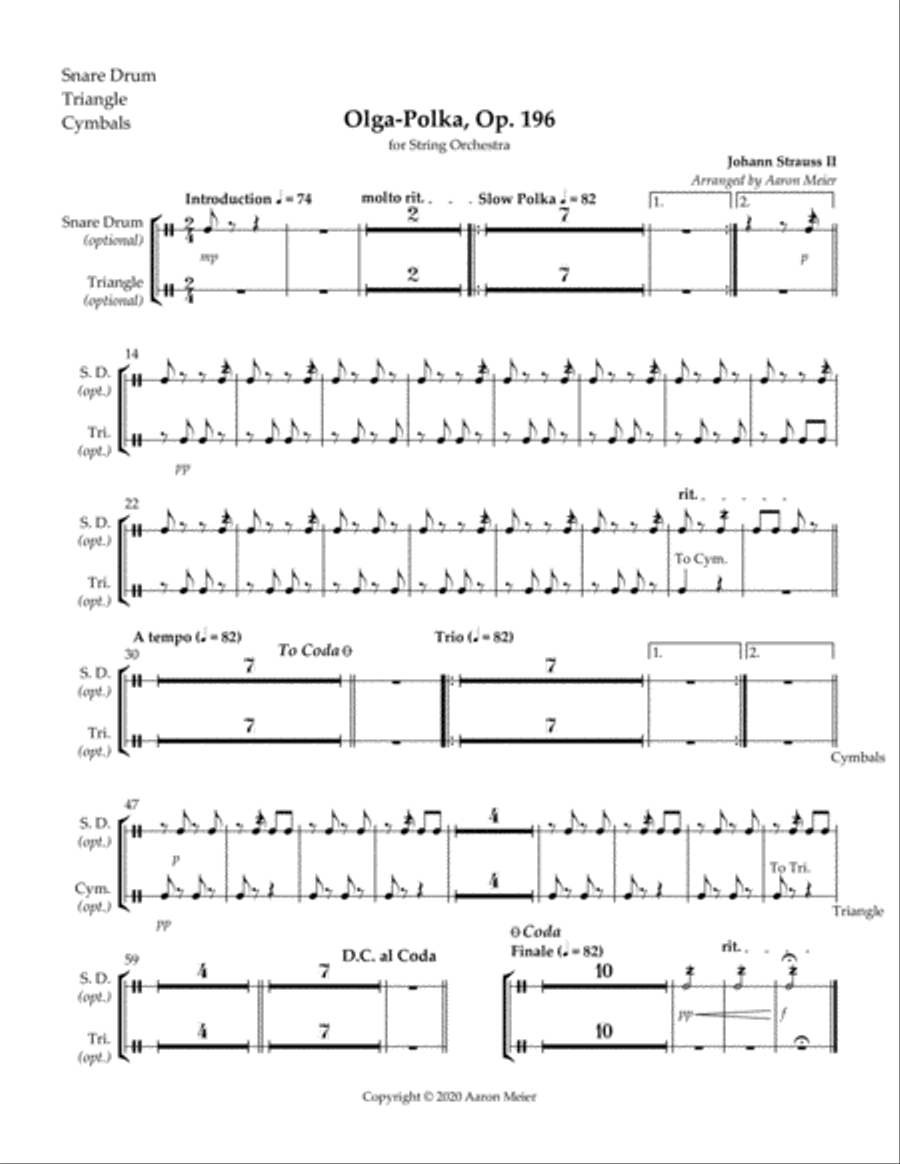
Olga-Polka, Op. 196 (arr. for string orchestra): Optional Percussion
Orchestre de chambre

$3.99 3.37 € Orchestre de chambre PDF SheetMusicPlus

String Orchestra - Level 4 - Digital Download SKU: A0.922639 Composed by Johann Strauss Jr. Arranged by Aaron Meier. Romantic Period,World. Score and parts. 1 pages. Aaron Meier #5792379. Published by Aaron Meier (A0.922639). Original by Johann Strauss II Reduction to String Orchestra by Aaron Meier Part: Double Bass True to the original work by Strauss, this reduction for string orchestra features the ornaments and mystical writing that defines Strauss' polkas. There are optional percussion parts to be added at the discretion of the ensemble, however even without percussion the ensemble will sound full (the percussion acts as an ornament). Difficulty: Intermediate-advanced - advanced (best-suited for advanced student ensembles) --- Performance Notes: • Approximate length: 3:30 minutes • 1st Violins: In m. 1, trill a half step from a Dâ™­ to a Dâ™®  • 2nd Violins:  - At m. 42, divide players by 3, with 2 players playing line A and the remaining player playing line B  - At m. 72-75, emphasize the Eâ™­ in the div. • Snare Drum: The buzz roll needs to be quieter than how it is played in the midi recording (*see YouTube link ↓) History: The Olga-Polka itself owed its creation to a Russian royal wedding which took place in St. Petersburg on 28 August 1857. On that day, amid accompanying splendour, the music-loving Grand Duke Michail Nikolaievich (1832-1909), youngest brother of Tsar Alexander II, married Princess Caecilie of Baden (1839-91), daughter of Archduke Leopold of Baden. Johann Strauss, who at that time was giving a summer season of concerts in nearby Pavlovsk, used the opportunity occasioned by the event to enhance his already enviable popularity with the Russian royal family and composed the Caecilien-Polka in honour of the lovely young bride. Indeed, it is clear from a letter which Johann wrote in late July 1857 to Carl Haslinger, his publisher in Vienna, that the new polka had been prepared well in advance of the wedding (the fair copy of the full orchestral score made for the publisher's engraver is dated 9 August) and was enjoying success even before the royal couple's official engagement on 16August 1857. Sometime after performing the Caecilien-Polka in Pavlovsk, Johann despatched the work to the Austrian capital where his brother Josef conducted its Viennese première, together with that of Johann's waltz Telegraphische Depeschen (op. 195, Volume 28), at his own benefit concert in the Volksgartenon Sunday 18 October 1857. The Wiener Allgemeine Theaterzeitung (16.10.1857) remarked that both works have caused a sensation in St. Petersburg and are truly genial Viennese sounds full of verve and melody. Since tradition demanded that the German Princess Caecilie adopt a Russian name - Olga Feodorovna - before her marriage, so Johann's Caecilien-Polka also underwent a change of identity. On 8 December 1857 Carl Haslinger announced the publication of Strauss's Olga-Polka, on the title page of which is the inscription: Dedicated to her Imperial Highness Grand Duchess Olga, née Princess of Baden. It was under this title, too, that Johann himself first conducted the work in Vienna at a concert in the Volksgarten on 1 November 1857, shortly after his return from Russia. Reporting on this event, the Wiener Allgemeine Theaterzeitung (3.11.1857) observed: The 'Olga-Polka' is a most delightful, fragrant musical bouquet, full of fine, gracious rhythms. [excerpted from NAXOS Records] Kemp, Peter. Program Notes - About this Recording. NAXOS, 1993, www.naxos.com/mainsite/blurbs_reviews.asp?item_code=8.223232&catNum=223232&filetype=About%20.......... Accessed 5 June 2020. Resources: • Visit.
Olga-Polka, Op. 196 (arr. for string orchestra): Double Bass
Orchestre à Cordes

$3.99 3.37 € Orchestre à Cordes PDF SheetMusicPlus

String Orchestra - Level 4 - Digital Download SKU: A0.922637 Composed by Johann Strauss Jr. Arranged by Aaron Meier. Romantic Period,World. Score and parts. 1 pages. Aaron Meier #5792373. Published by Aaron Meier (A0.922637). Original by Johann Strauss II Reduction to String Orchestra by Aaron Meier Part: Cello True to the original work by Strauss, this reduction for string orchestra features the ornaments and mystical writing that defines Strauss' polkas. There are optional percussion parts to be added at the discretion of the ensemble, however even without percussion the ensemble will sound full (the percussion acts as an ornament). Difficulty: Intermediate-advanced - advanced (best-suited for advanced student ensembles) --- Performance Notes: • Approximate length: 3:30 minutes • 1st Violins: In m. 1, trill a half step from a Dâ™­ to a Dâ™®  • 2nd Violins:  - At m. 42, divide players by 3, with 2 players playing line A and the remaining player playing line B  - At m. 72-75, emphasize the Eâ™­ in the div. • Snare Drum: The buzz roll needs to be quieter than how it is played in the midi recording (*see YouTube link ↓) History: The Olga-Polka itself owed its creation to a Russian royal wedding which took place in St. Petersburg on 28 August 1857. On that day, amid accompanying splendour, the music-loving Grand Duke Michail Nikolaievich (1832-1909), youngest brother of Tsar Alexander II, married Princess Caecilie of Baden (1839-91), daughter of Archduke Leopold of Baden. Johann Strauss, who at that time was giving a summer season of concerts in nearby Pavlovsk, used the opportunity occasioned by the event to enhance his already enviable popularity with the Russian royal family and composed the Caecilien-Polka in honour of the lovely young bride. Indeed, it is clear from a letter which Johann wrote in late July 1857 to Carl Haslinger, his publisher in Vienna, that the new polka had been prepared well in advance of the wedding (the fair copy of the full orchestral score made for the publisher's engraver is dated 9 August) and was enjoying success even before the royal couple's official engagement on 16August 1857. Sometime after performing the Caecilien-Polka in Pavlovsk, Johann despatched the work to the Austrian capital where his brother Josef conducted its Viennese première, together with that of Johann's waltz Telegraphische Depeschen (op. 195, Volume 28), at his own benefit concert in the Volksgartenon Sunday 18 October 1857. The Wiener Allgemeine Theaterzeitung (16.10.1857) remarked that both works have caused a sensation in St. Petersburg and are truly genial Viennese sounds full of verve and melody. Since tradition demanded that the German Princess Caecilie adopt a Russian name - Olga Feodorovna - before her marriage, so Johann's Caecilien-Polka also underwent a change of identity. On 8 December 1857 Carl Haslinger announced the publication of Strauss's Olga-Polka, on the title page of which is the inscription: Dedicated to her Imperial Highness Grand Duchess Olga, née Princess of Baden. It was under this title, too, that Johann himself first conducted the work in Vienna at a concert in the Volksgarten on 1 November 1857, shortly after his return from Russia. Reporting on this event, the Wiener Allgemeine Theaterzeitung (3.11.1857) observed: The 'Olga-Polka' is a most delightful, fragrant musical bouquet, full of fine, gracious rhythms. [excerpted from NAXOS Records] Kemp, Peter. Program Notes - About this Recording. NAXOS, 1993, www.naxos.com/mainsite/blurbs_reviews.asp?item_code=8.223232&catNum=223232&filetype=About%20.......... Accessed 5 June 2020. Resources: • Visit

Olga-Polka, Op. 196 (arr. for string orchestra): Cello
Orchestre à Cordes

$3.99 3.37 € Orchestre à Cordes PDF SheetMusicPlus

String Orchestra - Level 4 - Digital Download SKU: A0.922634 Composed by Johann Strauss Jr. Arranged by Aaron Meier. Romantic Period,World. Score and parts. 1 pages. Aaron Meier #5792359. Published by Aaron Meier (A0.922634). Original by Johann Strauss II Reduction to String Orchestra by Aaron Meier Part: Violin I True to the original work by Strauss, this reduction for string orchestra features the ornaments and mystical writing that defines Strauss' polkas. There are optional percussion parts to be added at the discretion of the ensemble, however even without percussion the ensemble will sound full (the percussion acts as an ornament). Difficulty: Intermediate-advanced - advanced (best-suited for advanced student ensembles) --- Performance Notes: • Approximate length: 3:30 minutes • 1st Violins: In m. 1, trill a half step from a Dâ™­ to a Dâ™®  • 2nd Violins:  - At m. 42, divide players by 3, with 2 players playing line A and the remaining player playing line B  - At m. 72-75, emphasize the Eâ™­ in the div. • Snare Drum: The buzz roll needs to be quieter than how it is played in the midi recording (*see YouTube link ↓) History: The Olga-Polka itself owed its creation to a Russian royal wedding which took place in St. Petersburg on 28 August 1857. On that day, amid accompanying splendour, the music-loving Grand Duke Michail Nikolaievich (1832-1909), youngest brother of Tsar Alexander II, married Princess Caecilie of Baden (1839-91), daughter of Archduke Leopold of Baden. Johann Strauss, who at that time was giving a summer season of concerts in nearby Pavlovsk, used the opportunity occasioned by the event to enhance his already enviable popularity with the Russian royal family and composed the Caecilien-Polka in honour of the lovely young bride. Indeed, it is clear from a letter which Johann wrote in late July 1857 to Carl Haslinger, his publisher in Vienna, that the new polka had been prepared well in advance of the wedding (the fair copy of the full orchestral score made for the publisher's engraver is dated 9 August) and was enjoying success even before the royal couple's official engagement on 16August 1857. Sometime after performing the Caecilien-Polka in Pavlovsk, Johann despatched the work to the Austrian capital where his brother Josef conducted its Viennese première, together with that of Johann's waltz Telegraphische Depeschen (op. 195, Volume 28), at his own benefit concert in the Volksgartenon Sunday 18 October 1857. The Wiener Allgemeine Theaterzeitung (16.10.1857) remarked that both works have caused a sensation in St. Petersburg and are truly genial Viennese sounds full of verve and melody. Since tradition demanded that the German Princess Caecilie adopt a Russian name - Olga Feodorovna - before her marriage, so Johann's Caecilien-Polka also underwent a change of identity. On 8 December 1857 Carl Haslinger announced the publication of Strauss's Olga-Polka, on the title page of which is the inscription: Dedicated to her Imperial Highness Grand Duchess Olga, née Princess of Baden. It was under this title, too, that Johann himself first conducted the work in Vienna at a concert in the Volksgarten on 1 November 1857, shortly after his return from Russia. Reporting on this event, the Wiener Allgemeine Theaterzeitung (3.11.1857) observed: The 'Olga-Polka' is a most delightful, fragrant musical bouquet, full of fine, gracious rhythms. [excerpted from NAXOS Records] Kemp, Peter. Program Notes - About this Recording. NAXOS, 1993, www.naxos.com/mainsite/blurbs_reviews.asp?item_code=8.223232&catNum=223232&filetype=About%20.......... Accessed 5 June 2020. Resources: • Visit

Olga-Polka, Op. 196 (arr. for string orchestra): Violin I
Orchestre à Cordes

$3.99 3.37 € Orchestre à Cordes PDF SheetMusicPlus

String Orchestra - Level 4 - Digital Download SKU: A0.922636 Composed by Johann Strauss Jr. Arranged by Aaron Meier. Romantic Period,World. Score and parts. 1 pages. Aaron Meier #5792367. Published by Aaron Meier (A0.922636). Original by Johann Strauss II Reduction to String Orchestra by Aaron Meier Part: Violin II True to the original work by Strauss, this reduction for string orchestra features the ornaments and mystical writing that defines Strauss' polkas. There are optional percussion parts to be added at the discretion of the ensemble, however even without percussion the ensemble will sound full (the percussion acts as an ornament). Difficulty: Intermediate-advanced - advanced (best-suited for advanced student ensembles) --- Performance Notes: • Approximate length: 3:30 minutes • 1st Violins: In m. 1, trill a half step from a Dâ™­ to a Dâ™®  • 2nd Violins:  - At m. 42, divide players by 3, with 2 players playing line A and the remaining player playing line B  - At m. 72-75, emphasize the Eâ™­ in the div. • Snare Drum: The buzz roll needs to be quieter than how it is played in the midi recording (*see YouTube link ↓) History: The Olga-Polka itself owed its creation to a Russian royal wedding which took place in St. Petersburg on 28 August 1857. On that day, amid accompanying splendour, the music-loving Grand Duke Michail Nikolaievich (1832-1909), youngest brother of Tsar Alexander II, married Princess Caecilie of Baden (1839-91), daughter of Archduke Leopold of Baden. Johann Strauss, who at that time was giving a summer season of concerts in nearby Pavlovsk, used the opportunity occasioned by the event to enhance his already enviable popularity with the Russian royal family and composed the Caecilien-Polka in honour of the lovely young bride. Indeed, it is clear from a letter which Johann wrote in late July 1857 to Carl Haslinger, his publisher in Vienna, that the new polka had been prepared well in advance of the wedding (the fair copy of the full orchestral score made for the publisher's engraver is dated 9 August) and was enjoying success even before the royal couple's official engagement on 16August 1857. Sometime after performing the Caecilien-Polka in Pavlovsk, Johann despatched the work to the Austrian capital where his brother Josef conducted its Viennese première, together with that of Johann's waltz Telegraphische Depeschen (op. 195, Volume 28), at his own benefit concert in the Volksgartenon Sunday 18 October 1857. The Wiener Allgemeine Theaterzeitung (16.10.1857) remarked that both works have caused a sensation in St. Petersburg and are truly genial Viennese sounds full of verve and melody. Since tradition demanded that the German Princess Caecilie adopt a Russian name - Olga Feodorovna - before her marriage, so Johann's Caecilien-Polka also underwent a change of identity. On 8 December 1857 Carl Haslinger announced the publication of Strauss's Olga-Polka, on the title page of which is the inscription: Dedicated to her Imperial Highness Grand Duchess Olga, née Princess of Baden. It was under this title, too, that Johann himself first conducted the work in Vienna at a concert in the Volksgarten on 1 November 1857, shortly after his return from Russia. Reporting on this event, the Wiener Allgemeine Theaterzeitung (3.11.1857) observed: The 'Olga-Polka' is a most delightful, fragrant musical bouquet, full of fine, gracious rhythms. [excerpted from NAXOS Records] Kemp, Peter. Program Notes - About this Recording. NAXOS, 1993, www.naxos.com/mainsite/blurbs_reviews.asp?item_code=8.223232&catNum=223232&filetype=About%20.......... Accessed 5 June 2020. Resources: • Visit

Olga-Polka, Op. 196 (arr. for string orchestra): Violin II
Orchestre à Cordes

$3.99 3.37 € Orchestre à Cordes PDF SheetMusicPlus

Choral Choir,Choral (SATB divisi) - Level 5 - Digital Download SKU: A0.900166 By Sarah Labrie, Conductor - Chamber Choral Conducting Workshop, Sarteano, Italy. By Mary Ellen Haupert. Easter,Sacred,Spiritual. 5 pages. Mary Ellen Haupert #3031789. Published by Mary Ellen Haupert (A0.900166). ILLUMINE LE TENEBRE (SSAATTBB) For Jean Saladino and the Viterbo University Concert Choir TRANSLATION of TEXT: Most High, glorious God, enlighten the darkness of my heart and give me true faith, certain hope and perfect charity, sense and knowledge, Lord, that I may carry out your holy and true command. Amen. - St. Francis of Assisi's Prayer before the Crucifix NOTES from the composer: One year ago, I had the privilege of participating in the Leadership Pilgrimage to Assisi and Rome (2011) sponsored by the Franciscan Sisters of Perpetual Adoration, Franciscan Healthcare, and Viterbo University.  I carried with me, not only the responsibility of bringing back a hint of Francis’ lived experience to my students, but the desire to compose something wholly Franciscan. The San Damiano Cross is one of the most distinctive Franciscan images we have on campus.  The gentle Jesus that hangs on this 12th-century icon will forever be linked to Francis’ dramatic step from citizen to sainthood-welcoming his earnest prayer to enlighten the darkness of his heart.  The Basilica of Santa Chiara in Assisi holds both the San Damiano Cross and the remains of his confidante, St. Clare.  It seemed a good place to start getting serious. Copying the prayer in at least six different languages, I tucked it away in my travel books, not digging it out again until the following summer (2012).  The opening phrases in the piece came easily enough (Altissimo, glorioso Dio), but I stumbled through a handful of ideas before coming up with the mantra (illumine le tenebre…).  It made sense that Francis would joyfully address God singing forte (Altissimo and Signore), while quietly chanting his humble prayers for faith, hope, charity, and knowledge. The friendship between Francis and Clare can’t be missed, not only in the intermingling of SATB voices, but in the setting of che faccia lo tuo santo e verace comadamento (that I may carry out your holy and true command).  The phrase is sung only once by the women before the final return of the illumine chant (which is repeated throughout by the men).  Maybe I chanced on weaving some of Clare’s courage with Francis’ persistence into Illumina le tenebre, all while trying to compose something wholly Franciscan?   ---Mary Ellen Haupert, October 2012.  
Illumine le tenebre
Chorale SATB
Sarah Labrie, Conductor - Chamber Choral Conducting Workshop, Sarteano, Italy
$3.99 3.37 € Chorale SATB PDF SheetMusicPlus


1 ....121 136 151 166 181 ....346


Partitions Gratuites
Acheter des Partitions Musicales
Acheter des Partitions Digitales à Imprimer
Acheter des Instruments de Musique

© 2000 - 2026

Accueil - Version intégrale


