EUROPE
1242 articles
USA
1864 articles
DIGITAL
2572 articles (à imprimer)
Partitions Digitales
Partitions à imprimer
2572 partitions trouvées

1 ....91 106 121 136 151 ....2566

Brass Ensemble - Level 3 - Digital Download SKU: A0.955876 Composed by Traditional Mexican Folksong. Arranged by Scott S. Stewart. Concert,Latin,World. Score and parts. 11 pages. Scott S. Stewart #6612045. Published by Scott S. Stewart (A0.955876). The melody of this traditional folksong A la orilla de un palmar, was originally found in the area of San Pedro Gorda, Zacatecas, México.  It is a story about a coastal orphan girl who lives alone in a palm grove by the sea.  Composers such as Manuel M. Ponce (1882-1948), the founder of Mexican musical nationalism, often incorporated the melodies of traditional folksongs into their music (12 Canciones mexicanas – 1913).  This arrangement is for a 4-part brass ensemble of 2 trumpets and 2 trombones.  Performance time: 4:15. Expand the awareness of Mexican Art Song repertoire through performance. 
A la orilla de un palmar (Brass Quartet)
Ensemble de cuivres

$19.99 16.94 € Ensemble de cuivres PDF SheetMusicPlus

String Ensemble - Level 2 - Digital Download SKU: A0.1037867 Composed by Pierre Phalèse. Arranged by Colin Kirkpatrick. Renaissance. Score and parts. 17 pages. Colin Kirkpatrick Publications #642781. Published by Colin Kirkpatrick Publications (A0.1037867). Unlike country dances, the formal dances of royal courts in the sixteenth century required a good deal of study and practice. Many dancing masters published self-help instructional books, especially in France and Italy. Composers and publishers saw a commercial potential in collections of dance music and one of the earliest collections was that by composer and publisher Tielman (or Tylman) Susato, who published his Danserye in Antwerp in 1551. These music books were usually arranged with four independent instrumental parts and intended for use by any instruments that happened to be available. The two almands in this arrangement were well known popular melodies at the time of publication. They still retain their freshness and charm today and are sure to be popular at any concerts, public recitals or end-of-semester events. This arrangement is for virtually any string ensemble and the single PDF file includes a full score and parts for violin 1, violin 2, viola (violin 3), cello and bass (combined), keyboard and simple percussion. Two additional melody part are provided in the treble and bass clefs and the chords (for optional guitar) are shown in both keyboard and cello-bass parts. In the spirit of the original publication, you can add to the melody line any other C-pitch instruments that happen to be available. Even the additional of a couple of recorders will enhance the sound. Alternatively, you can do opposite and create a pleasing contrast by omitting various instruments for certain sections. The audio demo will give you an idea how this might be achieved. While you can add flute, recorder, oboe, glockenspiel or whatever you want, additional instruments are not essential but can add contrasting tone colour. The keyboard part is intended as a guide and when possible, the keyboard player should feel free to improvise around the part and the chords shown. A digital or acoustic harpsichord sounds more authentic than a piano. Most electronic keyboards have a harpsichord option. The optional percussion instruments used are similar to those found in elementary school music rooms and usually include a tambour or hand-held drum, antique (finger) cymbals, wood-blocks and tambourine. Two or three players can be used (but feel free to add more) and the parts can be interpreted quite freely. Dance music is intended to be fun, and we hope that this arrangement brings you just that.
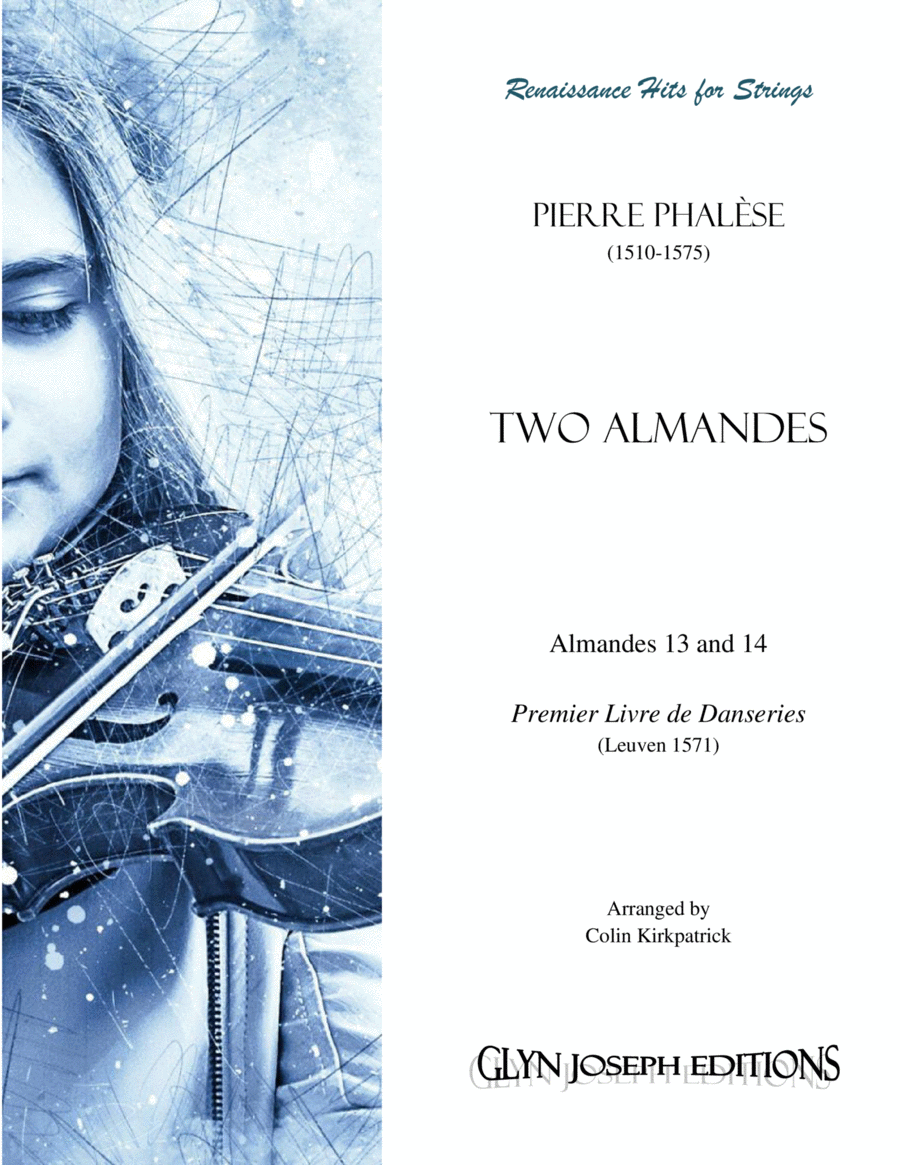
Two Almandes from Premier Livre de Danseries (Pierre Phalèse, 1571)

$8.99 7.62 € PDF SheetMusicPlus

String Ensemble - Level 2 - Digital Download SKU: A0.1041170 Composed by Pierre Phalèse Jnr. Arranged by Colin Kirkpatrick. Renaissance. Score and parts. 18 pages. Colin Kirkpatrick Publications #645901. Published by Colin Kirkpatrick Publications (A0.1041170). These two dances are taken from a collection entitled Recueil de danseries, contenant presque toutes sortes de danses (“Collection of dances, containing almost every kind of dancesâ€) published in Antwerp in 1583 by Pierre Phalèse Jnr (c.1545-1629). He was continuing the work of his father Pierre Phalèse the Elder (1510-1575) the most important publisher in the Low Countries during the 16th century. The piece known as Ungaresca evokes the atmosphere of street music rather than that of the court and the drone accompaniment that Phalèse provides suggests the sound of the peasant bagpipes. As the name implies, the dance came from Hungary though it may have simply been a dance in the Hungarian style. Even so, the melody was tremendously popular during the fifteenth century though the author is unknown. The dance calls for a lively performance, and you can use plenty of percussion to enliven it. This music was meant for dancing and entertainment and musicians would often combine several dances to make a more substantial piece. In this arrangement, the rather wild Ungaresca is paired with the stately Almande Poussinghe. The music would have been played by any instruments that happened to be available. The dances still retain their freshness and charm today and are sure to be popular at any concerts, public recitals or end-of-semester events. This arrangement is for virtually any string ensemble and the single PDF file includes a full score and parts for violin 1, violin 2, viola (violin 3), cello and bass (combined), keyboard and simple percussion. Two additional melody part are provided in the treble and bass clefs and the chords (for optional guitar) are shown in both keyboard and cello-bass parts. In the spirit of the original publication, you can add to the melody line any other C-pitch instruments that happen to be available. Even the additional of a couple of recorders will enhance the sound. Alternatively, you can do opposite and create a pleasing contrast by omitting various instruments for certain sections. The audio demo will give you an idea how this might be achieved. The keyboard part is intended as a guide and when possible, the keyboard player should feel free to improvise around the part and the chords shown. A digital or acoustic harpsichord sounds more authentic than a piano. Most electronic keyboards have a harpsichord option. The optional percussion instruments used are similar to those found in elementary school music rooms and usually include a tambour or hand-held drum, antique (finger) cymbals, wood-blocks and tambourine. Two or three players can be used (but feel free to add more) and the parts can be interpreted quite freely. Dance music is intended to be fun, and we hope that this arrangement brings you just that.
Ungaresca & Almande Poussinghe (Recueil de Danseries, 1583)

$9.99 8.47 € PDF SheetMusicPlus


1 ....91 106 121 136 151 ....2566


Partitions Gratuites
Acheter des Partitions Musicales
Acheter des Partitions Digitales à Imprimer
Acheter des Instruments de Musique

© 2000 - 2026

Accueil - Version intégrale





