EUROPE
853 articles
USA
0 articles
DIGITAL
26358 articles (à imprimer)
Partitions Digitales
Partitions à imprimer
26358 partitions trouvées


Alto Saxophone Duet Alto Saxophone - Level 3 - Digital Download SKU: A0.587425 Composed by Wolfgang Amadeus Mozart. Arranged by David McKeown. Classical,Concert,Instructional,Opera,Standards. 2 scores. 3 pages. David McKeown #3237401. Published by David McKeown (A0.587425). Der Vogelfanger bin ich Ja, (The Birdcatcher’s Song) is an aria from the first act of Mozart’s comic opera, The Magic Flute. It has become one of Mozart’s best loved melodies and features the birdcatcher Papageno. In the first production the role was played by the producer and theatre owner. He was not a trained singer so Mozart deliberately wrote a simple melody of limited range. This version is arranged as a duet for two Alto Saxophones Musicians at an intermediate level and above will find this ideal for formal and informal performances, with both parts enjoying melodic interest. The duet format gives instrumentalists an opportunity to play music written for the voice. The overall performance time is around a minute and a half. The full-length youtube performance is the Clarinet version of this duet. Teachers will enjoy using this arrangement as a fun way to help with detailed articulation and dynamics. There are many more top quality arrangements and compositions by David McKeown for you to browse at http://www.sheetmusicplus.com/publishers/david-mckeown/6203
The Birdcatcher's Song, from The Magic Flute, Alto Saxophone Duet
2 Saxophones (duo)

$4.60 4.01 € 2 Saxophones (duo) PDF SheetMusicPlus

Alto Saxophone Duet Alto Saxophone - Level 3 - Digital Download SKU: A0.590043 Composed by John Newton. Arranged by David McKeown. Christian,Gospel,Praise & Worship,Sacred,Spiritual. 2 scores. 5 pages. David McKeown #6139475. Published by David McKeown (A0.590043). This gospel version of Amazing Grace is arranged as a duet for two Alto Saxophones. Written in 1773 by John Newton and set to the traditional melody New Britain, Amazing Grace is perhaps the best-known and best-loved hymn in the world.John Newton, led a dissolute life as sailor in the slave trade for many years before marriage, along with a close encounter with death at sea, dramatically changed his perspective. He lived out his later years as a devout and charismatic clergyman in the English countryside, renowned for his direct and personal style. Amazing Grace is played three times, once in the traditional style in 3/4, then twice in a gospel swing style in 4/4. Click the link above to listen to a full Youtube performance of the Clarinet version of this duet.Amazing Grace is suitable for players at an intermediate level and above, though some of the rhythms in the third verse may be a challenge for less experienced players. With a performance time of around three and a half minutes, this version of Amazing Grace is perfect for worship and concert performances, both formal and informal. There are many more top quality arrangements and compositions by David McKeown for you to browse at http://www.sheetmusicplus.com/publishers/david-mckeown/6203 
Amazing Grace, Gospel style for Alto Saxophone Duet
2 Saxophones (duo)

$3.99 3.48 € 2 Saxophones (duo) PDF SheetMusicPlus

Alto Saxophone Duet Alto Saxophone - Level 3 - Digital Download SKU: A0.589963 Composed by Robert Lowry. Arranged by David McKeown. Christian,Gospel,Praise & Worship,Sacred,Spiritual. 2 scores. 3 pages. David McKeown #6134149. Published by David McKeown (A0.589963). Shall We Gather at The River is an American nineteenth century hymn often sung in a gospel style. This version is arranged as a duet for two Alto Saxophones. Shall We Gather at The River was composed in 1865 by a Baptist minister from New York, Robert Lowry. As well as becoming a gospel standard, the melody of Shall We Gather at The River has found its way into compositions by Charles Ives and Aaron Copeland and has often been used in classic Western movies.Shall We Gather at The River is simply arranged in keys and range best suited to the instruments. The hymn is played three times in a slow swing style, with a key change on the final verse and chorus. Click the link above to listen to a full Youtube performance of the Clarinet version of this duet.Shall We Gather at The River is suitable for players at an intermediate level and above, though the key change may require extra work for less experienced players. With a performance time of around three minutes, this version of Shall We Gather at The River is perfect for worship and concert performances, both formal and informal.There are many more top quality arrangements and compositions by David McKeown for you to browse at http://www.sheetmusicplus.com/publishers/david-mckeown/6203
Shall We Gather at The River, Gospel Hymn for Alto Saxophone Duet
2 Saxophones (duo)

$3.99 3.48 € 2 Saxophones (duo) PDF SheetMusicPlus

Alto Saxophone Duet Alto Saxophone - Level 3 - Digital Download SKU: A0.594195 Composed by William J Kirkpatrick. Arranged by David McKeown. Christmas,Jazz,Praise & Worship,Sacred. 2 scores. 4 pages. David McKeown #6560247. Published by David McKeown (A0.594195). Away in a Manger is a much-loved Christmas carol. This version is arranged as a duet in a Jazz Swing style for two Alto Saxophones. Click on the YouTube link above to listen to a full length performance of this arrangement played on Clarinet.The melody of Away in a Manger, Cradle Song was written by William J Kirkpatrick, an Irish born American composer. The origins of the lyrics are less certain. Throughout the nineteenth century they were attributed to Martin Luther, but this version of events has since been discredited. With a performance time of around two and a half minutes, this version of Away in a Manger is perfect for seasonal celebrations and concert performances, both formal and informal. The jazz swing style is a fun and fresh take on this familiar traditional tune.Away in a Manger is arranged in a key and range best suited to the instruments. The original 3/4 meter has been altered to 4/4. Rhythms are syncopated, as one would expect in swing music, and there is plenty of articulation detail to help deliver an authentic style. The melody is played twice, with intros and outros. This arrangement is suitable for players at an intermediate or early advanced level.
Away in a Manger, Jazz Style, for Alto Saxophone Duet
2 Saxophones (duo)

$3.99 3.48 € 2 Saxophones (duo) PDF SheetMusicPlus

Alto Saxophone Duet Alto Saxophone - Level 3 - Digital Download SKU: A0.592022 Composed by Traditional. Arranged by David McKeown. Christian,Gospel,Praise & Worship,Sacred. 2 scores. 3 pages. David McKeown #6320053. Published by David McKeown (A0.592022). Deep River is an Afro-American Spiritual Song. This version is arranged by David McKeown as a duet for two Alto Saxophones. Deep River was first published in 1917 and quickly became a public favourite. The writer and origin of the song is unknown. In the recording age, Deep River was made famous by Marian Anderson, Paul Robeson and Tommy Dorsey. Deep River is one of several Gospel arrangements available on Sheet Music Plus. Use the search bar above to find 10 Gospel Duets (for intermediate players), and 18 Easy Gospel Duets, Volumes 1 and 2, all available for this instrumental combination. Deep River is suitable for players at an intermediate level and above. With a performance time of around three minutes, this version of Deep River is perfect for worship and concert performances, both formal and informal. Click the link above to listen to a full performance of the Clarinet version on YouTube.There are many more top quality arrangements and compositions by David McKeown for you to browse at http://www.sheetmusicplus.com/publishers/david-mckeown/6203
Deep River, Gospel Song for Alto Saxophone Duet
2 Saxophones (duo)

$3.99 3.48 € 2 Saxophones (duo) PDF SheetMusicPlus

Alto Saxophone Duet Alto Saxophone - Level 3 - Digital Download SKU: A0.589702 Composed by Sholem Aleichem. Arranged by David McKeown. Hanukkah,Jewish,World. 2 scores. 3 pages. David McKeown #6088183. Published by David McKeown (A0.589702). Shlof Mein Kind is a Yiddish lullaby, often performed by Klezmer musicians. This version is arranged as a duet for two Alto Saxophones.There are two melodies in use for Shlof Mein Kind. The melody in this arrangement is the lesser known one, as sung by Paul Robeson. There is no record of the tune’s composer, but the words are a setting of a poem by the Jewish Ukrainian writer, Sholem Aleichem. Aleichem is best known as the creator of the Tevye short stories, which later inspired the musical Fiddler on the Roof.Shlof Mein Kind is arranged in a key and range best suited to the instruments. The simple melody is played three times with varying accompaniment. Shlof Mein Kind is suitable for players at an intermediate level and above. Around three minutes long, this version of Shlof Mein Kind invites an expressive performance andis perfect for concert performances, both formal and informal. Click the link above to listen to a full Youtube performance of the Clarinet version of this duet.There are many more top quality arrangements and compositions by David McKeown for you to browse at http://www.sheetmusicplus.com/publishers/david-mckeown/6203 
Shlof Mein Kind, Jewish Lullaby for Alto Saxophone Duet
2 Saxophones (duo)

$3.99 3.48 € 2 Saxophones (duo) PDF SheetMusicPlus

Alto Saxophone Duet Alto Saxophone - Level 3 - Digital Download SKU: A0.594115 Composed by Franz Xaver Gruber. Arranged by David McKeown. Blues,Christmas,Gospel,Praise & Worship,Sacred. 2 scores. 3 pages. David McKeown #6549715. Published by David McKeown (A0.594115). Silent Night is a much-loved Christmas carol. This version is arranged as a duet in a Gospel style for two Alto Saxophones. Click on the YouTube link above to listen to a full length performance of this arrangement played on Clarinet.The melody of Silent Night was composed by Franz Xaver Gruber in 1918, a setting for the lyrics of a young priest, Joseph Mohr. After flooding had damaged the church organ in Oberdorf, Austria, Mohr asked local schoolmaster, Gruber, to write a Christmas melody to be accompanied by guitar. Silent Night was the result. The carol remained unpublished until 1833, but has since gained huge international popularity. Bing Crosby’s version sold more than 10 million copies and UNESCO has declared the carol an intangible cultural heritageWith a performance time of around two and a half minutes, this version of Silent Night is perfect for seasonal celebrations and concert performances, both formal and informal. The gospel style is a fun, fresh and soulful take on this familiar tune.Silent Night is arranged in a key and range best suited to the instruments. The 9/8 meter may be feel unusual to some, and there is plenty of articulation detail to help deliver an authentic style. The melody is played twice, with a short intro and a bluesy outdo. This arrangement is suitable for players at an intermediate level.
Silent Night, Gospel Style, for Alto Saxophone Duet
2 Saxophones (duo)

$3.99 3.48 € 2 Saxophones (duo) PDF SheetMusicPlus

Alto Saxophone Duet Alto Saxophone - Level 3 - Digital Download SKU: A0.591112 Composed by David McKeown. Easter,Folk,Pop,R & B,Rock. 2 scores. 3 pages. David McKeown #6274697. Published by David McKeown (A0.591112). Daffodil Doo-Wop is a fun and original duet written by David McKeown for two Alto Saxophones. Daffodil Doo-Wop is one in a series of ten Easter-themed duets, each written in a different Rock’n’Roll style. Doo-wop reached the height of its popularity in the early ‘60s but its origins were in the African-American vocal harmony groups in East Coast cities in the ‘40s. Doo-Wop was a major influence on the soul and pop music that followed it, with groups such as the Drifters, the Four Seasons and even the Beach Boys adopting the vocal harmonies. Daffodil Doo-Wop is suitable for players at an intermediate level and above. With a playing-time of around two minutes, Daffodil Doo-Wop is a perfect addition to any performance program, formal or informal. Click on the link above to hear a full YouTube performance played on the clarinet version of this duet. There are many more top quality arrangements and compositions by David McKeown for you to browse at http://www.sheetmusicplus.com/publishers/david-mckeown/6203
The Daffodil Doo-Wop, for Alto Saxophone Duet
2 Saxophones (duo)

$2.99 2.6 € 2 Saxophones (duo) PDF SheetMusicPlus

Alto Saxophone Duet Alto Saxophone - Level 3 - Digital Download SKU: A0.591070 Composed by David McKeown. Blues,Easter,Pop,R & B,Rock. 2 scores. 3 pages. David McKeown #6273755. Published by David McKeown (A0.591070). Easter Bunny Hop is a fun and original duet written by David McKeown for two Alto Saxophones. Easter Bunny Hop is one in a series of ten Easter-themed duets each written in a different Rock’n’Roll style. The Hop was all the craze in the late ‘50s, when early Rock’n’Roll became popular at school gymnasium dances. Danny and the Juniors’ 1957 hit At the Hop defined the genre.Easter Bunny Hop is suitable for players at an intermediate level and above, with the accessible key and range balanced by the fast tempo, some syncopated rhythms and many accidentals. With a playing-time of around one and a half minutes, Easter Bunny Hop is a perfect addition to any performance program, formal or informal. Click on the link above to hear a full YouTube performance played on the clarinet version of this duet. There are many more top quality arrangements and compositions by David McKeown for you to browse at http://www.sheetmusicplus.com/publishers/david-mckeown/6203
The Easter Bunny Hop, for Alto Saxophone Duet
2 Saxophones (duo)

$2.99 2.6 € 2 Saxophones (duo) PDF SheetMusicPlus

Alto Saxophone Duet Alto Saxophone - Level 3 - Digital Download SKU: A0.587549 Composed by Richard Wagner. Arranged by David McKeown. Concert,Instructional,Romantic Period,Standards,Wedding. 2 scores. 3 pages. David McKeown #4359317. Published by David McKeown (A0.587549). The Bridal March was written by Richard Wagner in 1850, scored for orchestra and chorus, and opening the third act of his opera, Lohingren. It is best known in the English-speaking world as Here Comes the Bride. Queen Victoria’s daughter used the music for her marriage in 1858, and its popularity has endured ever since. This version is arranged as a duet for two Alto Saxophones.Musicians at an intermediate level and above will find this ideal for formal and informal performances, especially at weddings. The melody is mainly in the first part. The performance time is a little more than one minute. Follow the links above to hear a short audio sample or a complete performance on youtube. The samples come from the Clarinet Duet version of this arrangement.Teachers will enjoy using this arrangement as a fun way to help with phrasing and expressive playing. The rhythms are straightforward though there are unexpected accidentals in the middle section which might pose a challenge for finger coordination and reading.There are many more top quality arrangements and compositions by David McKeown for you to browse at http://www.sheetmusicplus.com/publishers/david-mckeown/6203 
Bridal March, "Here Comes The Bride", Alto Saxophone Duet
2 Saxophones (duo)

$4.60 4.01 € 2 Saxophones (duo) PDF SheetMusicPlus

Saxophone Quintet,Woodwind Ensemble Alto Saxophone,Baritone Saxophone,Soprano Saxophone,Tenor Saxophone - Level 3 - Digital Download SKU: A0.813297 Composed by Mykola Leontovych. Arranged by Regis Bookshar. 20th Century,A Cappella,Christmas,Multicultural,Standards,World. 16 pages. Regis Bookshar #6197307. Published by Regis Bookshar (A0.813297). Saxophone Quintet - Intermediate - Digital Download. This selection, Carol of the Bells, also known as Ring, Christmas Bells, is suitable for high school and college students and is perfect for Christmas concerts and church services. Carol of the Bells was written by the Ukrainian composer Mykola Leontovych in 1914 with lyrics by Peter J. Wilhousky. The song is based on the Ukrainian folk chant Shchedryk, a New Year's song, known in English as The Little Swallow, and utilizes a four-note ostinato which brings to mind the ringing of bells. Originally intended to be sung a capella by a mixed four-part choir it has since been recorded into over 150 versions and re-arrangements for various vocal and instrumental compositions. One version, Ring, Christmas Bells, an English-language variant with Nativity-based lyrics, was written by Minna Louise Hohman in 1947. Regis Bookshar has now arranged the music for a Saxophone Quintet, consisting of 1 Soprano Saxophone, 2 Alto Saxophones, 1 Tenor Saxophone and 1 Baritone Saxophone. Included are a score and a complete set of parts (16 pages). In addition to this version for a Saxophone Quintet, many other arrangements of this selection are also available for a variety of instrumental ensembles, including Quintets, Sextets, Septets and Octets, as well as numerous other selections in a wide variety of styles. I would encourage you to search for other arrangements by Regis Bookshar. You may find something else which might interest you as well. I'm certain that this exciting arrangement will entertain both performers and audiences alike for years to come.
Carol of the Bells (F min) (Saxophone Quintet - 1 Sop, 2 Alto, 1 Ten, 1 Bari)
Quintette de Saxophone: 5 saxophones

$12.00 10.45 € Quintette de Saxophone: 5 saxophones PDF SheetMusicPlus

Saxophone Quintet,Woodwind Ensemble Alto Saxophone,Baritone Saxophone,Soprano Saxophone,Tenor Saxophone - Level 3 - Digital Download SKU: A0.813298 Composed by Mykola Leontovych. Arranged by Regis Bookshar. 20th Century,A Cappella,Christmas,Multicultural,Standards,World. 16 pages. Regis Bookshar #6197303. Published by Regis Bookshar (A0.813298). Saxophone Quintet - Intermediate - Digital Download. This selection, Carol of the Bells, also known as Ring, Christmas Bells, is suitable for high school and college students and is perfect for Christmas concerts and church services. Carol of the Bells was written by the Ukrainian composer Mykola Leontovych in 1914 with lyrics by Peter J. Wilhousky. The song is based on the Ukrainian folk chant Shchedryk, a New Year's song, known in English as The Little Swallow, and utilizes a four-note ostinato which brings to mind the ringing of bells. Originally intended to be sung a capella by a mixed four-part choir it has since been recorded into over 150 versions and re-arrangements for various vocal and instrumental compositions. One version, Ring, Christmas Bells, an English-language variant with Nativity-based lyrics, was written by Minna Louise Hohman in 1947. Regis Bookshar has now arranged the music for a Saxophone Quintet, consisting of 1 Soprano Saxophone, 1 Alto Saxophone, 2 Tenor Saxophones and 1 Baritone Saxophone. Included are a score and a complete set of parts (16 pages). In addition to this version for a Saxophone Quintet, many other arrangements of this selection are also available for a variety of instrumental ensembles, including Quintets, Sextets, Septets and Octets, as well as numerous other selections in a wide variety of styles. I would encourage you to search for other arrangements by Regis Bookshar. You may find something else which might interest you as well. I'm certain that this exciting arrangement will entertain both performers and audiences alike for years to come.
Carol of the Bells (F min) (Saxophone Quintet - 1 Sop, 1 Alto, 2 Ten, 1 Bari)
Quintette de Saxophone: 5 saxophones

$12.00 10.45 € Quintette de Saxophone: 5 saxophones PDF SheetMusicPlus

Saxophone Ensemble,Woodwind Ensemble Alto Saxophone,Baritone Saxophone,Tenor Saxophone - Level 4 - Digital Download SKU: A0.1110932 Composed by Wolfgang Amadeus Mozart. Arranged by Regis Bookshar. Chamber,Christian,Classical,Instructional,Religious. 28 pages. Regis Bookshar #713198. Published by Regis Bookshar (A0.1110932). Recordare (from Requiem (K. 626) - Wolfgang Amadeus Mozart/Franz Xaver Sussmayr - Saxophone Sextet - Advanced/Intermediate - Digital Download. Hauntingly beautiful is how the Recordare from Mozart's Requiem is often described. Originally written for an orchestra and four vocal soloists, it has now been transcribed by Regis Bookshar for a Saxophone Sextet, consisting of 2 Alto Saxophones, 3 Tenor Saxophone and 1 Baritone Saxophone, and would be a wonderful addition to any music library. This arrangement will provide students with the opportunity to practice breath control because of its long, sustained phrases, This selection could be performed for concerts, recitals and church services and is suitable for high school and college students but professional musicians would also enjoy playing this arrangement. Included are a score and a complete set of parts (28 pages). The Regis Bookshar Trumpet Ensemble has performed the Trumpet Quintet version of the Recordare for funerals, providing beautiful, introspective music for the occasion. There is some controversy surrounding the circumstances of the Requiem's composition because Mozart died before he could complete it. Count Franz von Walsegg had commissioned a Requiem Mass but Mozart had received only half of the payment in advance. So, upon his death on December 5th, 1791, his widow, Constanze, wished to have the work completed secretly by someone else and submit it to the count as having been completed by Mozart to collect the final payment. Joseph von Eybler was one of the first composers to be asked to complete the score and had worked on a number of movements but felt unable to complete the remainder and gave the manuscript back to Constanze Mozart. The task was then given to another composer, Franz Xaver Sussmayr. Sussmayr borrowed some of Eybler's work in making his completion, added his own orchestration to other movements and added several new movements which a Requiem Mass would normally comprise. He then added a final section by adapting the opening two movements which Mozart had written to the different words which finish the Requiem Mass, which according to both Sussmayr and Mozart's wife, was done according to Mozart's directions. The completed score, initially by Mozart but largely finished by Sussmayr, was then dispatched to Count Walsegg complete with a counterfeited signature of Mozart dated 1792. Despite the controversy over how much of the music is actually Mozart's, the commonly performed Sussmayr version has become widely accepted by the public, and is considered one of Mozart's finest compositions. The Recordare is considered by many people to be one of the most beautiful compositions in Mozart's entire catalogue. Regis Bookshar, a trumpet player, has performed the Requiem in concert with a full orchestra, soloists and a chorus and felt that other musicians should have the opportunity to play the hauntingly beautiful Recordare as well. So, in addition to this arrangement for a Saxophone Sextet, he has made quite a few other arrangements of this beautiful composition. There are Quintets, Sextets, Septets and Octets readily available for a wide variety of instrumental ensembles. Please take the time to look for other versions of this composition. You may fine something else which may also suit your needs. I would also encourage you to search for other arrangements by Regis Bookshar as well, as there are numerous arrangements in a variety of styles, also available for purchase. You may find something else which might interest you. Please continue to check periodically because new arrangements are being added as often as possible. I'm certain that this beautiful arrangement of Mozart's Recordare, will continue to entertain both performers and audiences alike for years to come.
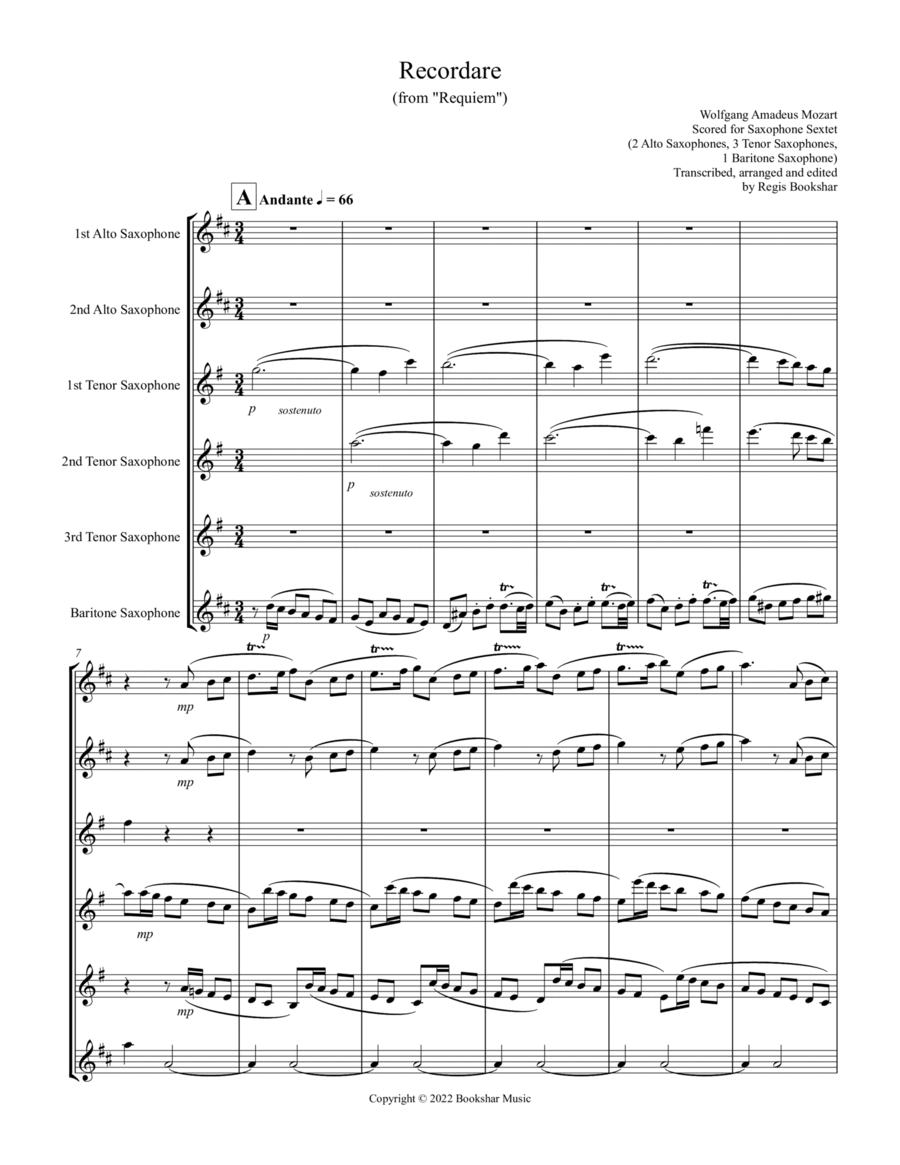
Recordare (from "Requiem") (F) (Saxophone Sextet - 2 Alto, 3 Ten, 1 Bari)
Ensemble de saxophones

$32.00 27.88 € Ensemble de saxophones PDF SheetMusicPlus

Saxophone Ensemble,Woodwind Ensemble Alto Saxophone,Baritone Saxophone,Tenor Saxophone - Level 4 - Digital Download SKU: A0.1110935 Composed by Wolfgang Amadeus Mozart. Arranged by Regis Bookshar. Chamber,Christian,Classical,Instructional,Religious. 28 pages. Regis Bookshar #713201. Published by Regis Bookshar (A0.1110935). Recordare (from Requiem (K. 626) - Wolfgang Amadeus Mozart/Franz Xaver Sussmayr - Saxophone Sextet - Advanced/Intermediate - Digital Download. Hauntingly beautiful is how the Recordare from Mozart's Requiem is often described. Originally written for an orchestra and four vocal soloists, it has now been transcribed by Regis Bookshar for a Saxophone Sextet, consisting of 3 Alto Saxophones, 2 Tenor Saxophone and 1 Baritone Saxophone, and would be a wonderful addition to any music library. This arrangement will provide students with the opportunity to practice breath control because of its long, sustained phrases, This selection could be performed for concerts, recitals and church services and is suitable for high school and college students but professional musicians would also enjoy playing this arrangement. Included are a score and a complete set of parts (28 pages). The Regis Bookshar Trumpet Ensemble has performed the Trumpet Quintet version of the Recordare for funerals, providing beautiful, introspective music for the occasion. There is some controversy surrounding the circumstances of the Requiem's composition because Mozart died before he could complete it. Count Franz von Walsegg had commissioned a Requiem Mass but Mozart had received only half of the payment in advance. So, upon his death on December 5th, 1791, his widow, Constanze, wished to have the work completed secretly by someone else and submit it to the count as having been completed by Mozart to collect the final payment. Joseph von Eybler was one of the first composers to be asked to complete the score and had worked on a number of movements but felt unable to complete the remainder and gave the manuscript back to Constanze Mozart. The task was then given to another composer, Franz Xaver Sussmayr. Sussmayr borrowed some of Eybler's work in making his completion, added his own orchestration to other movements and added several new movements which a Requiem Mass would normally comprise. He then added a final section by adapting the opening two movements which Mozart had written to the different words which finish the Requiem Mass, which according to both Sussmayr and Mozart's wife, was done according to Mozart's directions. The completed score, initially by Mozart but largely finished by Sussmayr, was then dispatched to Count Walsegg complete with a counterfeited signature of Mozart dated 1792. Despite the controversy over how much of the music is actually Mozart's, the commonly performed Sussmayr version has become widely accepted by the public, and is considered one of Mozart's finest compositions. The Recordare is considered by many people to be one of the most beautiful compositions in Mozart's entire catalogue. Regis Bookshar, a trumpet player, has performed the Requiem in concert with a full orchestra, soloists and a chorus and felt that other musicians should have the opportunity to play the hauntingly beautiful Recordare as well. So, in addition to this arrangement for a Saxophone Sextet, he has made quite a few other arrangements of this beautiful composition. There are Quintets, Sextets, Septets and Octets readily available for a wide variety of instrumental ensembles. Please take the time to look for other versions of this composition. You may fine something else which may also suit your needs. I would also encourage you to search for other arrangements by Regis Bookshar as well, as there are numerous arrangements in a variety of styles, also available for purchase. You may find something else which might interest you. Please continue to check periodically because new arrangements are being added as often as possible. I'm certain that this beautiful arrangement of Mozart's Recordare, will continue to entertain both performers and audiences alike for years to come.
Recordare (from "Requiem") (F) (Saxophone Sextet - 3 Alto, 2 Ten, 1 Bari)
Ensemble de saxophones

$32.00 27.88 € Ensemble de saxophones PDF SheetMusicPlus


Partitions Gratuites
Acheter des Partitions Musicales
Acheter des Partitions Digitales à Imprimer
Acheter des Instruments de Musique

© 2000 - 2026

Accueil - Version intégrale





