EUROPE
132460 articles
USA
0 articles
DIGITAL
14808 articles (à imprimer)
Partitions Digitales
Partitions à imprimer
14808 partitions trouvées


Piano,Vocal,Voice - Level 1 - Digital Download SKU: A0.1368512 Composed by John Newton. Arranged by Jhonatan Lucio Viana. Early Music,Holiday,Religious,Spiritual,Traditional. Score. 3 pages. JLVPartitura #952865. Published by JLVPartitura (A0.1368512). Explore the enchanting magic of Amazing Grace with our exclusive sheet music for Alto and Piano + Chords in the key of G. Tailored for easy intermediate level musicians, this timeless composition enhances your performance through the classic harmony between the Alto voice and Piano accompaniment.Key Features:- Easy Intermediate Level: Designed for accessibility without compromising on musical depth.- Alto and Piano + Chords Arrangement: Crafted to showcase the beauty and versatility of both instruments.- Versatile Vocal Ranges: Suitable for Alto.- High-Quality PDF Format: Ensures a clear and professional presentation, enhancing your practice and performance experience.- Genre: Amazing Grace transcends genres, offering a blend of spiritual and classical elements for a captivating musical journey.Embark on a thrilling musical journey with Amazing Grace. Improve your performance by downloading the sheet music today and let the timeless beauty of this composition resonate in every note of your music.I am pleased to present an exclusive offer to enrich your musical experience. Upon acquiring the sheet music of your choice, I invite you to explore my extensive database, accessible through the website by entering my name: Jhonatan Lucio Viana. There, discover a variety of thoughtfully crafted arrangements for various instruments, all at affordable prices.Looking to transpose this sheet music into a different key? You're in luck! It's available in 15 different keys right here on this website. Explore my profile and find the perfect match for your musical needs.
Amazing Grace
Piano, Voix

$1.99 1.73 € Piano, Voix PDF SheetMusicPlus

Brass Ensemble Trombone - Level 3 - Digital Download SKU: A0.813838 Composed by Antonin Dvorak. Arranged by Regis Bookshar. Concert,Contemporary,Folk,Romantic Period,Standards. Score and parts. 18 pages. Regis Bookshar #6533945. Published by Regis Bookshar (A0.813838). Largo (from Symphony No. 9 in E minor) (From the New World) (Db) (Trombone Quintet) - Intermediate - Digital Download. This marvelous arrangement of the Largo, based on the second movement of Antonin Dvorak's Symphony No. 9 in E minor, would be a fabulous addition to any music library and could be performed for concerts, recitals and church services, especially Funerals, but would be appropriate any time during the church year. This arrangement is suitable for high school and college students but professional musicians would also enjoy playing this selection. Included are a score and a complete set of parts (18 pages). This selection is one of the many arrangements from the The Regis Bookshar Trumpet Ensemble's extensive music library which are being made available for the first time.Symphony No. 9 in E minor, Op. 95 (subtitled From the New World and popularly know as the New World Symphony), was composed by Antonin Dvorak in 1893 while he was the director of the National Conservatory of Music of America from 1892 to 1895. It premiered at Carnegie Hall in New York City on December 16, 1893 and has been described as one of the most popular of all symphonies. The second movement of the symphony, upon which this arrangement is based, is marked Largo, and begins with a harmonic progression of chords which is then followed by a solo instrument playing the famous main theme.Dvorak was interested in Native American music and the African-American spirituals he heard in North America. While director of the National Conservatory he encountered an African-American student, Harry T. Burleigh, who sang traditional spirituals to him. Burleigh, later a composer himself, said that Dvorak had absorbed their spirit before writing his own melodies. Dvorak stated:    I am convinced that the future music of this country must be founded on what are called Negro melodies. These can be the foundation of a serious and original school of composition to be developed in the United States. These beautiful and varied themes are the product of the soil. They are folk songs of America and your composers must turn to them.He further explained how Native American music influenced his symphony:  I have not actually used any of these (Native American) melodies. I have simply written original themes embodying the peculiarities of the Indian music, and, using these themes as subjects, have developed them with all the resources of modern rhythms, counterpoint, and orchestral colour.In 1893, a newspaper interview quoted Dvorak as saying, I found that the music of the negroes and of the Indians was practically identical, and that the music of the two races bore a remarkable similarity to the music of Scotland. Most historians agree that Dvorak is referring to the pentatonic scale, which is typical of each of these musical traditions.Dvorak was influenced not only by music he heard, but also by what he had seen, in America. He wrote that he would not have composed his American pieces as he had if he had not seen America. It has been said that Dvorak was inspired by the wide open spaces of America, such as the prairies he may have seen on his trip to Iowa in the summer of 1893. Notices about several performances of the symphony include the phrase wide open spaces about what inspired the symphony and/or about the feelings it conveys to listeners.The theme from the Largo was adapted into the spiritual Goin' Home (often mistakenly considered a folk song or traditional spiritual) by Dvorak's pupil, William Arms Fisher, who wrote the lyrics in 1922. Regis Bookshar thought it would be wonderful if other instrumentalists could have the opportunity to play this beautiful melody, so, in addition to this version for a Trombone Quintet, he has made quite a few other arrangements of this selection which are readily available for a wide variety of instru.
Largo (from "Symphony No. 9") ("From the New World") (Db) (Trombone Quintet)
Ensemble de Trombones

$15.00 13.02 € Ensemble de Trombones PDF SheetMusicPlus

B-Flat Clarinet,Bassoon,Flute,Horn,Oboe,Piano Accompaniment - Level 1 - Digital Download SKU: A0.1202470 Composed by Ludwig van Beethoven. Arranged by Rodrigo Faleiros. Chamber,Classical,Romantic Period. 15 pages. Rodrigo Faleiros #801180. Published by Rodrigo Faleiros (A0.1202470). Beethoven Moonlight Sonata easy sheet music for woodwind quintet with piano accompaniment - A simplified and shorter version of the world famous Moonlight Sonata, composed by Ludwig van Beethoven. Just the theme of the 1st movement of the Sonata #14, op. 27, no. 2 in C# minor, suitable for students, school concerts and other shows. This arrangement is transposed to the key of Am for an easier performance. This woodwind quintet sheet music comprises the full score with piano accompaniment and parts for flute, oboe, clarinet in Bb, french horn and bassoon.
Moonlight Sonata

$19.99 17.36 € PDF SheetMusicPlus

SSAA choir and piano - Medium - Digital Download SKU: MQ.8807-E Composed by Stephen Chatman. 6 pages. E. C. Schirmer Music Company - Digital #8807-E. Published by E. C. Schirmer Music Company - Digital (MQ.8807-E). English.The opening lines, “Listen, I love you. Do not turn your face / Nor touch me.â€, reflect the somber feelings encompassing Sara Teasdale’s poem. Paired voices initially express contrapuntal melodic lines enhanced by underlying harmony and slow syncopation in the piano accompaniment. The middle and final sections, imbued with sad words such as “let me ease my heart,†“with broken wing†and “Forget that I am speaking,†evolve beautifully within contrasting tonal regions, supported by undulating keyboard arpeggios. One of a set of six of Teasdale's love songs. Duration: 2:00.
Listen, I love you
Chorale SSAA

$2.25 1.95 € Chorale SSAA PDF SheetMusicPlus

Alto Saxophone,Piano - Level 2 - Digital Download SKU: A0.1454514 By Classical. By Franz Schubert. Arranged by Jhonatan Lucio Viana. 19th Century,Chamber,Classical,Romantic Period,Sacred. Score and part. 4 pages. JLVPartitura #1033618. Published by JLVPartitura (A0.1454514). Ständchen - Serenade by Schubert for Alto Sax + Piano:Key Features:- Melodies and harmonies that capture the essence of the work;- Suitable for Easy Intermediate levels;- Professionally arranged sheet music in PDF format;- Genre: Classical;I am pleased to offer this arrangement to enrich your musical journey. After purchasing your sheet music, visit my extensive collection available on the website under the name: Jhonatan Lucio Viana. Explore various arrangements for different instruments and voices, all designed to inspire and challenge musicians of all levels.
Serenade | Ständchen |
Saxophone Alto et Piano
Classical
$2.99 2.6 € Saxophone Alto et Piano PDF SheetMusicPlus

Easy Piano - Level 1 - Digital Download SKU: A0.1080796 Composed by English Carol. Arranged by Sandra Zylstra. Children,Christian,Christmas,Sacred. Score. 4 pages. Sandra dee zylstra #685039. Published by sandra dee zylstra (A0.1080796). Coventry Carol is arranged in the key of Am and can be played as an elementary solo or with the duet part. This arrangement can also be found in the book Easy Christmas Around The World-Book 1! Coventry Carol is available with a stacked score and parts. (Approximately 1 minute, 4 pages) You can look at other arrangements by Sandra Zylstra on Sheet Music Plus: http://www.sheetmusicplus.com/formats/singles/sandra-zylstra/600092+3001855 and at Piano Pronto: Composers Community https://pianopronto.com/composers-community/sandra-zylstra/.
Coventry Carol (elementary piano with optional duet)
Piano Facile

$2.75 2.39 € Piano Facile PDF SheetMusicPlus

Instrumental Duet,Keyboard - Digital Download SKU: A0.1497852 Composed by Jenni Roditi. 21st Century,Classical,Contemporary. 17 pages. Jenni Roditi #1074264. Published by Jenni Roditi (A0.1497852). Piano Duo 2 pianos/4 hands. Curve, Between the Octaves points to a fugal past, where lines enter and build in stately flow. It invites lines to intermingle, without assuming they will all arrive somewhere, or at the same time. A certain intensity builds, then scales, both up and down, free themselves from the discussion of the interleaving lines. The chromaticism suggests curving between harmonies, and is nearly always ambivalent. An assertive chordal climax intervenes to shake off the tensions, yet this peels away into further curvatures that twist and twirl, until a final resting point agrees to present itself.  Names of all the movements in the suite Between the Octaves in the right order are Initiate, Surrender, Thread, Curve, Encircle, Ritualise, Ignite. The whole suite follows a long line from movement 1 to movement 7. However, individual pieces are well suited to be played alone too. Piano Duo is ideally two Steinway grands, otherwise, whatever is available. An enjoyment of the tensions and relationships generated between the two instruments: grand-upright, upright-electronic keyboard is to be explored as a positive. Each piece creates its own world in the suite and can be part of smaller subgroups taken from the suite, in any combination, but the order of the pieces needs to be maintained if more than one is played. Here is a taste of the background to the musical world of this 53 minute compositional suite. During a reflective time I read the following: The whole philosophy of dharma art (Buddhist art) is that you don't try to be artistic, but you just approach objects as they are, and the message comes through automatically. (Chogyam Trungpa Rinpoche, from 'True Perception The Path of Dharma Art.' Shambhala 2008, p.133.) The 'objects as they are' became the 'octaves as they are'. As the pieces were composed the octaves had a centring and clarifying role that allowed other material to circulate around or play against them. They acted as pivots, repetitions, drones, ostinati, pointillist nodes, pedals, melodic features, struts, harmonic turnpikes, breathing spaces, bass lines: musical imperatives. The octaves called the musical shots most of the time. When the music pulled a semitone up or down and away from the octaves (as it did quite often) it was especially telling in the context of the ringing spaces the octaves were creating. I became interested in the subtle dislocation that two pianos could provide. By dislocation I mean a degree of tension between the natural acoustics of the two instruments in the room and the players idiosyncrasies as musicians.  The whole point of this work was to examine the nature of my syntax, grammar, and compositional thinking. The title demanded one thing above all: what notes am I going to use between these octaves?? My choice of notes was derived in most instances from the tempo, pitch, and rhythm of the initial octaves at the beginning of each piece alongside the individual word titles that I set out to explore as musical images. The audio was developed from Sibelius software, via MIDI to Logic samples of a Steinway grand piano.
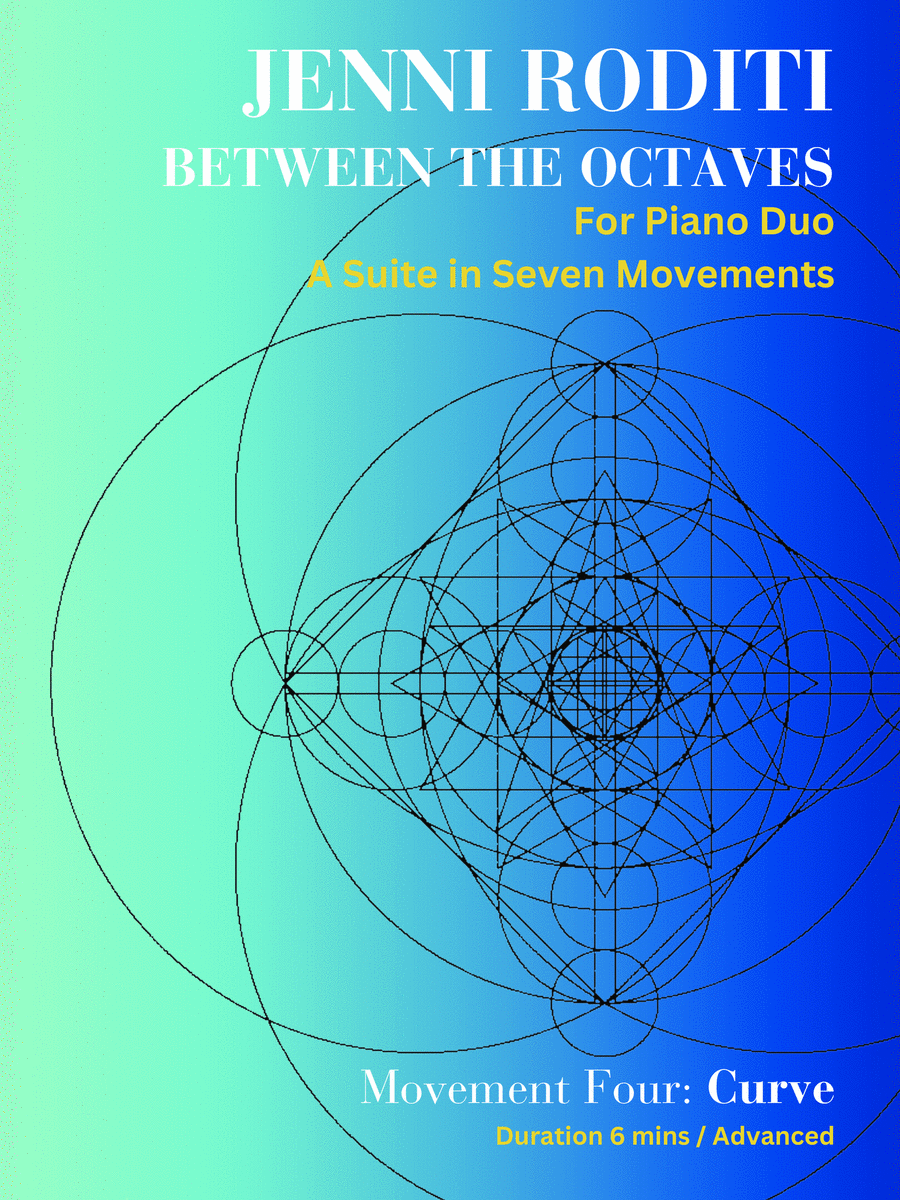
CURVE, Between the Octaves - A Piano Duo Suite (Movement 4 of 7)
2 Pianos, 4 mains
dislocation I mean a degree of tension between the natural acoustics of the two instruments in the room and the players idiosyncrasies as musicians  The whole point of this work was to examine the nature of my syntax, grammar, and compositional thinking
$20.00 17.37 € 2 Pianos, 4 mains PDF SheetMusicPlus


Partitions Gratuites
Acheter des Partitions Musicales
Acheter des Partitions Digitales à Imprimer
Acheter des Instruments de Musique

© 2000 - 2026

Accueil - Version intégrale





