EUROPE
7804 articles
USA
0 articles
DIGITAL
5968 articles (à imprimer)
Partitions Digitales
Partitions à imprimer
5968 partitions trouvées


Woodwind Ensemble Flute - Level 3 - Digital Download SKU: A0.549859 Composed by Johann Sebastian Bach. Arranged by James M. Guthrie, ASCAP. Baroque,Concert,Easter,Sacred,Wedding. 24 pages. Jmsgu3 #3556989. Published by jmsgu3 (A0.549859). Wachet auf, ruft uns die Stimme (Awake, the Voice is calling us) from Cantata BWV 140. Duration: ca. 4:00, Score: 10 pages, Program this for church services during the Easter season, weddings, or as a recital encore.Wachet auf, ruft uns die Stimme (Awake, the Voice is calling us) also known as: Sleepers Awake Bach composed his church cantata Wachet auf (BWV 140) as part of his second annual cantata cycle covering the entire annual church calendar. It is based on the hymn of the same name by Philipp Nicolai (1599). The hymn text covers the readings for the 27th Sunday after Trinity. Bach designed the cantata in seven movements, setting the stanzas in various forms. Among these forms are the chorale fantasia, the chorale prelude, and a four-part chorale. He casts the new lyrics as recitatives – in a manner similar to the opera. Fourth Movement Bach writes the fourth movement, Zion hört die Wächter singen (Zion hears the watchmen singing), in the style of a chorale prelude with the chorale phrases performed as a strict cantus firmus. The phrases seem to enter at times erratically against the famous lyrical melody. The violins play this melody in unison as a foil against the cantus phrases. The violin melody is so independent and complete that when the cantus melody appears it catches the listener at times totally off-guard. Bach later transcribed this movement for organ (BWV 645). This transcription became No. 1 of the Six Schübler Chorales. Bach Overview First of all, Johann Sebastian Bach is maybe the greatest composer in music history. Certainly, he was prolific. As a result, everyone has heard of his works. Furthermore, these works number well over a thousand. It seems like people are probably most familiar with the instrumental works such as the Brandenburg Concertos, and the Goldberg Variations. But, similarly famous are such noteworthy works as the Well-Tempered Clavier, the Musical Offering, and certainly the Art of Fugue. Seems like his most famous vocal works include the most noteworthy Mass in B Minor. Also, most noteworthy, though, are the St. John Passion, and certainly the Christmas Oratorio.  History Bach came from a long line of musicians and above all, composers. Consequently, he, first of all, pursued a career as a church organist. So as a result, he gained employment in various Protestant churches in Germany. For a while, he worked as a court musician in Weimar and Köthen. Here he probably developed his organ style and likewise his chamber music style. Eventually, he, therefore, gained an appointment as Cantor of St. Thomas in Leipzig. Here he worked until difficulties with his employer ultimately drove him away. The King of Poland finally appointed him as court composer.  Style It seems like Bach created a fascinating new international style. He synthesized elements of the most noteworthy European music ideas into his new style. Even more, this new style was probably his synthesis of European musical rhythm and form. Furthermore, he demonstrated a complete mastery of counterpoint and motivic development. His sense of harmonic organization probably propelled him to the top. Revival               Mendelssohn conducted a Bach revival in the nineteenth century. His effort probably helped to re-familiarize the public with the magnitude of Bach’s works. During this period, scholars published many noteworthy Bach biographies. Moreover, Wolfgang Schmieder published the BWV (Bach Werke Verzeichnis). As a result, this is now the official catalog of his entire artistic output. The BWV number allows us to locate a work in the catalog. Sometimes scholars will simply use an S (Schmieder) as an abbreviation for BWV.  Voyager      
Bach: Wachet auf for Flute Choir
Ensemble de Flûtes

$39.95 34.69 € Ensemble de Flûtes PDF SheetMusicPlus

Instrumental Duet Bassoon,Instrumental Duet,Piano - Level 2 - Digital Download SKU: A0.549851 Composed by Johann Sebastian Bach. Arranged by James M. Guthrie, ASCAP. Baroque,Concert,Easter,Sacred,Standards. Score and parts. 12 pages. Jmsgu3 #3555069. Published by jmsgu3 (A0.549851). Wachet auf, ruft uns die Stimme (Awake, the voice is calling us) from Cantata BWV 140. Duration: ca. 4:00, Score: 6 pages, solo part 1 page, piano part: 4 pages. Program this for church services during the Easter season, weddings, or as a recital encore.Wachet auf, ruft uns die Stimme (Awake, the Voice is calling us) also known as: Sleepers Awake Bach composed his church cantata Wachet auf (BWV 140) as part of his second annual cantata cycle covering the entire annual church calendar. It is based on the hymn of the same name by Philipp Nicolai (1599). The hymn text covers the readings for the 27th Sunday after Trinity. Bach designed the cantata in seven movements, setting the stanzas in various forms. Among these forms are the chorale fantasia, the chorale prelude, and a four-part chorale. He casts the new lyrics as recitatives – in a manner similar to the opera. Fourth Movement Bach writes the fourth movement, Zion hört die Wächter singen (Zion hears the watchmen singing), in the style of a chorale prelude with the chorale phrases performed as a strict cantus firmus. The phrases seem to enter at times erratically against the famous lyrical melody. The violins play this melody in unison as a foil against the cantus phrases. The violin melody is so independent and complete that when the cantus melody appears it catches the listener at times totally off-guard. Bach later transcribed this movement for organ (BWV 645). This transcription became No. 1 of the Six Schübler Chorales. Bach Overview First of all, Johann Sebastian Bach is maybe the greatest composer in music history. Certainly, he was prolific. As a result, everyone has heard of his works. Furthermore, these works number well over a thousand. It seems like people are probably most familiar with the instrumental works such as the Brandenburg Concertos, and the Goldberg Variations. But, similarly famous are such noteworthy works as the Well-Tempered Clavier, the Musical Offering, and certainly the Art of Fugue. Seems like his most famous vocal works include the most noteworthy Mass in B Minor. Also, most noteworthy, though, are the St. John Passion, and certainly the Christmas Oratorio.  History Bach came from a long line of musicians and above all, composers. Consequently, he, first of all, pursued a career as a church organist. So as a result, he gained employment in various Protestant churches in Germany. For a while, he worked as a court musician in Weimar and Köthen. Here he probably developed his organ style and likewise his chamber music style. Eventually, he, therefore, gained an appointment as Cantor of St. Thomas in Leipzig. Here he worked until difficulties with his employer ultimately drove him away. The King of Poland finally appointed him as court composer.  Style It seems like Bach created a fascinating new international style. He synthesized elements of the most noteworthy European music ideas into his new style. Even more, this new style was probably his synthesis of European musical rhythm and form. Furthermore, he demonstrated a complete mastery of counterpoint and motivic development. His sense of harmonic organization probably propelled him to the top. Revival               Mendelssohn conducted a Bach revival in the nineteenth century. His effort probably helped to re-familiarize the public with the magnitude of Bach’s works. During this period, scholars published many noteworthy Bach biographies. Moreover, Wolfgang Schmieder published the BWV (Bach Werke Verzeichnis). As a result, this is now the official catalog of his entire artistic output. The BWV number allows us to locate a work in the catalog. Sometimes scholars will simply use an S (Schmieder) as an abbreviation for BWV. &n.
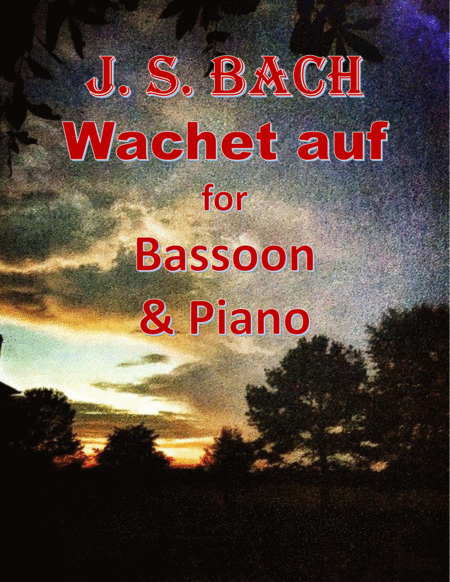
Bach: Wachet auf for Bassoon & Piano
Basson, Piano (duo)

$24.95 21.66 € Basson, Piano (duo) PDF SheetMusicPlus

Oboe,Piano - Level 2 - Digital Download SKU: A0.549840 Composed by Johann Sebastian Bach. Arranged by James M. Guthrie, ASCAP. Baroque,Christmas,Concert,Sacred,Standards. Score and part. 12 pages. Jmsgu3 #3554807. Published by jmsgu3 (A0.549840). Wachet auf, ruft uns die Stimme (Awake, the voice is calling us) from Cantata BWV 140. Duration: ca. 4:00, Score: 6 pages, solo part 1 page, piano part: 4 pages. Program this for church services during the Easter season, weddings, or as a recital encore.Wachet auf, ruft uns die Stimme (Awake, the Voice is calling us) also known as: Sleepers Awake Bach composed his church cantata Wachet auf (BWV 140) as part of his second annual cantata cycle covering the entire annual church calendar. It is based on the hymn of the same name by Philipp Nicolai (1599). The hymn text covers the readings for the 27th Sunday after Trinity. Bach designed the cantata in seven movements, setting the stanzas in various forms. Among these forms are the chorale fantasia, the chorale prelude, and a four-part chorale. He casts the new lyrics as recitatives – in a manner similar to the opera. Fourth Movement Bach writes the fourth movement, Zion hört die Wächter singen (Zion hears the watchmen singing), in the style of a chorale prelude with the chorale phrases performed as a strict cantus firmus. The phrases seem to enter at times erratically against the famous lyrical melody. The violins play this melody in unison as a foil against the cantus phrases. The violin melody is so independent and complete that when the cantus melody appears it catches the listener at times totally off-guard. Bach later transcribed this movement for organ (BWV 645). This transcription became No. 1 of the Six Schübler Chorales. Bach Overview First of all, Johann Sebastian Bach is maybe the greatest composer in music history. Certainly, he was prolific. As a result, everyone has heard of his works. Furthermore, these works number well over a thousand. It seems like people are probably most familiar with the instrumental works such as the Brandenburg Concertos, and the Goldberg Variations. But, similarly famous are such noteworthy works as the Well-Tempered Clavier, the Musical Offering, and certainly the Art of Fugue. Seems like his most famous vocal works include the most noteworthy Mass in B Minor. Also, most noteworthy, though, are the St. John Passion, and certainly the Christmas Oratorio.  History Bach came from a long line of musicians and above all, composers. Consequently, he, first of all, pursued a career as a church organist. So as a result, he gained employment in various Protestant churches in Germany. For a while, he worked as a court musician in Weimar and Köthen. Here he probably developed his organ style and likewise his chamber music style. Eventually, he, therefore, gained an appointment as Cantor of St. Thomas in Leipzig. Here he worked until difficulties with his employer ultimately drove him away. The King of Poland finally appointed him as court composer.  Style It seems like Bach created a fascinating new international style. He synthesized elements of the most noteworthy European music ideas into his new style. Even more, this new style was probably his synthesis of European musical rhythm and form. Furthermore, he demonstrated a complete mastery of counterpoint and motivic development. His sense of harmonic organization probably propelled him to the top. Revival               Mendelssohn conducted a Bach revival in the nineteenth century. His effort probably helped to re-familiarize the public with the magnitude of Bach’s works. During this period, scholars published many noteworthy Bach biographies. Moreover, Wolfgang Schmieder published the BWV (Bach Werke Verzeichnis). As a result, this is now the official catalog of his entire artistic output. The BWV number allows us to locate a work in the catalog. Sometimes scholars will simply use an S (Schmieder) as an abbreviation for BWV. &n.
Bach: Wachet auf for Oboe & Piano
Hautbois, Piano (duo)

$24.95 21.66 € Hautbois, Piano (duo) PDF SheetMusicPlus

Piano,Soprano Saxophone - Level 2 - Digital Download SKU: A0.549234 Composed by Johann Sebastian Bach. Arranged by James M. Guthrie, ASCAP. Baroque,Easter,Standards,Wedding. Score and part. 9 pages. Jmsgu3 #3468788. Published by jmsgu3 (A0.549234). J. S. Bach BWV 508. Bist du bei mir Bach adapted this aria from a lost Stölzel opera called Diomedes. He changed the original orchestral instrumentation to soprano, strings, and continuo.  He also modified the voice-leading making it sound more like a Bach composition. The work appears as BWV 508 No. 25 in the Anna Magdalena Notebook No. 2.   Source Only a few remnants of the original opera have survived. Historians speculate that Anna Magdalena got the song from the Leipzig Opera after the bankruptcy of 1720. Chances are good, though, that the tune was a favorite of everyone in Leipzig at the time.   Lyrics When thou art near, I go with joyTo death and to my rest.O how joyous would my end be,If your fair hands            Would close my faithful eyes. - Unknown Bach Overview First of all, Johann Sebastian Bach is maybe the greatest composer in music history. Certainly, he was prolific. As a result, everyone has heard of his works. Furthermore, these works number well over a thousand. It seems like people are probably most familiar with instrumental works such as the Brandenburg Concertos, and the Goldberg Variations. But, similarly famous are such noteworthy works as the Well-Tempered Clavier, the Musical Offering, and certainly the Art of Fugue. Seems like his most famous vocal works include the most noteworthy Mass in B Minor. Also, most noteworthy are the St. John Passion, and indeed the Christmas Oratorio.  History Bach came from a long line of musicians and above all, composers. Consequently, he, first of all, pursued a career as a church organist. So as a result, he gained employment in various Protestant churches in Germany. For a while, he worked as a court musician in Weimar and Köthen. Here he probably developed his organ style and likewise his chamber music style. Eventually, he, therefore, gained an appointment as Cantor of St. Thomas in Leipzig. Here he worked until difficulties with his employer ultimately drove him away. The King of Poland finally appointed him as court composer.  Style It seems like Bach created a fascinating new international style. He synthesized elements of the most noteworthy European music ideas into his new style. Even more, this new style was probably his synthesis of European musical rhythm and form. Furthermore, he demonstrated a complete mastery of counterpoint and motivic development. His sense of harmonic organization probably propelled him to the top. Revival               Mendelssohn conducted a Bach revival in the nineteenth century. His effort probably helped to re-familiarize the public with the magnitude of Bach’s works. During this period, scholars published many noteworthy Bach biographies. Moreover, Wolfgang Schmieder published the BWV (Bach Werke Verzeichnis). As a result, this is now the official catalog of his entire artistic output. The BWV number allows us to locate a work in the catalog. Sometimes scholars will simply use an S (Schmieder) as an abbreviation for BWV.  Voyager NASA launched two Voyager spacecraft in 1977. Onboard are phonograph records with sounds, music, and images of life on Earth. The purpose of the launch was to inform intelligent extraterrestrial life forms about conditions on Earth. The music on the disc is varied. There is Bach, Mozart, Beethoven, and Stravinsky among others. However, because Bach is so important in our music history, it contains three times more Bach than all the others combined.  
Bach: Bist du bei mir BWV 508 for Soprano Sax & Piano
Saxophone Soprano et Piano

$32.95 28.61 € Saxophone Soprano et Piano PDF SheetMusicPlus

Piano,Viola - Level 2 - Digital Download SKU: A0.549217 Composed by Johann Sebastian Bach. Arranged by James M. Guthrie, ASCAP. Baroque,Holiday,Standards,Wedding. Score and part. 9 pages. Jmsgu3 #3468034. Published by jmsgu3 (A0.549217). J. S. Bach BWV 508. Bist du bei mir Bach adapted this aria from a lost Stölzel opera called Diomedes. He changed the original orchestral instrumentation to soprano, strings, and continuo.  He also modified the voice-leading making it sound more like a Bach composition. The work appears as BWV 508 No. 25 in the Anna Magdalena Notebook No. 2.   Source Only a few remnants of the original opera have survived. Historians speculate that Anna Magdalena got the song from the Leipzig Opera after the bankruptcy of 1720. Chances are good, though, that the tune was a favorite of everyone in Leipzig at the time.   Lyrics When thou art near, I go with joyTo death and to my rest.O how joyous would my end be,If your fair hands            Would close my faithful eyes. - Unknown Bach Overview First of all, Johann Sebastian Bach is maybe the greatest composer in music history. Certainly, he was prolific. As a result, everyone has heard of his works. Furthermore, these works number well over a thousand. It seems like people are probably most familiar with instrumental works such as the Brandenburg Concertos, and the Goldberg Variations. But, similarly famous are such noteworthy works as the Well-Tempered Clavier, the Musical Offering, and certainly the Art of Fugue. Seems like his most famous vocal works include the most noteworthy Mass in B Minor. Also, most noteworthy are the St. John Passion, and indeed the Christmas Oratorio.  History Bach came from a long line of musicians and above all, composers. Consequently, he, first of all, pursued a career as a church organist. So as a result, he gained employment in various Protestant churches in Germany. For a while, he worked as a court musician in Weimar and Köthen. Here he probably developed his organ style and likewise his chamber music style. Eventually, he, therefore, gained an appointment as Cantor of St. Thomas in Leipzig. Here he worked until difficulties with his employer ultimately drove him away. The King of Poland finally appointed him as court composer.  Style It seems like Bach created a fascinating new international style. He synthesized elements of the most noteworthy European music ideas into his new style. Even more, this new style was probably his synthesis of European musical rhythm and form. Furthermore, he demonstrated a complete mastery of counterpoint and motivic development. His sense of harmonic organization probably propelled him to the top. Revival               Mendelssohn conducted a Bach revival in the nineteenth century. His effort probably helped to re-familiarize the public with the magnitude of Bach’s works. During this period, scholars published many noteworthy Bach biographies. Moreover, Wolfgang Schmieder published the BWV (Bach Werke Verzeichnis). As a result, this is now the official catalog of his entire artistic output. The BWV number allows us to locate a work in the catalog. Sometimes scholars will simply use an S (Schmieder) as an abbreviation for BWV.  Voyager NASA launched two Voyager spacecraft in 1977. Onboard are phonograph records with sounds, music, and images of life on Earth. The purpose of the launch was to inform intelligent extraterrestrial life forms about conditions on Earth. The music on the disc is varied. There is Bach, Mozart, Beethoven, and Stravinsky among others. However, because Bach is so important in our music history, it contains three times more Bach than all the others combined.  
Bach: Bist du bei mir BWV 508 for Viola & Piano
Alto, Piano

$32.95 28.61 € Alto, Piano PDF SheetMusicPlus

Euphonium,Piano - Level 2 - Digital Download SKU: A0.549854 Composed by Johann Sebastian Bach. Arranged by James M. Guthrie, ASCAP. Baroque,Concert,Easter,Sacred,Standards. Score and part. 12 pages. Jmsgu3 #3555095. Published by jmsgu3 (A0.549854). Wachet auf, ruft uns die Stimme (Awake, the voice is calling us) from Cantata BWV 140. Duration: ca. 4:00, Score: 6 pages, solo part 1 page, piano part: 4 pages. Program this for church services during the Easter season, or as a recital encore.Wachet auf, ruft uns die Stimme (Awake, the Voice is calling us) also known as: Sleepers Awake Bach composed his church cantata Wachet auf (BWV 140) as part of his second annual cantata cycle covering the entire annual church calendar. It is based on the hymn of the same name by Philipp Nicolai (1599). The hymn text covers the readings for the 27th Sunday after Trinity. Bach designed the cantata in seven movements, setting the stanzas in various forms. Among these forms are the chorale fantasia, the chorale prelude, and a four-part chorale. He casts the new lyrics as recitatives – in a manner similar to the opera. Fourth Movement Bach writes the fourth movement, Zion hört die Wächter singen (Zion hears the watchmen singing), in the style of a chorale prelude with the chorale phrases performed as a strict cantus firmus. The phrases seem to enter at times erratically against the famous lyrical melody. The violins play this melody in unison as a foil against the cantus phrases. The violin melody is so independent and complete that when the cantus melody appears it catches the listener at times totally off-guard. Bach later transcribed this movement for organ (BWV 645). This transcription became No. 1 of the Six Schübler Chorales. Bach Overview First of all, Johann Sebastian Bach is maybe the greatest composer in music history. Certainly, he was prolific. As a result, everyone has heard of his works. Furthermore, these works number well over a thousand. It seems like people are probably most familiar with the instrumental works such as the Brandenburg Concertos, and the Goldberg Variations. But, similarly famous are such noteworthy works as the Well-Tempered Clavier, the Musical Offering, and certainly the Art of Fugue. Seems like his most famous vocal works include the most noteworthy Mass in B Minor. Also, most noteworthy, though, are the St. John Passion, and certainly the Christmas Oratorio.  History Bach came from a long line of musicians and above all, composers. Consequently, he, first of all, pursued a career as a church organist. So as a result, he gained employment in various Protestant churches in Germany. For a while, he worked as a court musician in Weimar and Köthen. Here he probably developed his organ style and likewise his chamber music style. Eventually, he, therefore, gained an appointment as Cantor of St. Thomas in Leipzig. Here he worked until difficulties with his employer ultimately drove him away. The King of Poland finally appointed him as court composer.  Style It seems like Bach created a fascinating new international style. He synthesized elements of the most noteworthy European music ideas into his new style. Even more, this new style was probably his synthesis of European musical rhythm and form. Furthermore, he demonstrated a complete mastery of counterpoint and motivic development. His sense of harmonic organization probably propelled him to the top. Revival                 Mendelssohn conducted a Bach revival in the nineteenth century. His effort probably helped to re-familiarize the public with the magnitude of Bach’s works. During this period, scholars published many noteworthy Bach biographies. Moreover, Wolfgang Schmieder published the BWV (Bach Werke Verzeichnis). As a result, this is now the official catalog of his entire artistic output. The BWV number allows us to locate a work in the catalog. Sometimes scholars will simply use an S (Schmieder) as an abbreviation for BWV.  .
Bach: Wachet auf for Euphonium & Piano
Euphonium, Piano (duo)

$24.95 21.66 € Euphonium, Piano (duo) PDF SheetMusicPlus

Level 3 - Digital Download SKU: A0.549857 Composed by Johann Sebastian Bach. Arranged by James M. Guthrie, ASCAP. Baroque,Easter,Sacred,Wedding. 17 pages. Jmsgu3 #3556935. Published by jmsgu3 (A0.549857). Wachet auf, ruft uns die Stimme (Awake, the Voice is calling us) from Cantata BWV 140.  Program this for church services during Easter or as a recital encore. Also great for Weddings. Wachet auf, ruft uns die Stimme (Awake, the Voice is calling us) also known as Sleepers Awake Bach composed his church cantata Wachet auf (BWV 140) as part of his second annual cantata cycle covering the entire church calendar. It is based on the hymn of the same name by Philipp Nicolai (1599). The hymn text covers the readings for the 27th Sunday after Trinity. Bach designed the cantata in seven movements, setting the stanzas in various forms. Among these forms are the chorale fantasia, the prelude, and a four-part chorale. He casts the new lyrics as recitatives – like the opera. Fourth Movement Bach writes the fourth movement, Zion hört die Wächter singen (Zion hears the guards singing), in the style of a chorale prelude with the chorale phrases performed as a strict cantus firmus. The phrases seem to enter at times erratically against the famous lyrical melody. The violins play this melody in unison as a foil against the cantus phrases. The violin melody is so independent and complete that when the cantus melody appears; it catches the listener off-guard. Bach later transcribed this movement for organ (BWV 645). This transcription became No. 1 of the Six Schübler Chorales. Bach Overview First, Johann Sebastian Bach may be the greatest composer in music history. Indeed, he was prolific. As a result, everyone has heard of his works. Furthermore, these works number well over a thousand. People are probably most familiar with instrumental works such as the Brandenburg Concertos and the Goldberg Variations. But, similarly famous are such noteworthy works as the Well-Tempered Clavier, the Musical Offering, and the Art of Fugue. His most famous vocal works seem to include the most noteworthy Mass in B Minor. Also, most notable are the St. John Passion and, indeed, the Christmas Oratorio.  History Bach came from a long line of musicians and, above all, composers. Consequently, he first of all pursued a career as a church organist. As a result, he gained employment in various Protestant churches in Germany. He worked as a court musician in Weimar and Köthen for a while. Here, he probably developed his organ style and, likewise, his chamber music style. Eventually, he gained an appointment as Cantor of St. Thomas in Leipzig. Here, he worked until difficulties with his employer ultimately drove him away. The King of Poland finally appointed him as court composer.  Style It seems like Bach created a fascinating new international style. He synthesized elements of the most noteworthy European music ideas into his unique style. This new style was probably his synthesis of European musical rhythm and form. Furthermore, he demonstrated a complete mastery of counterpoint and motivic development. His sense of harmonic organization probably propelled him to the top. Revival               Mendelssohn conducted a Bach revival in the nineteenth century. His effort probably helped to re-familiarize the public with the magnitude of Bach's works. During this period, scholars published many noteworthy Bach biographies. Moreover, Wolfgang Schmieder published the BWV (Bach Werke Verzeichnis). As a result, this is now the official catalog of his entire artistic output. The BWV number allows us to locate a work in the catalog. Sometimes scholars will use an S (Schmieder) as an abbreviation for BWV.  
Bach: Wachet auf for Brass Quintet
Quintette de Cuivres: 2 trompettes, Cor, trombone, tuba

$39.95 34.69 € Quintette de Cuivres: 2 trompettes, Cor, trombone, tuba PDF SheetMusicPlus

Woodwind Ensemble,Woodwind Quartet Bassoon,Clarinet,Flute,Oboe - Level 2 - Digital Download SKU: A0.1277248 Composed by Felix Bartholdy Mendelssohn. Arranged by Glauco Fernandes. Chamber,Classical,Wedding. 9 pages. Glauco Fernandes #868944. Published by Glauco Fernandes (A0.1277248). **Title:** Enchanting Woodwind Quartet Arrangement with Chord Notations for Felix Mendelssohn's Wedding March**Introduction:**Step into the timeless beauty of Felix Mendelssohn's Wedding March as never before! We're excited to present an exclusive arrangement of this iconic composition, meticulously crafted for a woodwind quartet. This sheet music, complete with chord notations, promises to infuse enchantment into any wedding ceremony.**Discover the Unique Arrangement:**Our rendition of the Wedding March captures its essence while offering fresh, captivating interpretations. The woodwind quartet creates a smooth and elegant texture, harmonizing seamlessly to deliver an emotive musical experience resonating with couples and guests alike.**Why Choose Our Sheet Music:**- **Enchanting Sound:** The woodwind quartet arrangement conjures a unique, captivating soundscape, adding a touch of magic to wedding ceremonies.- **Musical Accessibility:** Designed for musicians of varying skill levels, this arrangement ensures a splendid performance that encourages everyone to contribute, regardless of expertise.- **Customizable Expression:** Our arrangement is meticulously designed for individualized expression, empowering musicians to infuse personal nuances and artistic flair. The included chord notations enhance versatility and collaboration.**How to Acquire:**Elevate your upcoming wedding ceremony with a unique musical experience. Secure your copy now of the enchanting woodwind quartet arrangement of Felix Mendelssohn's Wedding March, complete with chord notations. This sheet music promises to create enduring, heartwarming musical memories.**Search Keywords:**Sheet music Wedding March Mendelssohn, Woodwind Quartet Arrangement, Chord Notations Included, Emotional Wedding Music, Purchase Wedding Sheet Music, Woodwind Quartet Performance.Seize the chance to elevate your wedding's atmosphere with our captivating Wedding March woodwind quartet arrangement. Acquire it now and turn your ceremony into an unforgettable, melodious celebration!
Wedding March
Flûte, Hautbois, Clarinette, Basson

$12.99 11.28 € Flûte, Hautbois, Clarinette, Basson PDF SheetMusicPlus

Easy Piano - Level 2 - Digital Download SKU: A0.1272113 By Franz Joseph Haydn. By Franz Joseph Haydn. Arranged by Darek. Classical. Score. 2 pages. Darek #864445. Published by Darek (A0.1272113). String Quartet in F Major “Serenade†(EASY PIANO) Op. 3, No. 5, II. Andante cantabile (Hob. III:17) [Joseph Haydn]Simplified arrangement for pianists of String Quartet in F Major “Serenade†Op. 3, No. 5, II. Andante cantabile (Hob. III:17) by Joseph Haydn. Easy version for pianists | Easy piano arrangement | Beginner Version | Easy Piano Sheet Music For Beginners | Classical Period. Included: Fingering, Dynamics, Articulations and video YouTube tutorial.  Step into the enchanting world of classical music with String Quartet in F Major “Serenade†Op. 3, No. 5, II. Andante cantabile (Hob. III:17) by Joseph Haydn, a timeless piece from the classical era. As an aspiring pianist, you can now embark on a melodious journey with my easy-level piano sheet music. Meticulously crafted with Fingering, Articulation, and Dynamics markings, my sheet music ensures a seamless learning process, guiding you to express the andante cantabile with grace and emotion. The accessible level of difficulty is tailored for beginners, offering an opportunity to delve into the genius of Haydn's compositions. To enhance your musical experience, I provide access to a YouTube tutorial video, where you can gain valuable insights and tips from an experienced pianist. Unleash your artistic potential and savor the beauty of String Quartet in F Major “Serenade,†a true gem from the classical repertoire. Keywords: String Quartet in F Major “Serenade,†Joseph Haydn, classical era, piano sheet music, easy level, Fingering, Articulation, Dynamics, YouTube tutorial, melodious journey, aspiring pianists, Sheet music, classical composers, music education, piano tutorial, music theory, historical music, quartet, andante, musical expression, piano lessons, online store, classical repertoire, enchanting melodies.
String Quartet in F Major “Serenade” (EASY PIANO) Op. 3, No. 5 (Hob. III:17) [Haydn]
Piano Facile
Franz Joseph Haydn
$3.00 2.6 € Piano Facile PDF SheetMusicPlus

B-Flat Trumpet,Piano - Level 2 - Digital Download SKU: A0.549835 Composed by Johann Sebastian Bach. Arranged by James M. Guthrie, ASCAP. Baroque,Concert,Easter,Sacred,Standards. Score and part. 12 pages. Jmsgu3 #3554463. Published by jmsgu3 (A0.549835). Wachet auf, ruft uns die Stimme (Awake, the voice is calling us) from Cantata BWV 140. Duration: ca. 4:00, Score: 6 pages, solo part 1 page, piano part: 4 pages. Program this for church services during the Easter season, weddings, or as a recital encore.Wachet auf, ruft uns die Stimme (Awake, the Voice is calling us) also known as: Sleepers Awake Bach composed his church cantata Wachet auf (BWV 140) as part of his second annual cantata cycle covering the entire annual church calendar. It is based on the hymn of the same name by Philipp Nicolai (1599). The hymn text covers the readings for the 27th Sunday after Trinity. Bach designed the cantata in seven movements, setting the stanzas in various forms. Among these forms are the chorale fantasia, the chorale prelude, and a four-part chorale. He casts the new lyrics as recitatives – in a manner similar to the opera. Fourth Movement Bach writes the fourth movement, Zion hört die Wächter singen (Zion hears the watchmen singing), in the style of a chorale prelude with the chorale phrases performed as a strict cantus firmus. The phrases seem to enter at times erratically against the famous lyrical melody. The violins play this melody in unison as a foil against the cantus phrases. The violin melody is so independent and complete that when the cantus melody appears it catches the listener at times totally off-guard. Bach later transcribed this movement for organ (BWV 645). This transcription became No. 1 of the Six Schübler Chorales. Bach Overview First of all, Johann Sebastian Bach is maybe the greatest composer in music history. Certainly, he was prolific. As a result, everyone has heard of his works. Furthermore, these works number well over a thousand. It seems like people are probably most familiar with the instrumental works such as the Brandenburg Concertos, and the Goldberg Variations. But, similarly famous are such noteworthy works as the Well-Tempered Clavier, the Musical Offering, and certainly the Art of Fugue. Seems like his most famous vocal works include the most noteworthy Mass in B Minor. Also, most noteworthy, though, are the St. John Passion, and certainly the Christmas Oratorio.  History Bach came from a long line of musicians and above all, composers. Consequently, he, first of all, pursued a career as a church organist. So as a result, he gained employment in various Protestant churches in Germany. For a while, he worked as a court musician in Weimar and Köthen. Here he probably developed his organ style and likewise his chamber music style. Eventually, he, therefore, gained an appointment as Cantor of St. Thomas in Leipzig. Here he worked until difficulties with his employer ultimately drove him away. The King of Poland finally appointed him as court composer.  Style It seems like Bach created a fascinating new international style. He synthesized elements of the most noteworthy European music ideas into his new style. Even more, this new style was probably his synthesis of European musical rhythm and form. Furthermore, he demonstrated a complete mastery of counterpoint and motivic development. His sense of harmonic organization probably propelled him to the top. Revival               Mendelssohn conducted a Bach revival in the nineteenth century. His effort probably helped to re-familiarize the public with the magnitude of Bach’s works. During this period, scholars published many noteworthy Bach biographies. Moreover, Wolfgang Schmieder published the BWV (Bach Werke Verzeichnis). As a result, this is now the official catalog of his entire artistic output. The BWV number allows us to locate a work in the catalog. Sometimes scholars will simply use an S (Schmieder) as an abbreviation for BWV.
Bach: Wachet auf for Trumpet & Piano
Trompette

$24.95 21.66 € Trompette PDF SheetMusicPlus

E-Flat Clarinet,Piano - Level 2 - Digital Download SKU: A0.549849 Composed by Johann Sebastian Bach. Arranged by James M. Guthrie, ASCAP. Baroque,Concert,Easter,Sacred,Standards. Score and part. 12 pages. Jmsgu3 #3555017. Published by jmsgu3 (A0.549849). Wachet auf, ruft uns die Stimme (Awake, the voice is calling us) from Cantata BWV 140. Duration: ca. 4:00, Score: 6 pages, solo part 1 page, piano part: 4 pages. Program this for church services during the Easter season, weddings, or as a recital encore. www.jamesguthrie.comWachet auf, ruft uns die Stimme (Awake, the Voice is calling us) also known as: Sleepers Awake Bach composed his church cantata Wachet auf (BWV 140) as part of his second annual cantata cycle covering the entire annual church calendar. It is based on the hymn of the same name by Philipp Nicolai (1599). The hymn text covers the readings for the 27th Sunday after Trinity. Bach designed the cantata in seven movements, setting the stanzas in various forms. Among these forms are the chorale fantasia, the chorale prelude, and a four-part chorale. He casts the new lyrics as recitatives – in a manner similar to the opera. Fourth Movement Bach writes the fourth movement, Zion hört die Wächter singen (Zion hears the watchmen singing), in the style of a chorale prelude with the chorale phrases performed as a strict cantus firmus. The phrases seem to enter at times erratically against the famous lyrical melody. The violins play this melody in unison as a foil against the cantus phrases. The violin melody is so independent and complete that when the cantus melody appears it catches the listener at times totally off-guard. Bach later transcribed this movement for organ (BWV 645). This transcription became No. 1 of the Six Schübler Chorales. Bach Overview First of all, Johann Sebastian Bach is maybe the greatest composer in music history. Certainly, he was prolific. As a result, everyone has heard of his works. Furthermore, these works number well over a thousand. It seems like people are probably most familiar with the instrumental works such as the Brandenburg Concertos, and the Goldberg Variations. But, similarly famous are such noteworthy works as the Well-Tempered Clavier, the Musical Offering, and certainly the Art of Fugue. Seems like his most famous vocal works include the most noteworthy Mass in B Minor. Also, most noteworthy, though, are the St. John Passion, and certainly the Christmas Oratorio.  History Bach came from a long line of musicians and above all, composers. Consequently, he, first of all, pursued a career as a church organist. So as a result, he gained employment in various Protestant churches in Germany. For a while, he worked as a court musician in Weimar and Köthen. Here he probably developed his organ style and likewise his chamber music style. Eventually, he, therefore, gained an appointment as Cantor of St. Thomas in Leipzig. Here he worked until difficulties with his employer ultimately drove him away. The King of Poland finally appointed him as court composer.  Style It seems like Bach created a fascinating new international style. He synthesized elements of the most noteworthy European music ideas into his new style. Even more, this new style was probably his synthesis of European musical rhythm and form. Furthermore, he demonstrated a complete mastery of counterpoint and motivic development. His sense of harmonic organization probably propelled him to the top. Revival               Mendelssohn conducted a Bach revival in the nineteenth century. His effort probably helped to re-familiarize the public with the magnitude of Bach’s works. During this period, scholars published many noteworthy Bach biographies. Moreover, Wolfgang Schmieder published the BWV (Bach Werke Verzeichnis). As a result, this is now the official catalog of his entire artistic output. The BWV number allows us to locate a work in the catalog. Sometimes scholars will simply use an S (Schmieder) as an abbreviation.
Bach: Wachet auf for Alto Clarinet & Piano
Clarinette

$24.95 21.66 € Clarinette PDF SheetMusicPlus

Alto Saxophone,Tenor Saxophone - Level 2 - Digital Download SKU: A0.1486171 Composed by George and Ira Gershwin. Arranged by P. R. Frederick. Film/TV,Pop,Standards. Saxophone Duet. 3 pages. P. R. Frederick #1063228. Published by P. R. Frederick (A0.1486171). This song was initially conceived as an upbeat, jazzy number but evolved into a slower ballad style that became the standard in subsequent recordings. The definitive slow version was popularized by artists such as Lee Wiley in 1939 and Frank Sinatra, who recorded it multiple times, including for his album The Voice of Frank Sinatra in 1946 and again for the film Young At Heart in 1954.Notable RecordingsOver the years, Someone to Watch Over Me has been covered by a wide range of artists, solidifying its status as a jazz standard. Some notable recordings include:Ella Fitzgerald (1950, 1959)Sarah Vaughan (1957)Barbra Streisand (1965)Ray Charles (1969)Amy Winehouse (2008)IThe song's themes of longing and vulnerability resonate deeply, often interpreted as a love song despite its original context. Its use in various films, including Mr. Holland's Opus (1995), has further cemented its place in popular culture.Overall, Someone to Watch Over Me remains a beloved piece in the American songbook, celebrated for its emotional depth and the beautiful melodies crafted by the Gershwin brothers.Here is a beautiful duet arrangement for like saxophones. A score and separate parts are provided.
Someone To Watch Over Me
2 Saxophones (duo)

$6.00 5.21 € 2 Saxophones (duo) PDF SheetMusicPlus

Cello,Instrumental Duet,Violin - Level 3 - Digital Download SKU: A0.1074441 By Santo & Johnny. By Ann Farina, John Farina, and Santo Farina. Arranged by Sarah Cellobat Chaffee. Contemporary,Pop,Rock,Wedding. 7 pages. Sarah Cellobat Chaffee #678724. Published by Sarah Cellobat Chaffee (A0.1074441). Written, recorded, and released in 1959 by brothers Santo and Johnny Farina, Sleep Walk reached the top of the Billboard charts that year and has been popular ever since. A staple of the steel-guitar surf rock era, the beautiful instrumental ballad was later covered by a number of other artists, influenced a number of other songs, and even inspired Stephen King to write a screenplay! Originally written for a proposal, this arrangement for violin and cello duet brings to life the languid melodies, beautiful harmonies, and laid-back surf rock groove of the original for a chart that's just as much fun to play as it is to listen to. Rated intermediate; there are a handful of high notes and syncopated rhythms in the violin part, but overall this will be playable for students and easily sightreadable for professionals. Sarah “Cellobat†Chaffee is an in-demand acoustic & electric cellist and string arranger. Currently, she performs with legendary rock band Aerosmith in their “Deuces Are Wild†residency show, and she is the principal cellist for the Raiders House Band, playing for a crowd of 60,000 at all of the team's home games. She also plays with many other groups including Premiere Wedding Music, Bella Electric Strings, the Femmes Of Rock, and David Perrico’s Pop Strings Orchestra. Sarah has performed and recorded with numerous other artists including Disturbed, Mötley Crüe, Celine Dion, Halsey, Michael Bublé, Sarah Brightman, and Lady A. She is the exclusive arranger for a number of award-winning wedding and event companies all across the United States, including Premiere Wedding Music, Las Vegas Music Oasis, and Impulse Strings, and she has created custom arrangements for many other ensembles all over the world. You can find her at:http://www.cellobat.comhttp://www.instagram.com/cellobathttps://www.youtube.com/@Cellobat.
Sleepwalk (instrumental Version)
Violon, Violoncelle (duo)
Santo & Johnny
$9.99 8.67 € Violon, Violoncelle (duo) PDF SheetMusicPlus

Pipe Organ - Level 1 - Digital Download SKU: A0.1376951 Composed by Mark Andersen. Classical,Historic,Instructional,Multicultural,World. Educational Method. 60 pages. International Artists Foundation #961555. Published by International Artists Foundation (A0.1376951). A teaching method for beginning pipe organ students written and assembled by Dr. Mark Andersen. Includes exercises, hymn playing, organ descriptions, and the Andersen edition of the Eight Little Preludes and Fugues by J.S. Bach. This is an introductory learning aid that describes the elements of the organ console as well as the descriptions of the organ's family of pipe tones and their usage in playing. This is a 60 page tutorial for the beginning student who already has piano skills.
Learning To Play The Pipe Organ by Mark Andersen
Orgue

$24.00 20.84 € Orgue PDF SheetMusicPlus


Partitions Gratuites
Acheter des Partitions Musicales
Acheter des Partitions Digitales à Imprimer
Acheter des Instruments de Musique

© 2000 - 2026

Accueil - Version intégrale





