EUROPE
1086 articles
USA
0 articles
DIGITAL
965 articles (à imprimer)
Partitions Digitales
Partitions à imprimer
965 partitions trouvées

1 ....541 556 571 586 601 ....961

String Quartet Cello,String Quartet,Viola,Violin - Level 4 - Digital Download SKU: A0.553941 Composed by Marc-Antoine Charpentier. Arranged by Ray Thompson. Baroque,Christmas,Classical,Renaissance. Score and parts. 30 pages. RayThompsonMusic #6286665. Published by RayThompsonMusic (A0.553941). Charpentier wrote a lot of music for Christmas: oratorios on Christmas themes, pastorals, noels, and a lovely Midnight Mass for Christmas.He arranged a lot of French Christmas Carols (Noels) as 2 suites _ Noels sur les instruments and Noels pour les instruments for a string orchestra and 2 flutes/recorders.This is my transcription of the Noëls sur les instruments for standard string quartet.They are 6 pieces :Les Bourgeois de Chastre (The Townsfolk of Chastre) Où s'en vont ces gais bergers (Where have the merry shepherds gone?) Joseph est bien marié (Joseph is well married) Or nous dites Marie (But, tell us Mary) A la venue de Noël (With the coming of Christmas) Une jeune pucelle (A young virgin girl)This is purely the order they are shown in his manuscript.They appear in his Midnight Mass in the following order:(This follows the Christmas Story)Joseph est bien marié (Joseph is well married)Or nous dites Marie (But, tell us Mary)Une jeune pucelle (A young virgin girl)Les Bourgeois de Chastre (The Townsfolk of Chastre) Où s'en vont ces gais bergers (Where have the merry shepherds gone?)A la venue de Noël (With the coming of Christmas)
Charpentier: Noëls sur les instruments (Christmas Carols) H 534 (Complete) - string quartet
Quatuor à cordes: 2 violons, alto, violoncelle

$19.95 17.04 € Quatuor à cordes: 2 violons, alto, violoncelle PDF SheetMusicPlus

Concert Band - Level 5 - Digital Download SKU: A0.830745 Composed by Claude Debussy. Arranged by Richard Byrnes. 20th Century. Score and parts. 223 pages. Richard Byrnes #4890609. Published by Richard Byrnes (A0.830745). L'isle Joyeuse (The Isle of Joy) (1903-04) drew its inspiration from a Rococo painting (Embarkation for Cythera) by Jean-Antoine Watteau. According to legend, Cythera is the birthplace of Venus, the goddess of love. Debussy calls the work an orchestral reduction for piano  The arrangement is for symphonic band.In addition to works by Debussy, we offer works by J.S. Bach, Fauré, Glinka, Gottschalk, Granados, Lotti, Mozart, Ravel, Richard Strauss, and Turina.
L'isle Joyeuse (The Isle of Joy) (Symphonic Band)
Orchestre d'harmonie

$125.00 106.78 € Orchestre d'harmonie PDF SheetMusicPlus

Piano,Soprano Saxophone - Level 4 - Digital Download SKU: A0.533351 Composed by Ali Ben Sou Alle. Arranged by Paul Wehage. Concert,Romantic Period,Standards. Score and part. 33 pages. Musik Fabrik Music Publishing #2363197. Published by Musik Fabrik Music Publishing (A0.533351). One of the most enigmatic figures in the history of the Saxophone, Ali Ben Sou Alle (Charles-Valentin Soualle) was born in1820 in Arras, France. After receiving his first prize in Clarinet at the Paris Conservatory in 1844. he served as the director ofmusic of The French Marine Band in Senegal, and then was named first clarinet solo at the Opéra-Comique in Paris. However, after the Revolution of 1848, Soualle was forced to flee France to England where he settled in London, playing in the Orchestra of the Queen's Theatre. His songs and piano pieces were published in London.While in London, Soualle met another exiled French musician, Louis Antoine Jullien, who conducted a light music series inLondon. Jullien encouraged Soualle to take up the saxophone, and after modifying the instrument by adding a single octavemechanism (the modern system used today) and keys for the lower register, Soualle became known as a virtuoso and begantouring performing solo recitals (or mono-concerts, as they were called at the time) calling his modified saxophone the«turcophone ». He performed in all the European capitals and then traveled to Australia, New Zealand, Manilla, Java, throughChina and then to India where he finally settled in Mysore, becoming the director of the Royal Music for the Maharadjah. It wasduring this period that he converted to Islam and changed his nmae to Ali ben Sou Alle (or Ali, son of Soualle). Hesubsequently travaled to Ile Maurice, to French Polynesia, the Cap of Natal and the Cap of Good Hope. All of these voyageswere subjects of musical works which Soualle entitled Souvenirs de... and may perhaps have been part of a collection knownas The Royal Album which was presented to the Prince of Wales after a royal concert. Soualle returned to Mysore in 1858 and was almost killed in the Indian Revolution.Around 1860, Soualle returned to France for health reasons and began publishing his own music. On March 27 1865, heperformed a command performance for the Emperor Napoleon III at the Tuileries Palace in the presence of the entire ImperialFamily. After 1865, nothing more is known about him.Souvenirs du Cap Bonne Espérence (Souvenirs of the Cap of Good Hope) begins with a dramatic aria, perhaps evoking the trip to the Cap which was, in the 19th century, still very dangerous. The Irish folksong « the Irish Emigrant » is presented as a them and in two variations. Finally an extended polka in rondo form finishes the work brilliantly.
Ali Ben Sou Alle: Souvenirs du Cap Bonne Espérence Largo, Variations sur “The Irish Emigrant" et Pol
Saxophone Soprano et Piano

$19.95 17.04 € Saxophone Soprano et Piano PDF SheetMusicPlus

Voice and piano (2 songs with violoncello; 1 vocal duet) - Medium - Digital Download SKU: MQ.8491-01E Composed by MeeAe Cecilia Nam and Theodore Gouvy. 5 pages. E. C. Schirmer Music Company - Digital #8491-01E. Published by E. C. Schirmer Music Company - Digital (MQ.8491-01E). French.A French composer, Théodore Gouvy (1819-1898) was one of the most significant composers of 19th Century in Europe. The movement of rediscovering his instrumental music has been increasingly successful in Europe since the 1990s, especially following the birth of L’Institut Gouvy in France. However, his solo vocal music has been waiting to be unveiled to the public. Volume One includes 52 songs of Gouvy.Gouvy traveled widely throughout Europe. He was also a lover of nature. Generally, he spent his winters in Leipzig, but in the summertime, he always returned to Hombourg-Haut, France, to stroll through the woods, to hunt, and to relax. Gouvy was fluent in several languages and had a great appreciation of the Renaissance French Poetry of Pierre de Ronsard whose poetry he had set to music. The fifty-two songs in this volume are largely by Ronsard and other Renaissance poets of La Pléiade.Although Ronsard is approximately 300 years older than Gouvy, they both seem to have the same interest in classical literature, though, admittedly, for different reasons. Celebrated by the French and English courts, Ronsard (1525-1585) was the leader of La Pléiade: a group of seven poets (Joachim Du Bellay (1522-1560), Rémy Belleau (1528-1577), Étienne Jodelle (1532-1573), Pontus de Tyard (1521-1603), Jean–Antoine Baïf (1532-1589), and Jean Daurat (1508-1588), who dedicated their efforts to writing poetry in French rather than in Latin (or Greek) as most of the Romantic poets did. They wished to enrich the French language, and establish a new literature which would be the equal of the other literature of their period, and the equal to poets of the past. French Romantic poetry featured the closeness of the poet to nature, and his ability to communicate with nature by personifying (anthropomorphizing) all of nature’s elements: flowers, the planets, the moon, the breeze, and even the sand upon the shore. As a significant melodist, Gouvy’s treatment of the vocal solo line and his treatment and development of the piano accompaniment places him in the upper echelons as a composer of songs. His diverse cultural life led a rich and significant musical life, interacting with his contemporaries who admired his work, and whom Gouvy knew well, such as Liszt, Brahms, Schumann, Mendelssohn, Berlioz and Gounod. Contents:Six Odes de Ronsard pour ténor et piano, Op. 37 (No. 3 et No. 5 avec violoncelle) Neuf Poésies de Ronsard pour soprano ou ténor et piano, Op. 41 Six Poésies de Ronsard pour soprano ou ténor et piano, Op. 42 Quatre Odes de Ronsard pour baryton et piano, Op. 43 Huit Poésies de Ronsard pour ténor ou soprano et piano, Op. 44 Sept Poésies de Ronsard pour ténor ou soprano et piano, Op. 47.
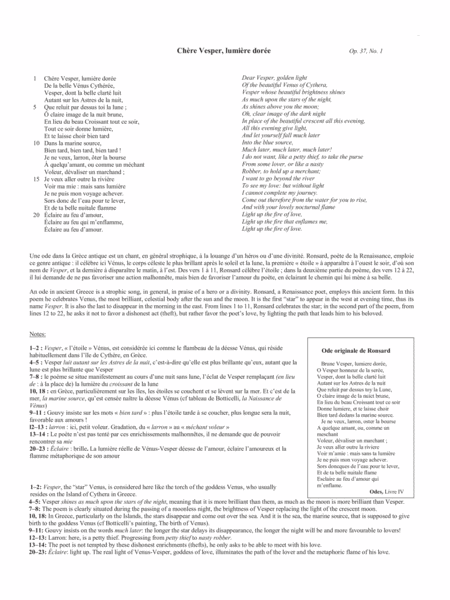
Op. 37, No. 1: Chère Vesper, lumière dorée from Songs of Gouvy, V1 (Downloadable)
Piano, Voix

$3.00 2.56 € Piano, Voix PDF SheetMusicPlus


1 ....541 556 571 586 601 ....961


Partitions Gratuites
Acheter des Partitions Musicales
Acheter des Partitions Digitales à Imprimer
Acheter des Instruments de Musique

© 2000 - 2026

Accueil - Version intégrale





