EUROPE
10926 articles
USA
0 articles
DIGITAL
23798 articles (à imprimer)
Partitions Digitales
Partitions à imprimer
23798 partitions trouvées


String Orchestra - Level 5 - Digital Download SKU: A0.742474 Composed by Antonio Vivaldi. Arranged by Arte Nova Music Lab. Baroque,Concert,Easter,Standards,World. Score and parts. 50 pages. Arte Nova Music Lab #4601825. Published by Arte Nova Music Lab (A0.742474). Antonio Lucio Vivaldi  4 March 1678 – 28 July 1741) was an Italian Baroque musical composer, virtuoso violinist, teacher, and priest. Born in Venice, the capital of the Venetian Republic, he is regarded as one of the greatest Baroque composers, and his influence during his lifetime was widespread across Europe. He composed many instrumental concertos, for the violin and a variety of other instruments, as well as sacred choral works and more than forty operas. His best-known work is a series of violin concertos known as the Four Seasons. Many of his compositions were written for the all-female music ensemble of the Ospedale della Pietà, a home for abandoned children. Vivaldi had worked there as a Catholic priest for 1 1/2 years and was employed there from 1703 to 1715 and from 1723 to 1740. Vivaldi also had some success with expensive stagings of his operas in Venice, Mantua and Vienna. After meeting the Emperor Charles VI, Vivaldi moved to Vienna, hoping for royal support. However, the Emperor died soon after Vivaldi's arrival, and Vivaldi himself died, in poverty, less than a year later. Taken from https://en.wikipedia.org/wiki/Antonio_Vivaldi
Concerto for 2 Cellos and Strings, RV 531 in G minor.
Orchestre à Cordes

$25.00 21.78 € Orchestre à Cordes PDF SheetMusicPlus

Instrumental Duet,Piano Euphonium,Instrumental Duet,Piano,Trombone - Level 3 - Digital Download SKU: A0.528546 Composed by Antonin Dvorak. Arranged by Diego Marani. Classical,Concert,Instructional,Romantic Period,Standards. Score and parts. 6 pages. Diego Marani #6197953. Published by Diego Marani (A0.528546). Humoresques, Op. 101 (B. 187), is a piano cycle by the Czech composer Antonín Dvořák, written during the summer of 1894. One writer says the seventh Humoresque is probably the most famous small piano work ever written after Beethoven's Für Elise.This arrangement for C or Bb Trombone (or C-Bb Euphonium) with Piano Accompaniment reflects faithfully the original for piano solo.
Humoresque No. 7 for Trombone and Piano
Trombone et Piano

$6.99 6.09 € Trombone et Piano PDF SheetMusicPlus

Piano,Tenor Saxophone - Level 2 - Digital Download SKU: A0.549424 Composed by Antonin Dvorak. Arranged by James M. Guthrie, ASCAP. Instructional,Romantic Period,Sacred,Standards. Score and part. 12 pages. Jmsgu3 #3494011. Published by jmsgu3 (A0.549424). Score: 7 pages, solo part: 2 pages, piano part: 3 pages. Duration: 4:25 Not difficult, but requires sensitivity & dynamic control. Suitable for recitals, church meditations, or school programs. Dvořák Background Antonín Dvořák (1841 –1904) was, of course, a composer from Czechoslovakia. As a matter of fact, he was among the first Bohemian composers to attain universal recognition. It is important to realize that the late Romantic Nationalist period featured composers who used traditional and folk elements to portray the character of their nation. In particular, we see this in the music of Grieg (Norway), Finland (Sibelius), and Smetana (Bohemia).  Dvořák relied markedly on rhythms and other characteristics of Moravian and Bohemian folk music. Ascent to Fame Dvořák was truly a child musical prodigy on the violin. The premiere performances of his compositions notably occurred in 1872 and 1873. He submitted his First Symphony in particular to a German competition, but it failed to win. Consequently, in 1874 he presented two more symphonies to the Austrian State Prize for Composition. Johannes Brahms was the principal of the jury and was accordingly very impressed. They forthwith awarded the prize to Dvořák in 1874, 1876, and 1877. At this point, Brahms thereupon endorsed Dvořák to the publisher Simrock. Later, the publisher commissioned Dvořák to compose the Slavonic Dances, Op. 46. These became popular overnight and, as a result, Dvořák's worldwide status was launched. International Status Dvořák visited England upon invitation nine times. On each visit, he frequently conducted performances of his own compositions. He conducted concerts of his music, especially in Moscow and St. Petersburg. Eventually, the Prague Conservatory in fact appointed Dvořák as a professor. There, to be sure, he wrote his famous Dumky Trio. United States Consequently, the National Conservatory of Music of America appointed him as director in 1892. As a result, Dvořák composed his two most famous symphonic works: the Symphony No. 9 (From the New World), which spread his name universally, and his Concerto for Cello and Orchestra, one of the most famous of all cello works. Moreover, he wrote his most celebrated American String Quartet during this time. At the same time, because of his growing recognition in Europe and his homesickness for his own country, he left to return to Bohemia in 1895.
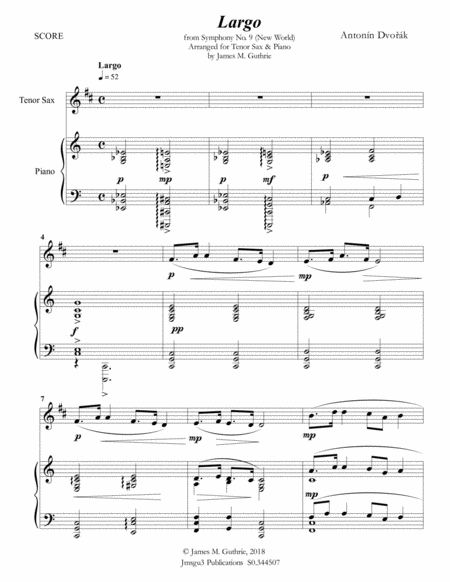
DvoÅ™ák: Largo from the New World Symphony for Tenor Sax & Piano
Saxophone Tenor et Piano

$32.95 28.71 € Saxophone Tenor et Piano PDF SheetMusicPlus

Alto Saxophone,Piano - Level 3 - Digital Download SKU: A0.1370909 Composed by Antonin Dvorak. Arranged by César Madeira. 19th Century,20th Century,Classical,Lent,Romantic Period. Score and part. 16 pages. Sheet Music To Play Editions #955252. Published by Sheet Music To Play Editions (A0.1370909). Romantic Pieces, Op. 75 (1st movement). Arrangement for Alto Sax and Piano. With Full Score and Individual Parts. Enjoy it!Antonín Leopold Dvořák (1841 – 1904) was a Czech composer. Dvořák frequently employed rhythms and other aspects of the folk music of Moravia and his native Bohemia, following the Romantic-era nationalist example of his predecessor Bedřich Smetana. Dvořák's style has been described as the fullest recreation of a national idiom with that of the symphonic tradition, absorbing folk influences and finding effective ways of using them.For Tutorials, Play Alongs or request New Arrangements, visit the YouTube Channel: Sheet Music To Play
Romantic Pieces, Op.75 (1st mov.) - Alto Sax and Piano (Full Score and Parts)
Saxophone Alto et Piano

$7.99 6.96 € Saxophone Alto et Piano PDF SheetMusicPlus

Brass Ensemble - Level 3 - Digital Download SKU: A0.720737 Composed by Antonin Dvorak. Arranged by Ralph Raymond Hays. Concert,Contemporary,Romantic Period,Sacred,Wedding. Score and parts. 9 pages. Ralph Raymond Hays #6246845. Published by Ralph Raymond Hays (A0.720737). Antonín Dvořák's poignant melody -- inspired by African American spirituals and lullabies -- has been masterfully edited and arranged for brass quintet by one of SMP's top arrangers. Transposed to a more hospitable key, this arrangement will imbue a solemn occasion, religious service, or recital with warmth and pathos.
LARGO from The New World Symphony (for brass quintet)
Quintette de Cuivres: 2 trompettes, Cor, trombone, tuba

$11.99 10.45 € Quintette de Cuivres: 2 trompettes, Cor, trombone, tuba PDF SheetMusicPlus

French Horn,Piano - Level 3 - Digital Download SKU: A0.1276600 Composed by Antonin Dvorak. Arranged by Diego Marani. Classical,Folk,Instructional,Romantic Period,Standards. Score and part. 11 pages. Diego Marani #868339. Published by Diego Marani (A0.1276600). The Slavonic Dances are a series of 16 orchestral pieces composed by Antonín Dvořák in 1878 and 1886 and published in two sets. Originally written for piano four hands, the Slavonic Dances were inspired by Johannes Brahms's own Hungarian Dances and were orchestrated at the request of Dvořák's publisher soon after composition. The pieces, lively and full of national character, were well received at the time and today are considered among the composer's most memorable works, occasionally making appearances in popular culture. This arrangement for horn with piano accompaniment of the marvelous dance no. 2 (Dumka) is suitable for classroom, repertoire, recital or for a thoughtful encore.
Slavonic Dance Op. 46 No. 2 for Horn and Piano
Cor et Piano

$9.99 8.71 € Cor et Piano PDF SheetMusicPlus

Brass Ensemble Trombone,Trumpet - Level 2 - Digital Download SKU: A0.625939 Composed by Antonin Dvorak. Arranged by Stephen DeCesare. Contemporary,Sacred,Spiritual. Score and parts. 13 pages. Exultet Music #5314409. Published by Exultet Music (A0.625939). (This version contains two Trombones in place of a French Horn and Trombone) The theme from the Largo by Antonín DvoÅ?ák which was adapted into the spiritual-like song Goin' Home which has been used for many funeral services, has now been freshly arranged for a Brass Quartet (Bb-Trumpet (2), Trombone (2) ) with Piano accompaniment. Accessible and appropriate for any church or concert setting.
Goin' Home (for Brass Quartet and Piano - Alternate Version)
Quatuor de cuivres: 2 trompettes, 2 trombones

$12.99 11.32 € Quatuor de cuivres: 2 trompettes, 2 trombones PDF SheetMusicPlus

Piano,Soprano Saxophone - Level 3 - Digital Download SKU: A0.1370903 Composed by Antonin Dvorak. Arranged by César Madeira. 19th Century,20th Century,Classical,Lent,Romantic Period. Score and part. 16 pages. Sheet Music To Play Editions #955245. Published by Sheet Music To Play Editions (A0.1370903). Romantic Pieces, Op. 75 (1st movement). Arrangement for Soprano Sax and Piano. With Full Score and Individual Parts. Enjoy it!Antonín Leopold Dvořák (1841 – 1904) was a Czech composer. Dvořák frequently employed rhythms and other aspects of the folk music of Moravia and his native Bohemia, following the Romantic-era nationalist example of his predecessor Bedřich Smetana. Dvořák's style has been described as the fullest recreation of a national idiom with that of the symphonic tradition, absorbing folk influences and finding effective ways of using them.For Tutorials, Play Alongs or request New Arrangements, visit the YouTube Channel: Sheet Music To Play
Romantic Pieces, Op.75 (1st mov.) - Soprano Sax and Piano (Full Score and Parts)
Saxophone Soprano et Piano

$7.99 6.96 € Saxophone Soprano et Piano PDF SheetMusicPlus

Baritone Saxophone,Piano - Level 2 - Digital Download SKU: A0.549425 Composed by Antonin Dvorak. Arranged by James M. Guthrie, ASCAP. Instructional,Romantic Period,Sacred,Standards. Score and part. 12 pages. Jmsgu3 #3494017. Published by jmsgu3 (A0.549425). Score: 7 pages, solo part: 2 pages, piano part: 3 pages. Duration: 4:25 Not difficult, but requires sensitivity & dynamic control. Suitable for recitals, church meditations, or school programs. Dvořák Background Antonín Dvořák (1841 –1904) was, of course, a composer from Czechoslovakia. As a matter of fact, he was among the first Bohemian composers to attain universal recognition. It is important to realize that the late Romantic Nationalist period featured composers who used traditional and folk elements to portray the character of their nation. In particular, we see this in the music of Grieg (Norway), Finland (Sibelius), and Smetana (Bohemia).  Dvořák relied markedly on rhythms and other characteristics of Moravian and Bohemian folk music. Ascent to Fame Dvořák was truly a child musical prodigy on the violin. The premiere performances of his compositions notably occurred in 1872 and 1873. He submitted his First Symphony in particular to a German competition, but it failed to win. Consequently, in 1874 he presented two more symphonies to the Austrian State Prize for Composition. Johannes Brahms was the principal of the jury and was accordingly very impressed. They forthwith awarded the prize to Dvořák in 1874, 1876, and 1877. At this point, Brahms thereupon endorsed Dvořák to the publisher Simrock. Later, the publisher commissioned Dvořák to compose the Slavonic Dances, Op. 46. These became popular overnight and, as a result, Dvořák's worldwide status was launched. International Status Dvořák visited England upon invitation nine times. On each visit, he frequently conducted performances of his own compositions. He conducted concerts of his music, especially in Moscow and St. Petersburg. Eventually, the Prague Conservatory in fact appointed Dvořák as a professor. There, to be sure, he wrote his famous Dumky Trio. United States Consequently, the National Conservatory of Music of America appointed him as director in 1892. As a result, Dvořák composed his two most famous symphonic works: the Symphony No. 9 (From the New World), which spread his name universally, and his Concerto for Cello and Orchestra, one of the most famous of all cello works. Moreover, he wrote his most celebrated American String Quartet during this time. At the same time, because of his growing recognition in Europe and his homesickness for his own country, he left to return to Bohemia in 1895.  
DvoÅ™ák: Largo from the New World Symphony for Baritone Sax & Piano
Saxophone Baryton, Piano

$32.95 28.71 € Saxophone Baryton, Piano PDF SheetMusicPlus


Partitions Gratuites
Acheter des Partitions Musicales
Acheter des Partitions Digitales à Imprimer
Acheter des Instruments de Musique

© 2000 - 2026

Accueil - Version intégrale





