EUROPE
10926 articles
USA
0 articles
DIGITAL
23798 articles (à imprimer)
Partitions Digitales
Partitions à imprimer
23798 partitions trouvées


Bassoon,Piano - Level 3 - Digital Download SKU: A0.1272571 Composed by Antonin Dvorak. Arranged by Diego Marani. Classical,Folk,Instructional,Romantic Period,Standards. Score and part. 12 pages. Diego Marani #864796. Published by Diego Marani (A0.1272571). The Slavonic Dances are a series of 16 orchestral pieces composed by Antonín Dvořák in 1878 and 1886 and published in two sets. Originally written for piano four hands, the Slavonic Dances were inspired by Johannes Brahms's own Hungarian Dances and were orchestrated at the request of Dvořák's publisher soon after composition. The pieces, lively and full of national character, were well received at the time and today are considered among the composer's most memorable works, occasionally making appearances in popular culture. This arrangement for bassoon with piano accompaniment of the marvelous dance no. 2 (Dumka) is suitable for classroom, repertoire, recital or for a thoughtful encore.
Slavonic Dance Op. 46 No. 2 for Bassoon and Piano
Basson, Piano (duo)

$9.99 8.71 € Basson, Piano (duo) PDF SheetMusicPlus

B-Flat Trumpet,Piano - Level 2 - Digital Download SKU: A0.1370898 Composed by Antonin Dvorak. Arranged by César Madeira. 19th Century,20th Century,Classical,Romantic Period,Wedding. Score and part. 7 pages. Sheet Music To Play Editions #955240. Published by Sheet Music To Play Editions (A0.1370898). Romantic Pieces, Op. 75 (1st movement). Arrangement for Bb Trumpet and Piano. With Individual Parts. Enjoy it!This file DOES NOT contain Full Score. Individual Parts only.Antonín Leopold Dvořák (1841 – 1904) was a Czech composer. Dvořák frequently employed rhythms and other aspects of the folk music of Moravia and his native Bohemia, following the Romantic-era nationalist example of his predecessor Bedřich Smetana. Dvořák's style has been described as the fullest recreation of a national idiom with that of the symphonic tradition, absorbing folk influences and finding effective ways of using them.For Tutorials, Play Alongs or request New Arrangements, visit the YouTube Channel: Sheet Music To Play
Romantic Pieces, Op.75 (1st mov.) - Bb Trumpet and Piano (Individual Parts)
Trompette, Piano

$4.99 4.35 € Trompette, Piano PDF SheetMusicPlus

Piano,Soprano Saxophone - Level 2 - Digital Download SKU: A0.549421 Composed by Antonin Dvorak. Arranged by James M. Guthrie, ASCAP. Instructional,Romantic Period,Sacred,Standards. Score and part. 12 pages. Jmsgu3 #3494001. Published by jmsgu3 (A0.549421). Score: 7 pages, solo part: 2 pages, piano part: 3 pages. Duration: 4:25 Not difficult, but requires sensitivity & dynamic control. Suitable for recitals, church meditations, or school programs. Dvořák Background Antonín Dvořák (1841 –1904) was, of course, a composer from Czechoslovakia. As a matter of fact, he was among the first Bohemian composers to attain universal recognition. It is important to realize that the late Romantic Nationalist period featured composers who used traditional and folk elements to portray the character of their nation. In particular, we see this in the music of Grieg (Norway), Finland (Sibelius), and Smetana (Bohemia).  Dvořák relied markedly on rhythms and other characteristics of Moravian and Bohemian folk music. Ascent to Fame Dvořák was truly a child musical prodigy on the violin. The premiere performances of his compositions notably occurred in 1872 and 1873. He submitted his First Symphony in particular to a German competition, but it failed to win. Consequently, in 1874 he presented two more symphonies to the Austrian State Prize for Composition. Johannes Brahms was the principal of the jury and was accordingly very impressed. They forthwith awarded the prize to Dvořák in 1874, 1876, and 1877. At this point, Brahms thereupon endorsed Dvořák to the publisher Simrock. Later, the publisher commissioned Dvořák to compose the Slavonic Dances, Op. 46. These became popular overnight and, as a result, Dvořák's worldwide status was launched. International Status Dvořák visited England upon invitation nine times. On each visit, he frequently conducted performances of his own compositions. He conducted concerts of his music, especially in Moscow and St. Petersburg. Eventually, the Prague Conservatory in fact appointed Dvořák as a professor. There, to be sure, he wrote his famous Dumky Trio. United States Consequently, the National Conservatory of Music of America appointed him as director in 1892. As a result, Dvořák composed his two most famous symphonic works: the Symphony No. 9 (From the New World), which spread his name universally, and his Concerto for Cello and Orchestra, one of the most famous of all cello works. Moreover, he wrote his most celebrated American String Quartet during this time. At the same time, because of his growing recognition in Europe and his homesickness for his own country, he left to return to Bohemia in 1895.
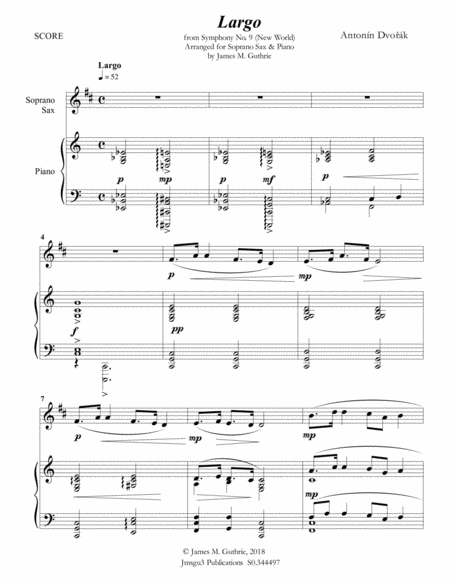
DvoÅ™ák: Largo from the New World Symphony for Soprano Sax & Piano
Saxophone Soprano et Piano

$32.95 28.71 € Saxophone Soprano et Piano PDF SheetMusicPlus

Cello,Piano - Level 3 - Digital Download SKU: A0.1267499 Composed by Antonin Dvorak. Arranged by Diego Marani. Classical,Contest,Festival,Folk,Instructional,Romantic Period. Score and part. 10 pages. Diego Marani #860033. Published by Diego Marani (A0.1267499). The Slavonic Dances are a series of 16 orchestral pieces composed by Antonín Dvořák in 1878 and 1886 and published in two sets. Originally written for piano four hands, the Slavonic Dances were inspired by Johannes Brahms's own Hungarian Dances and were orchestrated at the request of Dvořák's publisher soon after composition. The pieces, lively and full of national character, were well received at the time and today are considered among the composer's most memorable works, occasionally making appearances in popular culture. This arrangement for cello with piano accompaniment of the marvelous and nostalgic dance no. 2 is suitable for classroom, repertoire, recital or for a thoughtful encore.
Slavonic Dance Op. 72 No. 2 for Cello and Piano
Violoncelle, Piano

$9.99 8.71 € Violoncelle, Piano PDF SheetMusicPlus

Large Ensemble Bassoon,Clarinet,Double Bass,Flute,Horn,Oboe - Level 4 - Digital Download SKU: A0.553747 Composed by Antonin Dvorak. Arranged by Ray Thompson. Holiday,Romantic Period,Wedding. Score and parts. 133 pages. RayThompsonMusic #3881445. Published by RayThompsonMusic (A0.553747). Legends, Op. 59, B. 122 (Czech: Legendy), is a cycle of ten small-scale pieces by the Czech composer Antonín Dvořák. The work was composed originally for piano duet, but later was arranged also for a reduced orchestra.In this set, I have arranged the first 5 legends for double wind quintet and bass (contrebass) (parts are also provided for contrabassoon and tuba).The double bass is based on the original orchestration - it differs slightly from the wind/brass bass part.....either part will work.This set contains:Allegretto non troppo, quasi andantino (in D minor)Molto moderato (in G major)Allegro giusto (in G minor)Molto maestoso (in C major)Allegro giusto (in Aâ™­ major)The remaining 5 pieces in the cycle will be available as a separate set.
Dvorak: Legends Op.59 Nos. 1 - 5 - symphonic wind

$24.95 21.74 € PDF SheetMusicPlus

Woodwind Ensemble,Woodwind Quartet Alto Flute - Level 3 - Digital Download SKU: A0.1076169 Composed by Antonin Dvorak. Arranged by Diego Marani. Classical,Contest,Festival,Instructional,Romantic Period,Standards. 24 pages. Diego Marani #680341. Published by Diego Marani (A0.1076169). The Symphony No. 9 in E minor, From the New World, Op. 95, B. 178, popularly known as the New World Symphony, was composed by Antonín Dvořák in 1893 while he was the director of the National Conservatory of Music of America from 1892 to 1895. It premiered in New York City on 16 December 1893. It has been described as one of the most popular of all symphonies. This arrangement for flute quartet (Flute 1, Flute 2, Flute 3, Flute 4 or Alto Flute) of the beautiful last movement flawlessly renders all the magnificent original orchestral colors. It is suitable for classroom, repertoire and recital.
Finale from Symphony No. 9 "From the New World" for Flute Quartet
Quatuor de Flûtes : 4 flûtes

$14.99 13.06 € Quatuor de Flûtes : 4 flûtes PDF SheetMusicPlus

Alto Saxophone,Piano - Level 2 - Digital Download SKU: A0.549423 Composed by Antonin Dvorak. Arranged by James M. Guthrie, ASCAP. Instructional,Romantic Period,Sacred,Standards. Score and part. 12 pages. Jmsgu3 #3494005. Published by jmsgu3 (A0.549423). Score: 7 pages, solo part: 2 pages, piano part: 3 pages. Duration: 4:25. Not difficult, but requires sensitivity & dynamic control. Suitable for recitals, church meditations, or school programs. Dvořák Background Antonín Dvořák (1841 –1904) was, of course, a composer from Czechoslovakia. As a matter of fact, he was among the first Bohemian composers to attain universal recognition. It is important to realize that the late Romantic Nationalist period featured composers who used traditional and folk elements to portray the character of their nation. In particular, we see this in the music of Grieg (Norway), Finland (Sibelius), and Smetana (Bohemia).  Dvořák relied markedly on rhythms and other characteristics of Moravian and Bohemian folk music. Ascent to Fame Dvořák was truly a child musical prodigy on the violin. The premiere performances of his compositions notably occurred in 1872 and 1873. He submitted his First Symphony in particular to a German competition, but it failed to win. Consequently, in 1874 he presented two more symphonies to the Austrian State Prize for Composition. Johannes Brahms was the principal of the jury and was accordingly very impressed. They forthwith awarded the prize to Dvořák in 1874, 1876, and 1877. At this point, Brahms thereupon endorsed Dvořák to the publisher Simrock. Later, the publisher commissioned Dvořák to compose the Slavonic Dances, Op. 46. These became popular overnight and, as a result, Dvořák's worldwide status was launched. International Status Dvořák visited England upon invitation nine times. On each visit, he frequently conducted performances of his own compositions. He conducted concerts of his music, especially in Moscow and St. Petersburg. Eventually, the Prague Conservatory in fact appointed Dvořák as a professor. There, to be sure, he wrote his famous Dumky Trio. United States Consequently, the National Conservatory of Music of America appointed him as director in 1892. As a result, Dvořák composed his two most famous symphonic works: the Symphony No. 9 (From the New World), which spread his name universally, and his Concerto for Cello and Orchestra, one of the most famous of all cello works. Moreover, he wrote his most celebrated American String Quartet during this time. At the same time, because of his growing recognition in Europe and his homesickness for his own country, he left to return to Bohemia in 1895.  
DvoÅ™ák: Largo from the New World Symphony for Alto Sax & Piano
Saxophone Alto et Piano

$32.95 28.71 € Saxophone Alto et Piano PDF SheetMusicPlus


Partitions Gratuites
Acheter des Partitions Musicales
Acheter des Partitions Digitales à Imprimer
Acheter des Instruments de Musique

© 2000 - 2026

Accueil - Version intégrale





