EUROPE
10926 articles
USA
0 articles
DIGITAL
23793 articles (à imprimer)
Partitions Digitales
Partitions à imprimer
23793 partitions trouvées


Brass Ensemble - Level 3 - Digital Download SKU: A0.792427 Composed by Anton Bruckner. Arranged by Ralph Sauer. 20th Century,Christian,Romantic Period,Sacred. Score and parts. 56 pages. Gordon Cherry #4821639. Published by Gordon Cherry (A0.792427). Anton Bruckner’s Three Motets serve up some of the master’s most beautiful a cappela choral works with Ralph Sauer’s very eloquent transcriptions. The Motets span a 23 year period in Bruckner’s life and include, 1. Os Justi, 2. Ave Maria and 3. Christus factus est. The two outside movements feature Trumpets and Trombones (or optional Horns) and the Ave Maria utilizes four Horns and Tuba quartet (or optionally  four Trombones), adding a rich conical sound to the grouping of movements.When performing this transcription a brass group can utilize all the performers of a large ensemble, but having each section resting during one of the movements.
Three Motets for Brass Ensemble
Ensemble de cuivres

$20.00 17.41 € Ensemble de cuivres PDF SheetMusicPlus

Oboe,Piano - Level 2 - Digital Download SKU: A0.549426 Composed by Antonín Dvořák. Arranged by James M. Guthrie, ASCAP. Instructional,Romantic Period,Sacred,Standards. Score and part. 12 pages. Jmsgu3 #3494023. Published by jmsgu3 (A0.549426). Score: 7 pages, solo part: 2 pages, piano part: 3 pages. Duration: 4:25  Not difficult, but requires sensitivity & dynamic control. Suitable for recitals, church meditations, or school programs. Dvořák Background Antonín Dvořák (1841 –1904) was, of course, a composer from Czechoslovakia. As a matter of fact, he was among the first Bohemian composers to attain universal recognition. It is important to realize that the late Romantic Nationalist period featured composers who used traditional and folk elements to portray the character of their nation. In particular, we see this in the music of Grieg (Norway), Finland (Sibelius), and Smetana (Bohemia).  Dvořák relied markedly on rhythms and other characteristics of Moravian and Bohemian folk music. Ascent to Fame Dvořák was truly a child musical prodigy on the violin. The premiere performances of his compositions notably occurred in 1872 and 1873. He submitted his First Symphony in particular to a German competition, but it failed to win. Consequently, in 1874 he presented two more symphonies to the Austrian State Prize for Composition. Johannes Brahms was the principal of the jury and was accordingly very impressed. They forthwith awarded the prize to Dvořák in 1874, 1876, and 1877. At this point, Brahms thereupon endorsed Dvořák to the publisher Simrock. Later, the publisher commissioned Dvořák to compose the Slavonic Dances, Op. 46. These became popular overnight and, as a result, Dvořák's worldwide status was launched. International Status Dvořák visited England upon invitation all nine times. On each visit, he frequently conducted performances of his own compositions. He conducted concerts of his music, especially in Moscow and St. Petersburg. Eventually, the Prague Conservatory in fact appointed Dvořák as a professor. There, to be sure, he wrote his famous Dumky Trio. United States Consequently, the National Conservatory of Music of America appointed him as director in 1892. As a result, Dvořák composed his two most famous symphonic works: the Symphony No. 9 (From the New World), which spread his name universally, and his Concerto for Cello and Orchestra, one of the most famous of all cello works. Moreover, he wrote his most celebrated American String Quartet during this time. At the same time, because of his growing recognition in Europe and his homesickness for his own country, he left to return to Bohemia in 1895.
DvoÅ™ák: Largo from the New World Symphony for Oboe & Piano
Hautbois, Piano (duo)

$32.95 28.68 € Hautbois, Piano (duo) PDF SheetMusicPlus

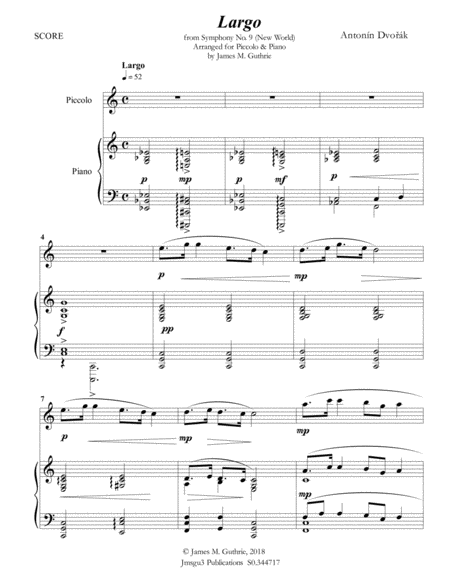
Instrumental Solo,Piano,Piccolo - Level 2 - Digital Download SKU: A0.549434 Composed by Antonín Dvořák. Arranged by James M. Guthrie, ASCAP. Instructional,Romantic Period,Sacred,Standards. Score and individual part. 12 pages. Jmsgu3 #3494221. Published by jmsgu3 (A0.549434). Score: 7 pages, solo part: 2 pages, piano part: 3 pages. Duration: 4:25 Not difficult, but requires sensitivity & dynamic control. Suitable for recitals, church meditations, or school programs. Dvořák Background Antonín Dvořák (1841 –1904) was, of course, a composer from Czechoslovakia. As a matter of fact, he was among the first Bohemian composers to attain universal recognition. It is important to realize that the late Romantic Nationalist period featured composers who used traditional and folk elements to portray the character of their nation. In particular, we see this in the music of Grieg (Norway), Finland (Sibelius), and Smetana (Bohemia).  Dvořák relied markedly on rhythms and other characteristics of Moravian and Bohemian folk music. Ascent to Fame Dvořák was truly a child musical prodigy on the violin. The premiere performances of his compositions notably occurred in 1872 and 1873. He submitted his First Symphony in particular to a German competition, but it failed to win. Consequently, in 1874 he presented two more symphonies to the Austrian State Prize for Composition. Johannes Brahms was the principal of the jury and was accordingly very impressed. They forthwith awarded the prize to Dvořák in 1874, 1876, and 1877. At this point, Brahms thereupon endorsed Dvořák to the publisher Simrock. Later, the publisher commissioned Dvořák to compose the Slavonic Dances, Op. 46. These became popular overnight and, as a result, Dvořák's worldwide status was launched. International Status Dvořák visited England upon invitation nine times. On each visit, he frequently conducted performances of his own compositions. He conducted concerts of his music, especially in Moscow and St. Petersburg. Eventually, the Prague Conservatory in fact appointed Dvořák as a professor. There, to be sure, he wrote his famous Dumky Trio. United States Consequently, the National Conservatory of Music of America appointed him as director in 1892. As a result, Dvořák composed his two most famous symphonic works: the Symphony No. 9 (From the New World), which spread his name universally, and his Concerto for Cello and Orchestra, one of the most famous of all cello works. Moreover, he wrote his most celebrated American String Quartet during this time. At the same time, because of his growing recognition in Europe and his homesickness for his own country, he left to return to Bohemia in 1895.    
DvoÅ™ák: Largo from the New World Symphony for Piccolo & Piano

$32.95 28.68 € PDF SheetMusicPlus

Violin, 2 violas and 2 cellos - intermediate - Digital Download SKU: S9.Q6741 Composed by Anton Vranitzky. This edition: score and parts. Downloadable, Score and parts. Op. 8/2. Schott Music - Digital #Q6741. Published by Schott Music - Digital (S9.Q6741). Key: G minor.The String Quartet in G minor by Anton Wranitzky (1761-1820) is one of the great works that combine stylistic devices developed by the turn of the century, such as the development of the sonata form by his thematic-motivic work, the contrasting effects of sound and structure, and the equal standard of all five parts. It is the second of the three Quintets Op. 8 with double violas and cellos. Unique in its instrumentation, they broaden the sound spectrum of the Boccherinian type with two cellos and some early quintets with three violins and two cellos, thus revealing the wealth of variants in the string quintet instrumentation which is typical of the genre. Also edited by Tilman Sieber, the volume 'Das klassische Streichquintett. Die Geschichte einer Gattung in Einzelwerken' (Musikalische Denkmäler, vol. IX, Mainz 2005, Schott, order no. MD 9) contains detailed information on the sources and a critical report.
String Quintet G minor

$42.99 37.42 € PDF SheetMusicPlus


Partitions Gratuites
Acheter des Partitions Musicales
Acheter des Partitions Digitales à Imprimer
Acheter des Instruments de Musique

© 2000 - 2026

Accueil - Version intégrale