EUROPE
1269 articles
USA
0 articles
DIGITAL
2397 articles (à imprimer)
Partitions Digitales
Partitions à imprimer
2397 partitions trouvées


Choral Choir (SATB) - Level 3 - Digital Download SKU: A0.874663 By Bruno Mars. By Ari Levine, Bruno Mars, and Philip Lawrence. Arranged by Chris Arnold. A Cappella,Pop,R & B. Octavo. 11 pages. Chris Arnold #4312437. Published by Chris Arnold (A0.874663). This song has been tailored to suit youth mass choir events, with participants ranging in age from teen to young adult. It features girls in 4-part harmony, then boys, and finally all singers in 8-part harmony. The message is especially suited to youth choir events.Written for combined men's and women's barbershop ensembles, the melody is primarily in the second voice, shown as Lead; dashed lines indicate where the melody moves to a different voice. The women's baritone and bass parts are written using the Bass 8va alta clef, meaning their pitches are sung one octave higher than the traditional bass clef. Middle C is found on the second space of the staff. The men's tenor and lead parts are written using the Treble 8va bassa clef, meaning their pitches are sung one octave lower than the traditional treble clef. Middle C is found on the third space of the staff.$25.98 US price includes 8 copies per purchase, suitable for double-quartets. For choruses, look for the same title available under choral ensembles.
Count On Me
Chorale SATB
Bruno Mars
$25.98 22.53 € Chorale SATB PDF SheetMusicPlus

Woodwind Ensemble Bassoon,English Horn,Oboe - Level 4 - Digital Download SKU: A0.582074 Composed by Jay Ferguson and Malcolm Arnold. Arranged by John Gibson. Contemporary. 16 pages. JB Linear #4849059. Published by JB Linear (A0.582074). Malcolm Arnold - 2 pieces from Set 1 of English Dances, arranged for double reed quartet. Arnold was born in Northampton, Northamptonshire, England in 1921. He not only wrote music for films, but also a great deal of compositions or a more serious nature. He wrote his English Dances (set 1) in 1950 and they became instantly popular. This is a setting for double reed quartet of two movements, Mesto, and Allegro. The instrumentation is 2 oboes, English Horn, and bassoon by John Gibson.
English Dances, Set 1, Op. 27: No. 3. Mesto

$16.25 14.09 € PDF SheetMusicPlus

Choral Choir (TTBB) - Level 4 - Digital Download SKU: A0.874638 By Frank Sinatra. By Sammy Cahn. Arranged by Chris Arnold. A Cappella,Jazz. Octavo. 4 pages. Chris Arnold #4287001. Published by Chris Arnold (A0.874638). This is an upbeat, short song, which would be suitable as an opener to a performance package. It features tight, jazzy harmonies.Written for men's barbershop ensemble, the melody is passed between the top voice (tenor) and the second voice (lead); dashed lines indicate where the melody moves to a different voice. The tenor and lead parts are written using the Treble 8va bassa clef, meaning their pitches are sung one octave lower than the traditional treble clef. Middle C is found on the third space of the staff.
Here Goes
Chorale TTBB
Frank Sinatra
$1.99 1.73 € Chorale TTBB PDF SheetMusicPlus

Voice, recorder and percussion - Digital Download SKU: S9.Q2433 Minor: Bordun. Composed by Carl Orff and Gunild Keetman. Arranged by Arnold Walter and Doreen Hall. This edition: score for voice and/or instruments. Orff-Schulwerk. Downloadable, Vocal and performing score. Op. 4. Schott Music - Digital #Q2433. Published by Schott Music - Digital (S9.Q2433). English.Carl Orff devoted much of his life to the development of a philosophy of Music for Children, based on his belief that music is the natural outcome of speech, rhythm and movement. His ideas and pioneering work have had a major influence on music and dance education throughout the world and today that work continues under the guidance of leading teachers and educators in many countries. The five basic German volumes of Music for Children by Carl Orff and Gunild Keetman were published between 1950 and 1954. Edition have since been published in Bolivia, Brazil, Canada, Czechoslovakia, Denmark, Estonia, France, Ghana, Great Britain (including a special Welsh edition), Greece, Italy, Japan, Korea, Latin-America, the Netherlands, Portugal, Spain, Sweden, Taiwan and the USA. In 1952 the first edition in translation appeared, an English language adaptation by Doreen Hall and Arnold Walter for their Canadian and American students. A few years later, Margaret Murray independently developed a version (1957-1966), essentially to fulfil the needs of United Kingdom teachers. Inevitably the considerable growth of Orff-Schulwerk in the United States led to the publication of the American Edition (1977) to satisfy the requirements of a different educational system and national heritage. Orff-Schulwerk: Music for Children has proved itself to be a stimulating source of material for music teaching. Carl Orff's fundamental educational ideas have revitalized music education in nursery schools, at all levels of primary and secondary education and in special music schools, based on the concepts that: - music, dance and language are inter-related and animated through rhythm. - when children discover, invent, improvise and compose, their experience of music is intensified. These creative activities are complementary to those of interpreting and listening to music. - all who take part are encouraged to contribute, not only vocally but also instrumentally. - the Orff approach to music education is many sided; it is concerned with practical music-making, it provides fundamental experiences and it lays the foundation for a comprehensive musical training. - movement games and activities for body awareness in space, time and flow, lead to movement improvisation and dance forms. - music and dance have been notated in many different ways in history. Various ways of writing down sounds and music, as well as playing from and interpreting different kinds of sources are being explored. Today, countless teachers and institutions are using these ideas. More and more teachers look for ways of invovling their students in active music making. In particular, they seek to challenge their pupils' creativity by the use of music, dance and speech - as media of human expression - as a foundation of all education. A prerequisite for work in Orff-Schulwerk is the artistic and pedagogical training of teachers. The Orff Institute was founded in 1961 as a Department of the 'Mozarteum', in Salzburg, Austria. Training offered includes a four-year diploma course, a two-year post-graduate course, and a one-year-course in English. At the opening of the Orff Institute in Salzburg in 1963, Carl Orff ended his speech with a quotation from Schiller: 'I have done my part, now do yours.' That challenge has been taken up by teachers worldwide. Hall/Walter Edition Based on Volumes 1, 2 and 4 of the original German Edition musik für Kinder, english adaption with additional material by Doreen Hall and Arnold Walter.
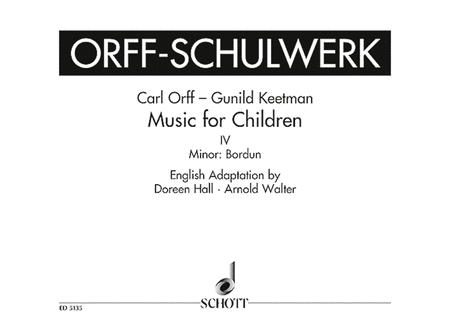
Music for Children

$11.99 10.4 € PDF SheetMusicPlus

Choral Choir (TTBB) - Level 4 - Digital Download SKU: A0.874637 By Frank Sinatra. By Sammy Cahn. Arranged by Chris Arnold. A Cappella,Jazz. Octavo. 4 pages. Chris Arnold #4286995. Published by Chris Arnold (A0.874637). This is an upbeat, short song, which would be suitable as an opener to a performance package. It features tight, jazzy harmonies.Written for men's barbershop ensemble, the melody is passed between the top voice (tenor) and the second voice (lead); dashed lines indicate where the melody moves to a different voice. The tenor and lead parts are written using the Treble 8va bassa clef, meaning their pitches are sung one octave lower than the traditional treble clef. Middle C is found on the third space of the staff.
Here Goes
Chorale TTBB
Frank Sinatra
$12.99 11.27 € Chorale TTBB PDF SheetMusicPlus

Full Orchestra - Level 4 - Digital Download SKU: A0.1478076 Composed by Malcolm Arnold. Arranged by Kevin Riley. 20th Century,Film/TV,March. 56 pages. Kevin Riley #1055459. Published by Kevin Riley (A0.1478076). The River Kwai March is a march composed by Malcolm Arnold in 1957. It was written as an orchestral counter-march to the Colonel Bogey March, which is whistled by the soldiers entering the prisoner camp in the film The Bridge on the River Kwai and again near the end of the film when the bridge is formally dedicated. The Arnold march re-appears (without the Colonel Bogey March) several times in the film and is repeated at the finale.If you enjoy playing this and would like to request a piece for your ensemble please get in touch at klscj@me.com.
The River Kwai March
Orchestre

$70.00 60.71 € Orchestre PDF SheetMusicPlus


Partitions Gratuites
Acheter des Partitions Musicales
Acheter des Partitions Digitales à Imprimer
Acheter des Instruments de Musique

© 2000 - 2026

Accueil - Version intégrale





