EUROPE
238079 articles
USA
0 articles
DIGITAL
5033 articles (à imprimer)
Partitions Digitales
Partitions à imprimer
5033 partitions trouvées


Guitar - Advanced - Digital Download SKU: ZZ.DZ-4088 Composed by Louis Trépanier. Score. 9 pages. Les Productions d'OZ - Digital #DZ 4088. Published by Les Productions d'OZ - Digital (ZZ.DZ-4088). ISBN 9782898522055.August nights can be tinged with a bit of melancholy because the end of the summer approaches. The moon softly glows with nostalgia for a season passing us by. This mood seems to me folded into the Brazilian Bossa Nova, and the Brazilians? term ?saudade?; in this piece I offer up my tribute to one of my favourite composers, Radamés Gnattali (1906-1988), who wrote for every musical situation in his era in Brazil ? from the concert stage to the back alley, and everything in between. Lua para Epilogo de Verão, is dedicated to the Brazilian guitarist Fabio Zanon, who is both a great friend and a tremendous inspiration.This étude tackles solid chords and contrary motion in the left hand, and, like all the études in this collection, voice separation and phrasing. In measure 24 the guitarist must execute a diagonal barré, where the first finger covers position IV at the first string, and position V at the fifth string, hence the V/IV indication after the barré symbol. The practicalities of navigating through the different chord shapes and rhythms in the piece mean that not all notes can be held for their full, written value. Such discrepancies between the text and the playing are common in this style of music.Les nuits du mois d?août peuvent contenir une douce mélancolie, à savoir que la fin de l?été approche. La lune luit alors avec une nostalgie pour la saison qui est déjà en train de passer. Cette saveur me semble parfaitement miroitée dans les couleurs de la bossa nova brésilienne et le terme brésilien « saudade » ; dans cette pièce je vous offre mon hommage au style d?un de mes compositeurs préféré, Radamés Gnattali (1906-1988), qui a su créer des musiques pour tous les différents musiciens de ses années au Brésil, de la salle de concert, jusqu?à la ruelle. Lua para Epilogo de Verão est dédié au guitariste brésilien Fabio Zanon, un bon ami, et une grande inspiration.Cette étude travaille les accords plaqués et divers mouvements contraires à la main gauche, et, comme toutes les études de cette collection, la séparation de voix et le phrasé. À la mesure 24, on doit exécuter un barré en diagonal, où le premier doigt un est à la position IV à la première corde, et à la position V à la cinquième corde, d?où l?indication V/IV suivant le symbole du barré. Pour des raisons pratiques à naviguer les accords et les rythmes de cette pièce, vous verrez qu?il n?est pas toujours possible de tenir toutes les notes pour leur durée complète. Ces différences entre l?écriture et l?exécution sont courantes dans ce style de musique.
Lua para o Epilogo de Verão (Août)
Guitare

$5.95 5.18 € Guitare PDF SheetMusicPlus

Instrumental Duet Bassoon,Instrumental Duet,Voice - Digital Download SKU: A0.576770 Composed by David Warin Solomons. Contemporary,Renaissance. Score and parts. 2 pages. David Warin Solomons #429021. Published by David Warin Solomons (A0.576770). Setting of Ronsard's poem A Cassandre for speaking voice and bassoon In the sound sample the poem is spoken in modern French by my father S N Solomons who also created an English version as shown below The bassoon part is based on the song To Cassandra for alto and guitar, using my father's translation, which is also available on this site Mignonne, allons voir si la rose Qui ce matin avoit desclose Sa robe de pourpre au Soleil, A point perdu ceste vesprée Les plis de sa robe pourprée, Et son teint au vostre pareil. Las ! voyez comme en peu d'espace, Mignonne, elle a dessus la place Las ! las ses beautez laissé cheoir ! Ô vrayment marastre Nature, Puis qu'une telle fleur ne dure Que du matin jusques au soir ! Donc, si vous me croyez, mignonne, Tandis que vostre âge fleuronne En sa plus verte nouveauté, Cueillez, cueillez vostre jeunesse : Comme à ceste fleur la vieillesse Fera ternir vostre beauté. [English translation by SN Solomons] Darling, come see the rose so red, Which this morn timidly had spread Her mantle to the eye of day. Come see if she has lost this e'en Her crimson pleated robe's soft sheen, That same blush which on your cheek plays. See how in but a paltry hour She has let fall her ailing flower. Her beauty lies there in the dust! Alas! How cruel is Mother Nature, Since such a blossom can endure Only from trembling dawn to dusk. Darling you must indeed believe, Whilst innocence within you cleaves The bud and blooms in purity, Garner the gifts of tender youth, For, like this flower, age in sooth Will sadly spoil and tarnish beauty.].
A Cassandre for spoken voice and bassoon

$8.00 6.97 € PDF SheetMusicPlus

Instrumental Duet Bassoon,Instrumental Duet,Voice - Level 3 - Digital Download SKU: A0.576771 Composed by David Warin Solomons. 20th Century,Contemporary. Score and parts. 2 pages. David Warin Solomons #431373. Published by David Warin Solomons (A0.576771). Setting of my father's translation of Ronsard's poem A Cassandre for speaking voice and bassoon In the sound sample the poem is spoken by my father S N Solomons The bassoon part is based on the song To Cassandra for alto and guitar, which is also available on this site [English translation by SN Solomons] Darling, come see the rose so red, Which this morn timidly had spread Her mantle to the eye of day. Come see if she has lost this e'en Her crimson pleated robe's soft sheen, That same blush which on your cheek plays. See how in but a paltry hour She has let fall her ailing flower. Her beauty lies there in the dust! Alas! How cruel is Mother Nature, Since such a blossom can endure Only from trembling dawn to dusk. Darling you must indeed believe, Whilst innocence within you cleaves The bud and blooms in purity, Garner the gifts of tender youth, For, like this flower, age in sooth Will sadly spoil and tarnish beauty. [Ronsard's original poem] Mignonne, allons voir si la rose Qui ce matin avoit desclose Sa robe de pourpre au Soleil, A point perdu ceste vesprée Les plis de sa robe pourprée, Et son teint au vostre pareil. Las ! voyez comme en peu d'espace, Mignonne, elle a dessus la place Las ! las ses beautez laissé cheoir ! Ô vrayment marastre Nature, Puis qu'une telle fleur ne dure Que du matin jusques au soir ! Donc, si vous me croyez, mignonne, Tandis que vostre âge fleuronne En sa plus verte nouveauté, Cueillez, cueillez vostre jeunesse : Comme à ceste fleur la vieillesse Fera ternir vostre beauté.
To Cassandra for spoken voice and bassoon

$8.00 6.97 € PDF SheetMusicPlus

Guitar - Advanced - Digital Download SKU: ZZ.DZ-4244 Composed by Konstantin Bliokh. Score. 13 pages. Les Productions d'OZ - Digital #DZ 4244. Published by Les Productions d'OZ - Digital (ZZ.DZ-4244). La Sonate n° 6 Kharkiv pour guitare solo a été composée en 2021, à la fin du confinement lié au COVID-19. Ã? ce moment-là, ma famille et moi étions restés dans notre ville natale de Kharkiv (également connue sous le nom de Kharkov), en Ukraine, pendant près de deux ans. Nous considérions cette période de pandémie comme un désastre, mais nous avons réalisé plus tard que c'était en fait un moment plutôt heureux, car la guerre est arrivée dans notre pays quelques mois plus tard. Depuis 2022, une fraction considérable des 1,5 million de citoyens de Kharkiv ont quitté leur foyer, ceux qui sont restés vivent sous des attaques incessantes de missiles, et beaucoup ont été tués. Je voudrais dédier cette Sonate à la ville frontalière de Kharkiv et, surtout, à ses citoyens souffrant de la guerre.Pourtant, la musique de la Sonate n'a aucun programme spécifique. Ici, je donnerai un bref aperçu de ses principaux éléments de composition pour faciliter les interprétations futures.Les premier et quatrième mouvements de cette Sonate sont basés sur l'interaction entre le principe dodécaphonique et le centre tonal de sol majeur, naturel pour la guitare. En particulier, le premier mouvement est basé sur l'interaction de la triade de sol majeur Solâ??Siâ??Ré des cordes de guitare à vide 2â??3â??4, le motif ascendant 1 impliquant les notes Miâ??Fa#â??Laâ??Do# (à l'origine sur la première corde), et le motif descendant 2 utilisant les notes Miâ??Doâ??Sibâ??La (à l'origine sur la corde de basse 6). Ces éléments se complètent presque pour former douze tons (à l'exception du Fa manquant), et les motifs alternent avec des fragments ostinato où chaque note de la triade de sol majeur est déplacée pas à pas d'un demi-ton vers le haut ou vers le bas.Le deuxième mouvement est un Scherzo impliquant de nombreux demi-tons dans des accords accentués et des passages rapides, ainsi qu'un mouvement mélodique chromatique dans la voix de basse. Il est presque atonal dans certains fragments, mais a un centre tonal global de la mineur.Le troisième mouvement est un Adagio méditatif basé sur un thème composé dans l'échelle hexatonique Réâ??Miâ??Faâ??Sol#â??Laâ??Si et des accords ostinato impliquant les cordes de basse à vide Miâ??Laâ??Ré et le demi-ton Siâ??Do.Enfin, le quatrième mouvement est basé sur le thème dodécaphonique complet composé de deux phrases comprenant les motifs 1 et 2 du premier mouvement : Solâ??Faâ??Sibâ??Labâ??Doâ??Mibâ??Ré et Miâ??Siâ??Do#â??Laâ??Fa#. Ce thème est présenté dans ses formes prime et rétrograde. Il y a des dialogues entre la première corde, les basses et les cordes médianes à vide, similaires au premier mouvement. Ã? son apogée, le thème dodécaphonique est interprété en utilisant le mouvement parallèle de l'accord de sol majeur standard de la guitare avec les cordes médianes à vide sur douze positions.La Sonate a été créée en première et enregistrée (CD Naxos No. 8.574630) par le célèbre guitariste ukrainien Marko Topchii, qui a également vécu et étudié à Kharkiv. Je lui suis extrêmement reconnaissant pour l'interprétation brillante de cette pièce.Je suis très redevable envers Productions d'Oz d'avoir conservé mes notations originales là où celles-ci ne correspondent pas au style de l'éditeur.Sonata No. 6 Kharkiv for guitar solo was composed in 2021, in the end of the COVID-19 lockdown. At that time my family and I were staying in our home city of Kharkiv (also known as Kharkov), Ukraine for almost two years. We considered that pandemic period as a disaster, but later have realized that it actually was a rather happy time, because a war came to our homeland just a few months later. Since 2022 a considerable fraction of the 1.5 millions of Kharkiv citizens have left their homes, those who stayed have been living under ceaseless missile attacks, and many have been killed. I would like to dedicate this Sonata to the frontier city of Kharkiv and, most of all, to its citizens suffering from the war.Yet, the music of the Sonata does not have any specific program. Here I will give a brief overview of its main composition elements to facilitate future interpretations.The first and fourth movements of this Sonata are based on the interplay between the twelve-tone principle and the G-major tonal center, natural for the guitar. Namely, the first movement is based on the interaction of the G-major triad Gâ??Bâ??D of the open guitar strings 2â??3â??4, ascending motif 1 involving the notes Eâ??F#â??Aâ??C# (originally on the first string), and descending motif 2 using the notes E-â??Câ??Bbâ??A- (originally, on the bass string 6). These elements supplement each other to almost make up twelve tones (apart from the missing F), and the motifs alternate with ostinato fragments where each note in the G major triad is step-by-step moved by a semitone up or down.The second movement is a Scherzo involving numerous semitones in accented chords and fast passages, as well as chromatic melodic motion in the bass voice. It is almost atonal in some fragments, but has an overall tonal center of A-minor.The third movement is a meditative Adagio based on a theme composed within hexatonic scale Dâ??Eâ??Fâ??G#â??Aâ??B and ostinato chords involving open bass strings Eâ??Aâ??D and semitone Bâ??C.Finally, the fourth movement is based on the complete twelve-tone theme consisting of two phrases including motifs 1 and 2 from the first movement: Gâ??Fâ??Bbâ??Abâ??Câ??Ebâ??D and Eâ??Bâ??C#â??Aâ??F#. This theme is presented in its prime and retrograde forms. There are dialogues between the first string, basses and open middle strings, similar to the first movement. In the culmination, the twelve-tone theme is performed using the parallel motion of the standard guitar G-major chord with open middle strings across twelve positions.The Sonata was premiered and recorded (CD Naxos No. 8.574630) by the prominent Ukrainian guitarist Marko Topchii who has also lived and studied in Kharkiv. I am extremely grateful to him for the brilliant performance of this piece.I am greatly indebted to Productions dâ??Oz for keeping my original notations in places where these do not conform to the publisherâ??s style.
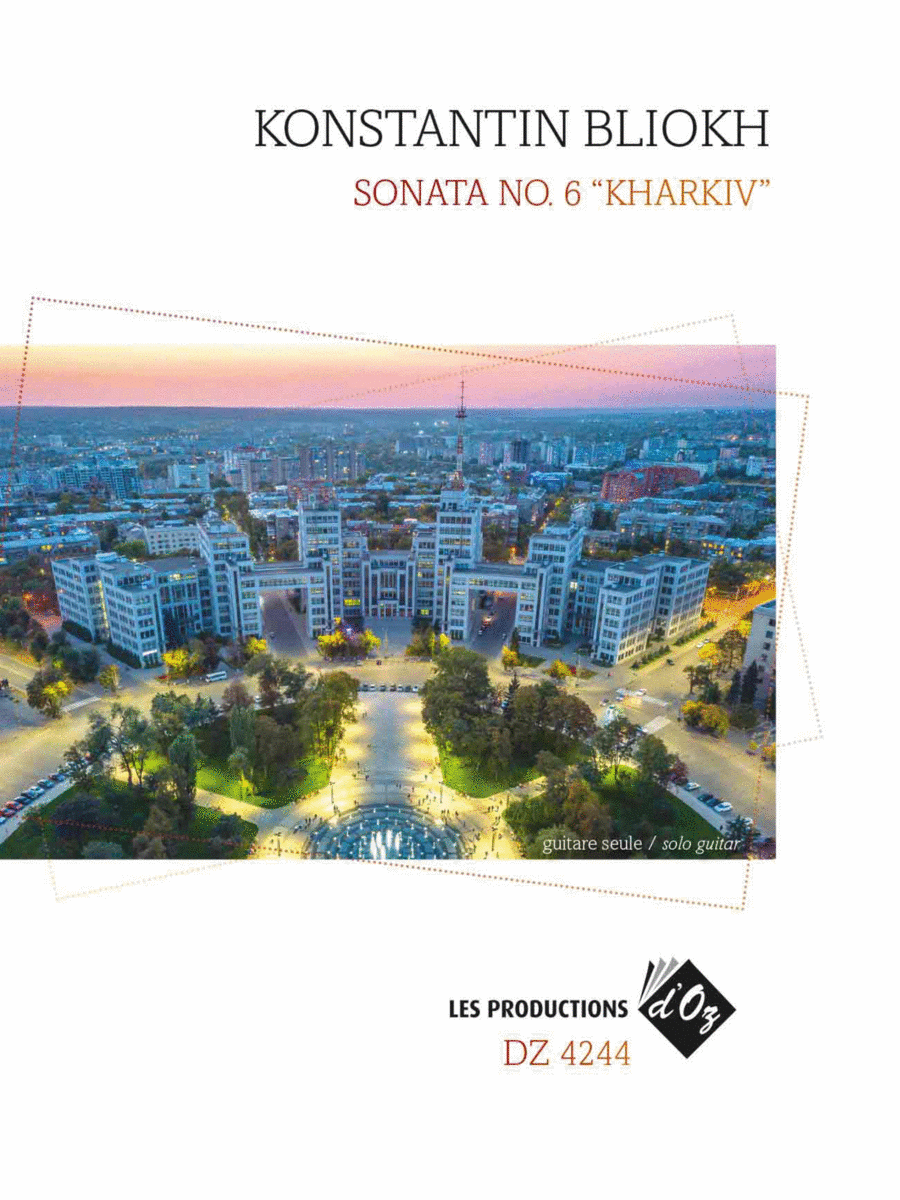
Sonata No. 6 "Kharkiv", Op. 48
Guitare

$7.95 6.93 € Guitare PDF SheetMusicPlus

Full Orchestra - Level 5 - Digital Download SKU: A0.878770 Composed by Jean-Christophe Masson. Contemporary. Score and parts. 38 pages. Jean-Christophe Masson #6307203. Published by Jean-Christophe Masson (A0.878770). Professional level Symphonic poem for violin solo, cello solo, and orchestra (flute, oboe, clar, horn, trumpet, trombone, Tubular bells, bass drum and strings) Duration : 7 minutes Niveau professionnel Poème symphonique pour violon solo, violoncelle solo, et orchestre (flûte, hautbois, clarinette, cor, trompette, trombone, cloches tubulaires, grosse caisse symphonique et cordes) Durée : 7 minutes Création au Temple de Dijon, le 27 mars 2009, par Simon Bouveret au violon et Lucie Mercat au violoncelle, direction Maxime Pitois. www.jcmasson.com
Voyage dans notre Autre --- Symphonic poem for violin cello and orchestra --- FULL SCORE AND PARTS J
Orchestre

$30.00 26.14 € Orchestre PDF SheetMusicPlus


Partitions Gratuites
Acheter des Partitions Musicales
Acheter des Partitions Digitales à Imprimer
Acheter des Instruments de Musique

© 2000 - 2026

Accueil - Version intégrale





