EUROPE
238079 articles
USA
0 articles
DIGITAL
5033 articles ( imprimer)
Partitions Digitales
Partitions à imprimer
5033 partitions trouvées


Jazz Ensemble Jazz Ensemble - Level 4 - Digital Download SKU: A0.1290132 Composed by Charles Pasquale and Maria Grever. Arranged by Brad Esbensen. Contemporary,Jazz,Latin,Standards. Score and Parts. 46 pages. Brad Esbensen Music Services #880843. Published by Brad Esbensen Music Services (A0.1290132). This arrangement for vocalist and big band is written in the key of C major and follows a similar format to the version recorded by Rosemary Clooney. All brass parts are generally written in a comfortable range (Trumpet 1 to D6 and Trombone 1 to G4)  and fully notated rhythm section parts are included. One trick with this chart is the drums playing a shuffle feel against a mambo feel in the horns. Players should check out Rosemary Clooney's recording to learn how this feel works. I hope you enjoy performing this chart and if you would like it transposed into another key, please e-mail me at brad@bemus.com.au. www.bemus.com.au.
Te Quiero Dijiste (magic Is The Moonlight)
Ensemble Jazz

$60.00 52.28 € Ensemble Jazz PDF SheetMusicPlus

Full Orchestra - Digital Download SKU: A0.1008372 Composed by Claude Debussy. Arranged by Arkady Leytush. 20th Century. Score and parts. 24 pages. Arkady Leytush #4849769. Published by Arkady Leytush (A0.1008372). Estampes (Engravings) is the title of the triptych of three pieces which Debussy put together in 1903. The first complete performance was given on 9 January 1904 in the Salle Erard, Paris, by the young Spanish pianist Ricardo Viñes, who was already emerging as the prime interpreter of the new French music of Debussy and Ravel. The first two pieces were completed in 1903, but the third derives from an earlier group of pieces from 1894, collectively titled Images, which remained unpublished until 60 years after Debussy’s death, when they were printed as Images (oubliées). Estampes marks an expansion of Debussy’s keyboard style: he was apparently spurred to fuse neo-Lisztian technique with a sensitive, impressionistic pictorial impulse under the impact of discovering Ravel’s Jeux d’eau, published in 1902. The opening movement, ‘Pagodes’, is Debussy’s first pianistic evocation of the Orient and is essentially a fixed contemplation of its object, as in a Chinese print. This static impression is partly caused by Debussy’s use of long pedal-points, partly by his almost constant preoccupation with pentatonic melodies which subvert the sense of harmonic movement. He uses such pentatonic fragments in many different ways: in delicate arabesques, in two-part counterpoint, in canon, harmonized in fourths and fifths and as an underpinning for pattering, gamelan-like ostinato writing. Altogether the piece reflects the decisive impression made on him by hearing Javanese and Cambodian musicians at the 1889 Paris Exposition, which he had striven for years to incorporate effectively in music. In its final bars the music begins to dissolve into elaborate filigree. Just as ‘Pagodes’ was his first Oriental piece, so ‘La soirée dans Grenade’ was the first of Debussy’s evocations of Spain-that preternatural embodiment of an ‘imaginary Andalusia’ which would inspire Manuel de Falla, the native Spaniard, to go back to his country and create a true modern Spanish music based on Debussyan principles. Debussy’s personal acquaintance with Spain was virtually non-existent (he had spent a day just over the border at San Sebastian) and it is possible that one model for the piece was Ravel’s Habanera. Yet he wrote of this piece (to his friend Pierre Louÿs, to whom it was dedicated), ‘if this isn’t the music they play in Granada, so much the worse for Granada!’-and there is no debate about the absolute authenticity of Debussy’s use of Spanish idioms here. Falla himself pronounced it ‘characteristically Spanish in every detail’. ‘La soirée dans Grenade’ is founded on an ostinato that echoes the rhythm of the habanera and is present almost throughout. Beginning and ending in almost complete silence, this dark nocturne of warm summer nights builds powerfully to its climaxes. The melodic material ranges from a doleful Moorish chant with a distinctly oriental character to a stamping, vivacious dance-measure, taking in brief suggestions of guitar strumming and perfumed Impressionist haze. There is even a hint of castanets near the end. The piece fades out in a coda that seems to distil all the melancholy of the Moorish theme and a last few distant chords of the guitar.  ‘Jardins sous la pluie’ is based on the children’s song ‘Nous n’rons plus au bois’ (We shan’t go to the woods): its original 1894 form was in fact entitled Quelques aspects de ‘Nous n’rons plus au bois’. The two versions are really two distinct treatments of the same set of ideas, but in ‘Jardins sous la pluie’ Estampes the earlier piece has been entirely rethought. The whole conception is more impressionistic, and subtilized. The teeming semiquaver motion is more all-pervasive, the tunes (for Debussy has added a second children’s song for treatment, ‘Do, do, l’enfant do’) more elusive and tinged sometimes with melancholy or nostalgia. Th.
Claude Debussy ‒ Estampes, Orchestra Suite, Orchestrated by Arkady Leytush No. 1 Pagodes (Pagodas
Orchestre

$25.00 21.78 € Orchestre PDF SheetMusicPlus

Jazz Ensemble Jazz Ensemble - Level 3 - Digital Download SKU: A0.1314052 By The Andrews Sisters. By Philip Moore. Arranged by Brad Esbensen. Jazz,Standards. 59 pages. Brad Esbensen Music Services #902783. Published by Brad Esbensen Music Services (A0.1314052). This chart, very loosely based on The Andrews Sisters version, is in the key of C major and features a solo vocalist. There is an extended ensemble shout section for the band to strect out and brass ranges are moderate with Trumpet 1 requiring B5 (and one D6 at the end). The sax section is scored for Clarinet lead over two altos and two tenors. I hope you enjoy performing this chart and if you would like it transposed into another key, please e-mail me at brad@bemus.com.au. www.bemus.com.au.
Shoo-shoo Baby
Ensemble Jazz
The Andrews Sisters
$60.00 52.28 € Ensemble Jazz PDF SheetMusicPlus

Full Orchestra - Level 4 - Digital Download SKU: A0.774436 Composed by Graham Goble and John Farnham. Arranged by Brad Esbensen. Contemporary,Pop,Rock. Score and Parts. 147 pages. Brad Esbensen Music Services #6204419. Published by Brad Esbensen Music Services (A0.774436). This arrangement, in the key of E minor, generally follows the form of John Farnham's recording he made while with the Little River Band. All rhythm section parts are fully notated thorughout to assist younger players. This Australian pop classic is sure to be a hit with audiences. I hope you enjoy performing this chart and if you would like it transposed into another key or would like alternate parts/instrumental combinations, please e-mail me at brad@bemus.com.au www.bemus.com.au.
Playing To Win
Orchestre

$60.00 52.28 € Orchestre PDF SheetMusicPlus

String Quartet Cello,Double Bass,String Quartet,Viola,Violin - Digital Download SKU: A0.878727 Composed by Jean-Christophe Masson. Contemporary. Score and parts. 21 pages. Jean-Christophe Masson #3064419. Published by Jean-Christophe Masson (A0.878727). ''Poème sans dessein'' Composition s'inspirant de deux thèmes de Chopin et Schumann (à l'occasion du bicentenaire de leur naissance) pour violoncelle solo et violon, alto, violoncelle et contrebasse de Jean-Christophe Masson (2010) créé le 08 juin 2010 (Schumann est né un 8 juin), au Grand Amphitéâtre de la Sorbonne à Paris, par Jérémy Genet au violoncelle (commanditaire : la partition lui est dédicacée). Jean-Christophe Masson N° de membre SACEM 00623 9409 Droits de reproduction sonore réservés www.jcmasson.com
Poème sans dessein --- for cello solo and violin, viola, cello, and doublebass --- JCM 2010
Quatuor cordes: 2 violons, alto, violoncelle

$9.99 8.71 € Quatuor cordes: 2 violons, alto, violoncelle PDF SheetMusicPlus

Choral Choir (Mixed) - Level 3 - Digital Download SKU: A0.958765 Composed by Peter Ilyich Tchaikovsky. Arranged by Juan Carlos Cortés A. Instructional,Romantic Period,World. Octavo. 234 pages. Juan Carlos Cortés Aguirre #6473855. Published by Juan Carlos Cortés Aguirre (A0.958765). Traducción al idioma Español (Castellano) de la obra pedagógica musical Guía práctica para el estudio de la armonía por Piotr Ilich Tchaikovsky (Vótkinsk, 7 de mayo de 1840 - San Petersburgo, 6 de noviembre de 1893), compositor ruso del Siglo XIX basado en la versión rusa, luego traducida a los idiomas Alemán e Inglés. Obra amparada por el © Copyright como Derecho Conexo que otorga protección a quienes, sin ser autores, contribuyen con creatividad, técnica u organización, en el proceso de poner a disposición del público una obra.VÍDEOS:VIMEO:https://vimeo.com/679341606Перевод на испанский (кастильский) язык музыкально-педагогического сочинения «Практическое пособие по изучению гармонии Петра Ильича Чайковского (Воткинск, 7 мая 1840 г. - Санкт-Петербург, 6 ноября 1893 г.), русского композитора XIX века. Русская версия, затем переведенная на немецкий и английский языки. Работа защищена авторским правом © как смежное право, которое обеспечивает защиту тем, кто, не являясь авторами, вносит свой творческий вклад, используя технику или организацию, в процессе предоставления общественности Работа.Übersetzung in die spanische Sprache (Kastilisch) des musikpädagogischen Werks Praktischer Leitfaden für das Studium der Harmonielehre von Pjotr ​​Iljitsch Tschaikowsky (Vótkinsk, 7. Mai 1840 - Sankt Petersburg, 6. November 1893), russischer Komponist des 19. Russische Version, dann in die deutsche und englische Sprache übersetzt.. Werk geschützt durch © Copyright als verwandtes Recht, das denjenigen Schutz gewährt, die, ohne Autoren zu sein, mit Kreativität, Technik oder Organisation einen Beitrag zur öffentlichen Zugänglichmachung leisten a Arbeit.Translation into Spanish language (Castilian) of the musical pedagogical work Practical guide for the study of harmony by Pyotr Ilyich Tchaikovsky (Vótkinsk, May 7, 1840 - Saint Petersburg, November 6, 1893), Russian composer of the XIX century based in the Russian version, later translated into the German and English languages. Work protected by © Copyright as a Related Right that grants protection to those who, without being authors, contribute with creativity, technique or organization, in the process of making available to the public a work.Traduzione in lingua spagnola (castigliano) dell'opera di pedagogia musicale Guida pratica per lo studio dell'armonia di Pyotr Ilyich Tchaikovsky (Vótkinsk, 7 maggio 1840 - San Pietroburgo, 6 novembre 1893), compositore russo del XIX secolo con sede nel Versione russa, poi tradotta in lingua tedesca e inglese Opera protetta da © Copyright as a Related Right che garantisce protezione a coloro che, senza essere autori, contribuiscono con creatività, tecnica o organizzazione, nel processo di messa a disposizione del pubblico di un lavoro. Traduction en espagnol (castillan) de l'ouvrage de pédagogie musicale Guide pratique pour l'étude de l'harmonie de Piotr Ilich Tchaïkovski (Votkinsk, 7 mai 1840 - Saint-Pétersbourg, 6 novembre 1893), compositeur russe du XIXe siècle, basée sur la version russe, traduite ultérieurement en allemand et en anglais. L'œuvre est couverte par le © Copyright en tant que droit voisin qui accorde une protection à ceux qui, sans être des auteurs, contribuent de manière créative, technique ou organisationnelle au processus de mise à disposition d'une œuvre au public.
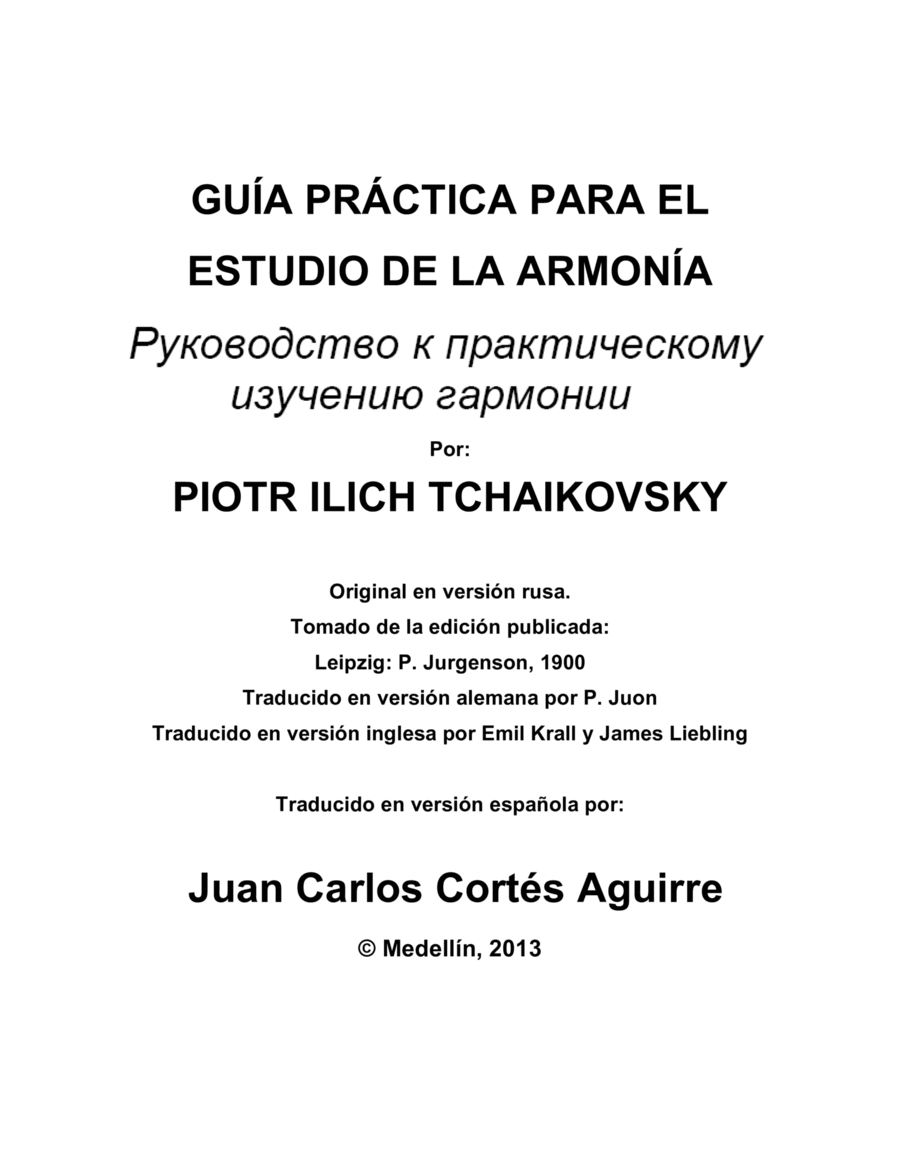
Guía práctica para el estudio de la armonía - Piotr Ilich Tchaikovsky
Chorale SATB

$39.99 34.85 € Chorale SATB PDF SheetMusicPlus


Partitions Gratuites
Acheter des Partitions Musicales
Acheter des Partitions Digitales à Imprimer
Acheter des Instruments de Musique

© 2000 - 2026

Accueil - Version intégrale





