EUROPE
32391 articles
USA
0 articles
DIGITAL
198410 articles (à imprimer)
Partitions Digitales
Partitions à imprimer
198410 partitions trouvées


Woodwind Ensemble Bassoon - Level 5 - Digital Download SKU: A0.755244 Composed by Sy Brandon. 20th Century,Contemporary. 47 pages. Sy Brandon #3590241. Published by Sy Brandon (A0.755244). Cycles for bassoon quartet honors those who lost loved ones in the March 2011 earthquake and tsunami in Japan. The title reflects both the living earth upon which we live and the fortitude of humanity.             The first movement depicts serenity interrupted by bombastic resemblances of earthquakes and tsunamis. The movement is called The Living Earth as our planet is still evolving by constantly building up pressure and releasing that pressure. The opening serene section uses key clicks and wind sounds in the serenity section. Pitch bends in the melody are designed to resemble a shakuhachi. Syncopated explosions that use polytonal pentatonic scales represent the earthquake. Rapid ascending and descending scale patterns depict the resultant tsunami.             The second movement is a hymn song for the souls of the dead. It is called Ashes to Ashes as it represents a different cycle, one of death and rebirth. Pentatonic scales abound once again but this time they modulate gently from one tonality to another instead of being used simultaneously.             A song of redemption and hope for the survivors is the theme for the third and final movement, Resiliency of the Spirit. It depicts the strength of the human spirit and it is the cycle of joy growing out of sorrow. Taiko drumming is the major influence in this movement. It begins with a foot stomp followed by the drummers warming up. A staccato rhythmic section that imitates the drums follows this. A hymn-like theme in pentatonic is interpolated over this rhythmic drumming bringing the movement and the piece to a hopeful conclusion.
Cycles for Bassoon Quartet
4 Bassons

$14.99 13.01 € 4 Bassons PDF SheetMusicPlus

Woodwind Ensemble,Woodwind Trio Bassoon - Level 2 - Digital Download SKU: A0.1142125 Composed by Ludwig van Beethoven. Arranged by Ander. Classical,Instructional,Opera,Romantic Period,Traditional. 11 pages. Woods Only, Arrangements #742503. Published by Woods Only, Arrangements (A0.1142125). This adaptation was intended for a small group of bassoon trio, where the original essence of the piece was kept, however, with a reduction in the duration, where only the main themes of the opening were extracted. As it is simplified, it is intended for beginner students of instrumental music who want to enter orchestral music, even in a simplified and reduced form, and can be used by music teachers with their students in ensemble practice in situations such as academic recitals, didactic concerts, or assessment tests. The Symphony No. 5 in C minor, Op. 67, known as the Symphony of Destiny, by Ludwig van Beethoven, written between 1804 and 1808, is one of the most popular and best known compositions in the entire repertoire of European music. The four movements are characterized by orchestral homogeneity, being, at the same time, an example of alternation: the first movement, revealing great tension, denounced by the strings and raised to an extreme drama; the second movement reveals solemnity, in a funeral march that rises by its emotion and beauty; the third movement, a crispness; the fourth movement expresses triumph and magnificence.
Symphony No. 5 by Beethoven for Bassoon Trio
3 Bassons

$5.99 5.2 € 3 Bassons PDF SheetMusicPlus

Instrumental Duet Bassoon,Instrumental Duet - Level 3 - Digital Download SKU: A0.734469 Composed by Samuel E. Goldfarb (1891 -1978). Arranged by Dennis Ruello. 20th Century,Children,Holiday,Jewish,World. Score and parts. 3 pages. Chicory Music #5795181. Published by Chicory Music (A0.734469). The Dreidel Song (Traditional Hanukkah Tune)The song I Have a Little Dreidel describes the creation of the four-sided spinning top that is used to play the traditional game of dreidel during the Festival of Lights. With its catchy, cheerful and spirited tune and simple to remember lyrics, the song quickly became a holiday classic. This arrangement for Bassoon duet is written at the Intermediate Level.Performance Time Approx. 2 minutes 5 seconds.
The Dreidel Song - Bassoon Duet - Intermediate
2 Bassons (duo)

$2.99 2.59 € 2 Bassons (duo) PDF SheetMusicPlus

Woodwind Ensemble,Woodwind Quintet Bassoon - Level 3 - Digital Download SKU: A0.1128141 Composed by Ludwig van Beethoven. Arranged by Ander. Classical,Folk,March,Opera,Romantic Period. 12 pages. Woods Only, Arrangements #728756. Published by Woods Only, Arrangements (A0.1128141). This arrangement adapted for bassoon quintet was written keeping the characteristics of the original work, in order to be performed by young music students who want to enter the symphonic music. Besides, it can also be used by professional musicians for recitals, repertoire, academic presentations and didactic material. The transcription remains faithful to the structure, with only one change in tone, so that it is comfortable for all the instruments in the formation, as well as being used as an activity in ensemble practice among musicians of different traditions. Beethoven's Turkish March (Op. 113) is the 4th movement of the operatic work: The Ruins of Athens, a set of incidental pieces written in 1812 by Ludwig van Beethoven, where the melody was originally written in 1809 as Theme with Six Variations for Piano, Op. 76. The work was written to accompany the play of the same name by August von Kotzebue, for the dedication of a new theater in Pest. Perhaps the best known part of the composition is the Marcia alla turca, In Latin America, this movement became known in Jean-Jacques Perrey's version (who titled it The Elephant never Forgets) since it was used as the opening theme of the successful Mexican TV comedy El Chavo del Ocho. The opening and the turkish march are often performed separately, and the other pieces in this set are not often heard.
Turkish March by Beethoven for Bassoon Quintet
5 Bassons

$9.99 8.67 € 5 Bassons PDF SheetMusicPlus

Instrumental Duet Bassoon,Instrumental Duet - Level 1 - Digital Download SKU: A0.548710 Composed by Martin Luther. Arranged by James M. Guthrie. Easter,Instructional,Standards. Score and parts. 4 pages. Jmsgu3 #3411733. Published by jmsgu3 (A0.548710). Out of the Depths I Cry to You by Martin Luther arranged for bassoon & piano. The first verses feature modified counterpoint and harmony proceeding at quarter = 82. The final verse is reharmonized for maximum dramatic effect at a more contemplative tempo such as quarter = 64. Features the entire range of the instrument. Very powerful selection for Lent or Easter. Duration (3 verses) 3:05, 36 ms. Score: 3 pg. Solo part: 1 pg. The piano reads from the score. Out of the Depths Aus tiefer Not schrei ich zu dir (From deep affliction I cry out to you), is, of course, a hymn composed by Martin Luther. Moreover, Luther also wrote the lyrics, essentially a paraphrase of Psalm 130. First published in 1524, it is also one of eight songs in the original Lutheran hymnal. It appears likewise in many hymnals and in different translations. The lyrics furthermore stimulated compositions from the Renaissance to the contemporary. Consequently, composers such as Johann Sebastian Bach built an entire chorale cantata on it. Other composers similarly contributed pieces, such as Felix Mendelssohn and Max Reger. Luther Background Martin Luther, (1483 –1546) was a German professor of theology, composer, priest, and moreover, an influential character in the Protestant Reformation. Luther had a momentous impact on church and society due to his contributions to the musical arts. He wanted to disseminate the gospel among mankind and with this intention thought that the best way to do that was through music. Influence It is important to realize that other musicians, and their descendants, were encouraged by Luther’s songs and wrote their own hymns. Luther, to be sure, had a thorough musical education. For example, he knew secular and sacred songs from an early age. He, in particular, played the lute well and sang in the monastery when he was a monk. That is to say, music was an essential part of his life. He in fact first began writing songs in 1523, sometimes writing the melody as well as the lyrics. Luther was certainly able to evaluate the composers of his time. He thought especially highly of Josquin des and Ludwig Senfl. He was also acquainted, with this in mind, with other composers and their works. Legacy The Lutheran musical ethos soon covered all of Germany and later significantly fashioned Protestant musical culture. Heinrich Schütz and Johann Sebastian Bach are the most compelling evidence of this Protestant musical culture. Additionally, as a point often overlooked, the pedal organ, first refined in northern Germany, became universally prevalent. As a matter of fact, Dieterich Buxtehude established a regular evening organ concert series in Lübeck. Another key point is that this concert series, in turn, spread North German Musical ideas worldwide. Luther was especially convinced that music is a beautiful and exclusive offering of the divine.
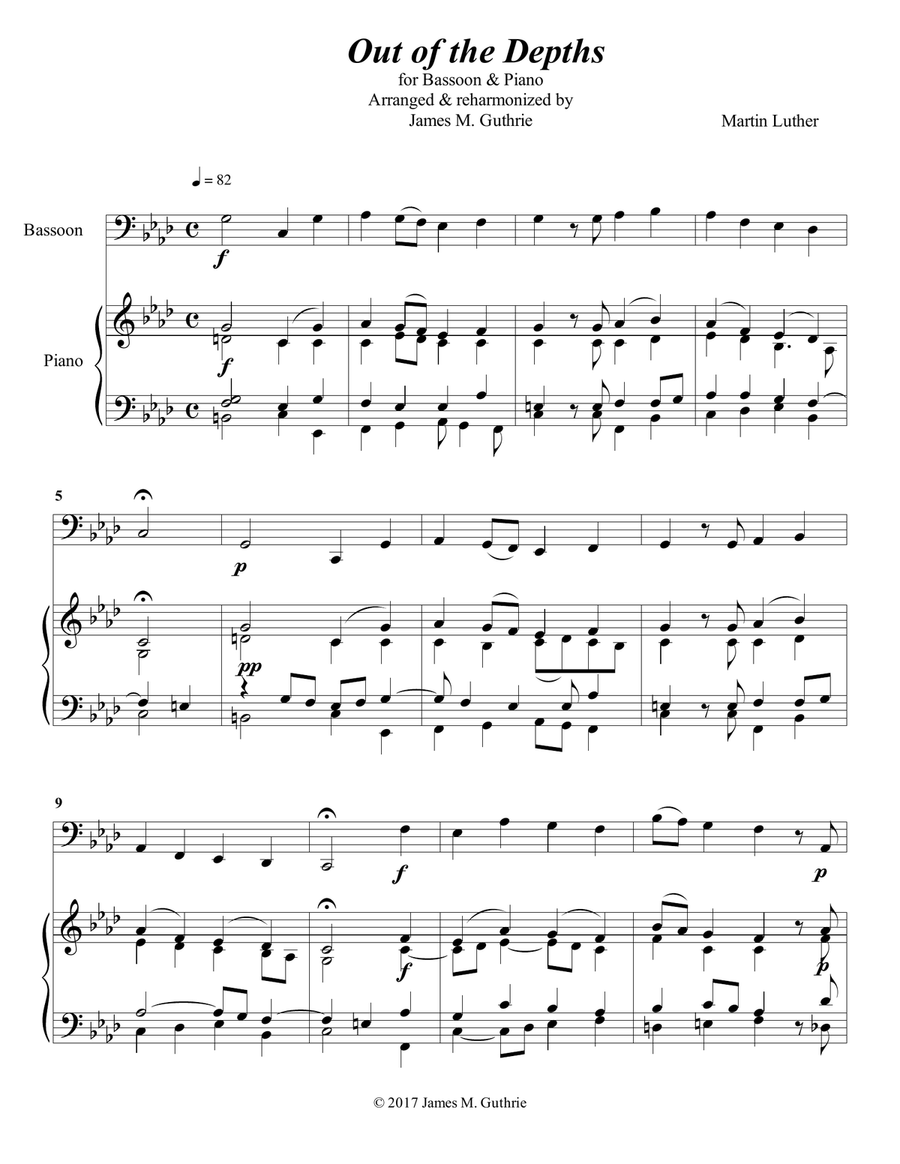
Luther: Out of the Depths for Bassoon & Piano
2 Bassons (duo)

$24.95 21.65 € 2 Bassons (duo) PDF SheetMusicPlus


Partitions Gratuites
Acheter des Partitions Musicales
Acheter des Partitions Digitales à Imprimer
Acheter des Instruments de Musique

© 2000 - 2026

Accueil - Version intégrale





