EUROPE
3528 articles
USA
5946 articles
DIGITAL
8272 articles (à imprimer)
Partitions Digitales
Partitions à imprimer
8272 partitions trouvées


Full Orchestra - Level 2 - Digital Download SKU: A0.1224099 Composed by Juan María Solare. 19th Century,20th Century,21st Century,Classical,Instructional. Score and Parts. 20 pages. Juan Maria Solare #820190. Published by Juan Maria Solare (A0.1224099). Orchestraining is a cycle of orchestral studies, each of which focuses on different aspects of performance. These studies are specifically designed for non-professional orchestras, although any orchestra will improve by playing some of these pieces during rehearsals. It is always necessary to pay attention to intonation and many other aspects of orchestral performance.In addition, these studies are also useful for orchestral conducting students. For example, it is essential to know how to conduct a simultaneous attack of a chord that does not begin on the first beat, but a eighth note after the third beat.I began writing these studies around 2013, when I took over the direction of the Bremer Orchestergemeinschaft and noticed the complete absence of repertoire of this kind. As a pianist, I am accustomed to studies by Carl Czerny or playing scales. Each individual instrumentalist knows studies of technique for their instrument. However, there are no, or at least I am not aware of, similar studies for orchestral performance technique and the specific difficulties of ensemble playing that it requires. The cycle Orchestraining aims to fill this gap.The particular study Orchestraining Nr. 01 focuses on the subject of simultaneous attacks, presenting a series of staccato chords in different parts of the bar. The piece will be played twice, with different dynamics and (partly) different performing techniques (particularly in the strings: pizzicato vs. arco).Orchestraining No. 01 - simultaneous attacks*Orchestraining es un ciclo de estudios orquestales, cada uno de los cuales tematiza diferentes aspectos de la ejecución. Estos estudios están concebidos específicamente para orquestas no profesionales; sin embargo, cualquier orquesta mejorará si toca alguna de estas piezas durante los ensayos. Siempre es necesario cuidar la afinación y muchos otros aspectos de la ejecución orquestal.Adicionalmente, estos estudios son también útiles para estudiantes de dirección orquestal. Por ejemplo, es imprescindible saber cómo dirigir un ataque simultáneo de un acorde que no comienza en el uno, sino una corchea después del tercer tiempo.Comencé a escribir estos estudios hacia 2013, cuando asumí la dirección de la Bremer Orchestergemeinschaft y noté la ausencia total de repertorio de este tipo. Como pianista estoy acostumbrado a los estudios de Carl Czerny o a tocar escalas. Cada instrumentista, individualmente, conoce sobradamente estudios de técnica para su instrumento. Sin embargo no existen, o no conozco, estudios similares para la técnica de ejecución orquestal y las dificultades específicas de ensamblaje que ésta requiere. El ciclo Orchestraining intenta cubrir esta laguna.El estudio Orchestraining Nr. 01 en particular trata el tema de los ataques simultáneos, presentando una serie de acordes staccato en distintas partes del compás. La obra se tocará dos veces, con distintas dinámicas y (en parte) con distintas técnicas de ejecución (particularmente en las cuerdas: pizzicato vs. arco).
Orchestraining No. 01 [Orchestra]
Orchestre

$5.00 4.3 € Orchestre PDF SheetMusicPlus

Chamber Orchestra - Level 3 - Digital Download SKU: A0.1432026 By Juan Maria Solare. By Juan Maria Solare. Arranged by Juan Maria Solare. 20th Century,Classical,Contemporary,Historic,Instructional. 15 pages. Juan Maria Solare #1012506. Published by Juan Maria Solare (A0.1432026). Orchestraining is a cycle of orchestral studies, each focusing on different aspects of performance. These studies are specifically designed for non-professional orchestras, although any orchestra will improve by playing some of these pieces during rehearsals. It is always necessary to pay attention to intonation and many other aspects of orchestral performance.In addition, these studies are also useful for orchestral conducting students. For example, it is essential to know how to conduct a simultaneous attack of a chord that does not begin on the first beat, but a eighth note after the third beat.I began writing these studies around 2013, when I took over the direction of the Bremer Orchestergemeinschaft and noticed the complete absence of repertoire of this kind. As a pianist, I am accustomed to studies by Carl Czerny or playing scales. Each individual instrumentalist knows studies of technique for their instrument. However, there are no, or at least I am not aware of, similar studies for orchestral performance technique and the specific difficulties of ensemble playing that it requires. The cycle Orchestraining aims to fill this gap.The fourth etude focuses on dynamics: crescendi and diminuendi, exploring the extremes forte vs piano and gradually changing from one to the other one.
Orchestraining No. 4 [Orchestra]
Orchestre de chambre
Juan Maria Solare
$5.00 4.3 € Orchestre de chambre PDF SheetMusicPlus

Cello,Instrumental Duet,Violin - Level 3 - Digital Download SKU: A0.526236 By Jonas Brothers. By Adam Feeney, Carl Rosen, Frank Dukes, Homer Steinweiss, Joe Jonas, Joseph Jonas, Kevin Jonas, Louis Bell, Miles Ale, Mustafa Ahmed, Nick Jonas, and Ryan Tedder. Arranged by Sarah Cellobat Chaffee. Contemporary,Pop,Wedding. 10 pages. Sarah Cellobat Chaffee #6091587. Published by Sarah Cellobat Chaffee (A0.526236). Sucker, released in March 2019, was the Jonas Brothers' first single together in six years. Due to its danceable beat, dark rhythmic intensity, and catchy melody, it debuted immediately as number one on the Billboard Hot 100 charts - the first number one hit by a boy band since 2003! This song has become one of their most beloved hits, and now you can have a blast playing it with your violin and cello duo! With its catchy vocal lines, driving beat, interesting rhythms, and catch-you-off-guard dynamic contrasts, this Cellobat arrangement delivers all the punch of the original song and is sure to get your audience dancing along! Playable for intermediate students and easily sightreadable for professionals -- this chart isn't difficult to play, but it's definitely a lot of fun. :) Sarah “Cellobat†Chaffee is an in-demand acoustic & electric cellist and string arranger. Currently, she performs with legendary rock band Aerosmith in their “Deuces Are Wild†residency show, and she is the principal cellist for the Raiders House Band, playing for a crowd of 60,000 at all of the team's home games. She also plays with many other groups including Premiere Wedding Music, Bella Electric Strings, the Femmes Of Rock, and David Perrico’s Pop Strings Orchestra. Sarah has performed and recorded with numerous other artists including Disturbed, Mötley Crüe, Celine Dion, Halsey, Michael Bublé, Sarah Brightman, and Lady A. She is the exclusive arranger for a number of award-winning wedding and event companies all across the United States, including Premiere Wedding Music, Las Vegas Music Oasis, and Impulse Strings, and she has created custom arrangements for many other ensembles all over the world. You can find her at:http://www.cellobat.comhttp://www.instagram.com/cellobathttps://www.youtube.com/@Cellobat
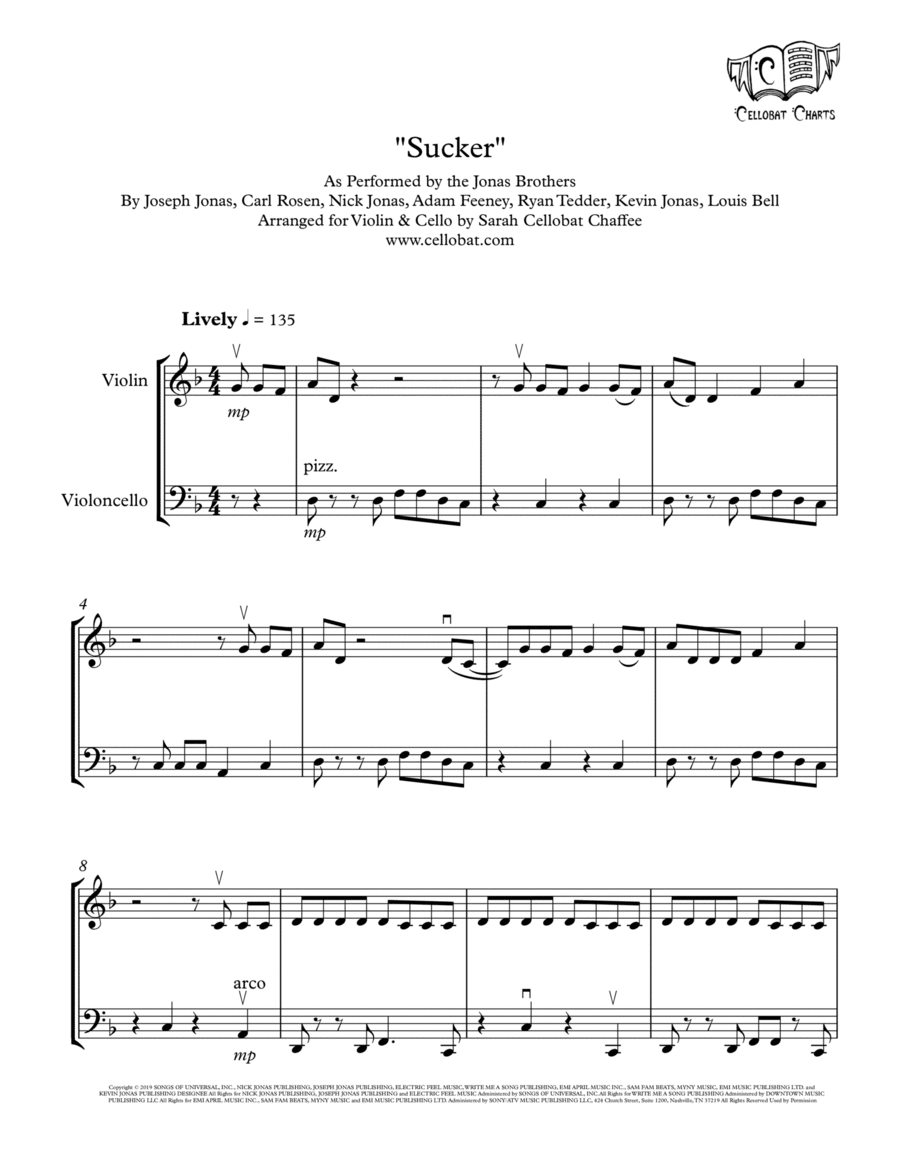
Sucker
Violon, Violoncelle (duo)
Jonas Brothers
$9.99 8.6 € Violon, Violoncelle (duo) PDF SheetMusicPlus

Guitar - Level 2 - Digital Download SKU: A0.841182 By James Taylor. By James Taylor. Arranged by John Murphy C.S.M.V. Rock. Guitar Tab. 4 pages. John Murphy #5793051. Published by John Murphy (A0.841182). You can close your eyes     James TaylorLearn this classic James Taylor song and master his characteristic finger picking guitar technique.You will learn: 4/4 Fingerpicking rhythm patterns that you can use in many other songs and other genres.Popular and widely used great guitar chord inversions (also sometimes called slash chords, e.g. G/B )to create interesting bass lines that complement the melody of the tune and give direction and forward momentum to the song’s chord progression. Bass driven chord progressions are a characteristic feature of accomplished guitarists like James Taylor and Chet Atkins.‘Clawhammer’ technique or ‘Travis picking’ are the names often given to a style of playing four bass notes to the bar (usually alternating from root to fifth of the chord played with the R.H.thumb). If you listen to the great country guitarist Chet Atkins you will hear this ‘clawhammer’ style in most of his guitar arrangements.Useful hammer-ons/pull-offs and passing notes that will improve your technique and add a professional touch to enhance your guitar performances. See bar for 8 hammer on the A sus chord and also on the B minor in bar 32. Note the pull off on G chord in bar 11.Intro and outro sections are included in this James Taylor guitar arrangement of ‘You can close your eyes’Most songs have intros and outros so that the singer can get the tempo and start in the right key. However, many published arrangements often just start on a pick-up note or two on the last beat of the bar with no chord indicated and end the song on a chord that is not the tonic or main key chord that tells the listener the song has ended. ‘Leaving On A Jet Plane’ by John Denver is a good example. In the key of ‘D’ the song starts with the notes ‘C#’ and ‘E’ and then the first bar is indicated as ‘D’ major chord. If you start the song playing a ‘D’ chord you will most likely sing the wrong notes because ‘C#’ and ‘E’ belong to the A7 chord of the song. So a simple 2 bar intro of ‘D’ , A7 (start singing on the last beat) and back to ‘D’ would help the singer to get the tempo and sing the correct pick-up notes. The printed sheet music of ‘Leaving On A Jet Plane’ ends on an ‘A7’ chord of the chorus and as such does not indicate that the end chord should be ‘D’. So it is not always safe to assume that the end chord in printed music indicates the key of the song. Lyrics with chord symbols to show when to change chords. Matching the fingerpicking tab or sheet music to the lyrics can sometimes prove difficult so I have included a lyrics sheet of ‘You can close your eyes’ with chord symbols. This is a very popular format to give an indication when to change chords. However, the drawback is that there is no way of knowing how long each chord lasts as the bar structure is missing. But once you learn the bar structure from the sheet music or tab part you will find this Lyrics and chords sheet of ‘You can close your eyes’ your go to page for performing the song until you know it from memory.Downloads available Include:Score Tab Chords Lyrics For GuitarNotes Chords Lyrics For GuitarTab Chords Lyrics For GuitarIf you like or buy this arrangement it helps if you leave even a brief review- two words( very good) or even better one word (Awesome) :)Contact me at info@guitarlessonsdundrum.comTags :    Sheet music, Tab,  Pop/Rock, Folk , Country, Acoustic Guitar,  Easy  Intermediate
You Can Close Your Eyes
Guitare notes et tablatures
James Taylor
$5.99 5.16 € Guitare notes et tablatures PDF SheetMusicPlus

Guitar - Level 3 - Digital Download SKU: A0.841181 By James Taylor. By James Taylor. Arranged by John Murphy C.S.M.V. Rock. Guitar Tab. 4 pages. John Murphy #5793043. Published by John Murphy (A0.841181). You can close your eyes     James TaylorLearn this classic James Taylor song and master his characteristic finger picking guitar technique.You will learn: 4/4 Fingerpicking rhythm patterns that you can use in many other songs and other genres.Popular and widely used great guitar chord inversions (also sometimes called slash chords, e.g. G/B )to create interesting bass lines that complement the melody of the tune and give direction and forward momentum to the song’s chord progression. Bass driven chord progressions are a characteristic feature of accomplished guitarists like James Taylor and Chet Atkins.‘Clawhammer’ technique or ‘Travis picking’ are the names often given to a style of playing four bass notes to the bar (usually alternating from root to fifth of the chord played with the R.H.thumb). If you listen to the great country guitarist Chet Atkins you will hear this ‘clawhammer’ style in most of his guitar arrangements.Useful hammer-ons/pull-offs and passing notes that will improve your technique and add a professional touch to enhance your guitar performances. See bar for 8 hammer on the A sus chord and also on the B minor in bar 32. Note the pull off on G chord in bar 11.Intro and outro sections are included in this James Taylor guitar arrangement of ‘You can close your eyes’Most songs have intros and outros so that the singer can get the tempo and start in the right key. However, many published arrangements often just start on a pick-up note or two on the last beat of the bar with no chord indicated and end the song on a chord that is not the tonic or main key chord that tells the listener the song has ended. ‘Leaving On A Jet Plane’ by John Denver is a good example. In the key of ‘D’ the song starts with the notes ‘C#’ and ‘E’ and then the first bar is indicated as ‘D’ major chord. If you start the song playing a ‘D’ chord you will most likely sing the wrong notes because ‘C#’ and ‘E’ belong to the A7 chord of the song. So a simple 2 bar intro of ‘D’ , A7 (start singing on the last beat) and back to ‘D’ would help the singer to get the tempo and sing the correct pick-up notes. The printed sheet music of ‘Leaving On A Jet Plane’ ends on an ‘A7’ chord of the chorus and as such does not indicate that the end chord should be ‘D’. So it is not always safe to assume that the end chord in printed music indicates the key of the song. Lyrics with chord symbols to show when to change chords. Matching the fingerpicking tab or sheet music to the lyrics can sometimes prove difficult so I have included a lyrics sheet of ‘You can close your eyes’ with chord symbols. This is a very popular format to give an indication when to change chords. However, the drawback is that there is no way of knowing how long each chord lasts as the bar structure is missing. But once you learn the bar structure from the sheet music or tab part you will find this Lyrics and chords sheet of ‘You can close your eyes’ your go to page for performing the song until you know it from memory.Downloads available Include:Score Tab Chords Lyrics For GuitarNotes Chords Lyrics  For GuitarTab Chords Lyrics  For GuitarIf you like or buy this arrangement it helps if you leave even a brief review- two words( very good) or even better one word (Awesome) :)Contact me at info@guitarlessonsdundrum.com
You Can Close Your Eyes
Guitare notes et tablatures
James Taylor
$5.99 5.16 € Guitare notes et tablatures PDF SheetMusicPlus

Piano,Vocal,Voice - Level 2 - Digital Download SKU: A0.1353795 Composed by Anon. Arranged by Phil Beaman. Advent,Christmas,Jazz,Renaissance. Score. 3 pages. Phil Beaman #938564. Published by Phil Beaman (A0.1353795). This jazz composition is based on the hauntingly beautiful 15th century medieval tune that is commonly used for the Advent carol O Come, O Come, Emmanuel.  I have reharmonized it with the accompaniment in a Key Signature a fifth above that of the melody.  The accompaniment has a broken two chord ostinato throughout written as a walking bass line.  I have altered the melody and moved much of it to the off beats.  As in period early music, I allow occassional dissonances in order to keep the ostinato.  I have chosen 4 of the many historic verses that are more inclusive and general.  This piece makes a wonderfully useful and unique addition to the season's repertoire.  (I have also published several versions on this site for flute or clarinet solo using various instrumental accompaniments as a duet.)  (Also as a piano solo.)range - melody - 10th, low B to D3 pages score;  3:17 minutes.
O Come, Emmanuel - jazz mezzo-soprano voice and piano
Piano, Voix

$4.99 4.3 € Piano, Voix PDF SheetMusicPlus

Piano Solo - Level 4 - Digital Download SKU: A0.984709 Composed by Ludwig van Beethoven. Arranged by John M. Honeycutt. Romantic Period. Score. 10 pages. Music Innovators Workshop #4357661. Published by Music Innovators Workshop (A0.984709). The great piece is notated on a key map tablature.This piece is notated on a vertically oriented tablature called a key map. Key maps are intended to SHOW you (visually) which keys to play by matching (mapping) the locations of the keys on the keyboard. >>> The group of 12 keys from Middle C up to B form what we call the green Octave Group. (There are 7 of these identical groups on the piano distinguished by their colors and locations.) The key map staff is based on an octave group of the keyboard. For each key map octave group, the 5 vertical lines of the staff stand for the 5 matching black KEYS. >>> Staff lines ARE SPACED to match the horizontal spacing of the black keys on the keyboard The notes for black keys are placed ON these staff lines. The notes for the white keys are placed BETWEEN the lines. >>> The notes of a key map move to the left and right to indicate change in PITCH and down the page to indicate the passing of TIME (rhythm). The vertical length of each note is proportional to the time (in beats) that the sound requires.If you want to know more about this beautiful key map notation, you might consider reviewing our article describing how this notation works, entitled: Getting Started With Key Maps for the Piano. It contains an explanation of how key maps work and includes a number of examples. 16 pages. It is promotionally priced at only $1.99. (Actually, you can read the fist few pages simply by going to the look inside pages of the article.)
Beethoven - The Smaller Rondo in C Major - (Key Map Tablature)
Piano seul

$2.00 1.72 € Piano seul PDF SheetMusicPlus

Small Ensemble Baritone Recorder,Bassoon,Cello - Level 3 - Digital Download SKU: A0.842536 Composed by Various (Collection). Arranged by B. Brennan. Concert,Instructional,Romantic Period,Standards. Score and parts. 24 pages. Bl_music #5290001. Published by bl_music (A0.842536). Calisthenics for Bass Recorder 15 Solo-Etudes, Gallops, Polkas, Variations (notation: bass clef)15 entertaining solo-etudes: Rondos, Polkas, Gallops, Variations….. all suitable for intermediate to advanced students as well as professionals; as exercises for the fingers, just for the fun of it or as (shorter) concert /contest pieces or encores.What are Calisthenics?You’ve all come across them in one form or another….mainly probably in caricatures of Victorian or Edwardian men in boldly striped sportswear lifting heavy weights or Victorian ladies elegantly waving their arms around(see photo)We found the idea of daily exercises in combination with utterly lovely tunes so intriguing that we decided to call our latest publication CalisthenicsThe music combines training of speed, thumb technique, interpretation. Short: another great fun and educational publication.The word calisthenics is derived from the Greek, kalos, beautiful; and sthenos, strength; the object of calisthenic exercises being to secure physical beauty by developing the limbs and muscles of the human frame, and making the joints flexible, thereby giving strength and power, and ensuring a graceful carriage, erect bearing, and freedom to the figure.In the words of the old Victorians:The highest refinement of that beauty is unattainable without splendour of activity and delicate strength.Exercise is now recognised to be as great a necessity in woman's education as in man's we are learning that many bodily defects and much of her weak health is attributable to the want of it; more especially in youth, when the frame is growing.Such exercises must, however, be carried out under a system; irregularly conducted, they do more harm than good. The constitution must be coaxed, not strained; the strength not unduly taxed, no over-fatigue ensuing; for exhaustion makes people look worn and old. The exertion must not be too violent, and the health and physical development of each pupil must be specially studied.Early morning or evening are the best times to select, but on no account immediately after a meal. The clothing should not be too warm, nor interfere in any way with the action of the limbs.A musical accompaniment will best preserve the necessary rhythm - the time, four or eight beats to a bar; failing this, the pupils should be taught to sing or count in concert, thereby keeping up their interest and zest. A castanet will, failing better means, help to mark the time with or without music. One of our aims is to revive these compositions and bring them to the attention of players and audiences.
"Calisthenics for Bass Recorder" 15 Etudes, Gallops, Polkas, Variations

$15.99 13.76 € PDF SheetMusicPlus

Full Orchestra - Digital Download SKU: A0.617904 Composed by Amphibia Cultural Legacy. Arranged by Britney Taylor. 20th Century,Broadway,Classical,Contemporary,Musical/Show,Opera. Score and parts. 2 pages. Amphibia Cultural Legacy #227055. Published by Amphibia Cultural Legacy (A0.617904). Victory Music is a new sensation that has overtaken the music industry. It is an orchestral cover remixed with additional instruments by Amphibia Cultural Legacy based on the popular children's song, Head Shoulders Knees and Toes, by TabTale. This creative masterpiece combines classical instruments with modern elements like EDM beats and electronic synths.The result is a unique sound that will leave you feeling energized and triumphant. The arrangement of different instruments creates a harmonious melody that awakens your senses from the song's beginning. The composition also features powerful percussion sounds that give listeners a sense of adrenaline rush.Victory Music pays tribute to the original Head Shoulders Knees and Toes track while elevating it to new heights with its catchy tune.
Victory Music
Orchestre

$26.00 22.38 € Orchestre PDF SheetMusicPlus

Mixed Percussion B-Flat Tuba,B-Flat trombone,Baritone Horn TC/Euphonium,Bass Trombone,E-Flat Cornet,E-Flat Tenor Horn,E-Flat Tuba TC,Flugelhorn,Percussion 1,Percussion 2,Tenor Trombone - Level 5 - Digital Download SKU: A0.1488809 Composed by David Woodcock. 21st Century,Classical,Contemporary. Brass Band. 110 pages. David Woodcock #1065660. Published by David Woodcock (A0.1488809). Twin PolaritiesThis work challenges the audience from a musicological perspective. It residescomfortably in two worlds: that of the diatonic system, which is key-centric andhas harmonic parameters, as distinct from the world of chromaticism, whichtranscends the harmonic boundaries of the diatonic playing field. Combined,these two polarities create an inherent pervading ambiguity.The work’s structure could be loosely defined as ABA, with A being spikey andfrenetic using many compositional devices in a unified manner, with powerfulrhythmic motifs. The use of accents on the off beats, the use of slurs, staccato andtenuto and the use of syncopation both within and across the bar, all adds to themaelstrom and energy that pervades this piece. This frenetic energy is enhancedby motifs which are rhythmically augmented. Amongst all the chromaticism, therepeated semiquaver is arresting, simply because it is not chromatic and providesa brief aural respite. The B section has essentially long melodic legato phrases,which are a counterweight to the opening, and the return of the energy of A. Theseemingly innocuous repeated semiquaver ultimately has the final word.One is left with the impression that diatonic or chromatic, legato or staccato, thatsyncopation and accents, are all so much a part of the language of music that theyare both a unifying and fragmenting force which create inseparable polarities.
Twin Polarities for Brass Band

$74.99 64.55 € PDF SheetMusicPlus

Large Ensemble Alto Saxophone,Baritone Saxophone,Clarinet,Flute,Oboe,Soprano Recorder,Soprano Saxophone,Tenor Recorder,Tenor Saxophone - Level 3 - Digital Download SKU: A0.842537 Composed by Various (Collection). Arranged by B. Brennan. Concert,Instructional,Romantic Period,Standards. Score and parts. 24 pages. Bl_music #5290007. Published by bl_music (A0.842537). Calisthenics for Recorders in C 15 Solo-Etudes, Gallops, Polkas, Variations (notation: treble clef) 15 entertaining solo-etudes: Rondos, Polkas, Gallops, Variations….. all suitable for intermediate to advanced students as well as professionals; as exercises for the fingers, just for the fun of it or as (shorter) concert /contest pieces or encores. What are Calisthenics? You’ve all come across them in one form or another….mainly probably in caricatures of Victorian or Edwardian men in boldly striped sportswear lifting heavy weights or Victorian ladies elegantly waving their arms around(see photo) We found the idea of daily exercises in combination with utterly lovely tunes so intriguing that we decided to call our latest publication Calisthenics The music combines training of speed, thumb technique, interpretation. Short: another great fun and educational publication. The word calisthenics is derived from the Greek, kalos, beautiful; and sthenos, strength; the object of calisthenic exercises being to secure physical beauty by developing the limbs and muscles of the human frame, and making the joints flexible, thereby giving strength and power, and ensuring a graceful carriage, erect bearing, and freedom to the figure. In the words of the old Victorians: The highest refinement of that beauty is unattainable without splendour of activity and delicate strength. Exercise is now recognised to be as great a necessity in woman's education as in man's we are learning that many bodily defects and much of her weak health is attributable to the want of it; more especially in youth, when the frame is growing. Such exercises must, however, be carried out under a system; irregularly conducted, they do more harm than good. The constitution must be coaxed, not strained; the strength not unduly taxed, no over-fatigue ensuing; for exhaustion makes people look worn and old. The exertion must not be too violent, and the health and physical development of each pupil must be specially studied. Early morning or evening are the best times to select, but on no account immediately after a meal. The clothing should not be too warm, nor interfere in any way with the action of the limbs. A musical accompaniment will best preserve the necessary rhythm - the time, four or eight beats to a bar; failing this, the pupils should be taught to sing or count in concert, thereby keeping up their interest and zest. A castanet will, failing better means, help to mark the time with or without music. One of our aims is to revive these compositions and bring them to the attention of players and audiences.
"Calisthenics for Recorders in C" 15 Fun Studies,Gallops,Polkas,Variations

$15.99 13.76 € PDF SheetMusicPlus

String Orchestra - Level 2 - Digital Download SKU: A0.919914 Composed by Mykola Leontovych. Arranged by William E. Moats. Christmas. 15 pages. William E. Moats #4370180. Published by William E. Moats (A0.919914). This arrangement for Young String Orchestra of the traditional Bell Carol is written in the key of D minor.   It is all bowed and is intended to move along at a pace of 112 beats per minute and runs about two minutes.   All parts have some notes that should be played détaché . The violins have the eighth note runs in the bridge section each time, requiring B naturals and C sharps.  Although the carol was composed by Mykola Leontovych in the early 1900's, it is based on a four note ostinato taken from ancient Ukranian folk sources.  The piano part is not necessary for performance but can be used to add rhythmic, melodic and harmonic reinforcement.  The .pdf parts file contains:  Score, 1st Violin, 2nd Violin, Viola, Cello, Double Bass, & Piano.  
Carol of the Bells
Orchestre à Cordes

$8.00 6.89 € Orchestre à Cordes PDF SheetMusicPlus

Piano Solo - Level 3 - Digital Download SKU: A0.862446 Composed by Michael Bomier. Contemporary,Standards. Score. 2 pages. Michael Butkus-Bomier #2007883. Published by Michael Butkus-Bomier (A0.862446). A Minimalist piece, using a constant 16th note figure in the R.H. as the L.H. plays low in the bass clef and high in the treble, on beats One and Three. Two alternate fingerings are provided for the R.H. part, so that the player can vary it to avoid fatigue. Each repetition should have a change of the sustain pedal. The tune marches up and down the Bb major scale, with a chromatic F# providing minimal contrast in the middle of the piece. Each new melody tone is introduced along with the preceding one, as a dyad,and then the leading note plays alone, followed by the next new dyad, except for the lone color-tone F#, which is presented by itself. It concludes with a coda that has the upper L.H. note staying on F, whilst the lower one proceeds down to Bb, and One Note Beyond, to A. Each measure is repeated three times. Approx. duration 3 mins 15-30 secs. Typical Minimalist features, and Counting each measure's repetitions is essential!
Prelude No. 21 in Bb Major from 24 Preludes
Piano seul

$1.99 1.71 € Piano seul PDF SheetMusicPlus

Marching Band - Level 3 - Digital Download SKU: A0.1245380 By Juan Luis Guerra. By Juan Luis Guerra. Arranged by Elisa Rangel Hill. Latin,Multicultural,Standards,World. Score and Parts. 69 pages. Cunaguaro Music #840258. Published by Cunaguaro Music (A0.1245380). Las Avispas by Juan Luis Guerra is a popular song known for its energetic and lively musical arrangement. This catchy tune, released in 2001, combines elements of merengue, bachata, and other Caribbean rhythms, creating a unique and vibrant sound.The instrumental version of Las Avispas is perfect for marching bands looking to add a touch of Latin flavor to their repertoire. The song's lively rhythms, catchy melodies, and infectious beats make it an ideal choice for performances that aim to engage and energize the audience.With its dynamic brass section, pulsating percussion, and rhythmic guitar lines, the instrumental arrangement of Las Avispas captures the essence of Juan Luis Guerra's original recording. It offers marching bands an opportunity to showcase their musicianship and bring a festive and celebratory atmosphere to any event or parade.The song's melodic hooks and memorable chorus provide ample opportunities for engaging choreography and synchronized movements, allowing the marching band to captivate both the ears and eyes of the audience.By choosing to perform the instrumental version of Las Avispas, marching bands can infuse their repertoire with a lively Latin vibe, offering a refreshing and exhilarating experience for both performers and spectators.In summary, the instrumental version of Las Avispas is an energetic and vibrant choice for marching bands. With its lively rhythms, catchy melodies, and engaging instrumentation, this arrangement allows bands to showcase their talent while infusing their performances with the infectious spirit of Latin music.
Las Avispas
Fanfare
Juan Luis Guerra
$49.99 43.03 € Fanfare PDF SheetMusicPlus


Partitions Gratuites
Acheter des Partitions Musicales
Acheter des Partitions Digitales à Imprimer
Acheter des Instruments de Musique

© 2000 - 2026

Accueil - Version intégrale





