EUROPE
1842 articles
USA
0 articles
DIGITAL
5989 articles (à imprimer)
Partitions Digitales
Partitions à imprimer
5989 partitions trouvées


Brass Quintet Baritone Horn TC,Cornet,Euphonium,Flugelhorn,Trombone,Tuba - Level 3 - Digital Download SKU: A0.1215186 By Keith Terrett. By Williamson. Arranged by Keith Terrett. Patriotic,Praise & Worship,Traditional. 10 pages. Keith Terrett #812052. Published by Keith Terrett (A0.1215186). An arrangement of the Scottish National Anthem for Brass Band Quintet. A constituent nation of the United Kingdom, Scotland lacks an official, legislated national song; in fact there are several songs in use as national songs of Scotland. The one most often considered as the unofficial national anthem (and most often presented as Scotland’s anthem at sporting matches) is Flower of Scotland, written by Roy Williamson in 1965 for the popular folk group The Corries. It was first used in a sporting match in 1974 by the Scottish national rugby team in 1974, sung by the team. When the British God Save the Queen was sung before a rugby match in 1988 to represent Scotland, and was met by derision from the crowd, Flower of Scotland was adopted as Scotland’s pregame anthem. Flower of Scotland, however, has not been adopted in any official basis as the Scottish anthem. Other popular national songs of Scotland have sometimes used as unofficial national anthems, the most common being Scotland the Brave (a traditional melody (sheet music) with lyrics writted by Cliff Hanley in 1950). Scotland the Brave was used as the Scottish anthem at the Commonwealth Games until 2010 (when it was replaced by Flower of Scotland) and is most commonly heard on the bagpipe, the Scottish national instrument. When the Scottish Parliament was opened in 1997, another national song (A Man’s A Man for A’ That by national poet Robert Burns) was used, which isn’t usually presented as a Scottish anthem. The choice of this song may have been to duck the controversy of choosing one of the previously mentioned national songs as an official regional anthem, or by using God Save the Queen (the anthem of the United Kingdom, of which Scotland is a part). For more of my original music, great arrangements and all the national anthems of the world, check out my on-line stores: http://www.scoreexchange.com/profiles/keith_terret http://musicforalloccasions.org.uk http://www.sheetmusicplus.com/search?Ntt=keith+terrett Need an anthem fast? They are ALL in my store! All my anthem arrangements are also available for Orchestra, Recorders, Saxophones, Wind, Brass and Flexible band. If you need an anthem urgently for an instrumentation not in my store, let me know via e-mail, and I will arrange it for you FOC if possible! keithterrett@gmail.com.
Scottish National Anthem for Brass Band Quintet
Keith Terrett
$8.99 7.8 € PDF SheetMusicPlus

Piano Solo - Level 4 - Digital Download SKU: A0.958601 Composed by Casey Crosby. 20th Century,Celtic,Contemporary,New Age. Score. 5 pages. Casey Crosby #4320309. Published by Casey Crosby (A0.958601). This solo piano song is from Casey Crosby's album November. The album is a personal collection of memories and landscapes of Casey growing up in the Blue Ridge Mountain region of Northern Virginia and a small farming community in rural Upstate New York. The songs are images and observations of Casey's personal experiences of autumn, particularly November. It was a common event between Casey and his older brother to try to capture fireflies in glass jars as the sun set. Being only 4 or 5 years old, you can imagine how magical it must have been for a young boy to see his brother catch these flying creatures in a jar and stare in wonder at how they lit up the night. Sometimes his brother let Casey carry the jar through the forrest before letting them go free. Sometimes Casey got lucky and caught his own and his brother then would exaggerate his level of skill and stealth and hunting technique to their parents on arriving home. It’s the first time Casey remembers feeling a sense of accomplishment. The magical wonder of creation and nature and the eternal bond between brothers – both so easily taken for granted and yet both so easily lost. Surely on Smith Mountain road, Lynchburg, Virginia, even now, those fireflies are putting on their show for free to an enraptured child. The song Chasing Fireflies is about this memory of Casey. Reviewers say that the nostalgic yet hopeful song perfectly captures the flying fireflies and the innocence of a time long since passed.
Chasing Fireflies
Piano seul

$3.99 3.46 € Piano seul PDF SheetMusicPlus

Euphonium - Level 4 - Digital Download SKU: A0.1111655 Composed by Wolfgang Amadeus Mozart. Arranged by Regis Bookshar. Chamber,Christian,Classical,Instructional,Religious. 40 pages. Regis Bookshar #713947. Published by Regis Bookshar (A0.1111655). Recordare (from Requiem (K. 626) - Wolfgang Amadeus Mozart/Franz Xaver Sussmayr - Euphonium Septet - Advanced/Intermediate - Digital Download. Hauntingly beautiful is how the Recordare from Mozart's Requiem is often described. Originally written for an orchestra and four vocal soloists, it has now been transcribed by Regis Bookshar for a Euphonium Septet, and would be a wonderful addition to any music library. This arrangement will provide students with the opportunity to practice breath control because of its long, sustained phrases, and also to give them the chance to play this beautiful composition, something which they may not have had the opportunity to do, otherwise. This selection could be performed for concerts, recitals and church services and is suitable for high school and college students but professional musicians would also enjoy playing this arrangement. Included are a score and a complete set of parts (40 pages) written in Treble Clef. There is also a version written in Bass Clef if you prefer. The Regis Bookshar Trumpet Ensemble has performed the Trumpet Quintet version of the Recordare for funerals, providing beautiful, introspective music for the occasion. There is some controversy surrounding the circumstances of the Requiem's composition because Mozart died before he could complete it. Count Franz von Walsegg had commissioned a Requiem Mass but Mozart had received only half of the payment in advance. So, upon his death on December 5th, 1791, his widow, Constanze, wished to have the work completed secretly by someone else and submit it to the count as having been completed by Mozart to collect the final payment. Joseph von Eybler was one of the first composers to be asked to complete the score and had worked on a number of movements but felt unable to complete the remainder and gave the manuscript back to Constanze Mozart. The task was then given to another composer, Franz Xaver Sussmayr. Sussmayr borrowed some of Eybler's work in making his completion, added his own orchestration to other movements and added several new movements which a Requiem Mass would normally comprise. He then added a final section by adapting the opening two movements which Mozart had written to the different words which finish the Requiem Mass, which according to both Sussmayr and Mozart's wife, was done according to Mozart's directions. The completed score, initially by Mozart but largely finished by Sussmayr, was then dispatched to Count Walsegg complete with a counterfeited signature of Mozart dated 1792. Despite the controversy over how much of the music is actually Mozart's, the commonly performed Sussmayr version has become widely accepted by the public, and is considered one of Mozart's finest compositions. The Recordare is considered by many people to be one of the most beautiful compositions in Mozart's entire catalogue. Regis Bookshar, a trumpet player, has performed the Requiem in concert with a full orchestra, soloists and a chorus and felt that other musicians should have the opportunity to play the hauntingly beautiful Recordare as well. So, in addition to this arrangement for a Euphonium Septet, he has made quite a few other arrangements of this beautiful composition. There are Quintets, Sextets, Septets and Octets readily available for a wide variety of instrumental ensembles. Please take the time to look for other versions of this composition. You may fine something else which may also suit your needs. I would also encourage you to search for other arrangements by Regis Bookshar as well, as there are numerous arrangements in a variety of styles, also available for purchase. You may find something else which might interest you. Please continue to check periodically because new arrangements are being added as often as possible. I'm certain that this beautiful arrangement of Mozart's Recordare, will continue to entertain both performers and audiences alike for years to come.
Recordare (from "Requiem") (F) (Euphonium Septet - Treble Clef)

$36.00 31.24 € PDF SheetMusicPlus

Twenty-three patriotic and seasonal selections, hymns, gospel songs and choruses From the Forward: EASY ENSEMBLE MUSIC is a collection of patriotic and seasonal selections, hymns, gospel songs and choruses. It has been prepared for use by church ensembles in various types of programs and services. It is also practical for school ensembles, which today are an important adjunct of the instrumental music teaching program. This volume is intended to help provide worthwhile and instructive music that is interesting to perform for players just beyond the beginner stage (or Grade II as defined by the Instrumentalist Magazine.) It will probably be used most often by youngsters who will need to spend time in individual practice before performing the selections with a group. However, more experienced musicians will find the contents pleasant to play without being taxing. Most selections are of modest length, have ample time for lead parts to catch their breath, and do not make undue demands upon range, technique, or rhythmic virtuosity. All selections are scored for a five (or four) part brass ensemble. Performing groups must have at least one book for each part (with the possible exception of Part 5, Tuba) in order to obtain satisfactory harmony. The parts are distinguished as follows: Part 1: C Instruments (Violin, Oboe, Flute); 1st Bb Trumpet or Cornet (Bb Clarinet) Part 2: 2nd Bb Trumpet or Cornet (Bb Clarinet) Part 3: Trombone (Baritone bass clef, Bassoon, Cello); F Horn (English Horn); Eb Horn (Alto Saxophone, Eb Alto Clarinet) Part 4: Trombone (Baritone bass clef, Bassoon, Cello); Baritone treble clef (Tenor Saxophone, Bass Clarinet) Part 5: Tuba or Sousaphone (Bassoon or Cello with occasional lower range limits, String Bass 8vb) WESLEY L. HANSON
Easy Ensemble Music

$11.95 10.37 € PDF SheetMusicPlus

String Ensemble Viola - Level 4 - Digital Download SKU: A0.1112906 Composed by Wolfgang Amadeus Mozart. Arranged by Regis Bookshar. Chamber,Christian,Classical,Instructional,Religious. 44 pages. Regis Bookshar #714862. Published by Regis Bookshar (A0.1112906). Recordare (from Requiem (K. 626) - Wolfgang Amadeus Mozart/Franz Xaver Sussmayr - Viola Octet - Advanced/Intermediate - Digital Download. Hauntingly beautiful is how the Recordare from Mozart's Requiem is often described. Originally written for an orchestra and four vocal soloists, it has now been transcribed by Regis Bookshar for a Viola Octet and would be a wonderful addition to any music library. This arrangement will provide students with the opportunity to play this beautiful composition, something which they may not have had the opportunity to do, otherwise. This selection could be performed for concerts, recitals and church services and is suitable for high school and college students but professional musicians would also enjoy playing this arrangement. Included are a score and a complete set of parts (44 pages). The Regis Bookshar Trumpet Ensemble has performed the Trumpet Quintet version of the Recordare for funerals, providing beautiful, introspective music for the occasion. There is some controversy surrounding the circumstances of the Requiem's composition because Mozart died before he could complete it. Count Franz von Walsegg had commissioned a Requiem Mass but Mozart had received only half of the payment in advance. So, upon his death on December 5th, 1791, his widow, Constanze, wished to have the work completed secretly by someone else and submit it to the count as having been completed by Mozart to collect the final payment. Joseph von Eybler was one of the first composers to be asked to complete the score and had worked on a number of movements but felt unable to complete the remainder and gave the manuscript back to Constanze Mozart. The task was then given to another composer, Franz Xaver Sussmayr. Sussmayr borrowed some of Eybler's work in making his completion, added his own orchestration to other movements and added several new movements which a Requiem Mass would normally comprise. He then added a final section by adapting the opening two movements which Mozart had written to the different words which finish the Requiem Mass, which according to both Sussmayr and Mozart's wife, was done according to Mozart's directions. The completed score, initially by Mozart but largely finished by Sussmayr, was then dispatched to Count Walsegg complete with a counterfeited signature of Mozart dated 1792. Despite the controversy over how much of the music is actually Mozart's, the commonly performed Sussmayr version has become widely accepted by the public, and is considered one of Mozart's finest compositions. The Recordare is considered by many people to be one of the most beautiful compositions in Mozart's entire catalogue. Regis Bookshar, a trumpet player, has performed the Requiem in concert with a full orchestra, soloists and a chorus and felt that other musicians should have the opportunity to play the hauntingly beautiful Recordare as well. So, in addition to this arrangement for a Viola Octet, he has made quite a few other arrangements of this beautiful composition. There are Quintets, Sextets, Septets and Octets readily available for a wide variety of instrumental ensembles. Please take the time to look for other versions of this composition. You may fine something else which may also suit your needs. I would also encourage you to search for other arrangements by Regis Bookshar as well, as there are numerous arrangements in a variety of styles, also available for purchase. You may find something else which might interest you. Please continue to check periodically because new arrangements are being added as often as possible. I'm certain that this beautiful arrangement of Mozart's Recordare, will continue to entertain both performers and audiences alike for years to come.
Recordare (from "Requiem") (F) (Viola Octet)

$40.00 34.71 € PDF SheetMusicPlus

Woodwind Ensemble,Woodwind Quintet - Level 4 - Digital Download SKU: A0.786139 Composed by Heinrich Marschner. Arranged by Bill Malcolm. Halloween,Romantic Period. 40 pages. Bill Malcolm #3585693. Published by Bill Malcolm (A0.786139). This overture was to an opera that I once (decades ago) played and haven't heard of since, which surprises me because the music was quite good and got good reviews at the time it was written (by Wagner). As usual, condensing the score into a quintet keeps everyone busy. The sound clip is from the beginning and cuts off just before the second theme, which is very lyrical. Maybe it can be used for Hallowe'en. Have fun with it.
Der Vampyr for wind quintet
Quintette à Vent: flûte, Hautbois, basson, clarinette, Cor

$15.00 13.02 € Quintette à Vent: flûte, Hautbois, basson, clarinette, Cor PDF SheetMusicPlus

Instrumental Duet Bassoon,Euphonium,Instrumental Duet,Trombone - Digital Download SKU: A0.784312 Composed by Joshua Hauser. Instructional. Score and parts. 41 pages. Slide Ride #3570005. Published by Slide Ride (A0.784312).  If this is your first exposure to these scale studies, you are in for a treat!  Donuts, if you make a mistake!  The initial incarnation of these studies were written for trombone quartet and we would play them in the Tennessee Tech Trombone Choir with the challenge that whomever made the first mistake had to buy donuts for the rest of the ensemble.  Since then I have brought that version to several clinics and warm up sessions.  One time before I got to explain the title, a fellow trombone professor said, Oh, I get it!  Don’t step in the holes! I only wish I had thought of that myself...  Since we have one of the best donut shops in TN here in Cookeville, treating the studio to sugar coated goodies was always my intent.  â€ƒAs with those exercises, you can vary these as much as you’d like.• Choose a tempo• Choose a dynamic. • Choose an articulation/style.  One way I like to play these is to have one person be the model, playing the entire scale over and over while everyone else plays the fragmented versions.  That helps everyone to keep on track and stay in time.  Double or triple up the parts for ensemble cohesion with a larger group.  Practice one key, gradually speeding it up to improve fluidity or choose a variation and take it through all keys, playing version A, B, C, or D then skipping 5 lines to play the same set in a new key.  If you want an additional challenge in terms of range, play them in different octaves or change the clef and key signature to expand the set.  For example, if you play the F Major example in Tenor Clef, change the key signature to C Major and you have a version that is based an octave higher than the C Major version as written later. Additionally, you can change the Key.  Play them in f minor (all forms), different modes, etc.  For jazz players, try swinging them in dorian or mixolydian modes.  The variations are endless!  All Donut Etudes with the same version number are compatible so you can play them in mixed duets with one person on part 1 and a different instrument on part 2.  Enjoy!
Donut Etudes v5 - Scale Duets for 2 Trombones in Bb/F, 2 Euphoniums in Bass Clef, or 2 Bassoons

$10.00 8.68 € PDF SheetMusicPlus

Brass Ensemble - Level 5 - Digital Download SKU: A0.883769 Composed by Claude Debussy. Arranged by Phil Lawrence. 20th Century,World. Score and parts. 76 pages. Phillip Lawrence #3565825. Published by Phillip Lawrence (A0.883769). I recently published Romeo & Juliet Tchiakovsky which is a big bridge musically technically and and needs a big chunk of stamina. Before I did this there was another work on my mind of an opposite challenge for band in the orch rep dep.An impressionist work of great delicacy, subtle beyond belief, the fabric is fragile like lace with a feeling of transparency and lucidity and must move as if played by one person, colour and timbre, light, lithe, the orchestration a masterpiece, utilising fx from all dep’s often at ppp and most difficult to replicate at all for brass band.And, it’s a fair cop! The purists outsiders will say that this is the last piece that should be arranged for a brass band. So why arrange the greatest impressionist work ever written, for Brass Band?Well, because it’s there, and I believe it can be played with the above requirements by band. The work was written in the summer of 1894, and finished in the September. Three months later in December the Societe Nationale de Musique conducted by Gustave Doret with Marcel Moyse playing the opening flute solo gave the first performance. The concept of the piece was built around a poem by Stephan Mallarme, who describes the wishes and dreams of a faun in the heat of a summer afternoon. Prep for tres difficile?
Prelude a l'apres-midi d'un faune by Debussy
Ensemble de cuivres

$34.99 30.36 € Ensemble de cuivres PDF SheetMusicPlus

Easy Piano - Level 2 - Digital Download SKU: A0.1159689 By Charlie Puth (feat. Jung Kook Of Bts). By Charlie Puth and Jacob Kasher Hindlin. Arranged by Frank Pisani. Contemporary,Pop,Singer/Songwriter. Score. 6 pages. Frank Pisani #759946. Published by Frank Pisani (A0.1159689). Solo Piano arrangement for Charlie Puth's pop song, Left and Right featuring Jung Kook of BTS, from the 2022 album CHARLIE. This arrangement is in the original key and is perfect for beginner pianists - featuring a simplified vocal line. This arrangement also features lyrics and chord symbols, making it easy to sing along and learn the chord progression. Finger number markings make it easy to know which fingers to use, and how to easily move around the keyboard. You may find it easier to learn how to play this song if you practice each hand separately first before trying to play them together. This arrangement is appropriate for schools and students. Arrangement Duration: 2:37.
Left And Right
Piano Facile
Charlie Puth (feat Jung Kook Of Bts)
$4.99 4.33 € Piano Facile PDF SheetMusicPlus

Brass Ensemble Horn,Trombone,Trumpet,Tuba - Level 3 - Digital Download SKU: A0.1092042 Composed by Claude Debussy. Arranged by Diego Marani. 20th Century,Classical,Instructional,Romantic Period,Standards. Score and parts. 17 pages. Diego Marani #696176. Published by Diego Marani (A0.1092042). Suite bergamasque (L. 75) is a piano suite by Claude Debussy. He began composing it around 1890, at the age of 28, but significantly revised it just before its 1905 publication. The popularity of the 3rd movement, Clair de lune (moonlight in French), has made it one of the composer's most famous works for piano, as well as one of the most famous piano compositions of all-time. This arrangement for brass quartet (Bb Trumpet 1, Bb Trumpet 2, Trombone or F Horn, Tuba) is suitable for classroom, repertoire, recital and also for wedding.
Clair de Lune from "Suite Bergamasque" for Brass Quartet
Quatuor de Cuivres : 2 trompettes, trombone, tuba

$9.99 8.67 € Quatuor de Cuivres : 2 trompettes, trombone, tuba PDF SheetMusicPlus

Piano,Viola - Level 3 - Digital Download SKU: A0.549373 Composed by George Frideric Handel. Arranged by James M. Guthrie, ASCAP. Baroque,Sacred,Standards,Wedding. Score and part. 9 pages. Jmsgu3 #3491405. Published by jmsgu3 (A0.549373). Duration: 4:55, Score: 6 pages, Solo part: 1 page, piano part: 2 pages. A very famous aria (Ombra mai fu) from XerxesSuitable for any venue requiring meditative music. Excellent choice for a recital encore. Xerxes Xerxes is, in fact, an opera seria in three acts by Handel. Moreover, Handel conducted the premiere performance in London in 1738. Handel casts the opera in Persia in 470 BC. The part of Xerxes was indeed originally sung by a soprano castrato. Nowadays, the part is generally sung by a mezzo-soprano or conversely a counter-tenor. In the first place, Xerxes sings an opening aria, Ombra mai fu to a plane tree. Handel sets this aria to one of his most truly famous melodies. Although many refer to it traditionally as Handel’s Largo, Handel has, on the contrary, clearly marked Larghetto in the score. Handel Background George Frideric Handel (1685 - 1759) was born in Germany but eventually became a British citizen. Nonetheless, he was a famous Baroque composer. In fact, he became famous for his operas, oratorios, anthems, and organ concertos. Handel studied music and, by and large, worked as a composer in Germany and Italy before moving to London. On the whole, Handel was very familiar with the contemporary music of Italy and Germany. Career in England It is essential to realize that Italian opera was all the rage in England at the time. Moreover, Handel was really good at writing them. Therefore, he started not one but three opera companies in England. Alexander's Feast was a huge success in 1736, but Handel began composing English choral works. After success with the Messiah in 1742) he certainly never again wrote an Italian opera. Consequently, he died in 1759, a treasured genius. Accordingly, the English government gave him full state honors at his funeral. Hence, he is buried in Westminster Abbey in London. Legacy Music historians agree that Handel was in general one of the greatest composers of the Baroque era.  To demonstrate, his works such as the Messiah, Water Music, and Music for the Royal Fireworks remain consistently popular up to the present time. He especially composed the coronation anthem, Zadok the Priest for the coronation of George II. Nevertheless, it has specifically been performed at every succeeding British coronation since. His oratorio Solomon has by all means also continued to be prevalent. As a matter of fact, Sinfonia from act 3 was featured in the 2012 London Olympics opening ceremony. Handel was particularly prolific. To enumerate, he wrote over forty operas.  Since the late 1960s, we have expressly experienced a revival of baroque music. Similarly, we have especially seen a pique of interest in historically informed musical performances. Since his death in 1779, interest in Handel's music has all in all, expanded.  
Handel: Largo from Xerxes for Viola & Piano
Alto, Piano

$32.95 28.59 € Alto, Piano PDF SheetMusicPlus

Easy Piano - Level 1 - Digital Download SKU: A0.937107 By Diane Guerrero & Stephanie Beatriz. By Lin-Manuel Miranda. Arranged by Frank Pisani. Broadway,Children,Contemporary,Film/TV,Musical/Show,Pop. Score. 6 pages. Frank Pisani #6889729. Published by Frank Pisani (A0.937107). Solo Piano arrangement for What Else Can I Do? from the movie musical, Disney's Encanto, with songs written by Lin-Manuel Miranda. This arrangement is in the easy key of C major (a semitone above the original key of B major) and is perfect for beginner pianists. This arrangement features a simplified vocal line, as well as lyrics and chord symbols, making it easy to sing along and learn the chord progression. Finger number markings make it easier to know which fingers to use, and how to easily move around the keyboard.You may find it easier to learn how to play this song if you practice both hand separately first before trying to play them together.Arrangement Duration: 2:54This arrangement is appropriate for schools and students.
What Else Can I Do?
Piano Facile
Diane Guerrero & Stephanie Beatriz
$4.99 4.33 € Piano Facile PDF SheetMusicPlus

Jazz Ensemble Jazz Ensemble - Level 3 - Digital Download SKU: A0.876417 Composed by Johann Sebastian Bach. Arranged by Joe Procopio. Baroque,Jazz. Score and parts. 42 pages. JoeCopio Music LLC #2032001. Published by JoeCopio Music LLC (A0.876417). THE BACH JAZZ SONATA FROM THE 3RD MOVEMENT OF THE FLUTE/VIOLIN SONATA II IN Eb* FOR Eb INSTRUMENTS Arr. By Joe Procopio These arrangements by Joe Procopio from J.S. Bach’s Flute/Violin Sonata II in Eb are special in many ways. Firstly, it fills the need for the very best in music combining the genres of both Classical and Jazz. In addition, it is also importantly unique because it may be performed by a variety of musicians. For example, the arrangement in C may be performed by 2 or more C Instruments including Flute, Piccolo, Oboe and Violin with a small band accompaniment (Piano, Guitar, Bass, and Drums - Guitar is optional). The work may also be performed with just the Piano and/or Guitar for accompaniment. What’s more, the Rhythm Track Accompaniment is available without the solo instruments adding to the already many attributes of this music that enhance its inherent genuine global appeal. This is critical because teachers, students and musicians worldwide are constantly seeking music of the highest quality that can be skillfully presented to the public while having, at the same time, built-in qualities both pleasing to the listener and the performer alike. Bach’s melodies have certainly stood the test of time and Jazz is without question internationally popular. That makes these arrangements truly worthy of attention from people, artists and publishers throughout the world. The composer personally has had great success with this work in many major concerts including its premier performance using a Flute Choir at a Civic Center Concert held in Syracuse, NY before several thousand people who triumphed the young musicians with a standing ovation. The melody by J.S. Bach used in this work is taken from the Bach-Gesellschaft Ausgabe Band 9 and 1 Kammermusik BWV 1031- known as the complete works of Johann Sebastian Bach which was published in 46 volumes from 1851-1899. A single volume was issued in 1926. The last surviving editor of the series died in 1928, and these volumes are now public domain worldwide. They are also held in acclaim because there are no articulation or expression marks in the Gesellshaft. Therefore, the articulation and expression marks written in these arrangements by the arranger are suggestions only. Musicians may perform the works in any manner best suited to the betterment of their own performance.
THE BACH JAZZ SONATA FROM THE 3RD MOVEMENT OF THE FLUTE/VIOLIN SONATA II IN Eb* FOR Eb INSTRUMENTS A
Ensemble Jazz
Joe Procopio These arrangements by Joe Procopio from J S
$5.99 5.2 € Ensemble Jazz PDF SheetMusicPlus

Full Orchestra - Level 5 - Digital Download SKU: A0.1040096 Composed by An-lun Huang. 20th Century,Contemporary,Multicultural,Traditional,World. Score and parts. 424 pages. DoReMi Edition #644919. Published by DoReMi Edition (A0.1040096). One of the Masterpieces of Chinese Music of 20th Century The magnificent cave art at Dunhuang, in Western China sets the stage for the ballet, “Dream of Dunhuangâ€. In the middle of the vast wastes of Western China, lies the oasis of Dunhuang, situated in today‘s Gansu Province. Since the Western Han Dynasty(202BC-8AC), Dunhuang was an important trading and cultural center on the famous “Silk Road’, the ribbon of communication which fostered the historic ties between East and West. In the East was China, source of treasured trading articles such as silk; in the West, the â€road“ branched to Venice, and north to what is today‘s Russia. The mural led caves at Dunhuang, which were begun the Northern Wei dynasty(336AD), and developed over one thousand years into the Qing Dynasty, re presents one of the world‘s richest cultural treasures. Drawing on bothn Western(Indian and Persian) as well as Chinese tradition, the caves, of which 492 remain intact, were decorated as a mines of religious devotion, with the initiation of Buddhism into China. The subjects of the murals, such as devise, demons, apsaras and bodhisattvas, represent the entire pantheon of Buddhist mythology, yet are also significant in their representation of muti-racial and muti-cultural influences, standing as an important testament to the age old exchange between East and West. A fabricated fantasia, the story of the ballet was inspirited by the famous artist, maestro Chang Shu-hong, who dedicated his whole life to Dunhuang. One of the Huang An-lun‘s major compositions with the play written by Xu Qing-dong, the score of “Dream of Dunhuang†was completed in mid-1979. The ballet has been dedicated to the composer‘s closest friends, Canadian writers John Fraser and Elizabeth MacCallun. Up to the date this CD being released, the ballet has never got a chance to performed in mainland China. Nevertheless, its music has been wildly performed and warmly received around the world. The Singapore premiere of its suite No.1 was performed by the SSO, conducted by Maestro Lim Yao. It has been also chosen as one of the “Master Piece of Chinese Music in 20th Century†in 1993. The world premiere of the complete ballet was performed successfully by the Russian State Ballet of Moscow, directed by its artist director, Vyatcheslav Godeyev, in 1994. Choreographed by Chen Min, it was took place in Taiwan with the Taiwan Symphony Orchestra, conducted by maestro David C.H.Chen. In 2002, ROI of Hong Kong has released the CD of the whole ballet, performed by the Russian Philharmonic Orchestra of Moscow. This is also the audio file attached. Before this recording conducted by the composer himself, the entire score was also performed by the Bolshoi Symphony Orchestra of Moscow in1995. The YouTube video was the World Premiere in Taiwan by the Russia National Ballet with the Taiwan symphony Orchestra, conducted by David Chen in 1994. The ballet, “ Dream of Dunhuang†depicts two young artists seeking the ultimate experience in love and expression. This two lovers arrived at desert and with the guidance of the celestial maiden, they discover the miracles of Dunhuang. It‘s divided into three acts: Act I: Desert, Act II: Cave, and Act III: Mogao cave.
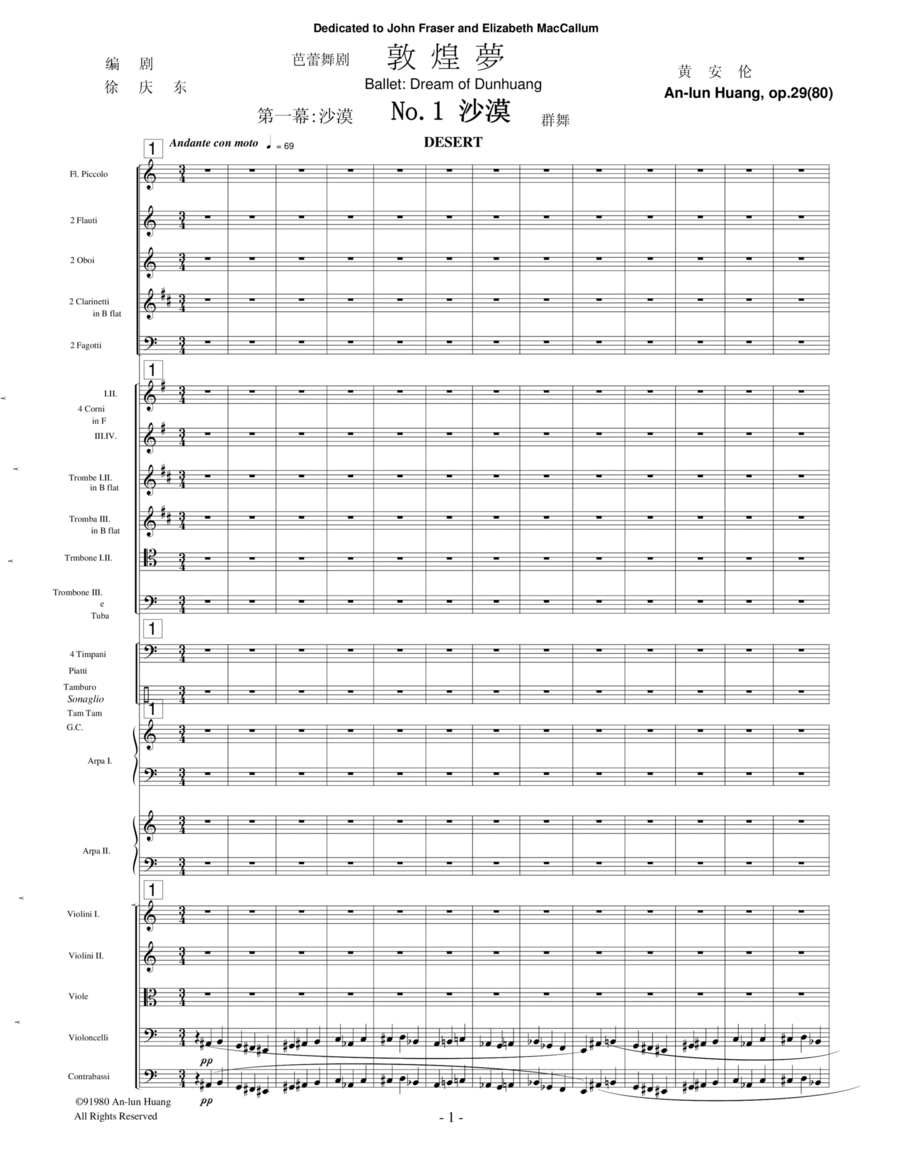
Dream of Dunhuang - Ballet in 3 Acts, O,p.29 (1979 - 80) - Score Only
Orchestre

$29.99 26.02 € Orchestre PDF SheetMusicPlus


Partitions Gratuites
Acheter des Partitions Musicales
Acheter des Partitions Digitales à Imprimer
Acheter des Instruments de Musique

© 2000 - 2026

Accueil - Version intégrale





