EUROPE
1842 articles
USA
0 articles
DIGITAL
5989 articles (à imprimer)
Partitions Digitales
Partitions à imprimer
5989 partitions trouvées


Clarinet Quartet,Woodwind Ensemble Bass Clarinet,E-Flat Clarinet - Level 3 - Digital Download SKU: A0.1325229 Composed by Pietro Mascagni. Arranged by Rob Bushnell. Classical,Easter,Film/TV,Opera,Romantic Period. 15 pages. RBMusic #913462. Published by RBMusic (A0.1325229). In 1889, a struggling composer called Pietro Mascagni heard about a sponsored competition for one-act operas, specifically for young Italian composers who had not yet had an opera performed, only two months before the deadline. With little time, he selected the subject for his opera and asked his childhood friend, Giovanni Targioni-Tozzetti (who was helped by Guido Menasci), to write a libretto for him. Mascagni selected a story that he had seen as a play in Milan in early 1884 by realist writer Giovanni Verga, “Rustic Chivalryâ€, or Cavalleria rusticana. A passionate love tragedy featuring seduction, adultery, revenge and murder, it is surprising set on Easter morning.Mascagni received only a few verses at a time from his librettists, but he was not worried because he had the opera clear in his mind: “I identified with the drama to such an extent that I felt it within myself in terms of music.†After two months’ of work, the music for Cavalleria rusticana was finished but he feared the opera would fail and put the music in a draw. Fortunately, his wife sent it off, he unanimously won the competition and was soon the talk of Europe. (At the premiere in May 1890 in Rome, Mascagni received no fewer than 60 curtain calls.) Unfortunately, it was a one-hit wonder with Mascagni unable to repeat its success, saying towards the end of his life that “it is a pity I wrote Cavalleria first for I was crowned before I became king.†He died, penniless, in 1945.Today, few people have heard of Mascagni’s name, and, if they have, it is rarely in relation to anything but one piece from Cavalleria rusticana, the Intermezzo. A short piece of purely orchestral music that is uses to denote the passage of time, the orchestration is very simple but it is such an indulgently beautiful melody (based on a hymn heard earlier in the short opera) that perfectly captures the peace of country living in Sicily against the intense feelings of the main characters and the looming tragedy to come.The piece is so popular that (along with the “Easter Hymn†from the same opera), it is the only reason Mascagni features in the Classic FM’s Hall of Fame.The piece was used in the 1980 film Raging Bull and the 1990 film The Godfather Part III.This arrangement includes alternative parts for clarinet in E-flat and alto clarinet in E-flat. A recording of the original song can be found on YouTube: https://www.youtube.com/watch?v=Kgr-I1y1_2M.Other searchable terms: Italy, Martin Scorsese, Robert De Niro, Joe Pesci, Cathy Moriarty, Nicholas Colasanto, Theresa Saldana, Frank Vincent, Al Pacino, Diane Keaton, Talia Shire, Andy García, Eli Wallach, Joe Mantegna, Bridget Fonda, George Hamilton, Sofia Coppola.
Intermezzo from "Cavalleria rusticana" (Mascagni) - Clarinet Quartet
Quatuor de Clarinettes: 4 clarinettes

$15.99 13.87 € Quatuor de Clarinettes: 4 clarinettes PDF SheetMusicPlus

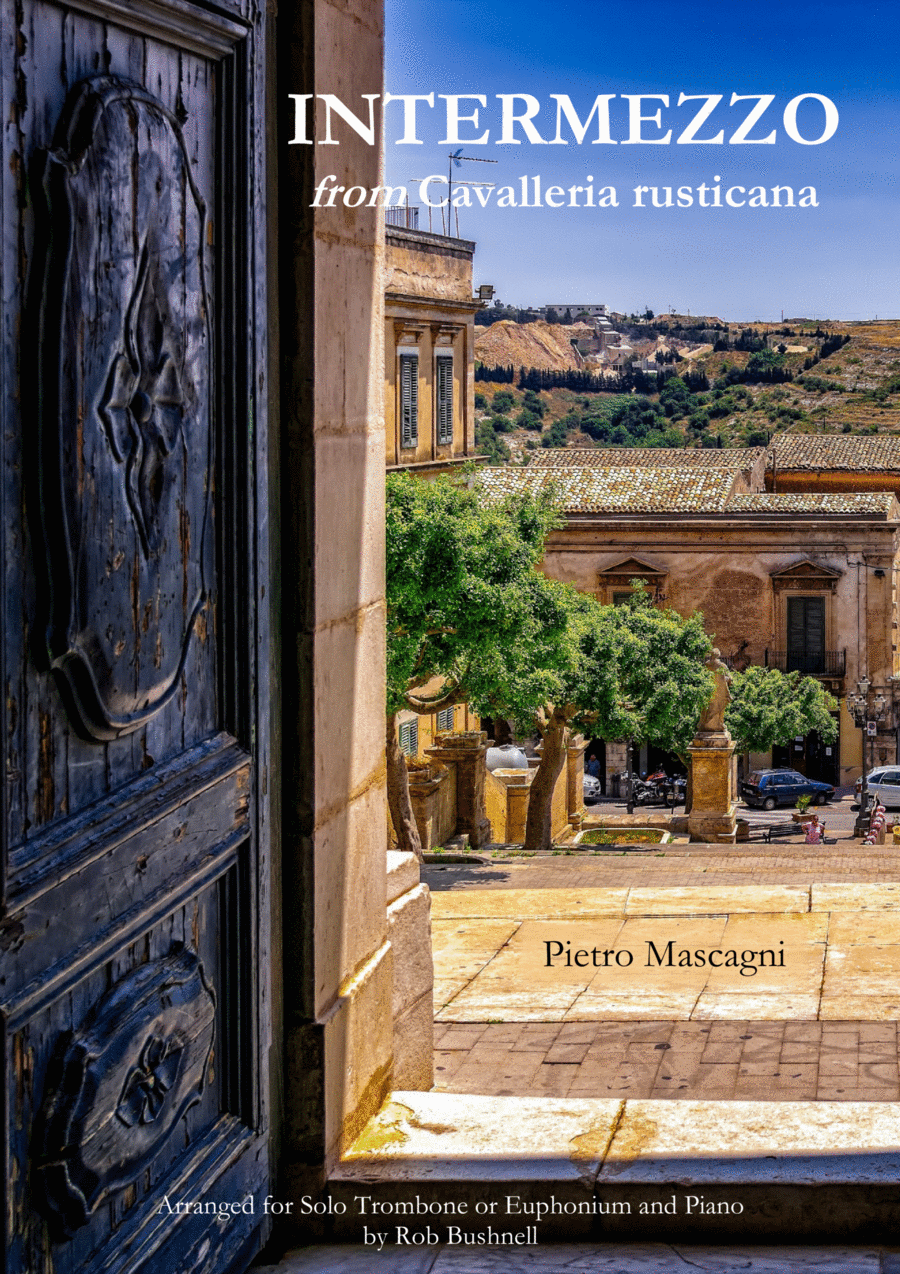
B-Flat instrument,B-Flat trombone,Baritone Horn TC/Euphonium,C Instrument,Instrumental Solo,Piano,Tenor Trombone,Trombone/Baritone B.C. - Level 3 - Digital Download SKU: A0.1320503 Composed by Pietro Mascagni. Arranged by Rob Bushnell. Classical,Easter,Film/TV,Opera,Romantic Period. Score and individual part. 9 pages. RBMusic #909019. Published by RBMusic (A0.1320503). In 1889, a struggling composer called Pietro Mascagni heard about a sponsored competition for one-act operas, specifically for young Italian composers who had not yet had an opera performed, only two months before the deadline. With little time, he selected the subject for his opera and asked his childhood friend, Giovanni Targioni-Tozzetti (who was helped by Guido Menasci), to write a libretto for him. Mascagni selected a story that he had seen as a play in Milan in early 1884 by realist writer Giovanni Verga, “Rustic Chivalryâ€, or Cavalleria rusticana. A passionate love tragedy featuring seduction, adultery, revenge and murder, it is surprising set on Easter morning.Mascagni received only a few verses at a time from his librettists, but he was not worried because he had the opera clear in his mind: “I identified with the drama to such an extent that I felt it within myself in terms of music.†After two months’ of work, the music for Cavalleria rusticana was finished but he feared the opera would fail and put the music in a draw. Fortunately, his wife sent it off, he unanimously won the competition and was soon the talk of Europe. (At the premiere in May 1890 in Rome, Mascagni received no fewer than 60 curtain calls.) Unfortunately, it was a one-hit wonder with Mascagni unable to repeat its success, saying towards the end of his life that “it is a pity I wrote Cavalleria first for I was crowned before I became king.†He died, penniless, in 1945.Today, few people have heard of Mascagni’s name, and, if they have, it is rarely in relation to anything but one piece from Cavalleria rusticana, the Intermezzo. A short piece of purely orchestral music that is uses to denote the passage of time, the orchestration is very simple but it is such an indulgently beautiful melody (based on a hymn heard earlier in the short opera) that perfectly captures the peace of country living in Sicily against the intense feelings of the main characters and the looming tragedy to come.The piece is so popular that (along with the “Easter Hymn†from the same opera), it is the only reason Mascagni features in the Classic FM’s Hall of Fame.The piece was used in the 1980 film Raging Bull and the 1990 film The Godfather Part III.This arrangement (for solo trombone or euphonium and piano accompaniment) includes an alternative part for trombone/euphonium in treble clef. A recording of the original song can be found on YouTube: https://www.youtube.com/watch?v=Kgr-I1y1_2M.Other searchable terms: Italy, Martin Scorsese, Robert De Niro, Joe Pesci, Cathy Moriarty, Nicholas Colasanto, Theresa Saldana, Frank Vincent, Al Pacino, Diane Keaton, Talia Shire, Andy García, Eli Wallach, Joe Mantegna, Bridget Fonda, George Hamilton, Sofia Coppola.
Intermezzo from "Cavalleria rusticana" (Mascagni) - Solo Trombone or Euphonium and Piano

$15.99 13.87 € PDF SheetMusicPlus

Piano,Violin - Level 4 - Digital Download SKU: A0.1315952 Composed by Pietro Mascagni. Arranged by Rob Bushnell. Classical,Easter,Film/TV,Opera,Romantic Period. 8 pages. RBMusic #904730. Published by RBMusic (A0.1315952). In 1889, a struggling composer called Pietro Mascagni heard about a sponsored competition for one-act operas, specifically for young Italian composers who had not yet had an opera performed, only two months before the deadline. With little time, he selected the subject for his opera and asked his childhood friend, Giovanni Targioni-Tozzetti (who was helped by Guido Menasci), to write a libretto for him. Mascagni selected a story that he had seen as a play in Milan in early 1884 by realist writer Giovanni Verga, “Rustic Chivalryâ€, or Cavalleria rusticana. A passionate love tragedy featuring seduction, adultery, revenge and murder, it is surprising set on Easter morning.Mascagni received only a few verses at a time from his librettists, but he was not worried because he had the opera clear in his mind: “I identified with the drama to such an extent that I felt it within myself in terms of music.†After two months’ of work, the music for Cavalleria rusticana was finished but he feared the opera would fail and put the music in a draw. Fortunately, his wife sent it off, he unanimously won the competition and was soon the talk of Europe. (At the premiere in May 1890 in Rome, Mascagni received no fewer than 60 curtain calls.) Unfortunately, it was a one-hit wonder with Mascagni unable to repeat its success, saying towards the end of his life that “it is a pity I wrote Cavalleria first for I was crowned before I became king.†He died, penniless, in 1945.Today, few people have heard of Mascagni’s name, and, if they have, it is rarely in relation to anything but one piece from Cavalleria rusticana, the Intermezzo. A short piece of purely orchestral music that is uses to denote the passage of time, the orchestration is very simple but it is such an indulgently beautiful melody (based on a hymn heard earlier in the short opera) that perfectly captures the peace of country living in Sicily against the intense feelings of the main characters and the looming tragedy to come.The piece is so popular that (along with the “Easter Hymn†from the same opera), it is the only reason Mascagni features in the Classic FM’s Hall of Fame.The piece was used in the 1980 film Raging Bull and the 1990 film The Godfather Part III.A recording of the original song can be found on YouTube: https://www.youtube.com/watch?v=Kgr-I1y1_2M.Other searchable terms: Italy, Martin Scorsese, Robert De Niro, Joe Pesci, Cathy Moriarty, Nicholas Colasanto, Theresa Saldana, Frank Vincent, Al Pacino, Diane Keaton, Talia Shire, Andy García, Eli Wallach, Joe Mantegna, Bridget Fonda, George Hamilton, Sofia Coppola.

Intermezzo from "Cavalleria rusticana" (Mascagni) - Solo Violin and Piano
Violon et Piano

$15.99 13.87 € Violon et Piano PDF SheetMusicPlus

Brass Quintet Baritone Horn TC,Bass Trombone,Cornet,Euphonium,Flugelhorn,Trumpet,Tuba - Level 3 - Digital Download SKU: A0.1321540 Composed by Pietro Mascagni. Arranged by Rob Bushnell. Classical,Easter,Film/TV,Opera,Romantic Period. 18 pages. RBMusic #910007. Published by RBMusic (A0.1321540). In 1889, a struggling composer called Pietro Mascagni heard about a sponsored competition for one-act operas, specifically for young Italian composers who had not yet had an opera performed, only two months before the deadline. With little time, he selected the subject for his opera and asked his childhood friend, Giovanni Targioni-Tozzetti (who was helped by Guido Menasci), to write a libretto for him. Mascagni selected a story that he had seen as a play in Milan in early 1884 by realist writer Giovanni Verga, “Rustic Chivalryâ€, or Cavalleria rusticana. A passionate love tragedy featuring seduction, adultery, revenge and murder, it is surprising set on Easter morning.Mascagni received only a few verses at a time from his librettists, but he was not worried because he had the opera clear in his mind: “I identified with the drama to such an extent that I felt it within myself in terms of music.†After two months’ of work, the music for Cavalleria rusticana was finished but he feared the opera would fail and put the music in a draw. Fortunately, his wife sent it off, he unanimously won the competition and was soon the talk of Europe. (At the premiere in May 1890 in Rome, Mascagni received no fewer than 60 curtain calls.) Unfortunately, it was a one-hit wonder with Mascagni unable to repeat its success, saying towards the end of his life that “it is a pity I wrote Cavalleria first for I was crowned before I became king.†He died, penniless, in 1945.Today, few people have heard of Mascagni’s name, and, if they have, it is rarely in relation to anything but one piece from Cavalleria rusticana, the Intermezzo. A short piece of purely orchestral music that is uses to denote the passage of time, the orchestration is very simple but it is such an indulgently beautiful melody (based on a hymn heard earlier in the short opera) that perfectly captures the peace of country living in Sicily against the intense feelings of the main characters and the looming tragedy to come.The piece is so popular that (along with the “Easter Hymn†from the same opera), it is the only reason Mascagni features in the Classic FM’s Hall of Fame.The piece was used in the 1980 film Raging Bull and the 1990 film The Godfather Part III.This arrangement includes alternative parts for tenor horn, treble-clef trombone/euphonium and tuba. A recording of the original song can be found on YouTube: https://www.youtube.com/watch?v=Kgr-I1y1_2M.Other searchable terms: Italy, Martin Scorsese, Robert De Niro, Joe Pesci, Cathy Moriarty, Nicholas Colasanto, Theresa Saldana, Frank Vincent, Al Pacino, Diane Keaton, Talia Shire, Andy García, Eli Wallach, Joe Mantegna, Bridget Fonda, George Hamilton, Sofia Coppola.

Intermezzo from "Cavalleria rusticana" (Mascagni) - Brass Quintet

$19.99 17.34 € PDF SheetMusicPlus

Cello,Instrumental Duet,Violin - Level 3 - Digital Download SKU: A0.1459257 By Josh Groban. By Brendan Graham and Rolf Lovland. Arranged by Homco/Crinion. Celtic,Folk,Irish,Praise & Worship,Wedding. 3 pages. Homco/Crinion #1038197. Published by Homco/Crinion (A0.1459257). This song was first composed in 2001 as an instrumental piece, and it wasn't until about a year later that an Irish novelist added the lyrics. That's why the music speaks so emotionally and provaocatively in and of itself - even without words. It is definitely Celtic-influenced music, but it wasn't until American up-and-coming singer Josh Groban recorded it in 2003 that it gained worldwide fame. In fact, Groban performed You Lift Me Up at Super Bowl XXXVIII and also at many national events of note. The Cello opens this Duo arrangement with the melody in the Irish-Tenor range. The Violin then plays it in the soprano register before re-stating it an octave higher -  like unto an Irish flute. The final reprise of the melancholy melody comes back one last time as a toned-down, soft-spoken voicing before a definitive cadence brings everything to a close.
You Raise Me Up
Violon, Violoncelle (duo)
Josh Groban
$7.99 6.93 € Violon, Violoncelle (duo) PDF SheetMusicPlus

String Quartet String Quartet - Digital Download SKU: A0.1031806 Composed by Liam Morrissey. 20th Century,Contemporary. Score and parts. 2 pages. Liam Morrissey #3572227. Published by Liam Morrissey (A0.1031806). Between gigs on winter terraces , walks on frozen streets , chamber music rehearsals , and the recognition of the good and the bad in man and machine , my quartet was born . It came at a time of reconciliation , of a dawning acceptance of the beauty , the necessity of exploration of advancing technology in music . Before then I had trouble with the synthetic nature of contemporary music ; it seemed to me a symbol of the degradation of the importance that we give to nature in society . However , as I listened more and more to electronic music , as I rehearsed Philip Glass with my friends , I came to accept that there is a coexistence as natural and wonderful as a cup of tea . Yes , it still worries me , the level to which we have come to depend on technological advantage , and I feel we have a long way to go before we reach equilibrium .In the meantime , I wrote this piece and prepared it with completely synthetic effects in the hope of reaching that balance , at least from an aesthetic perspective . It starts somewhat coldy , a siren , a train motor , a deep respiration and a sigh . It twists , it turns , and by the end humanity and its steel and plastic progeny are one .
Reconciliation
Quatuor à cordes: 2 violons, alto, violoncelle

$10.00 8.68 € Quatuor à cordes: 2 violons, alto, violoncelle PDF SheetMusicPlus

Jazz Ensemble Jazz Ensemble - Digital Download SKU: A0.947280 Composed by John Philips. Jazz. Score and parts. 36 pages. John Philips Music Service #3867733. Published by John Philips Music Service (A0.947280). This is a funky 2 beat built on double (24 bar) blues. It has an optional vocal,( cued in for alto sax) that should be sung thru a megaphone like the old Winchester Cathedral. The title comes from a pattern of speech found only in Chicago where people still say over by here and over by there. It swings well and invites a couple tambourines playing on 2 and 4. This is a fun chart but is very correct musically even if you expect the Blues Brothers to show up when it’s played. It can be opened for solos if needed. Don’t get too serious about the vocal, it’s best with your worst singer, maybe with a clothes-pin on his nose.   Enjoy it with your audience.If you want a Maynard or Buddy chart, look elsewhere. This series of charts uses nothing more complicated than eighth notes, are not frantic or screamers, extreme ranges and are hemi-demi-semi-quaver free. They depend on intonation and the players being not intimidated by what he is asked to play. There is no contest to see how high you can go before you need oxygen , how many notes you can play in 9 seconds or before your bell overheats , or how long it takes the audience to cover their earsRelaxed and confident players always play more in tune. Good harmonies, lines and realistic rhythm patterns will produce a good result that will swing and be enjoyed by player and listener alike.
Over By There----Old Chicago Love Song
Ensemble Jazz

$15.00 13.02 € Ensemble Jazz PDF SheetMusicPlus

B-Flat Trumpet,Piano - Level 1 - Digital Download SKU: A0.1080679 Composed by Alex Lewis and Eddie Lewis. Classical,Multicultural,World. Score and part. 9 pages. Tiger Music #684898. Published by Tiger Music (A0.1080679). Southwest Sunrise Trumpet Solo Eddie Lewis and Alex Lewis MTR P111 4137 Southwest Sunrise is a trumpet solo for beginner trumpet students that has a more complicated piano part. I often get requests for music for students of different skill levels. And in fact, that’s what of my strengths as a writer, is that I can blend parts across skill levels that way. In this case, Alex and I were striving for something that would be interesting for the pianist, but not overly challenging for the beginner trumpet student. The Process The inspiration for this piece came to me on a morning walk in Chandler, Arizona. Chandler is a suburb of Phoenix. I was walking east, into the rising sun. It was a very simple melody. It was a very simple blues melody that I immediately recognized as something that would work in our series for beginner trumpet students. This was during a time when my son, Alex, and I were already collaborating on some other projects. For this piece, I gave Alex the melody and gave him a general description of what I was hearing. Then I gave him his space to create what sounded good to him. The next stage was me editing some of his creativity. At this point we went back and forth on a few issues until we agreed on the final results. SKILL LEVEL The skill level for Southwest Sunrise is Trumpet Pioneer (we don’t have skill levels for piano parts yet on this website). Trumpet Pioner is the first of seven levels in our system. These are absolute beginners who have only been playing the trumpet for a few months. Our Trumpet Pioneer level limits the range to C in the staff. We also limit rhythms to nothing smaller than quarter-notes, and key signatures are limited to one flat or sharp. Practice Recommendations While it is obvious and I don’t normally list it as a point in this practice recommendations, but the rhythms are very different between the trumpet part and the trumpet part. So it is even MORE important to spend time listening to the composition long before you begin practicing it. As I said, this is a good habit for working on all performance pieces. There is research that proves that students learn their music best when they recognize their mistakes soonest. When you listen to the music repeatedly before you practice, it goes a long way towards helping you recognize your mistakes. This is one of the most important reasons for listening, but there are others that I won’t go into here. Assuming the pianist is far more advanced than the trumpeter, the pianist should assume a patient, educational role.
Southwest Sunrise Trumpet Solo with Piano
Trompette, Piano

$6.72 5.83 € Trompette, Piano PDF SheetMusicPlus

Brass Quintet - Level 4 - Digital Download SKU: A0.1489487 Composed by Dr. Daniel N. Thrower. 21st Century,Chamber,Classical,Historic,Multicultural,World. 28 pages. Https://gildedmusicpress.com/ #1066350. Published by https://gildedmusicpress.com/ (A0.1489487). One of my last assignments as an Air Force musician before being stationed in Japan was to perform music in support of the 50th commemoration of what has become known in America as “Vietnam Memorial Day.”  It is observed on March 29 every year, the date when the last U.S. troops withdrew from Vietnam in 1973.  After the memorable ceremony in 2023, I lingered to talk with those mature veterans and to hear some of their experiences.  It was a strange feeling when I told them that my first assignment at my new duty station in Japan would be a series of cultural exchange performances in Vietnam.  What a somber generational bridge.I was only in Japan for a matter of days, including some intense rehearsals, before Pacific Brass (the brass quintet from the U.S. Air Force Band of the Pacific) packed up and headed to Hanoi to start our brief musical outreach in three cities.  My reflections were sobering as I contrasted my military service in Vietnam with the veterans whom I had just honored three months prior.  During some off-duty time, all five of the Pacific Brass military musicians found our way to the well-known Hòa Ló Prison, infamously known as the “Hanoi Hilton.”  Indeed, how vastly different was my brief military service in Vietnam!To the Vietnamese people, the “American War,” as they call it, is ancient history.  They are extremely forward-thinking, putting those dark years far from them, looking to the bright future that is theirs.  What an educational bridge of paradigms.  Although it was important for us as U.S. Servicemembers to witness the Hòa Ló Prison firsthand, our lot was to experience the beautiful present-day Vietnam with its rich culture of food, street shops, temples, dance, music, and other wonders that awed us all—including gongs!Our trombone player purchased a gong in a shop that sold little else besides gongs of all sizes and pitches.  That struck me as quintessentially Vietnamese, and the sights and sounds of that modest shop lingered in my imagination.  As we absorbed the extraordinary majesty of the Temple of Literature in Hanoi, ideas for this musical composition started to formulate as a bridge connecting American musical culture with Vietnamese traditional gongs.  For practicality in both notation and live performance, I scored the consort of 18 glorious “gongs” in my head for orchestral tubular bells.  It is a passionate hope that someday in a video presentation, a masterful cultural bridge of the two diverse countries will be crafted.  Better yet, what an experience it would be to have a legitimate gong consort perform live with Pacific Brass!The year of our visit, as we were coached many times by the Embassy’s Attaché, was a milestone landmark between the two nations, worthy of praise and celebration: the ten-year anniversary of the U.S.-Vietnam Comprehensive Partnership, signed by Presidents Obama and Sang in July 2013.  This bilateral relationship has bridged both nations’ commitment to economic engagement, cultural exchange, tourism, education, and human rights.  This composition is in celebration of this Comprehensive Partnership and a gift to the wonderful people of Vietnam.  May this music contribute to a continuing growth of positive relations bridging the two nations.
Bridges, Op. 136 (for Brass Quintet and Chimes)
Quintette de Cuivres: 2 trompettes, Cor, trombone, tuba

$24.95 21.65 € Quintette de Cuivres: 2 trompettes, Cor, trombone, tuba PDF SheetMusicPlus

Concert Band - Level 2 - Digital Download SKU: A0.1235675 By Martin Garrix. By Martijn Garritsen. Arranged by Scaver. 21st Century,Disco,Pop,Video Game. Score and Parts. 41 pages. Scaver #831187. Published by Scaver (A0.1235675). Scaver Music, a renowned concert band arranger, has recently unveiled their latest project: a concert band version of the hit song Animals by Martin Garrix. Originally released as a digital download on iTunes on June 17, 2013, Animals quickly gained popularity within the electronic dance music (EDM) culture, propelling Martin Garrix to become the youngest producer to ever have a song reach number one on Beatport, a prominent electronic music store.The track's infectious beats and energetic melodies captivated listeners, leading it to achieve remarkable success on various music charts. It climbed into the top ten and secured the number one spot on numerous electronic music charts, as well as some mainstream ones. Notably, Animals topped the singles charts in the United Kingdom, French-speaking Switzerland, and Belgium. In the United States, it reached number 21 on the Billboard Hot 100 and claimed the number one position on the Dance chart.Before its official release, Animals generated significant buzz as it was played anonymously, causing speculation to grow about the artist behind the track. Dutch record label Spinnin' Records fueled the anticipation by sharing a teaser clip of the song online, titled Animals (Teaser). This led to increased speculation, with a Vine video featuring Agnes from the animated film Despicable Me further stoking curiosity. The track was mistakenly attributed to other artists such as Hardwell, GTA, Sidney Samson, and Bassjackers before Martin Garrix's true identity as the producer was revealed.Martin Garrix shared insights into the composition of Animals, explaining that the melody was based on a previous track he had composed two years prior but never released. The drop, characterized by its ruthlessly minimalist and rhythmic sound, is inspired by Busta Rhymes' What It Is. Additionally, the opening section of the song draws inspiration from a track called D.A.T.A. by Aura Qualic. While Animals is predominantly instrumental, it features a spoken verse by a friend of Martin Garrix with the lyrics We're the fucking animals, delivered in a low pitch and repeated twice throughout the song.Now, Scaver Music has taken up the exciting challenge of arranging Animals for a concert band, bringing a fresh interpretation of this electronic dance anthem to a new musical realm. With their expertise in creating captivating arrangements, Scaver Music aims to capture the essence of the original track while adding the rich harmonies, dynamic textures, and powerful brass and woodwind sections that define the concert band sound.Fans of Animals and concert band enthusiasts alike can look forward to experiencing this new rendition, which promises to be a thrilling and unforgettable musical journey. Scaver Music's concert band version of Animals will undoubtedly provide a unique and exhilarating performance, blending the infectious energy of electronic dance music with the grandeur and depth of a full concert band. Instrument list: PiccoloFlute 1,2OboeBassoonClarinet Bb 1,2,3Bass ClarinetAlto Saxophone 1,2Tenor SaxophoneBaritone SaxophoneTrumpet Bb 1,2,3Horn F 1-2,3-4Trombone 1,2,3Euphonium BbTuba BbTuba EbDouble BassTimpaniXylophoneDrumsetPercussion 1,2
Animals
Orchestre d'harmonie
Martin Garrix
$49.99 43.38 € Orchestre d'harmonie PDF SheetMusicPlus

B-Flat trombone,Baritone Horn BC,Baritone Horn TC/Euphonium,Instrumental Solo,Piano,Tenor Trombone,Trombone/Baritone B.C. - Level 3 - Digital Download SKU: A0.1490460 Composed by Giacomo Puccini. Arranged by Rob Bushnell. 19th Century,20th Century,Classical,Opera,Romantic Period. Score and individual part. 10 pages. Rob Bushnell #1067302. Published by Rob Bushnell (A0.1490460). Tosca is an opera in three acts by the Italian composer Giacomo Puccini. The opera is set in June 1800 in Rome, and tells the story of the Kingdom of Naples and the threat to its control of Rome by Napoleon’s invasion of Italy. Some of Puccini’s best-known arias can be found in Tosca.The opera is based on Victorien Sardou’s dramatic play of the same name (La Tosca). Puccini saw the play at least twice in 1889 and begged his publisher, Giulio Ricordi, to obtain the rights to turn it into an opera, which were secured in 1891 – although Puccini relinquished the rights to Alberto Franchetti before being recommissioned in 1895. Puccini wrote “I see in this Tosca the opera I need, with no overblown proportions, no elaborate spectacle, nor will it call for the usual excessive amount of music.” It took 4 years to write, with Puccini arguing with his librettists (Luigi Illica and Giuseppe Giacosa) and his publisher. Although the first performance was delayed by a day due to the unrest in Rome at the time, the opera was premiered on 14 January 1900 at the Teatro Costanzi in Rome. The critics reviews were indifferent, but it was an immediate success with the public. The opera is through-composed, with the different musical elements weaved from piece to piece. Puccini used the Wagner’s leitmotif concept to identity different parts of the opera.Taken from Act 3, E lucevan le stelle is sung by Cavaradossi, a painter, who has fallen for the singer Tosca. The corrupt Chief of Police, Baron Scarpia, longs for Tosca himself and, upon suspecting Cavaradossi of helping a political prisoner escape, he takes the opportunity to get rid of Cavaradossi and blackmail Tosca into being with him. The guards lead Cavaradossi to the roof of Castel Sant'Angelo, where he is told he has 1 hour to live before being executed. He asks to write a letter to Tosca, overcome by memories, he sings E lucevan le stelle (And the starts shone). It was selected by the tenor Wynne Evans as one of the most romantic songs for his top ten arias for Classic FM. He described it as “another tenor classic, both tragic and beautiful.”This arrangement (for solo euphonium and piano accompaniment) includes an alternative part for euphonium in treble clef. A recording of the original song can be found on YouTube: https://www.youtube.com/watch?v=EAqHQMX7GHYOther searchable terms: Luciano Pavarotti.
E lucevan le stelle from "Tosca" (Puccini) - Solo Trombone or Euphonium and Piano
Trombone et Piano

$19.99 17.34 € Trombone et Piano PDF SheetMusicPlus

Full Orchestra - Level 4 - Digital Download SKU: A0.755203 Composed by Sy Brandon. 20th Century,Contemporary. Score and parts. 253 pages. Sy Brandon #3415579. Published by Sy Brandon (A0.755203). Legacy is a three movement composition for chamber orchestra that makes social commentary on the issue of global warming. It was commission and premiered by the Washington Sinfonietta, Rufus Jones, conductor. I. Conflicts - This movement begins with a cry from native cultures admonishing our neglect of the environment. The cry is interspersed with debate regarding the seriousness of global warming (woodwinds). The debate grows stronger as the cries grow weaker. The debate is quieted by a measure of repeated chords that could be the words, stop it! stop it now!. A weak cry in the English Horn brings the introduction to a close. An Allegro section follows with a rhythmic and primitive sounding section representing the underdeveloped nations that are destroying the rain forests for economic gain. This material evolves into a more harmonic and contrapuntal section representing industrialized nations reluctant to change, also for economic reasons. Things quiet down as the music takes the listener to another part of the globe, East Asia. Conflict is again present in this section. The music returns to a varied restatement of the industrialized nations music before traveling to India for a section influenced by Raga. This section builds in dissonance until we hear the repeated stop it now chords from the introduction. A brief reprise of the cries bring the movement to a close. II. Consequences - This movement evokes a somber mood that is reflective of living in a climate of extremes. The movement is in arch form as it begins and ends with open harmony reflective of barren lands that once were fertile. The middle section serves as a climax expressive the harshness of the climate. Colleen McCollough’s book, A Creed for the Third Millennium was a source of inspiration for this movement. III. Sacrifice and Compromise - The movement begins with a strong section that suggests progress. It is followed by a quieter and intense section that alternates lyrical lines over a staccato ostinato that creates a sense of urgency. The opening section returns and is followed by a development of the ostinato section. This section is symbolic of how ideas need to be adapted in order for progress to be made. The opening section returns once more before leading into the concluding section where there is coming together of the instruments on a long lyrical line representing more and more people working together for change. The movement ends with a sense of triumph over adversity.The score prints on legal size paper and the parts on letter.
Legacy
Orchestre

$49.95 43.34 € Orchestre PDF SheetMusicPlus


Partitions Gratuites
Acheter des Partitions Musicales
Acheter des Partitions Digitales à Imprimer
Acheter des Instruments de Musique

© 2000 - 2026

Accueil - Version intégrale



