EUROPE
1842 articles
USA
0 articles
DIGITAL
5987 articles (à imprimer)
Partitions Digitales
Partitions à imprimer
5987 partitions trouvées


Picc. 4Fl. Afl. Bfl. (Cafl)Cbfl. (SCBfl). (Dble CBFl) - Intermediate-Advanced - Digital Download SKU: F2.FM553 Composed by Franz Joseph Haydn. Arranged by Robert Rainford. Flute Ensemble - Piccolo, 4Flutes, Alto Flute, Bass Flute, Optional Contr'Alto, Contrabass, Obtional Sub and Double Contras. Score and parts. 221 pages. Forton Music - Digital #FM553. Published by Forton Music - Digital (F2.FM553). ISBN 9790570484522.This is an arrangement of the last symphony that Haydn wrote. It was composed and premiered in London in 1795, and was an instant success. Following the standard four movement pattern of the time, it starts with a slow, serious introduction before the lighter, fast first movement begins properly. Using just one main theme, Haydn spins a delightful series of moods and emotions before rushing to the exciting conclusion. The second movement is more measured and controlled, but with episodes of drama and tension. The third movement is a traditional minuet and trio, with the lightness and humour of Haydn. The last movement has elements of folk music, with it's opening low drone and peasant like melody. Haydn however alternates the romping first section ideas with a more sophisticated, legato second section. This creates a delicious balance and has to make for one of the most satisfying symphonies ever written. This arrangement has been created with a range of playing standards in mind. The first and last movements use the full resources of the flute choir right down to the lowest double contrabass in C. The rarer flutes have optional parts so can be safely omitted, but add great depth to the sound. Flute 1 is quite complicated and involved, but then the parts get easier until flute 4 is fairly basic and could be easily realised by players with less experience. The second and third movements have been thinned down, with piccolo, G treble, contr'alto, subcontrabass in G and double contrabass in C being tacet. Also in these movements, flute 1 and 2 take the same line, while flute 3 and 4 are similarly in unison, with an optional contrabass part. These movements may be taken by four or five solo players, or some sections could be solos and others played by the full ensemble, or many other options.
Symphony No. 104 'London'

$31.95 27.72 € PDF SheetMusicPlus

Chamber Orchestra - Level 4 - Digital Download SKU: A0.922640 Composed by Johann Strauss Jr. Arranged by Aaron Meier. Romantic Period,World. Score and parts. 1 pages. Aaron Meier #5792381. Published by Aaron Meier (A0.922640). Original by Johann Strauss II Reduction to String Orchestra by Aaron Meier Part: *Optional Percussion (snare drum, triangle, cymbals) True to the original work by Strauss, this reduction for string orchestra features the ornaments and mystical writing that defines Strauss' polkas. There are optional percussion parts to be added at the discretion of the ensemble, however even without percussion the ensemble will sound full (the percussion acts as an ornament). Difficulty: Intermediate-advanced - advanced (best-suited for advanced student ensembles) --- Performance Notes: • Approximate length: 3:30 minutes • 1st Violins: In m. 1, trill a half step from a Dâ™­ to a Dâ™®  • 2nd Violins:  - At m. 42, divide players by 3, with 2 players playing line A and the remaining player playing line B  - At m. 72-75, emphasize the Eâ™­ in the div. • Snare Drum: The buzz roll needs to be quieter than how it is played in the midi recording (*see YouTube link ↓) History: The Olga-Polka itself owed its creation to a Russian royal wedding which took place in St. Petersburg on 28 August 1857. On that day, amid accompanying splendour, the music-loving Grand Duke Michail Nikolaievich (1832-1909), youngest brother of Tsar Alexander II, married Princess Caecilie of Baden (1839-91), daughter of Archduke Leopold of Baden. Johann Strauss, who at that time was giving a summer season of concerts in nearby Pavlovsk, used the opportunity occasioned by the event to enhance his already enviable popularity with the Russian royal family and composed the Caecilien-Polka in honour of the lovely young bride. Indeed, it is clear from a letter which Johann wrote in late July 1857 to Carl Haslinger, his publisher in Vienna, that the new polka had been prepared well in advance of the wedding (the fair copy of the full orchestral score made for the publisher's engraver is dated 9 August) and was enjoying success even before the royal couple's official engagement on 16August 1857. Sometime after performing the Caecilien-Polka in Pavlovsk, Johann despatched the work to the Austrian capital where his brother Josef conducted its Viennese première, together with that of Johann's waltz Telegraphische Depeschen (op. 195, Volume 28), at his own benefit concert in the Volksgartenon Sunday 18 October 1857. The Wiener Allgemeine Theaterzeitung (16.10.1857) remarked that both works have caused a sensation in St. Petersburg and are truly genial Viennese sounds full of verve and melody. Since tradition demanded that the German Princess Caecilie adopt a Russian name - Olga Feodorovna - before her marriage, so Johann's Caecilien-Polka also underwent a change of identity. On 8 December 1857 Carl Haslinger announced the publication of Strauss's Olga-Polka, on the title page of which is the inscription: Dedicated to her Imperial Highness Grand Duchess Olga, née Princess of Baden. It was under this title, too, that Johann himself first conducted the work in Vienna at a concert in the Volksgarten on 1 November 1857, shortly after his return from Russia. Reporting on this event, the Wiener Allgemeine Theaterzeitung (3.11.1857) observed: The 'Olga-Polka' is a most delightful, fragrant musical bouquet, full of fine, gracious rhythms. [excerpted from NAXOS Records] Kemp, Peter. Program Notes - About this Recording. NAXOS, 1993, www.naxos.com/mainsite/blurbs_reviews.asp?item_code=8.223232&catNum=223232&filetype=About%20.......... Accessed 5 June 2020.
Olga-Polka, Op. 196 (arr. for string orchestra): Optional Percussion
Orchestre de chambre

$3.99 3.46 € Orchestre de chambre PDF SheetMusicPlus

Brass Ensemble - Level 4 - Digital Download SKU: A0.808685 Composed by F. Leslie Smith. Arranged by F. Leslie Smith. Children,Holiday,Traditional. Score and parts. 83 pages. Sweetwater Brass Press #3631645. Published by Sweetwater Brass Press (A0.808685).     What is a Rumpus? Most definitions include words such as noisy disturbance, commotion and uproar. Sort of like the sounds from a group of neighborhood children in the days before play dates, private lessons and organized kids’ sports. These sounds were part and parcel of the games they played, games that originated years, even centuries, before and involved high energy levels and top-of-their-voices counting, chanting or singing (with an occasional Nyah-nyah nyah-nyah nyah nyah thrown in for good measure!). Rowdy and raucous, indeed!    This composition is one that will entertain both adults (who, after all, are just grown-up children!) and youngsters. Like children at play, it races right along. In one 6-minute work, it incorporates tunes of eleven children’s game and campfire songs: Michael Finnegan; Ring a Ring o’ Roses; Twinkle, Twinkle, Little Star; London Bridge; Hickory Dickory Dock; Three Blind Mice; John Jacob Jingleheimer Schmidt; My Pony Boy; Old MacDonald Had A Farm; The Farmer in the Dell and Bingo. And, again, like children at play, there is fun, humor and a surprise at every turn.    A Rowdy, Raucous Rumpus is a hoot to play. At a cut-time tempo of 132 and with 14(!) changes of key, it keeps all five musicians on their toes. And busy: on the Tuba part, there are V.S. (turn the page quickly) indications on the bottom of 6 of the 8 pages, 5 for Trombone and Horn in F, 3 for Trumpet 2, and 2 for Trumpet 1. In Bingo, the last tune, the group intermittently stops playing and claps or foot-taps loudly (which is a good spot for audience participation!). On the audio clip, this is indicated with a click (actually, a tambourine sound).    There are a few high notes scattered throughout. Trumpet plays B above its staff once and A a number of times. Trumpet 2 has one A above its staff. Trombone has one F above its staff. Tuba has one G in the top space of its staff.
A Rowdy, Raucous Rumpus
Ensemble de cuivres

$9.95 8.63 € Ensemble de cuivres PDF SheetMusicPlus

SATB chorus & piano - Grade 2 - Digital Download SKU: IZ.VMW193 Composed by Richard Sorce. Score. 8 pages. Imagine Music - Digital #VMW193. Published by Imagine Music - Digital (IZ.VMW193). 6.75 x 10.5 in inches.In 2015, Fr. Paulo Tanzini, former pastor of Church of the Assumption in Emerson, NJ, commissioned me to write a piece for the fiftieth anniversary of the building to be celebrated in mid-August of the same year during the recognition of Mary's Assumption. Although this was to be a fiftieth year jubilee, the parish had been in existence for many decades prior, and many of the choir members had been parishioners since the construction of the new building and some even before.Myidea was to ask the choir members to participate in this piece by expressing their thoughts regarding their devotion to Mary, and from their writing I would assemble their words into a lyric.Initially, A Prayer to Mary was composed as a unison/octave setting, after which I arranged it for SATB with piano accompaniment. Most important in the performance of this piece is to approach it with a generous amount of expression and rubato in several areas so that the meanings of the individual lyric phrases become meaningful and not just words.I have included chord symbols in the score for those who wish to personalize their own accompaniments; however, chord symbols do not, and in several cases cannot capture the exact content of the accompaniment. It would be beneficial to analyze the content of the written accompaniment before assuming that the chord symbols reflect the exact harmony.A Prayer To Mary can be appropriately performed during Mother's Day, the celebration of The Assumption of Mary in mid-August, as a communion meditation or any time during which special devotions are warranted.
A Prayer to Mary
Chorale SATB

$2.05 1.78 € Chorale SATB PDF SheetMusicPlus

Brass Ensemble Euphonium - Level 3 - Digital Download SKU: A0.813067 Composed by Traditional French Melodies. Arranged by Regis Bookshar. Christmas,Classical,Instructional,Multicultural,Standards,World. Score and parts. 22 pages. Regis Bookshar #6096687. Published by Regis Bookshar (A0.813067). Euphonium Quintet - Intermediate - Digital Download. This selection, Burgundian Air/March of the Three Kings, has been arranged for 5 Euphoniums by Regis Bookshar. It incorporates two Traditional French melodies into one exciting arrangement, which, I'm certain, will entertain both performers and audiences alike. It is suitable for high school and college students and is perfect for Christmas concerts and church services but could be performed anytime and anywhere. Included are a score and a complete set of parts, written in Treble Clef (22 pages). It begins with a Burgundian Air, played by a solo instrument. The melody is then played by two instruments in harmony before the rest of the ensemble joins in. This is followed by the March of the Three Kings, a Provencal melody (La Marche Des Rois Mages) which dates from the 13th century and recalls the Three Kings of the Christmas story. The peasants probably sang and danced to this tune, even perhaps honoring their own folk heroes, the French dukes, dressed in their shining armor and carrying brilliant banners, as they marched off to the Crusades. Georges Bizet utilized this tune as a farandole, or stately dance, in his incidental music for Alphonse Daudet's play L'Arlesienne (The Girl from Arles). There is a fugal section in which each instrument enters, playing an embellished version of the tune before concluding the arrangement. Also available are other settings of these two Traditional french melodies for a variety of instrumental ensembles as well as numerous other arrangements in a variety of styles. Please feel free to search for other arrangements by Regis Bookshar. You may find something else which might interest you as well. I'm certain that students will enjoy playing this arrangement.
Burgundian Air/March of the Three Kings (F min) (Euphonium Quintet - Treble Clef)

$18.00 15.62 € PDF SheetMusicPlus

Brass Ensemble - Level 3 - Digital Download SKU: A0.1027894 Composed by William Elsom. Contemporary. Score and parts. 46 pages. Will Elsom #3053855. Published by Will Elsom (A0.1027894). Programme Notes Boudicca became the Queen of the Iceni upon the death of her husband, Prasutagus. The Iceni had lived in relative peace with the Romans, with Prasutagus living as a client king, paying tribute to Rome. The Romans refused to accept a woman as the ruler, and sought to assume total control. To demonstrate its superiority, a Roman Legion attacked the Iceni, captured Boudicca and made her watch as her daughters were raped. She sought revenge, allying the Iceni with the Trinovantes under her command, and wreaked havoc, destroying many Roman settlements. Boudicca was only stopped when Rome sent one of the best generals of the time, Seutonius Paulinus. Seutonius has been depicted offering Boudicca surrender with honour and her life, but when she rejected this, his tactical acumen proved superior, and all the Iceni and Trinovantes were wiped out. 1 – Boudicca Unites the Tribes The piece opens with the initial statement of Boudicca’s theme. Figure 3 depicts Boudicca’s reign as the leader of the Iceni, interspersed with a sadder theme depicting her lonely widowhood. Figure 4 sees the tribes called together with a drinking song and Figure 5 is the war cry, as Boudicca gives a rousing speech, first to her own warriors then to the Trinovantes. The second time bar before Figure 7 sees the tribes fall into a restless sleep. Amid early morning mists, Figure 7 sees restless horses, with distant fanfares heard, signalling the coming of the Romans. The Romans main theme is at Figure 8, with a constant fanfare over the top, signalling the confidence of the leaders. Figure 10 sees the Iceni and Trinovantes coming slowly out of hiding, and Boudicca’s theme growing in volume until the death chords signify the tribes have prevailed. 2. The Bards Sing The tribes sing a hymn to an unnamed Pagan God. At Figure 13, the Euphonium develops Boudicca’s theme depicting Taranis, the Bard of the Iceni, singing wistfully of happier times. He then makes an impassioned speech for peace, before cutting off in mid sentence. He then sits quietly (Figure 16) fearing the future. Figure 17 gives a euphoric and hopeful rendition of the hymn, as if Taranis has not been heard. 3 – Epping NB: It is my piece, and I say Epping is as credible as anywhere as the site of the final battle, and will not enter into any correspondence on the matter! A fanfare awakens the two tribes. Figure 18 sees the tribes prepare for a final battle, and the repeated section depicts two victories at Verulanium (St Albans) and Londinium (London – then a small barracks). At Figure 20 Taranis has a vision, and tries to change Boudicca’s mind about another attack. Boudicca listens to him, but tells him the die is cast, and there is no going back. Death or Glory… The war cry ensues at Figure 21, but at Figure 22 it is the Romans’ theme heard, and the death chords (Figure 24) signify that it is the two tribes that are being slaughtered this time. Brave souls (Repiano and Flugel at 24) fight on in vain to allow Boudicca to escape. At Figure 25 Boudicca prays, but realising all is lost, at Figure 26 drinks poison. As she dies, the last thing this brave British heroine hears is the sound of the Roman’s theme, signifying Seutonius’ total victory.   William Elsom, December 2004
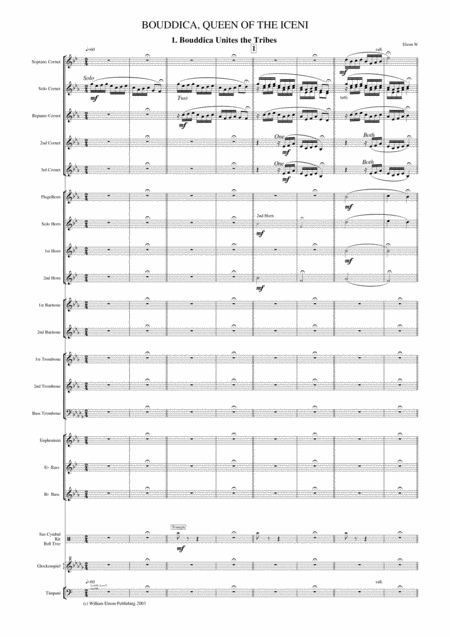
Boudicca, Queen of the Iceni
Ensemble de cuivres

$60.00 52.06 € Ensemble de cuivres PDF SheetMusicPlus

Woodwind Ensemble,Woodwind Quartet Bassoon,Clarinet,Flute,Oboe - Level 3 - Digital Download SKU: A0.1089055 Composed by Grant Horsley. Christmas,Contest,Easter,Festival,Praise & Worship,Sacred. 21 pages. Grant Horsley #693274. Published by Grant Horsley (A0.1089055). Aria is scored for Woodwind Quartet (Flute, Oboe Clarinet in B flat and Bassoon) It is a very restful melodic piece based on a single motif heard in bar 1. Written in the key of C major the piece is very hymn -like in design- with long notes and chords but has some unusual harmonies. The searing theme is stated then repeated with variation in texture. The theme is then developed using the rhythmic motif in the beginning climaxing in D major briefly before calmly returning to C major to repeat again. On this repeat more variation and articulation takes place before a restful conclusion. The range of all instruments is around two octaves with no complicated rhythms and I've tried to keep all parts interesting. and evenly balanced in terms of quantity. The full score is 8 pages and parts are 3 pages each- it is roughly 5 mins 40 in length. I have set it to intermediate level but an early intermediate should be ok with some of the parts. The whole score is on the youtube link for you to assess suitability. Price is for the full score and all parts. Suitable for a variety of purposes: Concerts, Recitals, Contests, Festivals, Easter, Church services, Weddings, Sacred, Interludes, Productions or an addition to the repertoire.
"Aria" For Woodwind Quartet
Flûte, Hautbois, Clarinette, Basson

$11.50 9.98 € Flûte, Hautbois, Clarinette, Basson PDF SheetMusicPlus

Jazz Ensemble Jazz Ensemble - Level 1 - Digital Download SKU: A0.947267 Composed by John Philips. Blues,Jazz. Score and parts. 15 pages. John Philips Music Service #3867629. Published by John Philips Music Service (A0.947267). First adjust the tempo...This should run at about 130/140. It’s a Funky 2 beat on I Got Rhythm changes gets into 4 on the first bridge. Ending is multiple tags with big finish. This could be opened for choruses. The idea here is the loose swing and not to concentrate on technique so it bogs down. If you liked Basie you would like this.If you want a Maynard or Buddy chart, look elsewhere. This series of charts uses nothing more complicated than eighth notes, are not frantic or screamers, extreme ranges and are hemi-demi-semi-quaver free. They depend on intonation and the players being not intimidated by what he is asked to play. There is no contest to see how high you can go before you need oxygen , how many notes you can play in 9 seconds or before your bell overheats , or how long it takes the audience to cover their earsRelaxed and confident players always play more in tune. Good harmonies, lines and realistic rhythm patterns will produce a good result that will swing and be enjoyed by player and listener alike.
Holland Street Boogie
Ensemble Jazz

$15.00 13.02 € Ensemble Jazz PDF SheetMusicPlus

String Orchestra - Level 4 - Digital Download SKU: A0.922636 Composed by Johann Strauss Jr. Arranged by Aaron Meier. Romantic Period,World. Score and parts. 1 pages. Aaron Meier #5792367. Published by Aaron Meier (A0.922636). Original by Johann Strauss II Reduction to String Orchestra by Aaron Meier Part: Violin II True to the original work by Strauss, this reduction for string orchestra features the ornaments and mystical writing that defines Strauss' polkas. There are optional percussion parts to be added at the discretion of the ensemble, however even without percussion the ensemble will sound full (the percussion acts as an ornament). Difficulty: Intermediate-advanced - advanced (best-suited for advanced student ensembles) --- Performance Notes: • Approximate length: 3:30 minutes • 1st Violins: In m. 1, trill a half step from a Dâ™­ to a Dâ™®  • 2nd Violins:  - At m. 42, divide players by 3, with 2 players playing line A and the remaining player playing line B  - At m. 72-75, emphasize the Eâ™­ in the div. • Snare Drum: The buzz roll needs to be quieter than how it is played in the midi recording (*see YouTube link ↓) History: The Olga-Polka itself owed its creation to a Russian royal wedding which took place in St. Petersburg on 28 August 1857. On that day, amid accompanying splendour, the music-loving Grand Duke Michail Nikolaievich (1832-1909), youngest brother of Tsar Alexander II, married Princess Caecilie of Baden (1839-91), daughter of Archduke Leopold of Baden. Johann Strauss, who at that time was giving a summer season of concerts in nearby Pavlovsk, used the opportunity occasioned by the event to enhance his already enviable popularity with the Russian royal family and composed the Caecilien-Polka in honour of the lovely young bride. Indeed, it is clear from a letter which Johann wrote in late July 1857 to Carl Haslinger, his publisher in Vienna, that the new polka had been prepared well in advance of the wedding (the fair copy of the full orchestral score made for the publisher's engraver is dated 9 August) and was enjoying success even before the royal couple's official engagement on 16August 1857. Sometime after performing the Caecilien-Polka in Pavlovsk, Johann despatched the work to the Austrian capital where his brother Josef conducted its Viennese première, together with that of Johann's waltz Telegraphische Depeschen (op. 195, Volume 28), at his own benefit concert in the Volksgartenon Sunday 18 October 1857. The Wiener Allgemeine Theaterzeitung (16.10.1857) remarked that both works have caused a sensation in St. Petersburg and are truly genial Viennese sounds full of verve and melody. Since tradition demanded that the German Princess Caecilie adopt a Russian name - Olga Feodorovna - before her marriage, so Johann's Caecilien-Polka also underwent a change of identity. On 8 December 1857 Carl Haslinger announced the publication of Strauss's Olga-Polka, on the title page of which is the inscription: Dedicated to her Imperial Highness Grand Duchess Olga, née Princess of Baden. It was under this title, too, that Johann himself first conducted the work in Vienna at a concert in the Volksgarten on 1 November 1857, shortly after his return from Russia. Reporting on this event, the Wiener Allgemeine Theaterzeitung (3.11.1857) observed: The 'Olga-Polka' is a most delightful, fragrant musical bouquet, full of fine, gracious rhythms. [excerpted from NAXOS Records] Kemp, Peter. Program Notes - About this Recording. NAXOS, 1993, www.naxos.com/mainsite/blurbs_reviews.asp?item_code=8.223232&catNum=223232&filetype=About%20.......... Accessed 5 June 2020. Resources: • Visit
Olga-Polka, Op. 196 (arr. for string orchestra): Violin II
Orchestre à Cordes

$3.99 3.46 € Orchestre à Cordes PDF SheetMusicPlus

Piano Solo - Level 5 - Digital Download SKU: A0.533692 Composed by Carson Cooman. 20th Century,Concert,Contemporary,Sacred,Standards. Score. 17 pages. Musik Fabrik Music Publishing #3038635. Published by Musik Fabrik Music Publishing (A0.533692). Biblicals: Concerto for Solo Piano in Five Movements (1998) was commissioned from thecomposer by an anonymous benefactor for pianist Kathleen Supové in tribute of her tirelesssupport of new music.The work is in five movements, each inspired by a different biblical quotation which isquoted in the score before each movement. If possible, these passages should be printed inthe program or read aloud before the performance of the work. Each movement isprogrammatic only in an internal sense. While the movements do not attempt to directlyportray the action of the passage in a storybook sense, they do attempt to capture the overallaffect of the verse. The form of the work is as a concerto for solo piano drawing on a titlethat has been used in the past by numerous composers. Likewise, although the work does notinvolve an orchestra, I have titled it concerto because it contains elements of a concerto solopart and because of the virtuosity required to perform the work. The work explores a widerangeof styles from quasi-lyrical to highly chromatic. Throughout, the work has a rhythmicintensity which should be observed by the performer.The first movement, Hovering Over the Waters, makes use of an irregular rhythmic patternintroduced in the opening measure and used throughout the work. Irregular and nervousrhythms using chromatic intervals pervade the entire movement.The second movement, Baldhead, is a forceful and loud movement making use of the clashbetween diatonic and pentatonic clusters. It is relentless in its pounding energy, irregularrhythms, and volume. This movement is dedicated to American composer Daniel Pinkhamon the occasion his 75th birthday in 1998. The connection of this movement to Pinkhamcomes in the superimposition of pentatonic and diatonic clusters, a technique used so well inone of my favorite Pinkham works, Blessings for Organ (1978).The third movement, Forgiven and Free, presents a tranquil scene involving the building ofchords, standard and otherwise, through the adding of tones one at a time. Brief chromaticmelodies appear and then disappear quickly.The fourth movement, Under the Sun, makes use of a motive involving four chords over a lefthand bass consisting of a major-tenth chord. This motive appears throughout the movement,constantly breaking in and interrupting the action. A variety of irregular rhythmic motivesappear throughout as a contrast to the main motive with its strict rhythm. Quotes of nurseryrhyme tunes are hidden throughout the movement as well in various forms.The fifth movement, The Seventh Angel, is a fast and furious tarantella. As the movementflies by a variety of musical ideas emerge and then disappear into the main motive again.The music continues to get faster and faster and finally the movement ends with a furiousprogression from the bottom to top of the piano and then a thunderous unison chord in thelower register.
Carson Cooman: Biblicals: Concerto for Solo Piano
Piano seul

$16.95 14.71 € Piano seul PDF SheetMusicPlus

Clarinet Choir,Woodwind Ensemble Bass Clarinet,E-Flat Clarinet - Level 3 - Digital Download SKU: A0.1085640 Composed by Grant Horsley. Classical,Easter,Praise & Worship,Sacred,Wedding. 30 pages. Grant Horsley #689812. Published by Grant Horsley (A0.1085640). Aria is scored for Clarinet in E flat, 3 B flat Clarinets, Alto and Bass Clarinet. It is a very restful melodic piece based on a single motif heard in bar 1. Written in concert B flat major the piece is very hymn -like in design- with long notes and chords but has some unusual harmonies. The searing theme is stated then repeated with variation in texture. The theme is then developed using the rhythmic motif in the beginning climaxing in C major briefly before calmly returning to B flat major to repeat again. On this repeat more variation takes place before a restful conclusion. The top note is top B flat (C5) and I've tried to keep all parts interesting. The full score is 11 pages and parts are 3 pages each- it is roughly 5 mins 30 in length. I have set it to intermediate level but an early intermediate should be ok with some of the parts. The whole score is on the youtube link for you to assess suitability. Price is for the full score and all parts. Suitable for a variety of purposes: Concerts, Recitals, Contests, Festivals, Easter, Church services, Weddings, Productions or an addition to the repertoire.
"Aria" for Clarinet Choir
Ensemble de Clarinettes

$13.50 11.71 € Ensemble de Clarinettes PDF SheetMusicPlus

Woodwind Ensemble Bassoon - Level 3 - Digital Download SKU: A0.813063 Composed by Traditional French Melodies. Arranged by Regis Bookshar. Christmas,Classical,Instructional,Multicultural,Standards,World. 21 pages. Regis Bookshar #6095935. Published by Regis Bookshar (A0.813063). Bassoon Quintet - Intermediate - Digital Download. This selection, Burgundian Air/March of the Three Kings, has been arranged for 5 Bassoons by Regis Bookshar. It incorporates two Traditional French melodies into one exciting arrangement, which, I'm certain, will entertain both performers and audiences alike. It is suitable for high school and college students and is perfect for Christmas concerts and church services but could be performed anytime and anywhere. Included are a score and a complete set of parts (21 pages). It begins with a Burgundian Air, played by a solo instrument. The melody is then played by two instruments in harmony before the rest of the ensemble joins in. This is followed by the March of the Three Kings, a Provencal melody (La Marche Des Rois Mages) which dates from the 13th century and recalls the Three Kings of the Christmas story. The peasants probably sang and danced to this tune, even perhaps honoring their own folk heroes, the French dukes, dressed in their shining armor and carrying brilliant banners, as they marched off to the Crusades. Georges Bizet utilized this tune as a farandole, or stately dance, in his incidental music for Alphonse Daudet's play L'Arlesienne (The Girl from Arles). There is a fugal section in which each instrument enters, playing an embellished version of the tune before concluding the arrangement. Also available are other settings of these two traditional French melodies for a variety of instrumental ensembles as well as numerous other arrangements in a variety of styles. Please feel free to search for other arrangements by Regis Bookshar. You may find something else which might interest you as well. I'm certain that students will enjoy playing this arrangement.
Burgundian Air/March of the Three Kings (F min) (Bassoon Quintet)
Ensemble de Bassons

$18.00 15.62 € Ensemble de Bassons PDF SheetMusicPlus

Concert Band - Level 3 - Digital Download SKU: A0.1116337 Composed by Nathaniel Hontz and William Billings. Arranged by Nathaniel Hontz. Christian,Classical,Early Music,Folk,Sacred. Score and Parts. 33 pages. TigerSong LLC #717791. Published by TigerSong LLC (A0.1116337). William Billings's early American hymn Africa adapted for wind ensemble. It opens with a grand processional in 3/4 stating an original melody. It then moves to a minor inversion of Billings's melody, before resolving to the Africa as a trio between euphonium, trombone, and cornet. It then blossoms into a brass choir before ending with a grand march, in which the processional melody and Africa are played together. An easy piece that sounds great!
Africa (Now Shall My Inward Joys Arise)
Orchestre d'harmonie

$29.99 26.02 € Orchestre d'harmonie PDF SheetMusicPlus

Choral Choir (SATB) - Level 2 - Digital Download SKU: A0.976727 Composed by Robert Myers. Christian,Praise & Worship,Sacred. Octavo. 2 pages. WheatMyer Music #5197337. Published by WheatMyer Music (A0.976727). It was one of those accidents where you find something useful when you’re looking for something else. While reading on the nature of worship, a particular blog article ended with Adoniram Judson’s early 19th Century baptismal poem, Come Holy Spirit, Dove Divine. The flowing text called out (at least to me!) for a musical setting. Accordingly, some melodic and harmonic ideas began to percolate in my thoughts. However, before getting very far along in writing a tune, there were two surprises in store. First many others had already set the text to music before (with a multitude of tunes) going back to at least 1833. Second, despite being a Baptist for over forty years, I discovered that this hymn has been in the Baptist Hymnal since 1956 yet I have no recollection of every singing it! Well, chagrined at my ignorance, I carried on writing a new melody and harmony for this deserving text. I sought to make it friendly to congregational singers while still containing rich and sing-able harmonies and so aimed for a four-part hymn-style form. However, as I suspect my ignorance of the hymn is a common condition, a fresh and modern tune which would be at home in varied musical styles and have popular appeal was also pursued. The result is a delightful and uplifting tune, easy to sing, with an optimistic and forward momentum, commensurate with the meaning of believers’ baptism, Buried with Him in baptism; raised to walk in new life. The music is flexible in application to many church music styles: praise team and band, choir and organ, congregation and piano, or mix and match to fit your needs. May you find Come, Holy Spirit, Dove Divine, singing a much needed text, a means for your congregation to joyfully join with new believers in celebration of their baptism!
Come, Holy Spirit, Dove Divine
Chorale SATB

$1.99 1.73 € Chorale SATB PDF SheetMusicPlus

Clarinet Duet Clarinet - Level 3 - Digital Download SKU: A0.1368540 Composed by Grant Horsley. Classical,Contemporary,Contest,Festival,Film/TV,Romantic Period. 2 scores. 16 pages. Grant Horsley #952900. Published by Grant Horsley (A0.1368540). Serenity is as the title suggests, is a peaceful and relaxing composition with a sense of openness and space.It is a fusion of two styles-namely the late romantic period and film music. It is based on a single idea heard in the first two bars (a bar or so of quaver movement). This gets developed throughout the piece even changing key for a few bars at one point for a twist of harmonic interest before reaching a climax in the middle.After several more bars of an idea expressed earlier, the piece returns to the main theme for the last time featuring a small codetta before fading away gently to a whisper.The whole score is on here for you to assess suitability.It is set to intermediate level and is around 4min 40 in length. Price is for the full score and parts.The following versions are available: Solo Piano, Flute Duet with Piano, Flute, Clarinet and Piano, Clarinet Duet and Piano, Violin Duet with Piano, and Flute, Bassoon and Piano. Great for concerts, recitals, events etc.
Serenity. Original for Clarinet Duet
2 Clarinettes (duo)

$6.50 5.64 € 2 Clarinettes (duo) PDF SheetMusicPlus


Partitions Gratuites
Acheter des Partitions Musicales
Acheter des Partitions Digitales à Imprimer
Acheter des Instruments de Musique

© 2000 - 2026

Accueil - Version intégrale





