EUROPE
4779 articles
USA
0 articles
DIGITAL
6991 articles (à imprimer)
Partitions Digitales
Partitions à imprimer
6991 partitions trouvées


Voice and piano (2 songs with violoncello; 1 vocal duet) - Medium - Digital Download SKU: MQ.8491-21E Composed by MeeAe Cecilia Nam and Theodore Gouvy. 7 pages. E. C. Schirmer Music Company - Digital #8491-21E. Published by E. C. Schirmer Music Company - Digital (MQ.8491-21E). French.A French composer, Théodore Gouvy (1819-1898) was one of the most significant composers of 19th Century in Europe. The movement of rediscovering his instrumental music has been increasingly successful in Europe since the 1990s, especially following the birth of L’Institut Gouvy in France. However, his solo vocal music has been waiting to be unveiled to the public. Volume One includes 52 songs of Gouvy.Gouvy traveled widely throughout Europe. He was also a lover of nature. Generally, he spent his winters in Leipzig, but in the summertime, he always returned to Hombourg-Haut, France, to stroll through the woods, to hunt, and to relax. Gouvy was fluent in several languages and had a great appreciation of the Renaissance French Poetry of Pierre de Ronsard whose poetry he had set to music. The fifty-two songs in this volume are largely by Ronsard and other Renaissance poets of La Pléiade.Although Ronsard is approximately 300 years older than Gouvy, they both seem to have the same interest in classical literature, though, admittedly, for different reasons. Celebrated by the French and English courts, Ronsard (1525-1585) was the leader of La Pléiade: a group of seven poets (Joachim Du Bellay (1522-1560), Rémy Belleau (1528-1577), Étienne Jodelle (1532-1573), Pontus de Tyard (1521-1603), Jean–Antoine Baïf (1532-1589), and Jean Daurat (1508-1588), who dedicated their efforts to writing poetry in French rather than in Latin (or Greek) as most of the Romantic poets did. They wished to enrich the French language, and establish a new literature which would be the equal of the other literature of their period, and the equal to poets of the past. French Romantic poetry featured the closeness of the poet to nature, and his ability to communicate with nature by personifying (anthropomorphizing) all of nature’s elements: flowers, the planets, the moon, the breeze, and even the sand upon the shore. As a significant melodist, Gouvy’s treatment of the vocal solo line and his treatment and development of the piano accompaniment places him in the upper echelons as a composer of songs. His diverse cultural life led a rich and significant musical life, interacting with his contemporaries who admired his work, and whom Gouvy knew well, such as Liszt, Brahms, Schumann, Mendelssohn, Berlioz and Gounod. Contents:Six Odes de Ronsard pour ténor et piano, Op. 37 (No. 3 et No. 5 avec violoncelle) Neuf Poésies de Ronsard pour soprano ou ténor et piano, Op. 41 Six Poésies de Ronsard pour soprano ou ténor et piano, Op. 42 Quatre Odes de Ronsard pour baryton et piano, Op. 43 Huit Poésies de Ronsard pour ténor ou soprano et piano, Op. 44 Sept Poésies de Ronsard pour ténor ou soprano et piano, Op. 47.
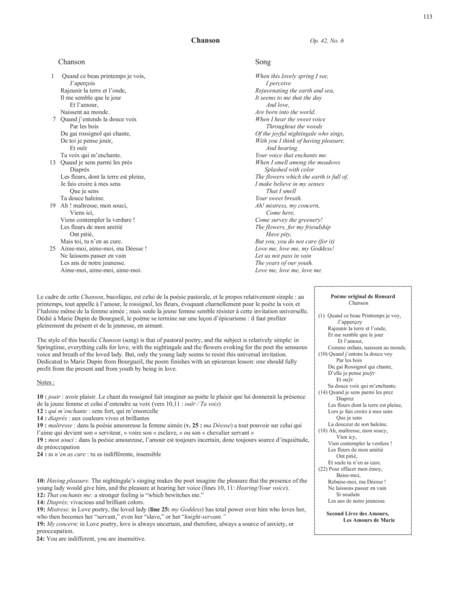
Op. 42, No. 6: Chanson from Songs of Gouvy, V1 (Downloadable)
Piano, Voix

$3.00 2.6 € Piano, Voix PDF SheetMusicPlus

Concert Band - Level 3 - Digital Download SKU: A0.734884 Composed by Joseph Hasper. 20th Century,Contemporary. Score and parts. 123 pages. Joseph Hasper #4569581. Published by Joseph Hasper (A0.734884). A bold, modern piece for full concert band composed in 2018. 7'00 duration. Includes a full score and set of parts.In Greek mythology the Titans were a powerful race that ruled the world before the Olympians. They were immortal giants of incredible strength and knowledge. According to mythology, a generation of younger Titans (Zeus, Hades, Poseidon, Hora, Hestia and Demeter) rebelled against their elders (Cronus and his followers) in a 10-year war. In the piece we hear the clashing of giant hammers forging weapons for that war. We also hear echoes of the ancient gods, Uranus and Gaea, and finally the martial beat of the rebellious Titans marching into cataclysmic battle. Musically, this piece is based on three ideas. A dynamic theme of chaos and instability reflects the conflict between the two generations of Titans. A more serene and melodic tune, the second idea, reflects the ordered and serene rule of the older Titans. The third idea is that even small actions often have far-reaching implications. This is musically represented by solo instruments that create ripples and echoes throughout the band.
Titan's Forge (Concert Band)
Orchestre d'harmonie

$39.00 33.86 € Orchestre d'harmonie PDF SheetMusicPlus

Cello Duet Cello - Level 2 - Digital Download SKU: A0.1508659 By Aaron Sinnett. By Jean-Baptiste Bréval. Arranged by Aaron Sinnett. 19th Century,Baroque,Chamber,Classical. Score. 89 pages. Aaron Sinnett #1083923. Published by Aaron Sinnett (A0.1508659). Jean-Baptiste Bréval, Six Sonatas, Op. 40Score and parts included. (Minimal markings, no additional edits, i.e. no fingerings or bowing added)As per the tradition of the era, Bréval composed the Cello solo and the bass line, leaving the chord making up to the performer. This means that there is originally no piano accompaniment part by Bréval. (If you are familiar with any sonata by said composer, it is likley No. 1 in C major, as it appears in volume 4 of a popular method, which is supplied with a piano accompoaniment.) Even so, as many can attest, most sonatas of the Baroque/early Classical periods are beautiful performed with two cellos, or cello duet.In this edition, I have made the notation modern, the layout clean and clear, as well as providing the score of the two original parts and individual parts, labeled Cello 1 and Cello 2. (For those wishing for historical accuracy in part naming Cello 2 should more appropriately be labelled Basso.) I have elevated it to Cello 2 simply to encourage the performance of this excellent set of sonatas with two cellos. I believe they sound very good this way in spite of being traditionally expected to be performed with a chord making instrument like a keyboard in addition to the solo cello and bass instrument. Thus, making it a trio.The Table of contents is the following without being overly detailed (one of the preview pages will have incipits from all six sonatas as is the custom when printing a complete set of pieces in a single volume).  Sonata No. 1 in C major Sonata No. 2 in F major Sonata No. 3 in G major Sonata No. 4 in Bb major Sonata No. 5 in A major Sonata No. 6 in D major Each sonata is two movements long. They all have first movements with the customary Sonata Allegro form. The seconds movements vary from RONDOs to Minuets to a set of variations.It is my sincere hope that more of these sonatas be learned and performed as they are not only great learning material, Bréval has crafted each one masterfully.
Six Sonatas for Cello, Op. 40
Aaron Sinnett
$14.99 13.02 € PDF SheetMusicPlus

Voice and piano (2 songs with violoncello; 1 vocal duet) - Medium - Digital Download SKU: MQ.8491-03E Composed by MeeAe Cecilia Nam and Theodore Gouvy. 7 pages. E. C. Schirmer Music Company - Digital #8491-03E. Published by E. C. Schirmer Music Company - Digital (MQ.8491-03E). French.A French composer, Théodore Gouvy (1819-1898) was one of the most significant composers of 19th Century in Europe. The movement of rediscovering his instrumental music has been increasingly successful in Europe since the 1990s, especially following the birth of L’Institut Gouvy in France. However, his solo vocal music has been waiting to be unveiled to the public. Volume One includes 52 songs of Gouvy.Gouvy traveled widely throughout Europe. He was also a lover of nature. Generally, he spent his winters in Leipzig, but in the summertime, he always returned to Hombourg-Haut, France, to stroll through the woods, to hunt, and to relax. Gouvy was fluent in several languages and had a great appreciation of the Renaissance French Poetry of Pierre de Ronsard whose poetry he had set to music. The fifty-two songs in this volume are largely by Ronsard and other Renaissance poets of La Pléiade.Although Ronsard is approximately 300 years older than Gouvy, they both seem to have the same interest in classical literature, though, admittedly, for different reasons. Celebrated by the French and English courts, Ronsard (1525-1585) was the leader of La Pléiade: a group of seven poets (Joachim Du Bellay (1522-1560), Rémy Belleau (1528-1577), Étienne Jodelle (1532-1573), Pontus de Tyard (1521-1603), Jean–Antoine Baïf (1532-1589), and Jean Daurat (1508-1588), who dedicated their efforts to writing poetry in French rather than in Latin (or Greek) as most of the Romantic poets did. They wished to enrich the French language, and establish a new literature which would be the equal of the other literature of their period, and the equal to poets of the past. French Romantic poetry featured the closeness of the poet to nature, and his ability to communicate with nature by personifying (anthropomorphizing) all of nature’s elements: flowers, the planets, the moon, the breeze, and even the sand upon the shore. As a significant melodist, Gouvy’s treatment of the vocal solo line and his treatment and development of the piano accompaniment places him in the upper echelons as a composer of songs. His diverse cultural life led a rich and significant musical life, interacting with his contemporaries who admired his work, and whom Gouvy knew well, such as Liszt, Brahms, Schumann, Mendelssohn, Berlioz and Gounod. Contents:Six Odes de Ronsard pour ténor et piano, Op. 37 (No. 3 et No. 5 avec violoncelle) Neuf Poésies de Ronsard pour soprano ou ténor et piano, Op. 41 Six Poésies de Ronsard pour soprano ou ténor et piano, Op. 42 Quatre Odes de Ronsard pour baryton et piano, Op. 43 Huit Poésies de Ronsard pour ténor ou soprano et piano, Op. 44 Sept Poésies de Ronsard pour ténor ou soprano et piano, Op. 47.
Op. 37, No. 3: Dieu vous gard’, messagers fidèles from Songs of Gouvy, V1 (Downloadable)
Piano, Voix

$3.00 2.6 € Piano, Voix PDF SheetMusicPlus

Piano,Vocal,Voice - Level 4 - Digital Download SKU: A0.1477790 Composed by Negro Spirituals. Arranged by Mary K. Sallee. Religious,Sacred,Spiritual. Score. 6 pages. Mary K. Sallee #1055171. Published by Mary K. Sallee (A0.1477790). This medley combines three popular spirituals in a fresh new way. It begins with a slower and free flowing interpretation of Every Time I Feel the Spirit in the beginning before segueing into an upbeat feel of Do Lord, Do You Remember Me? in a swing feel. It soon returns to the slower reflective version of Every Time before a surprise entry of He's Got the Whole World in His Hands.  The arrangement ends with what seems to be the slower reflective mood of Every Time, but then accelerates to a more energetic tempo with embelleshment for a showy coda that ties it all together for an inspirational ending.
Feeling the Spirit Medley (Every Time I Feel the Spirit, Do Lord, He's Got the Whole World)
Piano, Voix

$5.00 4.34 € Piano, Voix PDF SheetMusicPlus

Clarinet Choir,Woodwind Ensemble Bass Clarinet,E-Flat Clarinet - Level 4 - Digital Download SKU: A0.1240964 Composed by Everardo García Vargas. Chamber,Classical,Holiday,Multicultural,Traditional,World. 62 pages. Everardo García Vargas #836358. Published by Everardo García Vargas (A0.1240964). El Aventurero - Ensamble para Coro de ClarinetesEn abril de 2022, se lanzó esta nueva versión oficial definitiva de la composición Nº 07 “El Aventureroâ€, un ensamble para coro de clarinetes. Esta actualización fue posible gracias a la valiosa retroalimentación proporcionada por maestros, compañeros, alumnos y público en general, quienes solicitaron la incorporación de nuevos temas y una mayor duración de la obra para satisfacer la demanda de una experiencia auditiva más completa. Los aspectos más destacados y significativos de esta nueva versión radica en la incorporación de nuevos temas inéditos, tales como dos estribillos, un trío y un montuno extendido en forma de improvisación. Este último elemento fue fundamental para desarrollar, expandir y aventurarme nuevamente en la obra. A través de él, pude plasmar los ciclos de mi vida y transportar el pasado hacia el presente. Asimismo, se incorporó un desenlace explícito y coherente para garantizar que el oyente comprenda de manera inequívoca la conclusión de la obra. Esto contrasta con la versión anterior, que dejaba cierta ambigüedad sobre si la pieza continuaba o había llegado a su fin. Además de los nuevos temas, se realizaron mejoras en los ya existentes ampliando algunas frases y motivos y se añadieron puentes para facilitar la unión y repetición, y también se introdujeron cambios en los contrapuntos y armonías en frases específicas. En su obra “El Aventureroâ€, el compositor mexicano comparte su historia personal a través de las distintas etapas que ha experimentado a lo largo de su vida. Originario de la comunidad de Tlahuitoltepec Mixe, Oaxaca, el autor creció hablando la lengua mixe y se sumergió en las tradiciones, usos y costumbres de una comunidad rica en cultura. Desde temprana edad, estuvo expuesto a bandas filarmónicas con repertorios de sones y jarabes. A la edad de diez años, tuvo su primer acercamiento a la música a través de lecciones impartidas por su padre. Posteriormente, continuó su aprendizaje de manera autodidacta y se unió a la banda municipal del pueblo. Con el paso del tiempo, la banda municipal, ahora conocida como BASTLAM, alcanzó su máximo potencial en la década de los 90. Fue entonces cuando comenzaron las giras musicales y el autor tuvo la oportunidad de visitar las ciudades de Oaxaca, México y Veracruz. Quedó impresionado por la belleza de las grandes ciudades y sus distintas tradiciones, pero sobre todo por su rica cultura musical. Posteriormente, se trasladó a la Ciudad de México para residir allí temporalmente. Sus viajes musicales continuaron por casi todos los estados de la República Mexicana. Durante estos viajes, adquirió experiencias y conocimientos valiosos, maravillándose ante la magnificencia de las diferentes culturas, tradiciones y estilos musicales de cada estado. En conclusión: “El Aventurero†es una obra fascinante en la que el compositor mexicano relata su historia personal a través de las distintas etapas de su vida. Desde sus orígenes en la comunidad de Tlahuitoltepec Mixe, Oaxaca, hasta sus viajes musicales por la República Mexicana, el autor ha tenido la oportunidad de experimentar y aprender de las ricas culturas y tradiciones de su país. Su pasión por la música lo ha llevado a lugares y experiencias inolvidables, y esta obra es un testimonio conmovedor de su viaje. La nueva versión de “El Aventurero†representa una evolución enriquecedora de la obra original. Gracias a la incorporación de nuevos temas y desarrollos que invita al oyente a sumergirse en un emocionante viaje musical. Las sugerencias y comentarios recibidos permitieron mejorar y expandir esta composición para ofrecer una experiencia única.
El Aventurero - Ensamble para Coro de Clarinetes
Ensemble de Clarinettes

$70.50 61.21 € Ensemble de Clarinettes PDF SheetMusicPlus

Coolio : Esprits Rebelles - Gangsta's Paradise (niveau facile)
Flûte traversière
Téléchargez la partition Flûte Esprits Rebelles - Gangsta's Parad…
5.99 € Flûte traversière PDF Tomplay

Voice and piano (2 songs with violoncello; 1 vocal duet) - Medium - Digital Download SKU: MQ.8491-13E Composed by MeeAe Cecilia Nam and Theodore Gouvy. 5 pages. E. C. Schirmer Music Company - Digital #8491-13E. Published by E. C. Schirmer Music Company - Digital (MQ.8491-13E). French.A French composer, Théodore Gouvy (1819-1898) was one of the most significant composers of 19th Century in Europe. The movement of rediscovering his instrumental music has been increasingly successful in Europe since the 1990s, especially following the birth of L’Institut Gouvy in France. However, his solo vocal music has been waiting to be unveiled to the public. Volume One includes 52 songs of Gouvy.Gouvy traveled widely throughout Europe. He was also a lover of nature. Generally, he spent his winters in Leipzig, but in the summertime, he always returned to Hombourg-Haut, France, to stroll through the woods, to hunt, and to relax. Gouvy was fluent in several languages and had a great appreciation of the Renaissance French Poetry of Pierre de Ronsard whose poetry he had set to music. The fifty-two songs in this volume are largely by Ronsard and other Renaissance poets of La Pléiade.Although Ronsard is approximately 300 years older than Gouvy, they both seem to have the same interest in classical literature, though, admittedly, for different reasons. Celebrated by the French and English courts, Ronsard (1525-1585) was the leader of La Pléiade: a group of seven poets (Joachim Du Bellay (1522-1560), Rémy Belleau (1528-1577), Étienne Jodelle (1532-1573), Pontus de Tyard (1521-1603), Jean–Antoine Baïf (1532-1589), and Jean Daurat (1508-1588), who dedicated their efforts to writing poetry in French rather than in Latin (or Greek) as most of the Romantic poets did. They wished to enrich the French language, and establish a new literature which would be the equal of the other literature of their period, and the equal to poets of the past. French Romantic poetry featured the closeness of the poet to nature, and his ability to communicate with nature by personifying (anthropomorphizing) all of nature’s elements: flowers, the planets, the moon, the breeze, and even the sand upon the shore. As a significant melodist, Gouvy’s treatment of the vocal solo line and his treatment and development of the piano accompaniment places him in the upper echelons as a composer of songs. His diverse cultural life led a rich and significant musical life, interacting with his contemporaries who admired his work, and whom Gouvy knew well, such as Liszt, Brahms, Schumann, Mendelssohn, Berlioz and Gounod. Contents:Six Odes de Ronsard pour ténor et piano, Op. 37 (No. 3 et No. 5 avec violoncelle) Neuf Poésies de Ronsard pour soprano ou ténor et piano, Op. 41 Six Poésies de Ronsard pour soprano ou ténor et piano, Op. 42 Quatre Odes de Ronsard pour baryton et piano, Op. 43 Huit Poésies de Ronsard pour ténor ou soprano et piano, Op. 44 Sept Poésies de Ronsard pour ténor ou soprano et piano, Op. 47.

Op. 41, No. 7: Que dites-vous, que faites-vous, mignonne? from Songs of Gouvy, V1 (Downloadable)
Piano, Voix

$3.00 2.6 € Piano, Voix PDF SheetMusicPlus

Coolio : Esprits Rebelles - Gangsta's Paradise (niveau difficile)
Trompette
Téléchargez la partition Trompette Esprits Rebelles - Gangsta's Paradis…
5.99 € Trompette PDF Tomplay

Level 3 - Digital Download SKU: A0.1408422 Composed by Robert A. Howard. 21st Century,Chamber,Classical,Contemporary,New Age. 4 pages. Robert A. Howard #991006. Published by Robert A. Howard (A0.1408422). Promenade II a flexibly scored, open form, improvisatory version of the original Promenade piece for full orchestra, based on the same musical material. This second piece features 21 separate musical 'blocks' (labelled A-U). These are to be allocated to the available musical instruments. The blocks can be freely stated and repeated, in an improvisatory manner, as players sensitively respond to the changing texture during the course of a performance. Full playing instructions are given on the score. Note: the document provided is the full score (with indicated transpositions). No audio track is provided due to the considerably flexibility and variability of performances. The original version is available via a search of the COMA Music Library.Duration: Variable.Registered with PRS (Performing Rights Society, UK).Composer's website: www.roberthowardmusic.co.uk
Promenade II - Score Only

$3.99 3.46 € PDF SheetMusicPlus


Partitions Gratuites
Acheter des Partitions Musicales
Acheter des Partitions Digitales à Imprimer
Acheter des Instruments de Musique

© 2000 - 2026

Accueil - Version intégrale




