EUROPE
4779 articles
USA
0 articles
DIGITAL
6991 articles (à imprimer)
Partitions Digitales
Partitions à imprimer
6991 partitions trouvées


Piano Solo - Digital Download SKU: A0.507430 Composed by Heather Cattanach. 20th Century,Contemporary,Instructional. Score. 6 pages. Published by Heather Cattanach (A0.507430). In octaves the cantabile melody line soars above arpeggiated figures in this Early Advanced Piano Solo. Pegasus, the winged horse of Greek mythology, struck the ground with his hoof, releasing a spring of water which gives the gift of poetry to those who drink from it. The hero Bellerophon rode Pegasus and killed the monster Chimaera. Look for Pegasus in the northern hemisphere at the end of summer and through autumn. In the southern hemisphere you can see him in late winter through spring. From “88 Constellations†a collection by Heather Cattanach featuring one piece of piano music for each of the 88 constellations (to match the number of keys on a standard piano). Performance Time 2 minutes. 5 pages. (General Instructional, Modern, Romantic, Repertoire, Recital).
Pegasus
Piano seul

$4.99 4.33 € Piano seul PDF SheetMusicPlus

Voice and piano (2 songs with violoncello; 1 vocal duet) - Medium - Digital Download SKU: MQ.8491-31E Composed by MeeAe Cecilia Nam and Theodore Gouvy. 5 pages. E. C. Schirmer Music Company - Digital #8491-31E. Published by E. C. Schirmer Music Company - Digital (MQ.8491-31E). French.A French composer, Théodore Gouvy (1819-1898) was one of the most significant composers of 19th Century in Europe. The movement of rediscovering his instrumental music has been increasingly successful in Europe since the 1990s, especially following the birth of L’Institut Gouvy in France. However, his solo vocal music has been waiting to be unveiled to the public. Volume One includes 52 songs of Gouvy.Gouvy traveled widely throughout Europe. He was also a lover of nature. Generally, he spent his winters in Leipzig, but in the summertime, he always returned to Hombourg-Haut, France, to stroll through the woods, to hunt, and to relax. Gouvy was fluent in several languages and had a great appreciation of the Renaissance French Poetry of Pierre de Ronsard whose poetry he had set to music. The fifty-two songs in this volume are largely by Ronsard and other Renaissance poets of La Pléiade.Although Ronsard is approximately 300 years older than Gouvy, they both seem to have the same interest in classical literature, though, admittedly, for different reasons. Celebrated by the French and English courts, Ronsard (1525-1585) was the leader of La Pléiade: a group of seven poets (Joachim Du Bellay (1522-1560), Rémy Belleau (1528-1577), Étienne Jodelle (1532-1573), Pontus de Tyard (1521-1603), Jean–Antoine Baïf (1532-1589), and Jean Daurat (1508-1588), who dedicated their efforts to writing poetry in French rather than in Latin (or Greek) as most of the Romantic poets did. They wished to enrich the French language, and establish a new literature which would be the equal of the other literature of their period, and the equal to poets of the past. French Romantic poetry featured the closeness of the poet to nature, and his ability to communicate with nature by personifying (anthropomorphizing) all of nature’s elements: flowers, the planets, the moon, the breeze, and even the sand upon the shore. As a significant melodist, Gouvy’s treatment of the vocal solo line and his treatment and development of the piano accompaniment places him in the upper echelons as a composer of songs. His diverse cultural life led a rich and significant musical life, interacting with his contemporaries who admired his work, and whom Gouvy knew well, such as Liszt, Brahms, Schumann, Mendelssohn, Berlioz and Gounod. Contents:Six Odes de Ronsard pour ténor et piano, Op. 37 (No. 3 et No. 5 avec violoncelle) Neuf Poésies de Ronsard pour soprano ou ténor et piano, Op. 41 Six Poésies de Ronsard pour soprano ou ténor et piano, Op. 42 Quatre Odes de Ronsard pour baryton et piano, Op. 43 Huit Poésies de Ronsard pour ténor ou soprano et piano, Op. 44 Sept Poésies de Ronsard pour ténor ou soprano et piano, Op. 47.
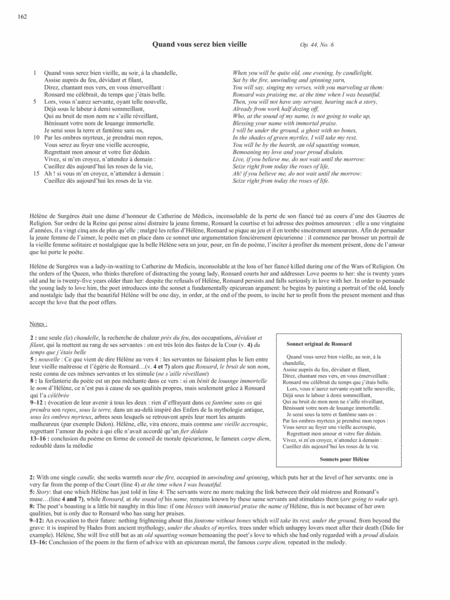
Op. 44, No. 6: Quand vous serez bien vieille from Songs of Gouvy, V1 (Downloadable)
Piano, Voix

$3.00 2.6 € Piano, Voix PDF SheetMusicPlus

Voice and piano (2 songs with violoncello; 1 vocal duet) - Medium - Digital Download SKU: MQ.8491-49E Composed by MeeAe Cecilia Nam and Theodore Gouvy. 5 pages. E. C. Schirmer Music Company - Digital #8491-49E. Published by E. C. Schirmer Music Company - Digital (MQ.8491-49E). French.A French composer, Théodore Gouvy (1819-1898) was one of the most significant composers of 19th Century in Europe. The movement of rediscovering his instrumental music has been increasingly successful in Europe since the 1990s, especially following the birth of L’Institut Gouvy in France. However, his solo vocal music has been waiting to be unveiled to the public. Volume One includes 52 songs of Gouvy.Gouvy traveled widely throughout Europe. He was also a lover of nature. Generally, he spent his winters in Leipzig, but in the summertime, he always returned to Hombourg-Haut, France, to stroll through the woods, to hunt, and to relax. Gouvy was fluent in several languages and had a great appreciation of the Renaissance French Poetry of Pierre de Ronsard whose poetry he had set to music. The fifty-two songs in this volume are largely by Ronsard and other Renaissance poets of La Pléiade.Although Ronsard is approximately 300 years older than Gouvy, they both seem to have the same interest in classical literature, though, admittedly, for different reasons. Celebrated by the French and English courts, Ronsard (1525-1585) was the leader of La Pléiade: a group of seven poets (Joachim Du Bellay (1522-1560), Rémy Belleau (1528-1577), Étienne Jodelle (1532-1573), Pontus de Tyard (1521-1603), Jean–Antoine Baïf (1532-1589), and Jean Daurat (1508-1588), who dedicated their efforts to writing poetry in French rather than in Latin (or Greek) as most of the Romantic poets did. They wished to enrich the French language, and establish a new literature which would be the equal of the other literature of their period, and the equal to poets of the past. French Romantic poetry featured the closeness of the poet to nature, and his ability to communicate with nature by personifying (anthropomorphizing) all of nature’s elements: flowers, the planets, the moon, the breeze, and even the sand upon the shore. As a significant melodist, Gouvy’s treatment of the vocal solo line and his treatment and development of the piano accompaniment places him in the upper echelons as a composer of songs. His diverse cultural life led a rich and significant musical life, interacting with his contemporaries who admired his work, and whom Gouvy knew well, such as Liszt, Brahms, Schumann, Mendelssohn, Berlioz and Gounod. Contents:Six Odes de Ronsard pour ténor et piano, Op. 37 (No. 3 et No. 5 avec violoncelle) Neuf Poésies de Ronsard pour soprano ou ténor et piano, Op. 41 Six Poésies de Ronsard pour soprano ou ténor et piano, Op. 42 Quatre Odes de Ronsard pour baryton et piano, Op. 43 Huit Poésies de Ronsard pour ténor ou soprano et piano, Op. 44 Sept Poésies de Ronsard pour ténor ou soprano et piano, Op. 47.
Op. 48, No. 9: Le Ruisseau from Songs of Gouvy, V1 (Downloadable)
Piano, Voix

$3.00 2.6 € Piano, Voix PDF SheetMusicPlus

Coolio : Esprits Rebelles - Gangsta's Paradise (niveau facile)
Trombone
Téléchargez la partition Trombone Esprits Rebelles - Gangsta's Paradise…
5.99 € Trombone PDF Tomplay

Voice and piano (2 songs with violoncello; 1 vocal duet) - Medium - Digital Download SKU: MQ.8491-44E Composed by MeeAe Cecilia Nam and Theodore Gouvy. 9 pages. E. C. Schirmer Music Company - Digital #8491-44E. Published by E. C. Schirmer Music Company - Digital (MQ.8491-44E). French.A French composer, Théodore Gouvy (1819-1898) was one of the most significant composers of 19th Century in Europe. The movement of rediscovering his instrumental music has been increasingly successful in Europe since the 1990s, especially following the birth of L’Institut Gouvy in France. However, his solo vocal music has been waiting to be unveiled to the public. Volume One includes 52 songs of Gouvy.Gouvy traveled widely throughout Europe. He was also a lover of nature. Generally, he spent his winters in Leipzig, but in the summertime, he always returned to Hombourg-Haut, France, to stroll through the woods, to hunt, and to relax. Gouvy was fluent in several languages and had a great appreciation of the Renaissance French Poetry of Pierre de Ronsard whose poetry he had set to music. The fifty-two songs in this volume are largely by Ronsard and other Renaissance poets of La Pléiade.Although Ronsard is approximately 300 years older than Gouvy, they both seem to have the same interest in classical literature, though, admittedly, for different reasons. Celebrated by the French and English courts, Ronsard (1525-1585) was the leader of La Pléiade: a group of seven poets (Joachim Du Bellay (1522-1560), Rémy Belleau (1528-1577), Étienne Jodelle (1532-1573), Pontus de Tyard (1521-1603), Jean–Antoine Baïf (1532-1589), and Jean Daurat (1508-1588), who dedicated their efforts to writing poetry in French rather than in Latin (or Greek) as most of the Romantic poets did. They wished to enrich the French language, and establish a new literature which would be the equal of the other literature of their period, and the equal to poets of the past. French Romantic poetry featured the closeness of the poet to nature, and his ability to communicate with nature by personifying (anthropomorphizing) all of nature’s elements: flowers, the planets, the moon, the breeze, and even the sand upon the shore. As a significant melodist, Gouvy’s treatment of the vocal solo line and his treatment and development of the piano accompaniment places him in the upper echelons as a composer of songs. His diverse cultural life led a rich and significant musical life, interacting with his contemporaries who admired his work, and whom Gouvy knew well, such as Liszt, Brahms, Schumann, Mendelssohn, Berlioz and Gounod. Contents:Six Odes de Ronsard pour ténor et piano, Op. 37 (No. 3 et No. 5 avec violoncelle) Neuf Poésies de Ronsard pour soprano ou ténor et piano, Op. 41 Six Poésies de Ronsard pour soprano ou ténor et piano, Op. 42 Quatre Odes de Ronsard pour baryton et piano, Op. 43 Huit Poésies de Ronsard pour ténor ou soprano et piano, Op. 44 Sept Poésies de Ronsard pour ténor ou soprano et piano, Op. 47.

Op. 48, No. 4: Eh! quoi ? tu fuis l’Amour from Songs of Gouvy, V1 (Downloadable)
Piano, Voix

$3.00 2.6 € Piano, Voix PDF SheetMusicPlus

String Quartet String Quartet - Level 3 - Digital Download SKU: A0.812099 Composed by George Frideric Handel. Arranged by Laura Chegwidden. Baroque,Concert,Graduation,Wedding. 40 pages. Laura Chegwidden #3468130. Published by Laura Chegwidden (A0.812099). Handel wrote 3 suites of Water Music, of which the D major suite is the second. It contains the famous Alla Hornpipe in D, along with four other movements, including a Minuet, Lentement and Bourree, along with one unlabelled movement. It is a fantastic example of a Baroque Orchestra suite written by one of the Masters of Baroque Music and is ideal for events like weddings, school concerts or functions. It functions easily both as a concert piece and background music for events like wedding receptions.The arrangement goes for approx. 6 min not including repeats. This purchase includes a score and parts for all performers; violin 1, violin 2, and cello. It would work best for players of an intermediate to advanced level. It is set in the key of D major, which is the original key that the suite was written in.Laura Chegwidden is a pianist, cellist, double bassist and singer from Newcastle Australia. She recently graduated with distinction  from the University of Newcastle with a B.MUS majoring in Cello and Composition. For more arrangements like this one or for any questions you can contact Laura through her facebook page: www.facebook.com/lchegmusic/
Water Music - Suite 2 in D Major for String Quartet
Quatuor à cordes: 2 violons, alto, violoncelle

$19.99 17.36 € Quatuor à cordes: 2 violons, alto, violoncelle PDF SheetMusicPlus

Alto Saxophone Solo - Level 3 - Digital Download SKU: A0.973982 By Shakira. By Emile Kojidie, Eugene Victor Doo Belley, Jean Ze Bella, John Hill, Shakira, and Zolani Mahola. Arranged by Alexander Bosrup Karlsen. Dance,Latin,Pop. Individual part. 4 pages. Alexander Bosrup Karlsen #5336373. Published by Alexander Bosrup Karlsen (A0.973982). Waka Waka is Shakiras song for the 2010 World Championship in Football. The song was a major hit, and here it's arranged for solo alto sax, in the original key, so you can play with the track.Check out my other arrangements, backing tracks etc, and don’t hesitate to contact me on email: alexander.bosrup@gmail.com instagram: @bosrup, @bossesbongoband youtube: alexanderbosrup
Waka Waka (this Time For Africa)
Saxophone Alto
Shakira
$5.50 4.78 € Saxophone Alto PDF SheetMusicPlus

Bassoon,Instrumental Duet,Violin - Level 3 - Digital Download SKU: A0.1363829 By Frank Leblois (bassoon) and Pavel Eret (violin). By David Warin Solomons. Contemporary,Medieval. 4 pages. David Warin Solomons #948227. Published by David Warin Solomons (A0.1363829). Instrumental duo inspired by the poem Rosa Divina by Sor Juana Inez de la Cruz (a Mexican nun and poet from the 17th century). performed by Pavel Eret and Franck LeBloisThe poem explores the mystery of the rose, which deceives us in its life and teaches us in its death. The music is written with a mediaeval feel. The mode is Dorian.Rosa divina que en gentil cultura eres, con tu fragrante sutileza.Magisterio purpureo en la belleza, enseñanza nevada a la hermosura.Amago de la humana arquitectura, ejemplo de la vana gentileza.En cuyo ser unio naturaleza la cuna alegre y triste sepultura,cuan altiva en tu pompa premusida soberbia.El riesgo de morir desdeñas.Y luego desmayada y encogida.De tu caduco ser das mustias señas.Con que con docta muerte y necia vida,viviendo engañas, muriendo enseñas.Divine rose, you who are so finely cultivated with yourfragrant sweetness and magisterial purple, teaching snowy white beauty.You are the image of human architecture,in whose being nature is united.You have a happy grave and you scorn death in your pride.Then struck down, you teach us in your frailty.Your life is vain, you deceive us in your life.Your death is learnèd, you teach us in your death.
Floreat Rosa Divina (May the divine rose flourish) for violin and bassoon
Violon, Basson (duo)
Frank Leblois (bassoon) and Pavel Eret (violin)
$9.00 7.81 € Violon, Basson (duo) PDF SheetMusicPlus


Partitions Gratuites
Acheter des Partitions Musicales
Acheter des Partitions Digitales à Imprimer
Acheter des Instruments de Musique

© 2000 - 2026

Accueil - Version intégrale




