EUROPE
1093 articles
USA
0 articles
DIGITAL
1170 articles (à imprimer)
Partitions Digitales
Partitions à imprimer
1170 partitions trouvées


String Quartet String Quartet - Level 5 - Digital Download SKU: A0.861791 Composed by Mark O'Connor. 20th Century,Contemporary,Folk,Traditional. Score and parts. 28 pages. Mark O'Connor Musik International #6201737. Published by Mark O'Connor Musik International (A0.861791). String Quartet No. 3 Old-Time (cello part – two vlns, vla, cel) MO169ECello Part (score and parts available)Music by Mark O’Connor24 pages - 24:00 minutes in lengthMovement I (5:02)Movement II (5:38)Movement III (3:18)Movement IV (9:46)String Quartet No. 3 (Old-Time) was composed on the occasion marking 400 years of history dating from the days of the first European settlements. My specific task from the Hudson Commission was to concentrate music based on the natural habitat and beauty of the Hudson as well as on the time of the first European settlers. It was natural for me to think about old-time fiddling in this light. In 1909 Washington Irving described the Catskill Mountains as a dismembered branch of the Appalachian Mountains. My own Dutch ancestors settled in the Hudson Valley in the early 1600’s, and eventually traveled down the Appalachians to settle in the South in the early 1800’s. The old-time fiddling that dominated those areas along that route is the musical language utilized in creating this String Quartet.For the musical genesis of the Quartet, I initially created phrases from the fiddle that were molded out of old-time fiddling tradition. With technical twists and turns, the phrases became unique and new but all the while still connected to the tradition. It is these phrases that I used as material to create the String Quartet. Through the process of composing, techniques such as re- harmonization, development, canonic applications spill over each other like the Hudson tributaries in the Adirondacks. The counterpoint of the Quartet invigorates and establishes itself. The result is a wholly participating body emphasizing transitions from the traditional to the contemporary in sound and style. The music here is no longer fiddle music as the inventions of the quartet embarks on a new story, a new way to play, and with a new musical idea to put forward. Original music printed from the composer’s manuscripts.Music editing, copying and engraving by Mark O’Connorusing Finale on Apple Macintosh 2007 Composed By Mark O’ConnorCommissioned by the Santa Fe and La Jolla Chamber Music FestivalsString Quartet No. 2 Bluegrass) can be heard on String Quartets No.’s 2 & 3 OMAC RecordsRecorded by Mark O’Connor - violin, Ida Kavafian - violin, Paul Neubauer - viola, Matt Haimovitz - cellohttps://omacrecords.com/omac-14-string-quartets-2-3 Catalogue Number MO169ECopyright © 2007 by Mark O’Connor Music InternationalFor more information on violinist and composer Mark O'Connor, O’Connor String Camps, Touring Ensembles, Discography, Bio, Repertoire and more, please visitwww.markoconnor.com For information on the O’Connor Method – instructional book series for violin, viola, cello and school string orchestra programs:www.oconnormethod.com  
String Quartet No. 3 "Old-Time" (cello part - two vlns, vla, cel)
Quatuor à cordes: 2 violons, alto, violoncelle
Mark O’Connor

Commissioned by the Santa Fe and La Jolla Chamber Music Festivals

String Quartet No 2 Bluegrass) can be heard on String Quartets No
$15.00 13.04 € Quatuor à cordes: 2 violons, alto, violoncelle PDF SheetMusicPlus

Guitar (fingerpicking) - Intermediate - Digital Download SKU: M0.95552EB Award-Winning Fingerstyle Guitar Solos. Composed by Al Petteway. Solos. Style. E-book. Mel Bay Publications - Digital Sheet Music #95552EB. Published by Mel Bay Publications - Digital Sheet Music (M0.95552EB). ISBN 9781619119215. 8.75x11.75 inches.Master guitarist Al Petteway ventures into new territory with 15 Celtic-inspired, traditional, and New Age fingerstyle compositions in standard and alternate tunings. Derived from Al’s award-winning solo recording of the same title, each piece bears the inimitable Petteway signature of profoundly graceful, inspired innovation. Written in standard notation and tab with several pieces in alternate tunings. Al began his professional music career at the age of 11. He played guitar, drums, and string bass with a variety of rock and folk acts in the Washington D.C. area during the 60’s, becoming a local legend by the time he went to college to study music composition in 1970. In 1977, Al took a job with The National Geographic Society. His work as Supervisor of Picture Editing for the society’s Image Collection, gave him the artistic freedom to develop his own acoustic guitar style. While long recognized as one of the country’s foremost bluegrass and folk sidemen, Celtic music specialty label Maggie’s Music signed Al in 1993 and released Whispering Stones following by The Waters and the Wild-exposing his solo acoustic guitar work to an international audience for the first time. Al left the National Geographic to become a full-time musician in the spring of 1995, just before the release of Midsummer Moon.
Midsummer Moon
Guitare

$17.99 15.64 € Guitare PDF SheetMusicPlus

String Quartet String Quartet - Level 5 - Digital Download SKU: A0.861790 Composed by Mark O'Connor. 20th Century,Contemporary,Folk,Traditional. Score and parts. 32 pages. Mark O'Connor Musik International #6201735. Published by Mark O'Connor Musik International (A0.861790). String Quartet No. 3 Old-Time (viola – two vlns, vla, cel) MO169DViola Part (score and parts available)Music by Mark O’Connor28 pages - 24:00 minutes in lengthMovement I (5:02)Movement II (5:38)Movement III (3:18)Movement IV (9:46)String Quartet No. 3 (Old-Time) was composed on the occasion marking 400 years of history dating from the days of the first European settlements. My specific task from the Hudson Commission was to concentrate music based on the natural habitat and beauty of the Hudson as well as on the time of the first European settlers. It was natural for me to think about old-time fiddling in this light. In 1909 Washington Irving described the Catskill Mountains as a dismembered branch of the Appalachian Mountains. My own Dutch ancestors settled in the Hudson Valley in the early 1600’s, and eventually traveled down the Appalachians to settle in the South in the early 1800’s. The old-time fiddling that dominated those areas along that route is the musical language utilized in creating this String Quartet.For the musical genesis of the Quartet, I initially created phrases from the fiddle that were molded out of old-time fiddling tradition. With technical twists and turns, the phrases became unique and new but all the while still connected to the tradition. It is these phrases that I used as material to create the String Quartet. Through the process of composing, techniques such as re- harmonization, development, canonic applications spill over each other like the Hudson tributaries in the Adirondacks. The counterpoint of the Quartet invigorates and establishes itself. The result is a wholly participating body emphasizing transitions from the traditional to the contemporary in sound and style. The music here is no longer fiddle music as the inventions of the quartet embarks on a new story, a new way to play, and with a new musical idea to put forward. Original music printed from the composer’s manuscripts.Music editing, copying and engraving by Mark O’Connorusing Finale on Apple Macintosh 2007 Composed By Mark O’ConnorCommissioned by the Santa Fe and La Jolla Chamber Music FestivalsString Quartet No. 2 Bluegrass) can be heard on String Quartets No.’s 2 & 3 OMAC RecordsRecorded by Mark O’Connor - violin, Ida Kavafian - violin, Paul Neubauer - viola, Matt Haimovitz - cellohttps://omacrecords.com/omac-14-string-quartets-2-3 Catalogue Number MO169DCopyright © 2007 by Mark O’Connor Music InternationalFor more information on violinist and composer Mark O'Connor, O’Connor String Camps, Touring Ensembles, Discography, Bio, Repertoire and more, please visitwww.markoconnor.com For information on the O’Connor Method – instructional book series for violin, viola, cello and school string orchestra programs:www.oconnormethod.com  
String Quartet No. 3 "Old-Time" (viola part - two vlns, vla, cel)
Quatuor à cordes: 2 violons, alto, violoncelle
Mark O’Connor

Commissioned by the Santa Fe and La Jolla Chamber Music Festivals

String Quartet No 2 Bluegrass) can be heard on String Quartets No
$15.00 13.04 € Quatuor à cordes: 2 violons, alto, violoncelle PDF SheetMusicPlus

Vocal Solo,Voice - Level 5 - Digital Download SKU: A0.938580 Composed by Douglas Pew. Contemporary,Opera. 42 pages. Blue Shore Music #13037. Published by Blue Shore Music (A0.938580). An Opera in one-act. Piano-Vocal Score. BSM0029a. Libretto by Dara Weinberg. Duration: 20:00. Commissioned by Washington National Opera at the John F. Kennedy Center for the Performing Arts. Premiered by the WNO, Domingo-Cafritz Young Artists at the Kennedy Center. Conductor, Anne Manson. Mr. Pew’s score-mirabile dictu-soars into a beautiful, Romantic vocal triptych. It was stunning. The audience greeted the singers, the musicians, and above all the composer-librettist team with a vigorous and appreciative round of applause. They noticed this little bit of magic, too. - The Washington Times. Synopsis: March 2001. Jean Bierbaum moves into Sunset Terrace, where her sister Sylvia and Sylvia's friend Harriet live. Dr. Vergara accidentally calls Jean Mrs. Bierbaum. Jean sings about her fiance, who died in WWII. She has never married. Sylvia and Harriet also sing about their experiences during WWII. Another resident, Jerry Rosenberg, whose wife is dying, enters and sings a song about his longing to see Poland again. His wife's illness prevents him from traveling. Jerry sympathizes with Jean's situation--he too is in love with someone who is unreachable. They sing a duet together. Jean begins to develop an interest in Jerry. For more information, please visit douglaspew.com.
A Game of Hearts, Vocal Score

$29.99 26.08 € PDF SheetMusicPlus

Brass Quintet Horn,Trombone,Trumpet,Tuba - Level 3 - Digital Download SKU: A0.746742 Composed by Charles W.A Ellerbrook, Daniel Adams Butterfield, Daniel Decatur Dan Emmett ( 1815 – 1904), and Valentine Vousden. Arranged by Keith Terrett. Contemporary,Multicultural,Patriotic,Traditional,World. 39 pages. Keith Terrett #2941995. Published by Keith Terrett (A0.746742). De facto Anthems of the Confederate States of America  ''I Wish I Was in Dixie & Taps''- ''God Save the South No. 1''  - The Bonnie Blue Flag, ''God Save the South No. 2'', arranged for Brass Quintet & Percussion.The Confederate States of America (also referred to as The Confederacy or simply The South) had, like the United States at the time, several patriotic songs in use which could have been considered anthems, like Dixie, The Bonnie Blue Flag, and God Save the South, none of which were officially declared (possibly because declaring an official anthem wasn’t as important to a new nation then as it is now). God Save the South does have more of an anthemaic quality in the music and lyrics, and several publications of the song refer to it as a (or the) anthem, and was also the first song to be published in the Confederacy (which was subsequently published in at least nine editions).God Save the South was written by George H. Miles under the pseudonym Earnest Halphin, soon after the war started. Miles was a Marylander, a state that did not officially secede and join the confederacy, but, being a border state, had several citizens with sympathies for the south. An interesting thing to note about the song is the reference to George Washington (the first president of the United States) in the song’s fifth verse. Apparently, the author of the song meant to tie in Washington’s stance as a rebel against the British in the American revolution with the South’s rebellion against the northern United States in the civil war.The music was written by C. W. A. Ellerbock, but another tune by C. T. De CÅ“niél was also popular at the time as well. (Ellerbock’s version, however, seems to be the original.)For more of my original music, great arrangements and all the national anthems of the world, check out my on-line stores:http://www.scoreexchange.com/profiles/keith_terrethttp://musicforalloccasions.org.ukhttp://www.sheetmusicplus.com/search?Ntt=keith+terrettNeed an anthem fast?  They are ALL in my store!All my anthem arrangements are also available for Orchestra, Recorders, Saxophones, Wind, Brass and Flexible band. If you need an anthem urgently for an instrumentation not in my store, let me know via e-mail, and I will arrange it for you FOC if possible! keithterrett@gmail.comIf you perform this arrangement in public, make a recording or broadcast it through any media, please notify the PRS (UK), or ASCAP (USA), or SOCAN (Canada), or APRA (Australia) or KODA (Denmark) or the equivalent organisation in your own country, giving the name of the arranger as Keith Terrett.   
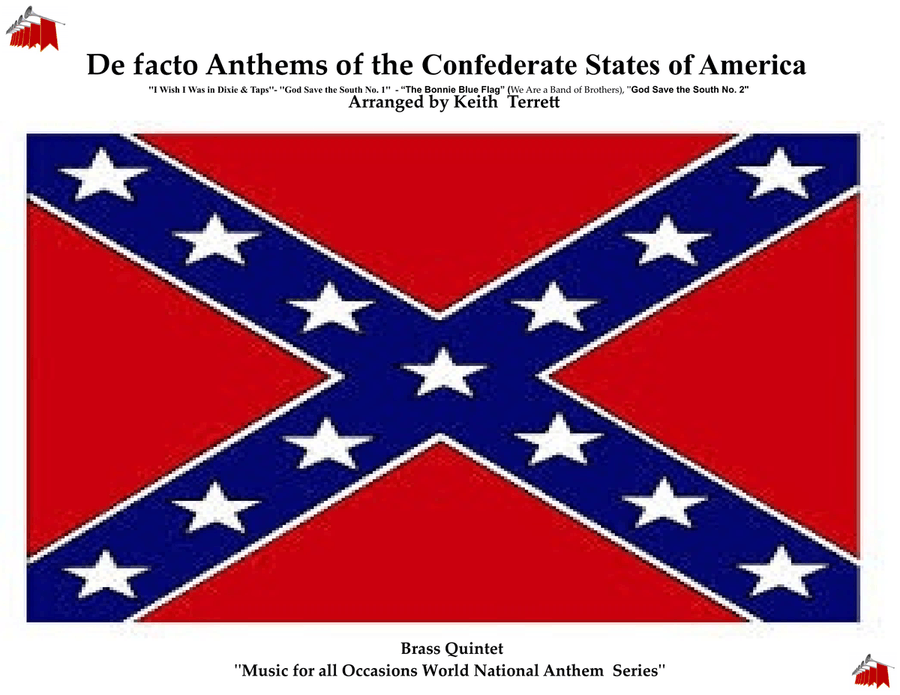
De facto Anthems of the Confederate States of America 
Quintette de Cuivres: 2 trompettes, Cor, trombone, tuba

$19.99 17.38 € Quintette de Cuivres: 2 trompettes, Cor, trombone, tuba PDF SheetMusicPlus

Woodwind Ensemble Clarinet - Level 4 - Digital Download SKU: A0.995506 Composed by Traditional. Arranged by Sarah Playford. Folk,Praise & Worship,Sacred,Spiritual. 16 pages. Sarah Playford #3560463. Published by Sarah Playford (A0.995506). An advanced intermediate work for Clarinet Choir arranged by Sarah Playford. Duration 2 minutes 40 seconds. The work is relatively simple but with demanding sections, ideal for demonstrating virtuosity of players. The piece explores clashing harmonies bringing a unique interpretation and instrumental colour to this traditional folk song. Perfect piece for concert or open air performance.Based on the formally published Slave Song The Good Old Way (1867) the exact origin of the melody is unknown but research points heavily to being composed by an African-American slave. The song has since been used in the 2000 feature film O Brother, Where Art Thou? as well as being interpreted by American bluesgrass-country singer Alison Krauss in 2002.
Down to the River (Clarinet Choir)
Ensemble de Clarinettes

$14.99 13.03 € Ensemble de Clarinettes PDF SheetMusicPlus

Brass Ensemble - Level 3 - Digital Download SKU: A0.995505 Composed by Traditional. Arranged by Sarah Playford. Folk,Gospel,Sacred,Spiritual. Score and parts. 13 pages. Sarah Playford #3556601. Published by Sarah Playford (A0.995505). An intermediate work for Brass Septet arranged by Sarah Playford. Duration 2 minutes 40 seconds. The work is relatively simple but with demanding sections, ideal for demonstrating virtuosity of players. The piece explores clashing harmonies bringing a unique interpretation and instrumental colour to this traditional folk song. Perfect piece for concert or open air performance.Based on the formally published Slave Song The Good Old Way (1867) the exact origin of the melody is unknown but research points heavily to being composed by an African-American slave. The song has since been used in the 2000 feature film O Brother, Where Art Thou? as well as being interpreted by American bluesgrass-country singer Alison Krauss in 2002.
Down to the River (Brass Septet)
Ensemble de cuivres

$14.99 13.03 € Ensemble de cuivres PDF SheetMusicPlus

Guitar,Piano,Vocal,Voice - Level 3 - Digital Download SKU: A0.1140167 By Arlo Guthrie. By Arlo Guthrie. Arranged by Jacob A Smith. 20th Century,Folk,Rock. Score. 2 pages. Jacob A Smith #740423. Published by Jacob A Smith (A0.1140167). Alice's Restaurant Massacree, commonly known as Alice's Restaurant, is a satirical talking blues song by singer-songwriter Arlo Guthrie, released as the title track to his 1967 debut album Alice's Restaurant. The song is a deadpan protest against the Vietnam War draft, in the form of a comically exaggerated but largely true story from Guthrie's own life: while visiting acquaintances in Stockbridge, Massachusetts, he is arrested and convicted of dumping trash illegally, which later endangers his suitability for the military draft. The title refers to a restaurant owned by one of Guthrie's friends, artist Alice Brock; although she is a minor character in the story, the restaurant plays no role in it aside from being the subject of the chorus and the impetus for Guthrie's visit. The song was an inspiration for the 1969 film also named Alice's Restaurant, which took numerous liberties with the story. The work has become Guthrie's signature song and he has periodically re-released it with updated lyrics. In 2017, it was selected for preservation in the National Recording Registry by the Library of Congress as being culturally, historically, or artistically significant.
Alice's Restaurant
Piano, Voix et Guitare
Arlo Guthrie
$4.99 4.34 € Piano, Voix et Guitare PDF SheetMusicPlus


Partitions Gratuites
Acheter des Partitions Musicales
Acheter des Partitions Digitales à Imprimer
Acheter des Instruments de Musique

© 2000 - 2026

Accueil - Version intégrale





