EUROPE
962 articles
USA
0 articles
DIGITAL
798 articles (à imprimer)
Partitions Digitales
Partitions à imprimer
798 partitions trouvées

1 ....481 496 511 526 541 ....796

C Instrument - Level 2 - Digital Download SKU: A0.1269691 Composed by Franz Schubert. Arranged by César Madeira. Classical,Film/TV,Multicultural,Opera,Romantic Period,World. Lead Sheet / Fake Book. 1 pages. Sheet Music To Play Editions #862200. Published by Sheet Music To Play Editions (A0.1269691). An Die Musik D.547 by Schubert. With Lead Sheet - Individual Voice Part with Chords - Bb Major Key. Enjoy it!Franz Peter Schubert (1797 - 1828) was an Austrian composer of the late Classical and early Romantic eras. Despite his short lifetime, Schubert left behind a vast oeuvre, including more than 600 secular vocal works (mainly lieder), seven complete symphonies, sacred music, operas, incidental music, and a large body of piano and chamber music.For Tutorials, Play Alongs or request New Arrangements, visit the YouTube Channel: Sheet Music To Play
An Die Musik - Lead Sheet - Bb Major
Instruments en Do

$4.99 4.35 € Instruments en Do PDF SheetMusicPlus

Accordion,Instrumental Solo - Level 2 - Digital Download SKU: A0.1431007 Composed by Franz Schubert. Arranged by Manuela Rosa. Romantic Period. Individual part. 10 pages. Manuela #1011497. Published by Manuela (A0.1431007). Franz Schubert, Walzer in H-Moll D145 op 18 Nr 6für Akkordeon in vier Tonarten (H, A, D, C Moll); gesetzt mit Lilypondjede Version passt auf ein A4-BlattWarum Lilypond? Die modernen, mit Computerprogrammen gesetzten Noten wirken irgendwie steril. Lilypond bringt die Ästhetik der historischen Notendruckkunst auf den Computer.for accordionversions in four key signatures (B, D, A, C minor); engraved with Lilypondeach version on one single pageWhy engrave with Lilypond? Computer engraved music looks somehow sterile.LilyPond is a music engraving program, devoted to producing the highest-quality sheet music possible. It brings the aesthetics of traditionally engraved music to computer printouts. LilyPond is free software.
Walzer H-Moll/waltz b minor (Einzelseite/single page Franz Schubert D145)
Accordéon

$2.00 1.74 € Accordéon PDF SheetMusicPlus

Accordion,Instrumental Solo - Level 2 - Digital Download SKU: A0.1431004 Composed by Franz Schubert. Arranged by Manuela Rosa. Romantic Period. Individual part. 14 pages. Manuela #1011494. Published by Manuela (A0.1431004). Franz Schubert, Walzer in H-Moll D145 op 18 Nr 6für Akkordeon in vier Tonarten (H, A, D, C Moll); gesetzt mit LilypondWarum Lilypond? Die modernen, mit Computerprogrammen gesetzten Noten wirken irgendwie steril. Lilypond bringt die Ästhetik der historischen Notendruckkunst auf den Computer.for accordionversions in four key signatures (B, D, A, C minor); engraved with LilypondWhy engrave with Lilypond? Computer engraved music looks somehow sterile.LilyPond is a music engraving program, devoted to producing the highest-quality sheet music possible. It brings the aesthetics of traditionally engraved music to computer printouts. LilyPond is free software.
Walzer H-Moll/waltz b minor (Franz Schubert D145)
Accordéon

$2.00 1.74 € Accordéon PDF SheetMusicPlus

Concert Band - Level 4 - Digital Download SKU: A0.1416281 Composed by Franz Schubert. Arranged by Ted R. Marcus. 19th Century,Classical,March,Romantic Period. 82 pages. Ted R. Marcus #997962. Published by Ted R. Marcus (A0.1416281). Many of us may not be aware that Franz Schubert's famous Marche Militaire in D is only the first in a set of three military marches for piano duet published in 1826. This is a colorful arrangement the third Marche Militaire in E-flat for concert band. It's a little gem with enough delightful melody, high spirits, and audience appeal to stand proudly beside its renowned sibling.This arrangement interprets Schubert's march for a modern band, but it alludes to the sound of early 20th century European marches. The horns have interesting and important parts rather than the usual pecking afterbeats!  Written for an adult community band, this arrangement is suitable for a good high school concert band (American Grade 3.5).Duration: approx. 5:35 with all repeats.Instrumentation: Piccolo / Flute 1-2 / Oboe 1-2 / E-flat Clarinet / Clarinet 1-2-3 / Alto Clarinet / Bass Clarinet /  Bassoon 1-2 / Alto Saxophone 1-2 / Tenor Saxophone / Baritone Saxophone / Trumpet 1-2-3 / Horn 1-2-3-4 / Trombone 1-2-3 (3rd is Bass Trombone) / Euphonium / Baritone T. C. / Tuba / String Bass / Percussion (Snare Drum, Crash Cymbals) / Bells / TimpaniPlease visit my Web site to explore more classics for adventurous concert bands.
Marche Militaire No. 3
Orchestre d'harmonie

$40.00 34.86 € Orchestre d'harmonie PDF SheetMusicPlus

Voice and piano - Medium - Digital Download SKU: MQ.8492-06E Composed by MeeAe Cecilia Nam and Theodore Gouvy. Instrument part. 4 pages. E. C. Schirmer Music Company - Digital #8492-06E. Published by E. C. Schirmer Music Company - Digital (MQ.8492-06E). French.Gouvy was known for writing some of the most beautiful melodies of the Romantic period. His style is a combination of German forms and an early French romantic harmonic structure. His writing for the piano in the songs is totally unified in mood and description with the voice, just as the piano is in Schubert’s songs. The equal partnership of the vocal line and piano interact closely to bring the poetry vividly into life with unimaginable artistic heights and unbridled passion.This volume includes Gouvy songs set to 18 poems of Philippe Desportes (1546–1606), and 18 poems of Moritz Hartmann (1821–1872). The elements of Romantic love poetry, such as enchanting love and its pain, and the personifying of nature, are fluently described with a great sensitivity in both voice and piano. Gouvy’s melody stir up the imagination because of his special treatment of words through a distinguishable and melodious vocal line, and his story telling and poetic treatment and development of the piano accompaniment. His compositional artistry places him in the upper echelons of art-song composers. One should note that Gouvy had a special fondness for the 16th Century poetry of La Pléiade (a group of Renaissance French poets, led by Pièrre de Ronsard (1524–1585). Desportes was truly the heir to Ronsard; however his work, when compared to that of Ronsard, is filled with greater abstraction and greater fluidity. Desportes seems to avoid any of the passionate anger that is occasionally characteristic of La Pléiade. This may be an indication that Desportes lived in a less distressed time. It also seems necessary to point out that he learned much in his early career by copying and studying the earlier works of La Pléiade. This has led some scholars to label him as a plagiarist, but it is important to realize that all the members of La Pléiade copied from each other when they wished to learn something new, and truly understand the style of the other poets in the group. Gouvy’s only choice of poems from his contemporaries, were the works of Moritz Hartmann (1821–1872), a good friend of Gouvy’s. Much of his poetry was strongly political in support of freedom of the individual. He traveled to Leipzig in 1845, but when the authorities discovered a volume of patriotic poems entitled Kelch und Schwert (Chalice and Sword), he fled to Belgium and France. It is at this time that he possibly met Théodore Gouvy. Eighteen poems of Hartmann were translated from German to French by the French poet, Adolph Larmande, of whom very little is known. Pierre Toussaint Adolphe Larmande seems to have been a rather obscure poet and musician. We know that he taught music theory at the Paris Conservatory at the same time Anton Reicha and Michele Carafa were on the faculty. We also know that in 1847 he married an English woman by the name of Marie Caroline Bradley. There are random documents, such as a Certificate of Arrival in London, England, in 1837, but there are no birth and death dates given, and that includes his obituary notice. Contents:18 Sonnets et Chansons de Desportes pour ténor ou soprano et piano, Op. 45 Six poésies allemandes de Moritz Hartmann pour baryton et piano, Op. 21 Douze poésies allemandes de Moritz Hartmann pour ténor et piano, Op. 26 (Poésies françaises d’Adolphe Larmande).
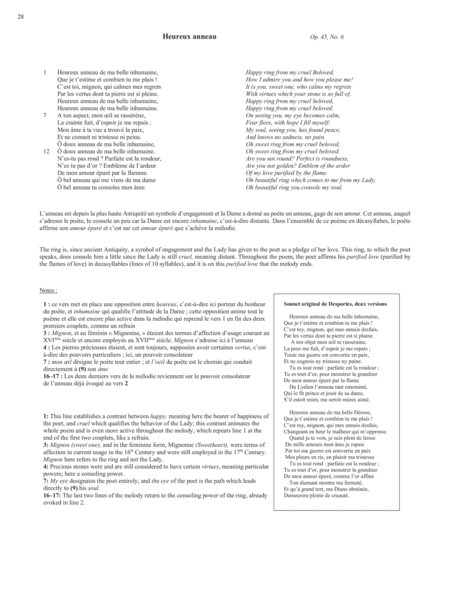
Op. 45, No. 6: Heureux anneau from Songs of Gouvy, V2 (Downloadable)
Piano, Voix

$3.00 2.61 € Piano, Voix PDF SheetMusicPlus

Voice and piano - Medium - Digital Download SKU: MQ.8492-24E Composed by MeeAe Cecilia Nam and Theodore Gouvy. Instrument part. 5 pages. E. C. Schirmer Music Company - Digital #8492-24E. Published by E. C. Schirmer Music Company - Digital (MQ.8492-24E). French.Gouvy was known for writing some of the most beautiful melodies of the Romantic period. His style is a combination of German forms and an early French romantic harmonic structure. His writing for the piano in the songs is totally unified in mood and description with the voice, just as the piano is in Schubert’s songs. The equal partnership of the vocal line and piano interact closely to bring the poetry vividly into life with unimaginable artistic heights and unbridled passion.This volume includes Gouvy songs set to 18 poems of Philippe Desportes (1546–1606), and 18 poems of Moritz Hartmann (1821–1872). The elements of Romantic love poetry, such as enchanting love and its pain, and the personifying of nature, are fluently described with a great sensitivity in both voice and piano. Gouvy’s melody stir up the imagination because of his special treatment of words through a distinguishable and melodious vocal line, and his story telling and poetic treatment and development of the piano accompaniment. His compositional artistry places him in the upper echelons of art-song composers. One should note that Gouvy had a special fondness for the 16th Century poetry of La Pléiade (a group of Renaissance French poets, led by Pièrre de Ronsard (1524–1585). Desportes was truly the heir to Ronsard; however his work, when compared to that of Ronsard, is filled with greater abstraction and greater fluidity. Desportes seems to avoid any of the passionate anger that is occasionally characteristic of La Pléiade. This may be an indication that Desportes lived in a less distressed time. It also seems necessary to point out that he learned much in his early career by copying and studying the earlier works of La Pléiade. This has led some scholars to label him as a plagiarist, but it is important to realize that all the members of La Pléiade copied from each other when they wished to learn something new, and truly understand the style of the other poets in the group. Gouvy’s only choice of poems from his contemporaries, were the works of Moritz Hartmann (1821–1872), a good friend of Gouvy’s. Much of his poetry was strongly political in support of freedom of the individual. He traveled to Leipzig in 1845, but when the authorities discovered a volume of patriotic poems entitled Kelch und Schwert (Chalice and Sword), he fled to Belgium and France. It is at this time that he possibly met Théodore Gouvy. Eighteen poems of Hartmann were translated from German to French by the French poet, Adolph Larmande, of whom very little is known. Pierre Toussaint Adolphe Larmande seems to have been a rather obscure poet and musician. We know that he taught music theory at the Paris Conservatory at the same time Anton Reicha and Michele Carafa were on the faculty. We also know that in 1847 he married an English woman by the name of Marie Caroline Bradley. There are random documents, such as a Certificate of Arrival in London, England, in 1837, but there are no birth and death dates given, and that includes his obituary notice. Contents:18 Sonnets et Chansons de Desportes pour ténor ou soprano et piano, Op. 45 Six poésies allemandes de Moritz Hartmann pour baryton et piano, Op. 21 Douze poésies allemandes de Moritz Hartmann pour ténor et piano, Op. 26 (Poésies françaises d’Adolphe Larmande).
Op. 21, No. 6: Amour brisé from Songs of Gouvy, V2 (Downloadable)
Piano, Voix

$3.00 2.61 € Piano, Voix PDF SheetMusicPlus

Voice and piano - Medium - Digital Download SKU: MQ.8492-18E Composed by MeeAe Cecilia Nam and Theodore Gouvy. Instrument part. 6 pages. E. C. Schirmer Music Company - Digital #8492-18E. Published by E. C. Schirmer Music Company - Digital (MQ.8492-18E). French.Gouvy was known for writing some of the most beautiful melodies of the Romantic period. His style is a combination of German forms and an early French romantic harmonic structure. His writing for the piano in the songs is totally unified in mood and description with the voice, just as the piano is in Schubert’s songs. The equal partnership of the vocal line and piano interact closely to bring the poetry vividly into life with unimaginable artistic heights and unbridled passion.This volume includes Gouvy songs set to 18 poems of Philippe Desportes (1546–1606), and 18 poems of Moritz Hartmann (1821–1872). The elements of Romantic love poetry, such as enchanting love and its pain, and the personifying of nature, are fluently described with a great sensitivity in both voice and piano. Gouvy’s melody stir up the imagination because of his special treatment of words through a distinguishable and melodious vocal line, and his story telling and poetic treatment and development of the piano accompaniment. His compositional artistry places him in the upper echelons of art-song composers. One should note that Gouvy had a special fondness for the 16th Century poetry of La Pléiade (a group of Renaissance French poets, led by Pièrre de Ronsard (1524–1585). Desportes was truly the heir to Ronsard; however his work, when compared to that of Ronsard, is filled with greater abstraction and greater fluidity. Desportes seems to avoid any of the passionate anger that is occasionally characteristic of La Pléiade. This may be an indication that Desportes lived in a less distressed time. It also seems necessary to point out that he learned much in his early career by copying and studying the earlier works of La Pléiade. This has led some scholars to label him as a plagiarist, but it is important to realize that all the members of La Pléiade copied from each other when they wished to learn something new, and truly understand the style of the other poets in the group. Gouvy’s only choice of poems from his contemporaries, were the works of Moritz Hartmann (1821–1872), a good friend of Gouvy’s. Much of his poetry was strongly political in support of freedom of the individual. He traveled to Leipzig in 1845, but when the authorities discovered a volume of patriotic poems entitled Kelch und Schwert (Chalice and Sword), he fled to Belgium and France. It is at this time that he possibly met Théodore Gouvy. Eighteen poems of Hartmann were translated from German to French by the French poet, Adolph Larmande, of whom very little is known. Pierre Toussaint Adolphe Larmande seems to have been a rather obscure poet and musician. We know that he taught music theory at the Paris Conservatory at the same time Anton Reicha and Michele Carafa were on the faculty. We also know that in 1847 he married an English woman by the name of Marie Caroline Bradley. There are random documents, such as a Certificate of Arrival in London, England, in 1837, but there are no birth and death dates given, and that includes his obituary notice. Contents:18 Sonnets et Chansons de Desportes pour ténor ou soprano et piano, Op. 45 Six poésies allemandes de Moritz Hartmann pour baryton et piano, Op. 21 Douze poésies allemandes de Moritz Hartmann pour ténor et piano, Op. 26 (Poésies françaises d’Adolphe Larmande).

Op. 45, No. 18: La vie est une fleur from Songs of Gouvy, V2 (Downloadable)
Piano, Voix

$3.00 2.61 € Piano, Voix PDF SheetMusicPlus


1 ....481 496 511 526 541 ....796


Partitions Gratuites
Acheter des Partitions Musicales
Acheter des Partitions Digitales à Imprimer
Acheter des Instruments de Musique

© 2000 - 2026

Accueil - Version intégrale




