EUROPE
9276 articles
USA
138709 articles
DIGITAL
163024 articles (à imprimer)
Partitions Digitales
Partitions à imprimer
163024 partitions trouvées


Level 3 - Digital Download SKU: A0.549196 Composed by Giovvanni Gabrieli. Arranged by James M. Guthrie, ASCAP. Easter,Renaissance,Standards. 42 pages. Jmsgu3 #3457617. Published by jmsgu3 (A0.549196). Giovanni Gabrieli: Jubilate Deo (Ch. 136). Instrumentation: 3 trombones, 3 euphoniums & 3 tubas. Duration: 3:00, cut time 4/2 at half-note = 96, 71 ms. Score: 24 pg. parts: 2 pg. Here is a stunningly beautiful example of Renaissance polyphony, and a mesmerizing fast-paced recital number. Program this either at the beginning to set an exciting mood or as an encore to leave the listeners in a jubilant afterglow. The parts are not difficult but plan to rehearse the many subtleties of dynamic contrast between the various sub-groups and the overall articulations. Innovations First of all, Gabrieli preferred sacred vocal and certainly instrumental music. Hence, he concentrated on music that consequently took advantage of resonance and likewise reverberation for maximum effect. Seems like Gabrieli may have invented dynamics – or was rather the first to indicate them such as in his Sonata Pian’ e Forte. Consequently, he was also a pioneer in spatial techniques. He therefore developed and used very specific notation to indicate instrumentation. Gabrieli experimented with assembling massive instrumental forces into isolated groups separated by space. In this way, he consequently contributed heavily to the Baroque Concertato style. Polychoral Works Gabrieli probably used the layout of the San Marco church for his experiments. This is because he worked there as a musician and composer. Furthermore, the church had two choir lofts facing each other. He certainly used these to create striking spatial effects between instrumental forces. Certainly, many of his works are composed such that a choir or instrumental group could first be heard on one side, then consequently followed by a response from the group on the other side. Sometimes there was probably a third group positioned near the main altar as well. Spatial Music Above all, Gabrieli studied carefully detailed groups of instruments and singers. Furthermore, it seems like he created precise directions for instrumentation in rather than two groups. The instruments, because they could be appropriately situated, could consequently be heard with perfect clearness at distant locations. As a result, arrangements that seem bizarre on paper, can in contrast sound perfectly in balance. First Works Finally, Gabrieli published his first motets along with his uncle Andrea's compositions in Concerti (1587). These compositions furthermore indicate considerable usage of dialogue and echo effects. Consequently, here we see low and high choirs with the variance between their ranges indicated by instrumental accompaniment. Seems like Gabrieli’s later motets Sacrae Symphoniae (1597) move away from close antiphony. In contrast, he moves towards not simply echoing the material but developing it through sequential choral entrances. Even more, he takes this procedure to the extreme in the Motet Omnes Gentes. Unlike earlier works, here the instruments are certainly an essential part of the presentation. Also, only parts marked: Capella are supposed to be sung. Homophony Hence, after 1605, Gabrieli moves to a much more homophonic style. He writes sections purely for instruments – which calls Sinfonia – and smaller sections for vocal soloists, accompanied by a basso continuo.
Gabrieli: Jubilate Deo Ch. 136 for Low Brass Choir

$47.95 40.29 € PDF SheetMusicPlus

Brass Ensemble Bass Trombone,Cornet,Horn - Level 3 - Digital Download SKU: A0.1227832 Composed by Giovanni Gabrieli. Arranged by James M. Guthrie, ASCAP. Chamber,Contest,Early Music,Festival,Historic,Renaissance. 72 pages. Jmsgu3 #823794. Published by jmsgu3 (A0.1227832). Minimum instrumentation: 4 Cornets in Bb, 4 Horns in F, 2 Tenor Trombones, and 2 Bass Trombones.InnovationsGabrieli preferred sacred vocal and, indeed, instrumental music. Hence, he concentrated on music that consequently took advantage of resonance and reverberation for maximum effect. Gabrieli may have invented dynamics – or was the first to indicate them, such as in his Sonata Pian' e Forte. Consequently, he was also a pioneer in spatial techniques. He, therefore, developed and used particular notation to indicate instrumentation. Gabrieli experimented with assembling massive instrumental forces into isolated groups separated by space. In this way, he consequently contributed heavily to the Baroque Concertato style.Polychoral WorksGabrieli probably used the layout of the San Marco church for his experiments. This is because he worked there as a musician and composer. Furthermore, the church had two choir lofts facing each other. He indeed used these to create striking spatial effects between instrumental forces. Indeed, many of his works are composed such that a choir or instrumental group could first be heard on one side, followed by a group response. Sometimes, there was probably a third group near the main altar.Spatial MusicAbove all, Gabrieli studied carefully detailed groups of instruments and singers. Furthermore, it seems like he created precise directions for instrumentation rather than two groups. Because they could be appropriately situated, the instruments could consequently be heard with perfect clearness at distant locations. As a result, arrangements that seem bizarre on paper can, in contrast, sound perfectly in balance.First WorksFinally, Gabrieli published his first motets and his uncle Andrea's compositions in Concerti (1587). Furthermore, these compositions indicate considerable usage of dialogue and echo effects. Consequently, here we see low and high choirs with the variance between their ranges characterized by instrumental accompaniment. Gabrieli's later motets Sacrae Symphoniae (1597) seem to move away from close antiphony. In contrast, he moves towards not simply echoing the material but developing it through sequential choral entrances. Even more, he takes this procedure to the extreme in the Motet Omnes Gentes. Unlike earlier works, here, the instruments are an essential part of the presentation—also, only parts marked Capella are supposed to be sung.HomophonyHence, after 1605, Gabrieli moves to a much more homophonic style. He writes sections purely for instruments – called Sinfonia – and smaller sections for vocal soloists, accompanied by a basso continuo. Above all, Gabrieli studied carefully detailed groups of instruments and singers. Furthermore, it seems like he created precise directions for instrumentation rather than two groups. Because they could be appropriately situated, the instruments could consequently be heard with perfect clearness at distant locations. As a result, arrangements that seem bizarre on paper can, in contrast, sound perfectly in balance.
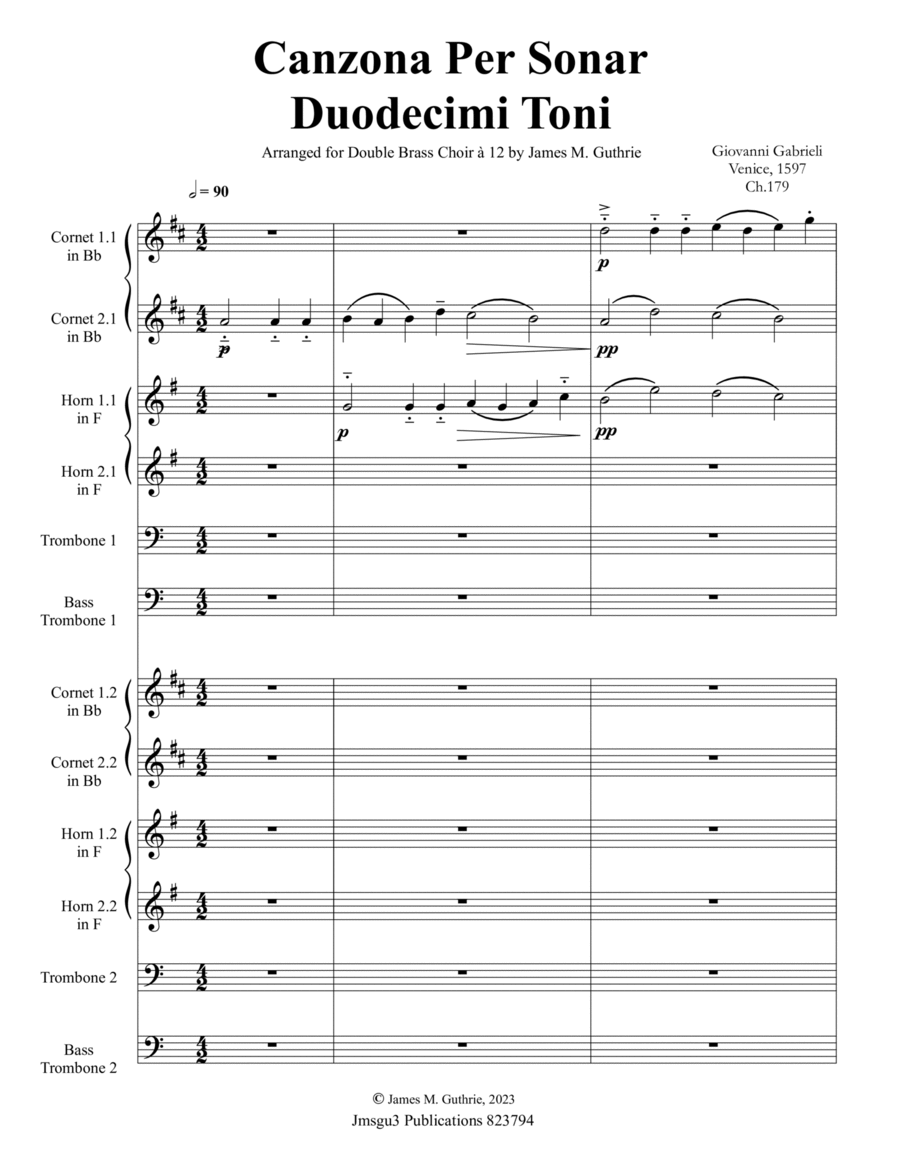
Gabrieli: Canzon per Sonar Ch. 179 for Double Brass Choir à 12

$47.95 40.29 € PDF SheetMusicPlus

Euphonium,Horn,Timpani,Trombone,Trumpet,Tuba - Level 3 - Digital Download SKU: A0.1221721 Composed by Georg Philipp Telemann. Arranged by Regis Bookshar. Baroque,Chamber,Historic,Instructional,March. 19 pages. Regis Bookshar #816378. Published by Regis Bookshar (A0.1221721). La Majeste (from Heroic Music) - Georg Philipp Telemann - Brass Choir, Timpani - Intermediate - Dugital Download.Heroic Music (or Heldenmusik) is a suite of twelve short marches and processionals, written by Georg Philipp Telemann in 1728, and is associated with various attributes of Heroism such as Dignity, Bravery and Alertness. All twelve movements have now been transcribed and arranged by Regis Bookshar to be played by Trumpet Quintets or Brass Quintets. Some of them have also been arranged for Sextets, Septets, Octets, Nonets and Brass Choirs. Some also include a Timpani. They can be purchased individually, or, if you prefer, as a complete set of all twelve at a huge saving.Any of these selections would be a wonderful addition to any music library. They are perfectly suited to recitals and public performances, can stand alone as short interludes and are generally well received by audiences. They are suitable for high school and college students but professional musicians would also enjoy playing these arrangements. These selections are some of the many arrangements from The Regis Bookshar Trumpet Ensemble's extensive music library which are being made available for the first time. In the past, these compositions have often been performed by a soloist playing on a Piccolo Trumpet, but these new arrangements are Bb Trumpet friendly as one player stated after playing through them, making them much easier for most high school students.This selection, La Majeste (from Heroic Music), is arranged for a Brass Choir with parts for 3 Bb Trumpets, 1 French Horn, 2 Trombones, 1 Euphonium and 1 Tuba and also a Timpani, and is associated with the heroic quality of Dignity. There is also aversion without the Timpani, if you would prefer. The parts may be doubled as needed.  Included are a score and a complete set of parts (19 pages).Many of these selections are readily available for a wide variety of instrumental ensembles. Please take the time to look for other versions of this composition. You may find something else that may also suit your needs. I would also encourage you to search for other arrangements by Regis Bookshar, as well, as there are numerous selections in a variety of styles, also available for purchase. You may find something else which might interest you. Please continue to check periodically because new arrangements are being added as often as possible. I am certain that these wonderful arrangements of Georg Philipp Telemann's Heroic Music will continue to entertain both performers and audiences alike for years to come.
La Majeste (from "Heroic Music") (C) (Brass Choir - 3 Trp, 1 Hrn, 2 Trb, 1 Euph, 1 Tuba, Timp)

$22.00 18.49 € PDF SheetMusicPlus

Brass Band Euphonium,Horn,Trombone,Trumpet,Tuba - Level 3 - Digital Download SKU: A0.1223242 Composed by Georg Philipp Telemann. Arranged by Regis Bookshar. Baroque,Chamber,Historic,Instructional,March. Score and Parts. 15 pages. Regis Bookshar #819450. Published by Regis Bookshar (A0.1223242). La Vigilance (from Heroic Music) - Georg Philipp Telemann - Brass Choir - Intermediate - Digital Download.Heroic Music (or Heldenmusik) is a suite of twelve short marches and processionals, written by Georg Philipp Telemann in 1728, and is associated with various attributes of Heroism such as Dignity, Bravery and Alertness. All twelve movements have now been transcribed and arranged by Regis Bookshar to be played by Trumpet Quintets or Brass Quintets. Some of them have also been arranged for Sextets, Septets, Octets, Nonets and Brass Choirs. Some also include a Timpani. They can be purchased individually, or, if you prefer, as a complete set of all twelve at a huge saving.Any of these selections would be a wonderful addition to any music library. They are perfectly suited to recitals and public performances, can stand alone as short interludes and are generally well received by audiences. They are suitable for high school and college students but professional musicians would also enjoy playing these arrangements. These selections are some of the many arrangements from The Regis Bookshar Trumpet Ensemble's extensive music library which are being made available for the first time. In the past, these compositions have often been performed by a soloist playing on a Piccolo Trumpet, but these new arrangements are Bb Trumpet friendly as one player stated after playing through them, making them much easier for most high school students.This selection, La Vigilance (from Heroic Music), is arranged for a Brass Choir with parts for 3 Bb Trumpets, 1 French Horn, 1 Trombone, 1 Euphonium and 1 Tuba, and is associated with the heroic quality of Alertness. The parts may be doubled as needed. There is also a version which includes a Timpani, if you would prefer. Included are a score and a complete set of parts (15 pages).Many of these selections are readily available for a wide variety of instrumental ensembles. Please take the time to look for other versions of this composition. You may find something else that may also suit your needs. I would also encourage you to search for other arrangements by Regis Bookshar, as well, as there are numerous selections in a variety of styles, also availbale for purchase. You may find something else which might interest you. Please continue to check periodically because new arrangements are being added as often as possible. I am certain that these wonderful arrangements of Georg Philipp Telemann 's Heroic Music will continue to entertain both performers and audiences alike for years to come.
La Vigilance (from "Heroic Music") (Bb) (Brass Choir - 3 Trp, 1 Hrn, 1 Trb, 1 Euph, 1 Tuba)
Quintette de Cuivres: 2 trompettes, Cor, trombone, tuba

$18.00 15.13 € Quintette de Cuivres: 2 trompettes, Cor, trombone, tuba PDF SheetMusicPlus

Choral Choir (2-Part) - Level 1 - Digital Download SKU: A0.844646 Composed by Phil Beaman. Contemporary,Easter,Sacred. Octavo. 5 pages. Phil Beaman #4719417. Published by Phil Beaman (A0.844646). Perfect for Easter! This simple but beautiful anthem is written to be accessible for all choirs. Very flexible, it is for 2-part Mixed Choir, and each voice part stays within an octave. The catchy tune is light and joyous. There are 3 verses:  Vs 1-Alleluia 2 part;  Vs 2- He is Risen 2 part;  Vs 3- the first two verses are sung simultaneously: Part 1 sings the 'Alleluia' of Vs 1 while Part 2 sings the 'He Is Risen' of Vs 2. (Don't worry, it is all clearly written out.) The accompaniment is very simple slow chords, the same for each verse.  5 pages, 2 1/2 minutesRecording is sung as a Duet
Alleluia, He Is Risen! - 2 part Mixed Choir
Chorale 2 parties

$2.99 2.51 € Chorale 2 parties PDF SheetMusicPlus

Brass Ensemble Bass Trombone,Cornet,Horn - Level 3 - Digital Download SKU: A0.1229556 Composed by Giovanni Gabrieli. Arranged by James M. Guthrie, ASCAP. Chamber,Early Music,Renaissance,Traditional,Wedding. 43 pages. Jmsgu3 #825055. Published by jmsgu3 (A0.1229556). Minimum instrumentation: 4 Cornets in Bb, 4 Horns in F, 1 Tenor Trombone & 1 Bass Trombone.InnovationsGabrieli preferred sacred vocal and certainly instrumental music. Hence, he concentrated on music that consequently took advantage of resonance and likewise reverberation for maximum effect. Seems like Gabrieli may have invented dynamics – or was rather the first to indicate them such as in his Sonata Pian’ e Forte. Consequently, he was also a pioneer in spatial techniques. He therefore developed and used very specific notation to indicate instrumentation. Gabrieli experimented with assembling massive instrumental forces into isolated groups separated by space. In this way, he consequently contributed heavily to the Baroque Concertato style.Polychoral WorksGabrieli probably used the layout of the San Marco church for his experiments. This is because he worked there as a musician and composer. Furthermore, the church had two choir lofts facing each other. He certainly used these to create striking spatial effects between instrumental forces. Certainly, many of his works are composed such that a choir or instrumental group could first be heard on one side, then consequently followed by a response from the group on the other side. Sometimes there was probably a third group positioned near the main altar as well.Spatial MusicAbove all, Gabrieli studied carefully detailed groups of instruments and singers. Furthermore, it seems like he created precise directions for instrumentation rather than two groups. The instruments, because they could be appropriately situated, could consequently be heard with perfect clearness at distant locations. As a result, arrangements that seem bizarre on paper, can in contrast sound perfectly in balance.First WorksFinally, Gabrieli published his first motets along with his uncle Andrea's compositions in Concerti (1587). These compositions furthermore indicate considerable usage of dialogue and echo effects. Consequently, here we see low and high choirs with the variance between their ranges indicated by instrumental accompaniment. Seems like Gabrieli’s later motets Sacrae Symphoniae (1597) move away from close antiphony. In contrast, he moves towards not simply echoing the material but developing it through sequential choral entrances. Even more, he takes this procedure to the extreme in the Motet Omnes Gentes. Unlike earlier works, here the instruments are certainly an essential part of the presentation. Also, only parts marked: Capella are supposed to be sung.HomophonyHence, after 1605, Gabrieli moves to a much more homophonic style. He writes sections purely for instruments – which calls Sinfonia – and smaller sections for vocal soloists, accompanied by a basso continuo.
Gabrieli: Canzon per Sonar à 10 Ch. 177 for Brass Choir

$47.95 40.29 € PDF SheetMusicPlus

String Ensemble Cello - Level 2 - Digital Download SKU: A0.549267 Composed by Giovanni Gabrieli. Arranged by James M. Guthrie, ASCAP. Instructional,Renaissance,Standards. 45 pages. Jmsgu3 #3479835. Published by jmsgu3 (A0.549267). A musical monument: the first composition to employ dynamics. Minimum instrumentation: 11 cellos.   Innovations First of all, Gabrieli preferred sacred vocal and certainly instrumental music. Hence, he concentrated on music that consequently took advantage of resonance and likewise reverberation for maximum effect. Seems like Gabrieli may have invented dynamics – or was rather the first to indicate them such as in his Sonata Pian’ e Forte. Consequently, he was also a pioneer in spatial techniques. He therefore developed and used very specific notation to indicate instrumentation. Gabrieli experimented with assembling massive instrumental forces into isolated groups separated by space. In this way, he consequently contributed heavily to the Baroque Concertato style. Polychoral Works Gabrieli probably used the layout of the San Marco church for his experiments. This is because he worked there as a musician and composer. Furthermore, the church had two choir lofts facing each other. He certainly used these to create striking spatial effects between instrumental forces. Certainly, many of his works are composed such that a choir or instrumental group could first be heard on one side, then consequently followed by a response from the group on the other side. Sometimes there was probably a third group positioned near the main altar as well. Spatial Music Above all, Gabrieli studied carefully detailed groups of instruments and singers. Furthermore, it seems like he created precise directions for instrumentation rather than two groups. The instruments, because they could be appropriately situated, could consequently be heard with perfect clearness at distant locations. As a result, arrangements that seem bizarre on paper, can in contrast sound perfectly in balance. First Works Finally, Gabrieli published his first motets along with his uncle Andrea's compositions in Concerti (1587). These compositions furthermore indicate considerable usage of dialogue and echo effects. Consequently, here we see low and high choirs with the variance between their ranges indicated by instrumental accompaniment. Seems like Gabrieli’s later motets Sacrae Symphoniae (1597) move away from close antiphony. In contrast, he moves towards not simply echoing the material, but developing it through sequential choral entrances. Even more, he takes this procedure to the extreme in the Motet Omnes Gentes. Unlike earlier works, here the instruments are certainly an essential part of the presentation. Also, only parts marked: Capella are supposed to be sung. Homophony Hence, after 1605, Gabrieli moves to a much more homophonic style. He writes sections purely for instruments – which calls Sinfonia – and smaller sections for vocal soloists, accompanied by a basso continuo.
Gabrieli: Sonata Pian e Forte Ch 175 for Cello Choir

$47.95 40.29 € PDF SheetMusicPlus

Choral Choir (Unison) - Level 1 - Digital Download SKU: A0.781383 Composed by Joanna Mills. Broadway,Children,Christmas,Holiday,Musical/Show,Sacred. Octavo. 8 pages. Joanna Mills Music #5324631. Published by Joanna Mills Music (A0.781383). This is one song from the complete children's musical Just in Time for Christmas - also available here. This thoughtful and lovely unison Christmas anthem is perfect for church soloists, children's choirs, or congregational singing. It explores the idea of looking past the commercial trappings of Christmas, and learning the true reason for the season. Set in an accessible key for most voices, this pretty song is perfect for Advent services, Lessons & Carols services, Christmas Eve services, and nativity plays or pageants. Approximate performance time is 2:54. Guitar chords included. Also available for 2-part choir, and a piano accompaniment track is also available on Sheet Music Plus.
Just in Time for Christmas (An Original Christmas Anthem for Unison Choir)
Chorale Unison

$1.99 1.67 € Chorale Unison PDF SheetMusicPlus

Choral Choir (Unison) - Level 2 - Digital Download SKU: A0.844488 Composed by Johann Cruger. Arranged by Phil Beaman. Christian,Holiday,Patriotic,Sacred,Wedding. Octavo. 7 pages. Phil Beaman #3448625. Published by Phil Beaman (A0.844488). Now Thank We All Our God is an English adaptation of the ancient German hymn Nun danket alle Gott. The lyrics were written by Rinkart in 1636, the melody by Cruger in 1647, and the popular harmony by Mendlessohn in 1840.This arrangement begins with a Handelian keyboard introduction, modulates to the 1st Verse for Unison choir with a new homophonic reharmonization for accompaniment, then modulates to Verse 2 which is a softer Unison with a drone accompaniment and a voice solo antiphon, then a final modulation into Verse 3 which is Unison with optional traditional SATB hymn parts.Since it is in Choral Unison we have used it here in the National Cathedral for gathered massed choirs from around the country to celebrate the official Government Holiday of National Day of Thanksgiving. I am aware that one country has also used this piece as part of the Investiture Ceremony to install their new Bishop. The addition of the Psalm antiphons gives it a Nationalistic angle as well. Further, in some countries this hymn is also a tradition at Christian Weddings. In short...this piece is perfect for any moment of Thanksgiving!7 pages  4 minutes
Now Thank We All Our God - Unison choir with solo
Chorale Unison

$2.99 2.51 € Chorale Unison PDF SheetMusicPlus

Choral Choir (Unison) - Level 1 - Digital Download SKU: A0.781370 Composed by Joanna Mills. Arranged by Based on the poetry of Frances Ellen Watkins Harper. Children,Contemporary,Easter,Folk,Holiday. Octavo. 8 pages. Joanna Mills Music #5178575. Published by Joanna Mills Music (A0.781370). Set to a sweet, original melody by Joanna Mills, Frances Ellen Watkins Harper's poem The Crocuses has been adapted into a lovely song about the first flowers of spring and their love for Mother Earth. Perfect for spring concerts, Earth Day or Mother's Day, the piece is set in an accessible key for young voices ( C4 - D5 ), and the piano score supports the choir, enabling even beginner choirs to learn this arrangement easily. There is an optional echo part available in section D for a small group. Approximate performance time 2:30.Piano accompaniment track also available to purchase on SMP (item S0.703135)The Crocuses
The Crocuses (for Unison Choir)
Chorale Unison

$1.99 1.67 € Chorale Unison PDF SheetMusicPlus

Brass Ensemble Horn,Trombone,Trumpet - Level 3 - Digital Download SKU: A0.1226321 Composed by Giovanni Gabrieli. Arranged by James M. Guthrie, ASCAP. Chamber,Contest,Early Music,Festival,Historic,Renaissance. 48 pages. Jmsgu3 #822323. Published by jmsgu3 (A0.1226321). Minimum instrumentation: 3 Brass Quartets - 6 trumpets in C (or cornets) 3 French Horns in F, and 3 trombones. InnovationsGabrieli preferred sacred vocal and certainly instrumental music. Hence, he concentrated on music that consequently took advantage of resonance and likewise reverberation for maximum effect. Seems like Gabrieli may have invented dynamics – or was rather the first to indicate them such as in his Sonata Pian’ e Forte. Consequently, he was also a pioneer in spatial techniques. He therefore developed and used very specific notation to indicate instrumentation. Gabrieli experimented with assembling massive instrumental forces into isolated groups separated by space. In this way, he consequently contributed heavily to the Baroque Concertato style.Polychoral WorksGabrieli probably used the layout of the San Marco church for his experiments. This is because he worked there as a musician and composer. Furthermore, the church had two choir lofts facing each other. He certainly used these to create striking spatial effects between instrumental forces. Certainly, many of his works are composed such that a choir or instrumental group could first be heard on one side, then consequently followed by a response from the group on the other side. Sometimes there was probably a third group positioned near the main altar as well.Spatial MusicAbove all, Gabrieli studied carefully detailed groups of instruments and singers. Furthermore, it seems like he created precise directions for instrumentation rather than two groups. The instruments, because they could be appropriately situated, could consequently be heard with perfect clearness at distant locations. As a result, arrangements that seem bizarre on paper, can in contrast sound perfectly in balance.First WorksFinally, Gabrieli published his first motets along with his uncle Andrea's compositions in Concerti (1587). These compositions furthermore indicate considerable usage of dialogue and echo effects. Consequently, here we see low and high choirs with the variance between their ranges indicated by instrumental accompaniment. Seems like Gabrieli’s later motets Sacrae Symphoniae (1597) move away from close antiphony. In contrast, he moves towards not simply echoing the material but developing it through sequential choral entrances. Even more, he takes this procedure to the extreme in the Motet Omnes Gentes. Unlike earlier works, here the instruments are certainly an essential part of the presentation. Also, only parts marked: Capella are supposed to be sung.HomophonyHence, after 1605, Gabrieli moves to a much more homophonic style. He writes sections purely for instruments – which calls Sinfonia – and smaller sections for vocal soloists, accompanied by a basso continuo.
Gabrieli: Canzon in Echo a 12 Ch. 192 for Triple Brass Choir
Quatuor de Cuivres: 2 trompettes, Cor, trombone

$47.95 40.29 € Quatuor de Cuivres: 2 trompettes, Cor, trombone PDF SheetMusicPlus


Partitions Gratuites
Acheter des Partitions Musicales
Acheter des Partitions Digitales à Imprimer
Acheter des Instruments de Musique

© 2000 - 2026

Accueil - Version intégrale





