EUROPE
633 articles
USA
0 articles
DIGITAL
4255 articles (à imprimer)
Partitions Digitales
Partitions à imprimer
4255 partitions trouvées


Brass Ensemble Horn,Trombone,Trumpet,Tuba - Level 4 - Digital Download SKU: A0.1130062 Composed by English Folk Song by way of American Appalachians. Arranged by F. Leslie Smith. Celtic,Children,Folk,Irish,Traditional,Wedding. Score and parts. 28 pages. Sweetwater Brass Press #730439. Published by Sweetwater Brass Press (A0.1130062). The origins of this lullaby can be traced back to 15th-century England. Pioneers from the British Isles brought it with them to the American Appalachians. Written in three verses, its lyrics tell of four seemingly impossible gifts the singer gave my love. The first verse describes each gift: cherry that has no stone, a chicken that has no bone. a story that has no end and a baby with no cryin'. The second verse poses the riddle: how can such items exist? The third provides the answers: A cherry when it's bloomin', it has no stone. A chicken when it's pippin', it has no bone. The story of I love you, it has no end. A baby when it's sleepin', has no cryin'. This Riddle Song has enjoyed somewhat of a revival since mid-20th century, making appearances in various movies, TV shows and recordings. In 1956, Jerry Livingston and Paul Francis adapted The Riddle Song tune, added an original bridge and created new lyrics; Johnny Mathis recorded it as The Twelfth of Never, giving the haunting melody probably its greatest surge in popularity. This arrangement is in G major and opens with an upbeat introduction. For the first statement of the melody, tempo slows and Trumpets alternate the lead. On the second time through, tempo speeds up slightly and tuba takes the lead. For the third, tempo is back to the opening speed and Horn in F plays the melody. On the fourth time through, Trumpets and Trombone frame the tune in a call-and-response form. In the fifth, Trombone takes the lead. In the sixth and final statement, Horn in F and Trombone play melody at half speed while Trumpets play a fairly complicated counterpoint (at what may seem like double speed!). This, until the last phrase (A baby when it's sleepin'), when the melody switches over to Trumpets and Trombone takes the counterpoint. Trumpet 1 plays its A above the staff a number of times. Tuba's lowest note is its F down below the staff. Otherwise, notes for all instruments are well within normal playing range. Because of the recommended tempo, the countermelody at measures 68-83 could be problematic for Trumpets and Trombone and may require a little extra work. Completed in 2022, performance time runs about 3 minutes, 42 seconds. The arranger, Les Smith, will be happy to provide substitute parts (for example, treble clef baritone for trombone) at no charge. He would like to receive your suggestions, comments, corrections and criticisms. For more arrangements by Les, enter Sweetwater Brass Press (without the quotation marks) in the Sheet Music Plus or Sheet Music Direct search box. (Also, purchase of this piece entitles you to your choice of another of his arrangements at no charge; send a copy of your purchase receipt directly to him at lessmith61@bellsouth.net.)
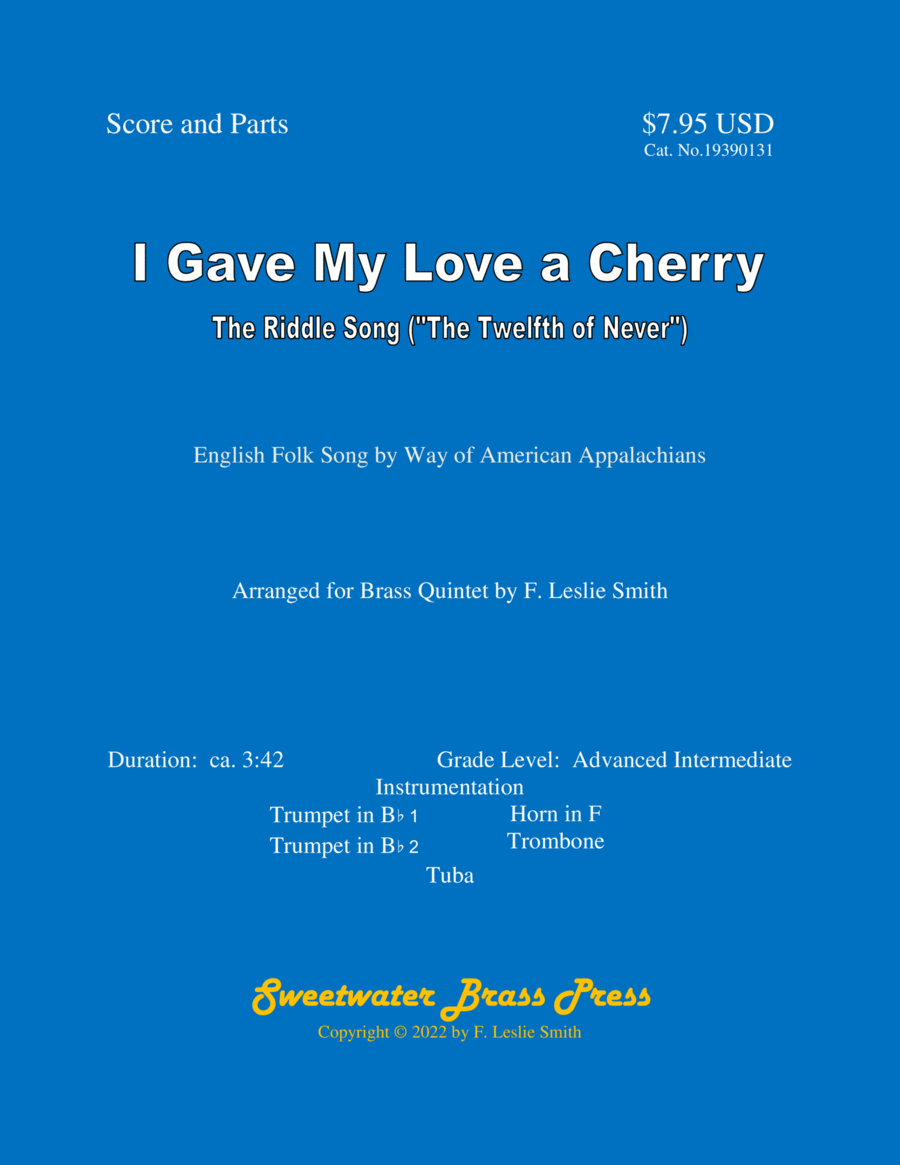
I Gave My Love a Cherry (The Riddle Song ["The Twelfth of Never"])
Quatuor de Cuivres : 2 trompettes, trombone, tuba

$7.95 6.86 € Quatuor de Cuivres : 2 trompettes, trombone, tuba PDF SheetMusicPlus

Saxophone quartet Alto Saxophone,Baritone Saxophone,Soprano Saxophone,Tenor Saxophone - Level 5 - Digital Download SKU: A0.764661 Composed by Ruggero Leoncavallo (1857-1919). Arranged by James Pybus. Opera,Romantic Period. 10 pages. James Pybus #37123. Published by James Pybus (A0.764661). Vesti la giubba (Put on the costume) is a famous tenor aria from Ruggero Leoncavallo's 1892 opera I Pagliacci. Vesti la giubba is sung at the conclusion of the first act, when Canio discovers his wife's infidelity, but must nevertheless prepare for his performance as Pagliaccio the clown because The show must go on. The aria is often regarded as one of the most moving in the operatic repertoire of the time. The pain of Canio is portrayed in the aria and exemplifies the entire notion of the tragic clown: smiling on the outside but crying on the inside. This is still displayed today, as the clown motif often features the painted-on tear running down the cheek of the performer. The 1904 recording by Enrico Caruso was the first million-selling record in history. This aria is often used in popular culture and has been featured in many renditions, mentions, and spoofs. In this arrangement for SATB Saxophone Quartet written in 2013, the original key has been transposed to a more saxophone-friendly key. The tenor saxophone is featured. Duration 3:35 contact me at james.pybus56@gmail.com.
Vesti la giubba from I Pagliacci
Quatuor de Saxophones: 4 saxophones

$15.00 12.95 € Quatuor de Saxophones: 4 saxophones PDF SheetMusicPlus

Instrumental Duet,Piano Cello,Instrumental Duet,Piano,Violin - Level 4 - Digital Download SKU: A0.780497 Composed by Fred Rogers. Arranged by Cathy Stamegna. Children,Contemporary,Film/TV,Jazz,Pop. Score and parts. 12 pages. Cathy Stamegna #4978739. Published by Cathy Stamegna (A0.780497). It's You I Like from MISTER ROGERS' NEIGHBORHOOD (Violin/Violoncello Duet, Chords, Piano Acc.) begins with Mister Rogers' thoughtful lyrics/traditional melody and transitions to a jazz/pop sound.  Set of Parts.  Other vocal and instrumental arrangements available.  Piano accompaniment optional for three and four-part arrangements, but recommended for two-part arrangements.  Graded Advanced Intermediate because of rhythms, harmonies in the jazz/pop section.
It's You I Like from MISTER ROGERS' NEIGHBORHOOD
Piano Trio: piano, violon, violoncelle

$4.99 4.31 € Piano Trio: piano, violon, violoncelle PDF SheetMusicPlus

Woodwind Ensemble,Woodwind Quartet Alto Saxophone,Baritone Saxophone,Soprano Saxophone,Tenor Saxophone - Level 4 - Digital Download SKU: A0.780478 Composed by Fred Rogers. Arranged by Cathy Stamegna. Children,Contemporary,Film/TV,Jazz,Pop. 15 pages. Cathy Stamegna #4968323. Published by Cathy Stamegna (A0.780478). It's You I Like from MISTER ROGERS' NEIGHBORHOOD - Saxophone Quartet (SATB, Chords, Optional Piano Acc.) begins with Mister Rogers' thoughtful lyrics/traditional melody and transitions to a jazz/pop sound.  Set of Parts.  Other vocal and instrumental arrangements available. Graded Advanced Intermediate because of rhythms, harmonies in the jazz/pop section.
It's You I Like from MISTER ROGERS' NEIGHBORHOOD
Quatuor de Saxophones: 4 saxophones

$12.99 11.22 € Quatuor de Saxophones: 4 saxophones PDF SheetMusicPlus

Percussion Ensemble - Level 5 - Digital Download SKU: A0.962406 Composed by Salvador Rojo Gamón. Concert,Contemporary,Instructional,Standards. Score and parts. 173 pages. Salvador Rojo-Gamon #5801913. Published by Salvador Rojo-Gamon (A0.962406). Four ForcesReviewsScherzohttps://scherzo.es/badajoz-vanguardias-lugarenas/Periodico Extremadurahttps://www.elperiodicoextremadura.com/noticias/badajoz/fuerzas_1214372.html NotesThis work was commissioned by Extremadura Orchestra for Percussion and Chamber orchestra.It has two movements. The first one has been done for mallets and the second one was built on a base of a drums work (GEA).The duration of those movements is 26 minutes, being around 11 minutes the first and 15 minutes the second one.The chamber music is formed by:Woodwind quintet (Flute, Oboe, Clarinet, Horn & Bassoon)Brasswind quintet (Trumpet 1, Trumpet 2, Horn, Trombone & Tuba)Strings orchestraThree firsts violinsThree seconds violinsThree violasTwo cellosFor the second movement is high recommendable to enlarge the strings, a good number of musician could be doubling.I. Strong ForcesThe work is inspired by the four fundamental forces of nature. These forces explain any phenomena which can be produced in the universe.Throughout all composition, it is latent the mathematic construction based in the series Fibonacci. In the first of the movements, Fibonacci's series is present in the notes' sequence that forms the series of 16 sounds and it is going to be present throughout the whole work. This series is taking form along the movement and it is getting melody and harmony.Although it is far away from the sonata form, as we know it in its period of highest glory, it takes elements of it and updates to our days. In this movement, we can find sonata form elements as the exposition, development, transitions or coda.The central part of the first movement becomes in the slow movement, being more intimate and lyrical, free of the serials ties although it uses resources before cited -now called common practice-.The movement finish with a short re-exposition that concludes with the virtuosic of the soloist doubling the series and adding more tension until conforming the series in its full whole.II. Weak ForcesIt is the most tribal of both movements. Its structure is more complex and in it, we also can find clear reminiscences to the sonata form.We can divide the movement into two big blocks. The first one is formed for the introduction and sections one and two.IntroducciónIt is based in one ostinato of three notes where the accent is changing provoking unsymmetric, this ostinato represents the nucleus of our existence. The piccolo and the trombone introduce us to the human element representing the two elements that form the development of the whole movement.The two elements of thematics are taken from the series, the first one is easily recognizable because it appears in his primary form.First section & cadenzaIn this movement, the rhythm, the melody, and the harmony are based on the sequence of Fibonacci. As the theme ostinato of the soloist as the melody is formed under the rhythm of 1, 2, 3 and 5. This section leads us to the second section with a clear mode of cadence. In the cadenza, the elements of the rhythm are varied freely with an accompaniment of the Spring Drum.DevelopmentIt is formed by two Rondo sub-sections in which the solo part has been created through the mirror technique.Both sections have the next form:Intro-A-B-A-B-(B(minor)+A)Intro-A-B-A-B-(B(major)+A)First section & CodaThe movement ends with the repetition of the first section and the final code. 
Four Forces (First movement) I. Strong Forces
Ensemble de Percussions

$300.00 259.04 € Ensemble de Percussions PDF SheetMusicPlus

Woodwind Ensemble,Woodwind Quintet Bassoon,Clarinet,Flute,Horn,Oboe - Level 4 - Digital Download SKU: A0.1114000 Composed by Ludwig van Beethoven. Arranged by Ray Thompson. Classical. 25 pages. RayThompsonMusic #715903. Published by RayThompsonMusic (A0.1114000). Arranged standard wind quintet New Horn in C basso created. (Alt Horn in F provided) The Wind Trio for two Oboes and English Horn in C major, Op. 87 is a trio composition by Ludwig van Beethoven written in 1794, shortly after he arrived Vienna. Because amateur performers would gather in unusual permutations of players, this Trio was quickly arranged for many other combinations of instruments: versions exist for two violins and bass line, two flutes and viola, two clarinets and bassoon, as a sonata for violin and piano, and in various piano settings. In 1806, Beethoven approved an arrangement (not by him) for two violins and viola, which was published that year. It was assigned the misleadingly-high opus number of 87, which would seem to place it near the Seventh Symphony; in fact, this music was written before Beethoven had published his Opus 1. I have now arranged all the movements for wind quintet.
Beethoven: Wind Trio in C major Op.87 Mvt.I Allegro - wind quintet
Quintette à Vent: flûte, Hautbois, basson, clarinette, Cor

$9.95 8.59 € Quintette à Vent: flûte, Hautbois, basson, clarinette, Cor PDF SheetMusicPlus

Piano,Vocal,Voice - Level 2 - Digital Download SKU: A0.1039325 By Jackaleen Justice - Angelical Realm. By Jackaleen Justice - Angelical Realm. Arranged by Jackaleen Justice - Angelical Realm. Country,Traditional. Score. 3 pages. Angelical Realm #644235. Published by Angelical Realm (A0.1039325). I’ve Tried Song Description Song Creation A fundamental idea behind each lyric in this song was developed by the Lyricist and Composer, Jackaleen Justice, who poured her heart and soul into the makings of this musical artwork. The lyrics attempt to depict a time in her life when she felt the same way as the singer in dealing with a challenging situation on her journey through life. In creating this musical artwork, the composer wanted to evoke an idea of a long-term relationship and being hurt often over many years. Throughout the years, many people around the world have been hurt in relationships. The song’s Composer wanted to help those around the world who have been in similar position to be able to relate to those feelings through this piece of musical artwork. Song Composition While creating the rhythm for this song, the composer aimed for a moderately slow tempo. After the lyrics were added, the target of approximately 80 - 90 beats per minute became unattainable, resulting in 78 beats per minute instead. In the end, it proved to be a much better tempo for the song, because it made the final piece sound much more polished and superior. Song Completion This musical piece is perfect for someone looking for a well-written and well-composed song that has rhythm that makes it stand out from all the others. With the right vocalist, this song has great potential in the music industry.
I've Tried
Piano, Voix
Jackaleen Justice - Angelical Realm
$19.99 17.26 € Piano, Voix PDF SheetMusicPlus

Piano,Voice Duet Piano,Voice - Level 4 - Digital Download SKU: A0.780488 Composed by Fred Rogers. Arranged by Cathy Stamegna. Children,Contemporary,Film/TV,Jazz,Pop. 6 pages. Cathy Stamegna #4969911. Published by Cathy Stamegna (A0.780488). It’s You I Like from MISTER ROGERS’ NEIGHBORHOOD (Duet for Soprano/Alto Solo, Chords, Optional Piano Acc.) begins with Mister Rogers' thoughtful lyrics/traditional melody and transitions to a jazz/pop sound. Perform a cappella or with piano accompaniment. Other vocal and instrumental arrangements available; piano acc. recommended for two-part arrangements. Graded Advanced Intermediate because of harmonies in the jazz/pop section.
It's You I Like from MISTER ROGERS' NEIGHBORHOOD
Voix duo, Piano

$4.99 4.31 € Voix duo, Piano PDF SheetMusicPlus


Partitions Gratuites
Acheter des Partitions Musicales
Acheter des Partitions Digitales à Imprimer
Acheter des Instruments de Musique

© 2000 - 2026

Accueil - Version intégrale





