EUROPE
334187 articles
USA
0 articles
DIGITAL
2276 articles (à imprimer)
Partitions Digitales
Partitions à imprimer
2276 partitions trouvées


Brass Ensemble - Level 3 - Digital Download SKU: A0.549195 Composed by Giovanni Gabrieli. Arranged by James M. Guthrie, ASCAP. Easter,Renaissance,Standards. Score and Parts. 44 pages. Jmsgu3 #3457607. Published by jmsgu3 (A0.549195). Giovanni Gabrieli: Jubilate Deo (Ch. 136). Instrumentation: 1 Alto or Tenor Trombone, 6 Tenor Trombones, and 2 Bass Trombones. Note: If an Alto is not available a Tenor may be used as an alternate. An additional alternate part is included. Duration: 3:00, cut time 4/2 at half-note = 96, 71 ms. Score: 24 pg. parts: 2 pg. Here is a stunningly beautiful example of Renaissance polyphony, and a mesmerizing fast-paced recital number. Program this either at the beginning to set an exciting mood or as an encore to leave the listeners in a jubilant afterglow. The parts are not difficult but plan to rehearse the many subtleties of dynamic contrast between the various sub-groups and the overall articulations.
Gabrieli: Jubilate Deo Ch. 136 for Trombone Choir
Ensemble de Trombones

$47.95 41.58 € Ensemble de Trombones PDF SheetMusicPlus

Cello Duet Cello - Level 3 - Digital Download SKU: A0.760008 Composed by George Frideric Handel. Arranged by Raymond Fenech. Baroque,Easter,Instructional,Praise & Worship,Standards. Score. 19 pages. Raymond Fenech #3480639. Published by Raymond Fenech (A0.760008). Lascia ch’io pianga, originally Lascia la spina, cogli la rosa, is an Italian-language soprano aria by composer George Frideric Handel that has become a popular concert piece. Its melody is first found in Act III of Handel’s 1705 opera Almira as a sarabande. This aria is arranged for 2 Violoncellos and Piano . The Duration is approx. 4 minutes and the level is Advanced Intermediate.
Lascia Ch'io Pianga - From Opera 'Rinaldo' - G.F. Handel ( 2 Violoncellos and Piano)
2 Violoncelles (duo)

$4.50 3.9 € 2 Violoncelles (duo) PDF SheetMusicPlus

Level 3 - Digital Download SKU: A0.549196 Composed by Giovvanni Gabrieli. Arranged by James M. Guthrie, ASCAP. Easter,Renaissance,Standards. 42 pages. Jmsgu3 #3457617. Published by jmsgu3 (A0.549196). Giovanni Gabrieli: Jubilate Deo (Ch. 136). Instrumentation: 3 trombones, 3 euphoniums & 3 tubas. Duration: 3:00, cut time 4/2 at half-note = 96, 71 ms. Score: 24 pg. parts: 2 pg. Here is a stunningly beautiful example of Renaissance polyphony, and a mesmerizing fast-paced recital number. Program this either at the beginning to set an exciting mood or as an encore to leave the listeners in a jubilant afterglow. The parts are not difficult but plan to rehearse the many subtleties of dynamic contrast between the various sub-groups and the overall articulations. Innovations First of all, Gabrieli preferred sacred vocal and certainly instrumental music. Hence, he concentrated on music that consequently took advantage of resonance and likewise reverberation for maximum effect. Seems like Gabrieli may have invented dynamics – or was rather the first to indicate them such as in his Sonata Pian’ e Forte. Consequently, he was also a pioneer in spatial techniques. He therefore developed and used very specific notation to indicate instrumentation. Gabrieli experimented with assembling massive instrumental forces into isolated groups separated by space. In this way, he consequently contributed heavily to the Baroque Concertato style. Polychoral Works Gabrieli probably used the layout of the San Marco church for his experiments. This is because he worked there as a musician and composer. Furthermore, the church had two choir lofts facing each other. He certainly used these to create striking spatial effects between instrumental forces. Certainly, many of his works are composed such that a choir or instrumental group could first be heard on one side, then consequently followed by a response from the group on the other side. Sometimes there was probably a third group positioned near the main altar as well. Spatial Music Above all, Gabrieli studied carefully detailed groups of instruments and singers. Furthermore, it seems like he created precise directions for instrumentation in rather than two groups. The instruments, because they could be appropriately situated, could consequently be heard with perfect clearness at distant locations. As a result, arrangements that seem bizarre on paper, can in contrast sound perfectly in balance. First Works Finally, Gabrieli published his first motets along with his uncle Andrea's compositions in Concerti (1587). These compositions furthermore indicate considerable usage of dialogue and echo effects. Consequently, here we see low and high choirs with the variance between their ranges indicated by instrumental accompaniment. Seems like Gabrieli’s later motets Sacrae Symphoniae (1597) move away from close antiphony. In contrast, he moves towards not simply echoing the material but developing it through sequential choral entrances. Even more, he takes this procedure to the extreme in the Motet Omnes Gentes. Unlike earlier works, here the instruments are certainly an essential part of the presentation. Also, only parts marked: Capella are supposed to be sung. Homophony Hence, after 1605, Gabrieli moves to a much more homophonic style. He writes sections purely for instruments – which calls Sinfonia – and smaller sections for vocal soloists, accompanied by a basso continuo.
Gabrieli: Jubilate Deo Ch. 136 for Low Brass Choir

$47.95 41.58 € PDF SheetMusicPlus

Cello,Viola,Violin,Voice - Level 2 - Digital Download SKU: A0.1223999 Composed by George Frideric Handel. Arranged by César Madeira. Baroque,Chamber,Children,Early Music,Multicultural,World. 4 pages. Sheet Music To Play Editions #820116. Published by Sheet Music To Play Editions (A0.1223999). Lascia Ch'Io Pianga by Handel for Voice and String Quartet - Violin 1, 2, Viola and Violoncello. C Major Key. With Full Score. Enjoy it!This file DOES NOT contain Individual Parts. Full Score only.Georg Friedrich Händel (1685 –1759) was a German-born Baroque composer becoming well known for his operas, oratorios, anthems, concerti grossi and organ concertos. Handel received his training in Halle and worked as a composer in Hamburg and Italy before settling in London in 1712, where he spent the bulk of his career and became a naturalised British subject in 1727. He was strongly influenced both by the middle-German polyphonic choral tradition and by composers of the Italian Baroque.For Tutorials, Play Alongs or request New Arrangements, visit the YouTube Channel: Sheet Music To Play
Lascia Ch'io Pianga - Voice and String Quartet - C Major (Full Score)
Quatuor à cordes: 2 violons, alto, violoncelle

$9.99 8.66 € Quatuor à cordes: 2 violons, alto, violoncelle PDF SheetMusicPlus

Soprano voice,Vocal Solo - Level 4 - Digital Download SKU: A0.759987 Composed by George Frideric Handel. Arranged by Raymond Fenech. Baroque,Christmas,Easter,Praise & Worship,Standards. 12 pages. Raymond Fenech #3478575. Published by Raymond Fenech (A0.759987). Lascia ch’io pianga, originally Lascia la spina, cogli la rosa, is an Italian-language soprano aria by composer George Frideric Handel that has become a popular concert piece. Its melody is first found in Act III of Handel’s 1705 opera Almira as a sarabande. This aria is arranged for Soprano Voice and Piano . The Duration is approx. 4 minutes and the level is Advanced Intermediate.
Lascia Ch'io Pianga - From Opera 'Rinaldo' - G.F. Handel ( Soprano Voice and Piano)
Voix Soprano, Piano

$4.99 4.33 € Voix Soprano, Piano PDF SheetMusicPlus

Woodwind Ensemble Bassoon,English Horn,Oboe - Level 3 - Digital Download SKU: A0.549199 Composed by Giovanni Gabrieli. Arranged by James M. Guthrie, ASCAP. Easter,Renaissance,Standards. 42 pages. Jmsgu3 #3458615. Published by jmsgu3 (A0.549199). Giovanni Gabrieli: Jubilate Deo (Ch. 136). Instrumentation: 4 oboes, 2 English horns, 2 bassoons, 1 contrabassoon (or 3 bassoons). Duration: 3:00, cut time 4/2 at half-note = 96, 71 ms. Score: 24 pg. parts: 2 pg. Here is a stunningly beautiful example of Renaissance polyphony, and a mesmerizing fast-paced recital number. Program this either at the beginning to set an exciting mood or as an encore to leave the listeners in a jubilant afterglow. The parts are not difficult but plan to rehearse the many subtleties of dynamic contrast between the various sub-groups and the overall articulations. Innovations First of all, Gabrieli preferred sacred vocal and certainly instrumental music. Hence, he concentrated on music that consequently took advantage of resonance and likewise reverberation for maximum effect. Seems like Gabrieli may have invented dynamics – or was rather the first to indicate them such as in his Sonata Pian’ e Forte. Consequently, he was also a pioneer in spatial techniques. He therefore developed and used very specific notation to indicate instrumentation. Gabrieli experimented with assembling massive instrumental forces into isolated groups separated by space. In this way, he consequently contributed heavily to the Baroque Concertato style. Polychoral Works Gabrieli probably used the layout of the San Marco church for his experiments. This is because he worked there as a musician and composer. Furthermore, the church had two choir lofts facing each other. He certainly used these to create striking spatial effects between instrumental forces. Certainly, many of his works are composed such that a choir or instrumental group could first be heard on one side, then consequently followed by a response from the group on the other side. Sometimes there was probably a third group positioned near the main altar as well. Spatial Music Above all, Gabrieli studied carefully detailed groups of instruments and singers. Furthermore, it seems like he created precise directions for instrumentation in rather more than two groups. The instruments, because they could be appropriately situated, could consequently be heard with perfect clearness at distant locations. As a result, arrangements which seem bizarre on paper, can in contrast sound perfectly in-balance. First Works Finally, Gabrieli published his first motets along with his uncle Andrea's compositions in Concerti (1587). These compositions furthermore indicate considerable usage of dialogue and echo effects. Consequently, here we see low and high choirs with the variance between their ranges indicated by instrumental accompaniment. Seems like Gabrieli’s later motets Sacrae Symphoniae (1597) move away from close antiphony. In contrast, he moves towards not simply echoing the material, but developing it by sequential choral entrances. Even more, he takes this procedure to the extreme in the Motet Omnes Gentes. Unlike earlier works, here the instruments are certainly an essential part of the presentation. Also, only parts marked: Capella are supposed to be sung. Homophony Hence, after 1605, Gabrieli moves to a much more homophonic style. He writes sections purely for instruments – which calls Sinfonia – and smaller sections for vocal soloists, accompanied by a basso continuo.  Register for free lifetime updates and revisions of this product at www.jamesguthrie.com
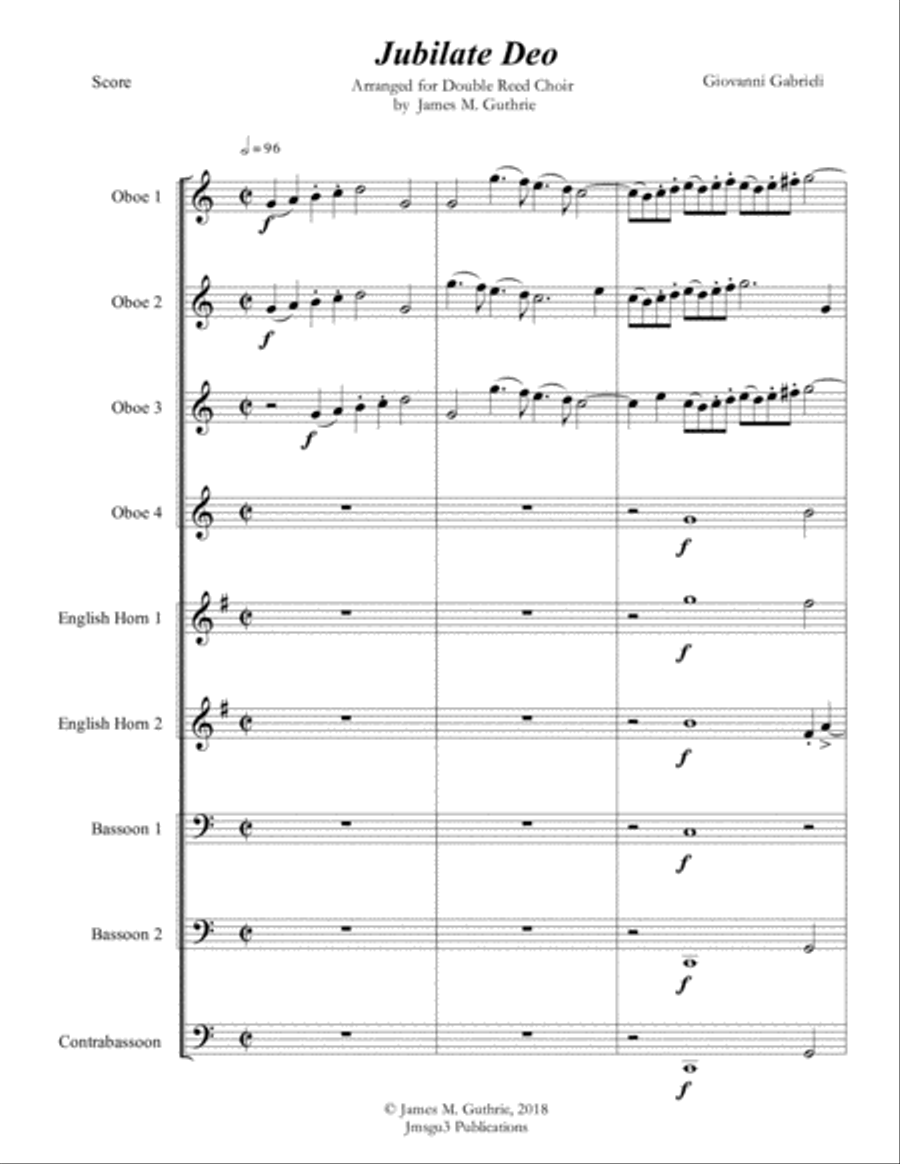
Gabrieli: Jubilate Deo Ch. 136 for Double Reed Choir

$47.95 41.58 € PDF SheetMusicPlus


Partitions Gratuites
Acheter des Partitions Musicales
Acheter des Partitions Digitales à Imprimer
Acheter des Instruments de Musique

© 2000 - 2026

Accueil - Version intégrale





