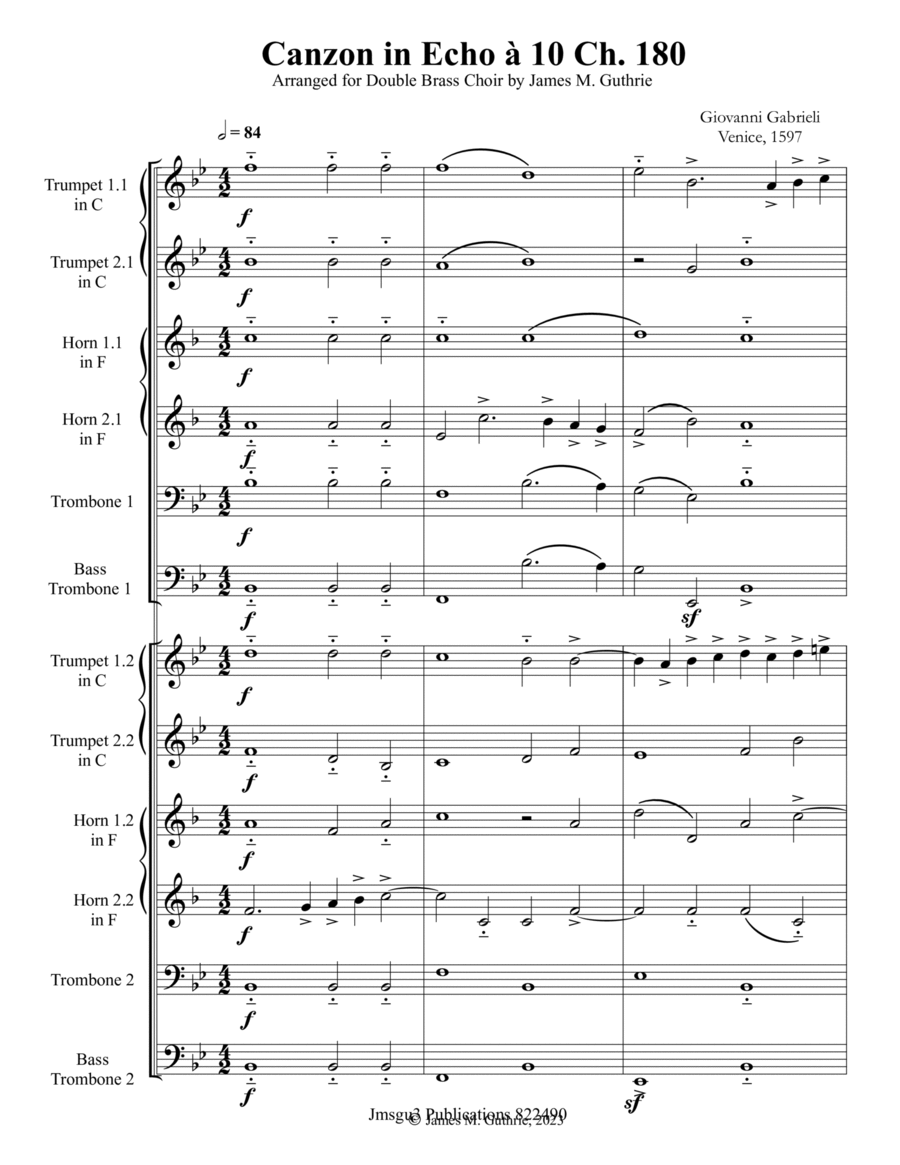
Brass Ensemble Horn,Trombone,Trumpet - Level 3 - Digital Download SKU: A0.1226488 Composed by Giovanni Gabrieli. Arranged by James M. Guthrie, ASCAP. Chamber,Contest,Early Music,Festival,Historic,Renaissance. Score and Parts. 51 pages. Jmsgu3 #822490. Published by jmsgu3 (A0.1226488). Minimum instrumentation: 4 Trumpets (or Cornets), 4 French Horns, 2 Tenor Trombones, and 2 Bass Trombones.InnovationsGabrieli preferred sacred vocal and certainly instrumental music. Hence, he concentrated on music that consequently took advantage of resonance and likewise reverberation for maximum effect. Seems like Gabrieli may have invented dynamics – or was rather the first to indicate them such as in his Sonata Pian’ e Forte. Consequently, he was also a pioneer in spatial techniques. He therefore developed and used very specific notation to indicate instrumentation. Gabrieli experimented with assembling massive instrumental forces into isolated groups separated by space. In this way, he consequently contributed heavily to the Baroque Concertato style.Polychoral WorksGabrieli probably used the layout of the San Marco church for his experiments. This is because he worked there as a musician and composer. Furthermore, the church had two choir lofts facing each other. He certainly used these to create striking spatial effects between instrumental forces. Certainly, many of his works are composed such that a choir or instrumental group could first be heard on one side, then consequently followed by a response from the group on the other side. Sometimes there was probably a third group positioned near the main altar as well.Spatial MusicAbove all, Gabrieli studied carefully detailed groups of instruments and singers. Furthermore, it seems like he created precise directions for instrumentation rather than two groups. The instruments, because they could be appropriately situated, could consequently be heard with perfect clearness at distant locations. As a result, arrangements that seem bizarre on paper, can in contrast sound perfectly in balance.First WorksFinally, Gabrieli published his first motets along with his uncle Andrea's compositions in Concerti (1587). These compositions furthermore indicate considerable usage of dialogue and echo effects. Consequently, here we see low and high choirs with the variance between their ranges indicated by instrumental accompaniment. Seems like Gabrieli’s later motets Sacrae Symphoniae (1597) move away from close antiphony. In contrast, he moves towards not simply echoing the material but developing it through sequential choral entrances. Even more, he takes this procedure to the extreme in the Motet Omnes Gentes. Unlike earlier works, here the instruments are certainly an essential part of the presentation. Also, only parts marked: Capella are supposed to be sung.HomophonyHence, after 1605, Gabrieli moves to a much more homophonic style. He writes sections purely for instruments – which calls Sinfonia – and smaller sections for vocal soloists, accompanied by a basso continuo.