EUROPE
8691 articles
USA
44279 articles
DIGITAL
154728 articles (à imprimer)
Partitions Digitales
Partitions à imprimer
154728 partitions trouvées


Guitar,Piano,Vocal,Voice - Digital Download SKU: A0.858679 Composed by Antonin Dvorak. Arranged by Stephen Bulat. Concert,Holiday,Love,Romantic Period,Sacred,Wedding. Score. 3 pages. Stephen Bulat Publishing #5745221. Published by Stephen Bulat Publishing (A0.858679). Lead sheet (melody & chords) of Dvorak’s classical earworm, Humoresque.A classical songbook must-have, this arrangement has been gig-tested and has a very easy to follow roadmap, with all essential music notes, musical cues and rehearsal markings throughout. Layout is in a larger style font than lead sheets in a typical fakebook yet still condensed to fit on 2 pages. This format can be used for guitar sheet music, for piano sheet music, as instrumental sheet music, vocal sheet music or as accompaniment to a soloist (e.g. violin, flute)Please click on the publisher to view this song in other keys as well as to purchase it in the Classical Wedding Fake Book or the Classic Love Songs - A Valentine's Day Fake Book.Classical Wedding Fake Book (C Instruments): https://www.sheetmusicplus.com/title/21758919 - Item Number: S0.776313Classical Wedding Fake Book (Bb Instruments): https://www.sheetmusicplus.com/title/21758922- Item Number: S0.776329Classical Wedding Fake Book (Eb Instruments): https://www.sheetmusicplus.com/title/21758923- Item Number: S0.776333Classical Wedding Fake Book - Band Leader Gig Pack (C, Bb & Eb Instruments): https://www.sheetmusicplus.com/title/21758924 - Item Number: S0.776337SMPPress publisher page: https://www.sheetmusicplus.com/publishers/stephen-bulat-sheet-music/3007289Online: http://stephenbulat.com
Humoresque (Dvorak) - Lead sheet (key of G)
Piano, Voix et Guitare

$2.99 2.51 € Piano, Voix et Guitare PDF SheetMusicPlus

Large Ensemble Alto Recorder,Bassoon,Clarinet,English Horn,Flute,Guitar,Harpsichord,Oboe,Organ,Piano,Soprano Recorder,Tenor Recorder,Trumpet,Ukulele,Viola,Violin,Voice - Digital Download SKU: A0.858349 Composed by J. S. Bach, Charles Gounod. Arranged by Stephen Bulat. Baroque,Contemporary,Praise & Worship,Sacred,Wedding. Score and parts. 3 pages. Stephen Bulat Publishing #4276957. Published by Stephen Bulat Publishing (A0.858349). Lead sheet (melody, lyrics & chords) of Bach/Gounod's classical masterpiece. Rehearsal markings throughout to facilitate an easy roadmap for musicians to follow. Contains both the English & Latin lyrics. A classical songbook must-have, this arrangement has been gig-tested and has a very easy to follow roadmap, with all essential music notes, musical cues and rehearsal markings throughout. Layout is in a larger style font than lead sheets in a typical fakebook yet still condensed to fit on 2 pages. This format can be used for guitar sheet music, for piano sheet music, as instrumental sheet music, vocal sheet music or as accompaniment to a soloist (e.g. violin, flute)Please click on the publisher to view this song in other keys as well as to purchase it in the Classical Wedding Fake Book or the Classic Love Songs Valentine's Day Fake Book..Classical Wedding Fake Book (C Instruments): https://www.sheetmusicplus.com/title/21758919 - Item Number: S0.776313Classical Wedding Fake Book (Bb Instruments): https://www.sheetmusicplus.com/title/21758922- Item Number: S0.776329Classical Wedding Fake Book (Eb Instruments): https://www.sheetmusicplus.com/title/21758923- Item Number: S0.776333Classical Wedding Fake Book - Band Leader Gig Pack (C, Bb & Eb Instruments): https://www.sheetmusicplus.com/title/21758924 - Item Number: S0.776337SMPPress publisher page: https://www.sheetmusicplus.com/publishers/stephen-bulat-sheet-music/3007289 Stephen Bulat (H0.873589-SC000010569Online: http://stephenbulat.com
Ave Maria (Bach/Gounod) - Lead sheet (key of A)

$2.99 2.51 € PDF SheetMusicPlus

Guitar,Piano,Vocal,Voice - Digital Download SKU: A0.858728 Composed by J. S. Bach, Charles Gounod. Arranged by Stephen Bulat. Baroque,Contemporary,Praise & Worship,Sacred,Wedding. Score. 3 pages. Stephen Bulat Publishing #6073405. Published by Stephen Bulat Publishing (A0.858728). Lead sheet (melody, lyrics & chords) of Bach/Gounod's classical masterpiece. Rehearsal markings throughout to facilitate an easy roadmap for musicians to follow. Contains both the English & Latin lyrics. A classical songbook must-have, this arrangement has been gig-tested and has a very easy to follow roadmap, with all essential music notes, musical cues and rehearsal markings throughout. Layout is in a larger style font than lead sheets in a typical fakebook yet still condensed to fit on 2 pages. This format can be used for guitar sheet music, for piano sheet music, as instrumental sheet music, vocal sheet music or as accompaniment to a soloist (e.g. violin, flute)Please click on the publisher to view this song in other keys as well as to purchase it in the Classical Wedding Fake Book or the Classic Love Songs Valentine's Day Fake Book.Classical Wedding Fake Book (C Instruments): https://www.sheetmusicplus.com/title/21758919 - Item Number: S0.776313Classical Wedding Fake Book (Bb Instruments): https://www.sheetmusicplus.com/title/21758922- Item Number: S0.776329Classical Wedding Fake Book (Eb Instruments): https://www.sheetmusicplus.com/title/21758923- Item Number: S0.776333Classical Wedding Fake Book - Band Leader Gig Pack (C, Bb & Eb Instruments): https://www.sheetmusicplus.com/title/21758924 - Item Number: S0.776337SMPPress publisher page: https://www.sheetmusicplus.com/publishers/stephen-bulat-sheet-music/3007289 Stephen Bulat (H0.873589-SC000010569Online: http://stephenbulat.com
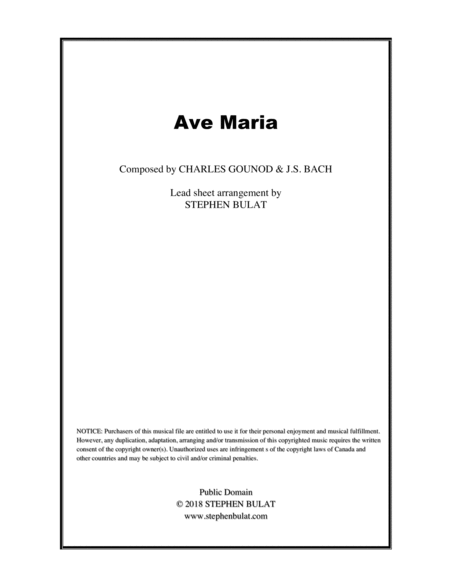
Ave Maria (Bach/Gounod) - Lead sheet (key of Db)
Piano, Voix et Guitare

$2.99 2.51 € Piano, Voix et Guitare PDF SheetMusicPlus

String Orchestra - Level 1 - Digital Download SKU: A0.773313 Composed by Yoel Epstein. Arranged by Yoel Epstein. Holiday,Instructional,Patriotic. Score and parts. 53 pages. Yoel Epstein #3686153. Published by Yoel Epstein (A0.773313). This volume contains songs for every national US holiday. The songs are arranged for beginning string orchestra (all first position), with additional parts for violin, viola and cello using open strings only. An accompaniment track is available at https://youtu.be/SlkbjfKBdjc . So you can play this with the accompaniment and any combination of parts. If there are no violists, or if the cello part is too hard for your students, you can play the songs with the accompaniment, and it will sound fine. In fact, I have performed this piece with the violin open string parts only, along with the accompaniment.  Important: This volume contains the scores and one copy of the parts. If you need more parts, please, please, please do not simply photocopy them. You can buy more parts at https://www.sheetmusicplus.com/title/20827196for practically nothing! I know your project is underbudgeted, and money is short, and the photocopier is right down the hall. But this is my livelihood. So I am asking you to please buy your additional parts. Thank you.  This is one of the Open String Symphony series of music for string players of mixed skill levels. You can see all the books of the series at  http://www.sheetmusicplus.com/search?Ntt=Open+String+Symphony  These pieces are part of a more complete program for teaching strings in classes. You can read the entire first-year program in the books Playing Together Student Workbook and Playing Together: Teacher's Guide, both available on Amazon:  Teacher's Guide: https://www.amazon.com/Playing-Together-Teachers-Guide-teaching/dp/1534974598 Student Workbook: https://www.amazon.com/Playing-Together-Student-Workbook-2/dp/1535336617  If you enjoy this, you are welcome to try some of my other arrangements. You can see them at http://www.sheetmusicplus.com/search?Ntt=Yoel+Epstein ), In particular, you might be interested in my music flash cards (here). If you need arrangements of any of these songs for special combinations of instruments, feel free to contact me, and I will try to accommodate. Write me at yoelepst@gmail.com. Hope you enjoy.
Open String Holidays: A song for every US Holiday for violinists of mixed skill levels
Orchestre à Cordes

$19.99 16.77 € Orchestre à Cordes PDF SheetMusicPlus

Instrumental Duet Bassoon,Instrumental Duet - Level 3 - Digital Download SKU: A0.549828 Composed by Peter Ilyich Tchaikovsky. Arranged by James M. Guthrie, ASCAP. Children,Christmas,Romantic Period,Standards. Score and parts. 48 pages. Jmsgu3 #3549777. Published by jmsgu3 (A0.549828). Duration: 6:12, Score: 29 pages, Solo part: 6 pages, Piano part: 12 pages. This is the grand finale of the Nutcracker Suite. Pyotr Ilyich Tchaikovsky Tchaikovsky is probably the most popular of the great composers in America. His music certainly appeals to musicians. Likewise, it appeals even to folks who don’t normally listen to serious music. This is probably because of his most noteworthy melodies. Above all, he writes with great emotion. This certainly makes a most noteworthy if not an unforgettable impact. Education First of all, He attended classes at the Russian Musical Society. Even more, He also attended the St. Petersburg Conservatory. There he studied music theory with Nikolai Zaremba. He also consequently studied composition with Anton Rubenstein. It seems like Rubenstein came under criticism from a group of Russian composers known as the Five. The Five The Five certainly rejected Western musical influences. They rather sought to use elements from Russian music. They furthermore wanted to use more exotic musical materials. Western Techniques More than other Russian composers, Tchaikovsky studied modern Western music. He certainly develops his music like the European masters. So, rather than repeating a motive, he moves to a new key. He then introduces a different theme in the new key. Hence, he maintained his independence from the Five. Even more, he became the first Russian composer of international stature. Influences Tchaikovsky was probably influenced in his ballet scoring by Léo Delibes. Richard Wagner influenced his symphonic writing. Tchaikovsky’s most famous works include the 1812 Overture, The Nutcracker Suite, and Swan Lake. Also famous are the Violin Concerto in D and the six symphonies. The greatest of the six symphonies may be No. 6, the Pathétique. Nutcracker Suite, Op. 71a The Nutcracker Suite is a ballet that was performed for the first time in December 1892 in St. Petersburg. To begin with, the original ballet failed to attract a positive reception. However, the ballet suite became probably one of the most popular of all of Tchaikovsky’s works. The ballet suite became even more famous in the 1960s. It is now performed all over the world, particularly during the Christmas season.  
Tchaikovsky: Waltz of the Flowers from Nutcracker Suite for Bassoon & Piano
2 Bassons (duo)

$32.95 27.64 € 2 Bassons (duo) PDF SheetMusicPlus

Instrumental Solo,Oboe d'Amore,Piano - Level 3 - Digital Download SKU: A0.549825 Composed by Peter Ilyich Tchaikovsky. Arranged by James M. Guthrie, ASCAP. Children,Christmas,Romantic Period,Standards. Score and individual part. 48 pages. Jmsgu3 #3547921. Published by jmsgu3 (A0.549825). Duration: 6:12, Score: 29 pages, Solo part: 6 pages, Piano part: 12 pages. This is the grand finale of the Nutcracker Suite. Pyotr Ilyich Tchaikovsky Tchaikovsky is probably the most popular of the great composers in America. His music certainly appeals to musicians. Likewise, it appeals even to folks who don’t normally listen to serious music. This is probably because of his most noteworthy melodies. Above all, he writes with great emotion. This certainly makes a most noteworthy if not an unforgettable impact. Education First of all, He attended classes at the Russian Musical Society. Even more, He also attended the St. Petersburg Conservatory. There he studied music theory with Nikolai Zaremba. He also consequently studied composition with Anton Rubenstein. It seems like Rubenstein came under criticism from a group of Russian composers known as the Five. The Five The Five certainly rejected Western musical influences. They rather sought to use elements from Russian music. They furthermore wanted to use more exotic musical materials. Western Techniques More than other Russian composers, Tchaikovsky studied modern Western music. He certainly develops his music like the European masters. So, rather than repeating a motive, he moves to a new key. He then introduces a different theme in the new key. Hence, he maintained his independence from the Five. Even more, he became the first Russian composer of international stature. Influences Tchaikovsky was probably influenced in his ballet scoring by Léo Delibes. Richard Wagner influenced his symphonic writing. Tchaikovsky’s most famous works include the 1812 Overture, The Nutcracker Suite, and Swan Lake. Also famous are the Violin Concerto in D and the six symphonies. The greatest of the six symphonies may be No. 6, the Pathétique. Nutcracker Suite, Op. 71a The Nutcracker Suite is a ballet that was performed for the first time in December 1892 in St. Petersburg. To begin with, the original ballet failed to attract a positive reception. However, the ballet suite became probably one of the most popular of all of Tchaikovsky’s works. The ballet suite became even more famous in the 1960s. It is now performed all over the world, particularly during the Christmas season.  
Tchaikovsky: Waltz of the Flowers from Nutcracker Suite for Oboe d'Amore & Piano

$32.95 27.64 € PDF SheetMusicPlus

Piano,Trombone - Level 3 - Digital Download SKU: A0.549831 Composed by Peter Ilyich Tchaikovsky. Arranged by James M. Guthrie, ASCAP. Children,Christmas,Romantic Period,Standards. Score and part. 48 pages. Jmsgu3 #3550639. Published by jmsgu3 (A0.549831). Duration: 6:12, Score: 29 pages, Solo part: 6 pages, Piano part: 12 pages. This is the grand finale of the Nutcracker Suite. Pyotr Ilyich Tchaikovsky Tchaikovsky is probably the most popular of the great composers in America. His music certainly appeals to musicians. Likewise, it appeals even to folks who don’t normally listen to serious music. This is probably because of his most noteworthy melodies. Above all, he writes with great emotion. This certainly makes a most noteworthy if not an unforgettable impact. Education First of all, He attended classes at the Russian Musical Society. Even more, He also attended the St. Petersburg Conservatory. There he studied music theory with Nikolai Zaremba. He also consequently studied composition with Anton Rubenstein. It seems like Rubenstein came under criticism from a group of Russian composers known as the Five. The Five The Five certainly rejected Western musical influences. They rather sought to use elements from Russian music. They furthermore wanted to use more exotic musical materials. Western Techniques More than other Russian composers, Tchaikovsky studied modern Western music. He certainly develops his music like the European masters. So, rather than repeating a motive, he moves to a new key. He then introduces a different theme in the new key. Hence, he maintained his independence from the Five. Even more, he became the first Russian composer of international stature. Influences Tchaikovsky was probably influenced in his ballet scoring by Léo Delibes. Richard Wagner influenced his symphonic writing. Tchaikovsky’s most famous works include the 1812 Overture, The Nutcracker Suite, and Swan Lake. Also famous are the Violin Concerto in D and the six symphonies. The greatest of the six symphonies may be No. 6, the Pathétique. Nutcracker Suite, Op. 71a The Nutcracker Suite is a ballet that was performed for the first time in December 1892 in St. Petersburg. To begin with, the original ballet failed to attract a positive reception. However, the ballet suite became probably one of the most popular of all of Tchaikovsky’s works. The ballet suite became even more famous in the 1960s. It is now performed all over the world, particularly during the Christmas season.  
Tchaikovsky: Waltz of the Flowers from Nutcracker Suite for Trombone & Piano
Trombone et Piano

$32.95 27.64 € Trombone et Piano PDF SheetMusicPlus

Baritone Saxophone,Piano - Level 3 - Digital Download SKU: A0.549820 Composed by Peter Ilyich Tchaikovsky. Arranged by James M. Guthrie, ASCAP. Children,Christmas,Romantic Period,Standards. Score and part. 48 pages. Jmsgu3 #3546585. Published by jmsgu3 (A0.549820). Duration: 6:12, Score: 29 pages, Solo part: 6 pages, Piano part: 12 pages. This is the grand finale of the Nutcracker Suite. Pyotr Ilyich Tchaikovsky Tchaikovsky is probably the most popular of the great composers in America. His music certainly appeals to musicians. Likewise, it appeals even to folks who don’t normally listen to serious music. This is probably because of his most noteworthy melodies. Above all, he writes with great emotion. This certainly makes a most noteworthy if not an unforgettable impact. Education First of all, He attended classes at the Russian Musical Society. Even more, He also attended the St. Petersburg Conservatory. There he studied music theory with Nikolai Zaremba. He also consequently studied composition with Anton Rubenstein. It seems like Rubenstein came under criticism from a group of Russian composers known as the Five. The Five The Five certainly rejected Western musical influences. They rather sought to use elements from Russian music. They furthermore wanted to use more exotic musical materials. Western Techniques More than other Russian composers, Tchaikovsky studied modern Western music. He certainly develops his music like the European masters. So, rather than repeating a motive, he moves to a new key. He then introduces a different theme in the new key. Hence, he maintained his independence from the Five. Even more, he became the first Russian composer of international stature. Influences Tchaikovsky was probably influenced in his ballet scoring by Léo Delibes. Richard Wagner influenced his symphonic writing. Tchaikovsky’s most famous works include the 1812 Overture, The Nutcracker Suite, and Swan Lake. Also famous are the Violin Concerto in D and the six symphonies. The greatest of the six symphonies may be No. 6, the Pathétique. Nutcracker Suite, Op. 71a The Nutcracker Suite is a ballet that was performed for the first time in December 1892 in St. Petersburg. To begin with, the original ballet failed to attract a positive reception. However, the ballet suite became probably one of the most popular of all of Tchaikovsky’s works. The ballet suite became even more famous in the 1960s. It is now performed all over the world, particularly during the Christmas season.
Tchaikovsky: Waltz of the Flowers from Nutcracker Suite for Baritone Sax & Piano
Saxophone Baryton, Piano

$32.95 27.64 € Saxophone Baryton, Piano PDF SheetMusicPlus

Oboe,Piano - Level 3 - Digital Download SKU: A0.549817 Composed by Peter Ilyich Tchaikovsky. Arranged by James M. Guthrie, ASCAP. Children,Christmas,Romantic Period,Standards. Score and part. 48 pages. Jmsgu3 #3546571. Published by jmsgu3 (A0.549817). Duration: 6:12, Score: 29 pages, Solo part: 6 pages, Piano part: 12 pages. This is the grand finale of the Nutcracker Suite. Pyotr Ilyich Tchaikovsky Tchaikovsky is probably the most popular of the great composers in America. His music certainly appeals to musicians. Likewise, it appeals even to folks who don’t normally listen to serious music. This is probably because of his most noteworthy melodies. Above all, he writes with great emotion. This certainly makes a most noteworthy if not an unforgettable impact. Education First of all, He attended classes at the Russian Musical Society. Even more, He also attended the St. Petersburg Conservatory. There he studied music theory with Nikolai Zaremba. He also consequently studied composition with Anton Rubenstein. It seems like Rubenstein came under criticism from a group of Russian composers known as the Five. The Five The Five certainly rejected Western musical influences. They rather sought to use elements from Russian music. They furthermore wanted to use more exotic musical materials. Western Techniques More than other Russian composers, Tchaikovsky studied modern Western music. He certainly develops his music like the European masters. So, rather than repeating a motive, he moves to a new key. He then introduces a different theme in the new key. Hence, he maintained his independence from the Five. Even more, he became the first Russian composer of international stature. Influences Tchaikovsky was probably influenced in his ballet scoring by Léo Delibes. Richard Wagner influenced his symphonic writing. Tchaikovsky’s most famous works include the 1812 Overture, The Nutcracker Suite, and Swan Lake. Also famous are the Violin Concerto in D and the six symphonies. The greatest of the six symphonies may be No. 6, the Pathétique. Nutcracker Suite, Op. 71a The Nutcracker Suite is a ballet that was performed for the first time in December 1892 in St. Petersburg. To begin with, the original ballet failed to attract a positive reception. However, the ballet suite became probably one of the most popular of all of Tchaikovsky’s works. The ballet suite became even more famous in the 1960s. It is now performed all over the world, particularly during the Christmas season.
Tchaikovsky: Waltz of the Flowers from Nutcracker Suite for Oboe & Piano
Hautbois, Piano (duo)

$32.95 27.64 € Hautbois, Piano (duo) PDF SheetMusicPlus

Bass Flute,Instrumental Solo,Piano - Level 3 - Digital Download SKU: A0.549824 Composed by Peter Ilyich Tchaikovsky. Arranged by James M. Guthrie, ASCAP. Children,Christmas,Romantic Period,Standards. Score and individual part. 48 pages. Jmsgu3 #3547907. Published by jmsgu3 (A0.549824). Duration: 6:12, Score: 29 pages, Solo part: 6 pages, Piano part: 12 pages. This is the grand finale of the Nutcracker Suite. Pyotr Ilyich Tchaikovsky Tchaikovsky is probably the most popular of the great composers in America. His music certainly appeals to musicians. Likewise, it appeals even to folks who don’t normally listen to serious music. This is probably because of his most noteworthy melodies. Above all, he writes with great emotion. This certainly makes a most noteworthy if not an unforgettable impact. Education First of all, He attended classes at the Russian Musical Society. Even more, He also attended the St. Petersburg Conservatory. There he studied music theory with Nikolai Zaremba. He also consequently studied composition with Anton Rubenstein. It seems like Rubenstein came under criticism from a group of Russian composers known as the Five. The Five The Five certainly rejected Western musical influences. They rather sought to use elements from Russian music. They furthermore wanted to use more exotic musical materials. Western Techniques More than other Russian composers, Tchaikovsky studied modern Western music. He certainly develops his music like the European masters. So, rather than repeating a motive, he moves to a new key. He then introduces a different theme in the new key. Hence, he maintained his independence from the Five. Even more, he became the first Russian composer of international stature. Influences Tchaikovsky was probably influenced in his ballet scoring by Léo Delibes. Richard Wagner influenced his symphonic writing. Tchaikovsky’s most famous works include the 1812 Overture, The Nutcracker Suite, and Swan Lake. Also famous are the Violin Concerto in D and the six symphonies. The greatest of the six symphonies may be No. 6, the Pathétique. Nutcracker Suite, Op. 71a The Nutcracker Suite is a ballet that was performed for the first time in December 1892 in St. Petersburg. To begin with, the original ballet failed to attract a positive reception. However, the ballet suite became probably one of the most popular of all of Tchaikovsky’s works. The ballet suite became even more famous in the 1960s. It is now performed all over the world, particularly during the Christmas season.  
Tchaikovsky: Waltz of the Flowers from Nutcracker Suite for Bass Flute & Piano

$32.95 27.64 € PDF SheetMusicPlus

French Horn,Piano - Level 3 - Digital Download SKU: A0.549834 Composed by Peter Ilyich Tchaikovsky. Arranged by James M. Guthrie, ASCAP. Children,Christmas,Romantic Period,Standards. Score and part. 48 pages. Jmsgu3 #3553495. Published by jmsgu3 (A0.549834). Duration: 6:12, Score: 29 pages, Solo part: 6 pages, Piano part: 12 pages. This is the grand finale of the Nutcracker Suite. Pyotr Ilyich Tchaikovsky Tchaikovsky is probably the most popular of the great composers in America. His music certainly appeals to musicians. Likewise, it appeals even to folks who don’t normally listen to serious music. This is probably because of his most noteworthy melodies. Above all, he writes with great emotion. This certainly makes a most noteworthy if not an unforgettable impact. Education First of all, He attended classes at the Russian Musical Society. Even more, He also attended the St. Petersburg Conservatory. There he studied music theory with Nikolai Zaremba. He also consequently studied composition with Anton Rubenstein. It seems like Rubenstein came under criticism from a group of Russian composers known as the Five. The Five The Five certainly rejected Western musical influences. They rather sought to use elements from Russian music. They furthermore wanted to use more exotic musical materials. Western Techniques More than other Russian composers, Tchaikovsky studied modern Western music. He certainly develops his music like the European masters. So, rather than repeating a motive, he moves to a new key. He then introduces a different theme in the new key. Hence, he maintained his independence from the Five. Even more, he became the first Russian composer of international stature. Influences Tchaikovsky was probably influenced in his ballet scoring by Léo Delibes. Richard Wagner influenced his symphonic writing. Tchaikovsky’s most famous works include the 1812 Overture, The Nutcracker Suite, and Swan Lake. Also famous are the Violin Concerto in D and the six symphonies. The greatest of the six symphonies may be No. 6, the Pathétique. Nutcracker Suite, Op. 71a The Nutcracker Suite is a ballet that was performed for the first time in December 1892 in St. Petersburg. To begin with, the original ballet failed to attract a positive reception. However, the ballet suite became probably one of the most popular of all of Tchaikovsky’s works. The ballet suite became even more famous in the 1960s. It is now performed all over the world, particularly during the Christmas season.  
Tchaikovsky: Waltz of the Flowers from Nutcracker Suite for French Horn & Piano
Cor et Piano

$32.95 27.64 € Cor et Piano PDF SheetMusicPlus

Piano,Viola - Level 3 - Digital Download SKU: A0.549814 Composed by Peter Ilyich Tchaikovsky. Arranged by James M. Guthrie, ASCAP. Children,Christmas,Romantic Period,Standards. Score and part. 47 pages. Jmsgu3 #3545591. Published by jmsgu3 (A0.549814). Duration: 6:12, Score: 29 pages, Solo part: 5 pages, Piano part: 12 pages. This is the grand finale of the Nutcracker Suite. Pyotr Ilyich Tchaikovsky Tchaikovsky is probably the most popular of the great composers in America. His music certainly appeals to musicians. Likewise, it appeals even to folks who don’t normally listen to serious music. This is probably because of his most noteworthy melodies. Above all, he writes with great emotion. This certainly makes a most noteworthy if not an unforgettable impact. Education First of all, He attended classes at the Russian Musical Society. Even more, He also attended the St. Petersburg Conservatory. There he studied music theory with Nikolai Zaremba. He also consequently studied composition with Anton Rubenstein. It seems like Rubenstein came under criticism from a group of Russian composers known as the Five. The Five The Five certainly rejected Western musical influences. They rather sought to use elements from Russian music. They furthermore wanted to use more exotic musical materials. Western Techniques More than other Russian composers, Tchaikovsky studied modern Western music. He certainly develops his music like the European masters. So, rather than repeating a motive, he moves to a new key. He then introduces a different theme in the new key. Hence, he maintained his independence from the Five. Even more, he became the first Russian composer of international stature. Influences Tchaikovsky was probably influenced in his ballet scoring by Léo Delibes. Richard Wagner influenced his symphonic writing. Tchaikovsky’s most famous works include the 1812 Overture, The Nutcracker Suite, and Swan Lake. Also famous are the Violin Concerto in D and the six symphonies. The greatest of the six symphonies may be No. 6, the Pathétique. Nutcracker Suite, Op. 71a The Nutcracker Suite is a ballet that was performed for the first time in December 1892 in St. Petersburg. To begin with, the original ballet failed to attract a positive reception. However, the ballet suite became probably one of the most popular of all of Tchaikovsky’s works. The ballet suite became even more famous in the 1960s. It is now performed all over the world, particularly during the Christmas season.
Tchaikovsky: Waltz of the Flowers from Nutcracker Suite for Viola & Piano
Alto, Piano

$32.95 27.64 € Alto, Piano PDF SheetMusicPlus

B-Flat Trumpet,Piano - Level 3 - Digital Download SKU: A0.549830 Composed by Peter Ilyich Tchaikovsky. Arranged by James M. Guthrie, ASCAP. Children,Christmas,Romantic Period,Standards. Score and part. 48 pages. Jmsgu3 #3550201. Published by jmsgu3 (A0.549830). Duration: 6:12, Score: 29 pages, Solo part: 6 pages, Piano part: 12 pages. This is the grand finale of the Nutcracker Suite. Pyotr Ilyich Tchaikovsky Tchaikovsky is probably the most popular of the great composers in America. His music certainly appeals to musicians. Likewise, it appeals even to folks who don’t normally listen to serious music. This is probably because of his most noteworthy melodies. Above all, he writes with great emotion. This certainly makes a most noteworthy if not an unforgettable impact. Education First of all, He attended classes at the Russian Musical Society. Even more, He also attended the St. Petersburg Conservatory. There he studied music theory with Nikolai Zaremba. He also consequently studied composition with Anton Rubenstein. It seems like Rubenstein came under criticism from a group of Russian composers known as the Five. The Five The Five certainly rejected Western musical influences. They rather sought to use elements from Russian music. They furthermore wanted to use more exotic musical materials. Western Techniques More than other Russian composers, Tchaikovsky studied modern Western music. He certainly develops his music like the European masters. So, rather than repeating a motive, he moves to a new key. He then introduces a different theme in the new key. Hence, he maintained his independence from the Five. Even more, he became the first Russian composer of international stature. Influences Tchaikovsky was probably influenced in his ballet scoring by Léo Delibes. Richard Wagner influenced his symphonic writing. Tchaikovsky’s most famous works include the 1812 Overture, The Nutcracker Suite, and Swan Lake. Also famous are the Violin Concerto in D and the six symphonies. The greatest of the six symphonies may be No. 6, the Pathétique. Nutcracker Suite, Op. 71a The Nutcracker Suite is a ballet that was performed for the first time in December 1892 in St. Petersburg. To begin with, the original ballet failed to attract a positive reception. However, the ballet suite became probably one of the most popular of all of Tchaikovsky’s works. The ballet suite became even more famous in the 1960s. It is now performed all over the world, particularly during the Christmas season.   
Tchaikovsky: Waltz of the Flowers from Nutcracker Suite for Trumpet & Piano
Trompette

$32.95 27.64 € Trompette PDF SheetMusicPlus

Bass Clarinet,Piano - Level 3 - Digital Download SKU: A0.549829 Composed by Peter Ilyich Tchaikovsky. Arranged by James M. Guthrie, ASCAP. Children,Christmas,Romantic Period,Standards. Score and part. 48 pages. Jmsgu3 #3549769. Published by jmsgu3 (A0.549829). Duration: 6:12, Score: 29 pages, Solo part: 6 pages, Piano part: 12 pages. This is the grand finale of the Nutcracker Suite. Pyotr Ilyich Tchaikovsky Tchaikovsky is probably the most popular of the great composers in America. His music certainly appeals to musicians. Likewise, it appeals even to folks who don’t normally listen to serious music. This is probably because of his most noteworthy melodies. Above all, he writes with great emotion. This certainly makes a most noteworthy if not an unforgettable impact. Education First of all, He attended classes at the Russian Musical Society. Even more, He also attended the St. Petersburg Conservatory. There he studied music theory with Nikolai Zaremba. He also consequently studied composition with Anton Rubenstein. It seems like Rubenstein came under criticism from a group of Russian composers known as the Five. The Five The Five certainly rejected Western musical influences. They rather sought to use elements from Russian music. They furthermore wanted to use more exotic musical materials. Western Techniques More than other Russian composers, Tchaikovsky studied modern Western music. He certainly develops his music like the European masters. So, rather than repeating a motive, he moves to a new key. He then introduces a different theme in the new key. Hence, he maintained his independence from the Five. Even more, he became the first Russian composer of international stature. Influences Tchaikovsky was probably influenced in his ballet scoring by Léo Delibes. Richard Wagner influenced his symphonic writing. Tchaikovsky’s most famous works include the 1812 Overture, The Nutcracker Suite, and Swan Lake. Also famous are the Violin Concerto in D and the six symphonies. The greatest of the six symphonies may be No. 6, the Pathétique. Nutcracker Suite, Op. 71a The Nutcracker Suite is a ballet that was performed for the first time in December 1892 in St. Petersburg. To begin with, the original ballet failed to attract a positive reception. However, the ballet suite became probably one of the most popular of all of Tchaikovsky’s works. The ballet suite became even more famous in the 1960s. It is now performed all over the world, particularly during the Christmas season.  
Tchaikovsky: Waltz of the Flowers from Nutcracker Suite for Bass Clarinet & Piano
Clarinette Basse, Piano

$32.95 27.64 € Clarinette Basse, Piano PDF SheetMusicPlus

Flute,Piano - Level 3 - Digital Download SKU: A0.549823 Composed by Peter Ilyich Tchaikovsky. Arranged by James M. Guthrie, ASCAP. Children,Christmas,Romantic Period,Standards. Score and part. 48 pages. Jmsgu3 #3547897. Published by jmsgu3 (A0.549823). Duration: 6:12, Score: 29 pages, Solo part: 6 pages, Piano part: 12 pages. This is the grand finale of the Nutcracker Suite. Pyotr Ilyich Tchaikovsky Tchaikovsky is probably the most popular of the great composers in America. His music certainly appeals to musicians. Likewise, it appeals even to folks who don’t normally listen to serious music. This is probably because of his most noteworthy melodies. Above all, he writes with great emotion. This certainly makes a most noteworthy if not an unforgettable impact. Education First of all, He attended classes at the Russian Musical Society. Even more, He also attended the St. Petersburg Conservatory. There he studied music theory with Nikolai Zaremba. He also consequently studied composition with Anton Rubenstein. It seems like Rubenstein came under criticism from a group of Russian composers known as the Five. The Five The Five certainly rejected Western musical influences. They rather sought to use elements from Russian music. They furthermore wanted to use more exotic musical materials. Western Techniques More than other Russian composers, Tchaikovsky studied modern Western music. He certainly develops his music like the European masters. So, rather than repeating a motive, he moves to a new key. He then introduces a different theme in the new key. Hence, he maintained his independence from the Five. Even more, he became the first Russian composer of international stature. Influences Tchaikovsky was probably influenced in his ballet scoring by Léo Delibes. Richard Wagner influenced his symphonic writing. Tchaikovsky’s most famous works include the 1812 Overture, The Nutcracker Suite, and Swan Lake. Also famous are the Violin Concerto in D and the six symphonies. The greatest of the six symphonies may be No. 6, the Pathétique. Nutcracker Suite, Op. 71a The Nutcracker Suite is a ballet that was performed for the first time in December 1892 in St. Petersburg. To begin with, the original ballet failed to attract a positive reception. However, the ballet suite became probably one of the most popular of all of Tchaikovsky’s works. The ballet suite became even more famous in the 1960s. It is now performed all over the world, particularly during the Christmas season.
Tchaikovsky: Waltz of the Flowers from Nutcracker Suite for Alto Flute & Piano
Flûte traversière et Piano

$32.95 27.64 € Flûte traversière et Piano PDF SheetMusicPlus


Partitions Gratuites
Acheter des Partitions Musicales
Acheter des Partitions Digitales à Imprimer
Acheter des Instruments de Musique

© 2000 - 2026

Accueil - Version intégrale





