EUROPE
13011 articles
USA
0 articles
DIGITAL
278423 articles (à imprimer)
Partitions Digitales
Partitions à imprimer
278423 partitions trouvées


Piano Solo - Level 2 - Digital Download SKU: A0.1258723 By Giorgio Costantini. By Giorgio Costantini. 21st Century,Classical,Contemporary,New Age. Score. 3 pages. Giorgio Costantini #851983. Published by Giorgio Costantini (A0.1258723). Rain is a neoclassical piano piece that is easy to perform. The theme is ethereal and sustained by long chords and pedal resonances, where the pauses are as significant as the played notes. In the central section, the soft and dense arpeggio gradually increases in speed and complexity, depicting the nuances of rain sounds. (Spotify link: https://open.spotify.com/track/1LMasCb4uDVxLX4ZKIYavO)Giorgio Costantini, originally from Venice, is a musician and composer with a vast number of concerts performed worldwide. With extensive experience in live performances and studio work, he has shared the stage with numerous successful Italian artists such as Zero, Mannoia, and Zarrillo, as well as internationally acclaimed musicians like Lenny Kravitz, Elvis Costello, and Michael Bolton. As a session musician, he has contributed to over 30 albums by Italian artists, which have collectively achieved more than 24 gold records. His compositions have been featured in commercials, television programs, and films.
Rain
Piano seul
Giorgio Costantini
$3.99 3.45 € Piano seul PDF SheetMusicPlus

Instrumental Solo - Level 5 - Digital Download SKU: A0.1091262 Composed by Adrian Gagiu. Classical,Contemporary. Individual part. 28 pages. Adrian Gagiu #695427. Published by Adrian Gagiu (A0.1091262). Piano sonata in Neoclassical style, developing the themes briefly tried out by Beethoven in the slow introduction to the Finale of his Sonata No. 29 op. 106 (1818). This first movement (Allegro moderato) utilizes the first two of those melodic and textural scraps as the two themes of a sonata form in a mostly delicate, fantasia-like manner, with time signature ambiguity and alternance. The second movement (Allegro) utilizes the next two of those melodic and textural scraps as the two themes of an agitated 'scherzo' in G sharp minor, with allusions to Bach's Prelude in C minor from the second book of 'The Well-Tempered Clavier' and to Beethoven's Bagatelle in G minor, op. 126 no. 2. The Finale (Largo - Allegro ma non troppo) utilizes first the searching sections of that Introduction, as an enigmatic preparation of the big surprise in the Finale proper: a set of nine, mostly powerful variations on a tone row, yet treated not entirely with the twelve-tone technique, but in extended tonality context. Variations 2-5 allude to motifs from the themes of the previous movements. The mp3 is a self-made recording of the first movement using a Graf 1826 fortepiano sampled by Modartt's Pianoteq. Performing Rights Organization: SOCAN. Total duration: 19 min.
Piano Sonata No. 5, op. 81
Piano seul

$12.99 11.24 € Piano seul PDF SheetMusicPlus

Piano,Soprano Flute - Level 3 - Digital Download SKU: A0.1314255 Composed by Camille Saint-Saens. Arranged by James M. Guthrie. 19th Century,Chamber,Contest,Festival,Historic,Romantic Period. Score and part. 11 pages. Jmsgu3 #902996. Published by jmsgu3 (A0.1314255). Saint-Saëns: The Swan (Le Cygne) movement 13 from the Carnival of the Animals Suite. One of his most popular and widely recognized works, it is the only movement from the Carnival Suite that Saint-Saëns permitted to be performed publicly during his lifetime. This is an excellent recital encore to demonstrate melodic playing and strategic phrasing. The Carnival of the AnimalsThe Carnival of the Animals is an entertaining musical suite of fourteen movements by Camille Saint-Saëns. The work was composed for private performance by an ensemble of two pianos and solo instruments. The Swan (No. 13) is among the fourteen most famous movements. In its entirety, it lasts about 25 minutes. Saint-Saëns BackgroundCharles-Camille Saint-Saëns 1835 – 1921) was, by all means, in particular, a famous French composer, brilliant organist, and significant musical mastermind of the Romantic era. Indeed, his most famous compositions, in the long run, include his Piano Concerto No. 2 (1868), Cello Concerto No. 1 (1872), and the Danse macabre (1874). Notwithstanding, we must also add Violin Concerto No. 3 (1880), Symphony No. 3 (the Organ Symphony, 1886), and, it must be remembered, Carnival of the Animals (1886) to the list. Childhood It is essential to realize that Saint-Saëns was undoubtedly, in fact, a child musical prodigy. Consequently, with this in mind, he made his concert debut, albeit at ten years old. Another critical point to remember is that he expressly studied at the Paris Conservatoire, then, despite reality, conversely followed a traditional career path as a church organist. Nevertheless, twenty years later, on the other hand, he left to become a successful freelance pianist and composer despite, as has been noted, his former employment situation. Furthermore, his performances were, after all, markedly in demand - not only in Europe but, above all, in the Americas all in all as well. YouthA point often overlooked is that in his youth, Saint-Saëns was undoubtedly excited about the modern music of the day. He was, in essence, fond of the music of his contemporaries, particularly Schumann, Liszt, and, for the most part, Wagner. In contrast, however, his compositions seemed, in fact, primarily confined within the conservative classical tradition. Be that as it may, he was, at the same time, nevertheless, a scholar of musical history. Criticism On the whole, his conservatism, in fact, ultimately brought him into frequent conflict in his later years with composers of the impressionist and, in particular, the dodecaphonic schools of musical thought. A point often overlooked is that he included neoclassical elements in his music, contrary to some critics. Furthermore, in so doing, he provided the most compelling evidence that he predicted the techniques and works by Stravinsky and Les Six. To put it another way, given these points, he was regarded, perhaps for the most part unfairly, as a non-progressive reactionary henceforth around the time of his passing.LegacySaint-Saëns taught briefly in Paris, where his students included Gabriel Fauré. Maurice Ravel later studied with Fauré. In conclusion, both Ravel and Fauré were powerfully influenced by Saint-Saëns, whom they respected as a musical mastermind.
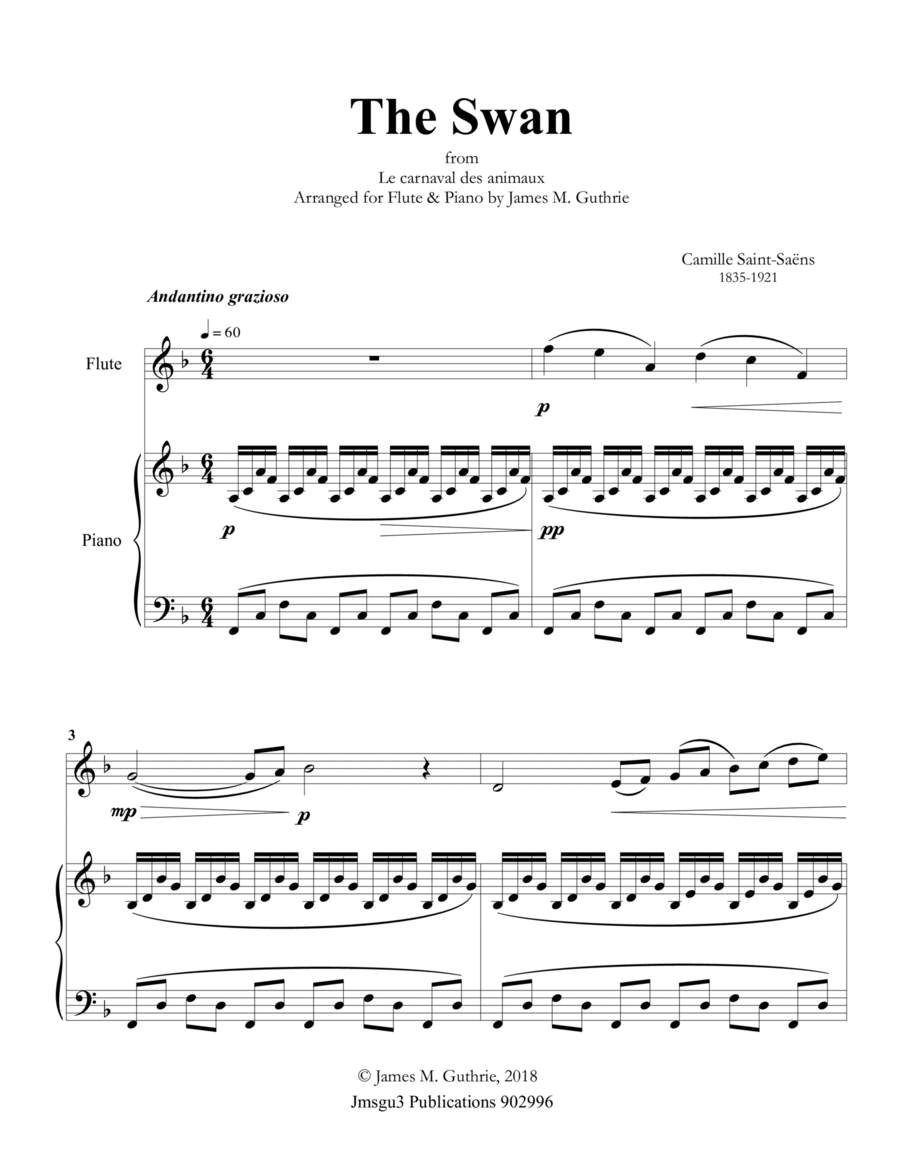
Saint-Saëns: The Swan for Flute & Piano
Flûte traversière et Piano

$32.95 28.52 € Flûte traversière et Piano PDF SheetMusicPlus

Piano Solo - Level 2 - Digital Download SKU: A0.1258719 By Giorgio Costantini. By Giorgio Costantini. 21st Century,Classical,Contemporary,New Age. Score. 6 pages. Giorgio Costantini #851979. Published by Giorgio Costantini (A0.1258719). Jellyfish Ballet is a solo piano piece by Giorgio Costantini in the neoclassical genre. With its simple execution and linear writing, it is a sweetly melancholic composition that draws inspiration from the harmonious and captivating movement of jellyfish. The alternating motion arpeggios and the theme, achieved by emphasizing the highest note of the arpeggio, beautifully depict the graceful motion of jellyfish.In the central part of the piece, a binary arpeggio in the left hand intertwines with a ternary arpeggio in the right hand, creating a soft and complex texture. (Spotify link: https://open.spotify.com/track/0DfAYlIcUbqMk3m6PLpUDI)Giorgio Costantini, hailing from Venice, is a musician and composer with a remarkable track record of performing thousands of concerts worldwide. With extensive experience in live performances and studio work, he has collaborated with numerous successful artists and contributed to over 30 albums, garnering more than 24 gold records in Italy. His compositions have been featured in commercials, television programs, and films.
Jellyfish Ballet
Piano seul
Giorgio Costantini
$3.99 3.45 € Piano seul PDF SheetMusicPlus

Level 3 - Digital Download SKU: A0.1401939 Composed by Camille Saint-Saens. Arranged by Roar Kvam. 19th Century,Christmas,Latin,Praise and Worship,Romantic Period. 64 pages. KVAMusic Edition #985137. Published by KVAMusic Edition (A0.1401939). Charles-Camille Saint-SaeÌ?ns (9 October 1835-16 December 1921) was a French composer, organist, conductor and pianist.He was a musical prodigy and made his concert debut at the age of ten. After studying at the Paris Conservatoire he followed a conventional career as a church organist, first at Saint-Merri, Paris and, from 1858, La Madeleine, the ocial church of the French Empire. After leaving the post twenty years later, he was a successful freelance pianist and composer, in demand in Europe and the Americas. As a young man, Saint-SaeÌ?ns was enthusiastic for the most modern music of the day, particularly that of Schumann, Liszt and Wagner, although his own compositions were generally within a conventional classical tradition. He was a scholar of musical history, and remained committed to the structures worked out by earlier French composers.This brought him into conflict in his later years with composers of the impressionist and dodecaphonic schools of music; although there were neoclassical elements in his music, foreshadowing works by Stravinsky and Les Six, he was often regarded as a reactionary in the decades around the time of his death. He wrote the Oratorio de NoeÌ?l (Christmas Oratorio) at the end of the 1850s and completed it in 1860.The first performanse was at the church La Madeleine in Paris December 1869.The work is dedicated to A Madame la Vicomtesse de Grandval.The work is originally scored for five soloists, soprano, mezzo-soprano, alto, tenor and baritone, mixed choir (except no. 4 which is for SSAA), harp, organ and strings (in this edition the choir has been transcribed for a SSAA choir). Texts in the Oratorio de NoeÌ?l is drawn from the Old and New Testaments: (1. Instrumental).2. Luke 2,8-14. 3. Psalm 39,1. 4. John 11.27. 5. Psalm 117, 26-28. 6. Psalm 2,1 and Gloria Patri. 7. Psalm 109,3 and Graduale. 8. Isaiah 49,13. 9. Lamentations 2,19, Mica 4.13, Zachary 9,9, Isaiah 62,1. 10. Psalm 95,8-9, 11,13.
Saint-Saëns: Oratorio de Noël, 5 soli, SSAA choir, harp, organ and strings - Score Only
Chorale SSAA

$20.00 17.31 € Chorale SSAA PDF SheetMusicPlus


Partitions Gratuites
Acheter des Partitions Musicales
Acheter des Partitions Digitales à Imprimer
Acheter des Instruments de Musique

© 2000 - 2026

Accueil - Version intégrale





