EUROPE
1093 articles
USA
1170 articles
DIGITAL
6491 articles (à imprimer)
Partitions Digitales
Partitions à imprimer
6491 partitions trouvées

1 ....31 46 61 76 91 ....6481

Woodwind Ensemble,Woodwind Quintet Bassoon,Clarinet,Flute,Horn,Oboe - Level 2 - Digital Download SKU: A0.1375010 By Edvard Grieg. By Edvard Grieg. Arranged by Glauco Fernandes. Chamber,Classical,Instructional,Romantic Period,Wedding. 15 pages. Glauco Fernandes #959582. Published by Glauco Fernandes (A0.1375010). Introducing the Exclusive Sheet Music: Edvard Grieg's Morning Mood - Easy Intermediate ArrangementExplore the timeless beauty of classical music with our special arrangement of Edvard Grieg's Morning Mood. Carefully crafted for musicians at an easy intermediate level, this arrangement offers an engaging and challenging experience, perfect for those looking to expand their musical skills.Ideal for beginners eager for challenges and chamber music practice, our sheet music provides a gradual introduction to new musical elements, ensuring a enriching experience. This arrangement is also a valuable tool for teachers seeking stimulating material for ensemble practice with students, fostering a collaborative and inspiring learning environment.Professional musicians will find in this arrangement a simple and practical option for various events, including weddings. The softness and captivating melody of Morning Mood create a charming atmosphere, making it the perfect choice for special and memorable moments.Key Features of the Sheet Music:- Easy intermediate level arrangement, striking a perfect balance between challenge and accessibility.- Suitable for beginners seeking technical development and ensemble practice.- Excellent resource for teachers and students looking to enhance their musical skills in a group setting.- Practical option for professional musicians seeking a delightful interpretation at events, especially weddings.By acquiring this exclusive sheet music, you are investing in a versatile tool that can enrich your musical practice and add a special touch to your performances. Discover the magic of Edvard Grieg's Morning Mood in a unique and accessible way. Download now and embark on an inspiring musical journey!
Morning Mood by Grieg - Woodwind Quintet & Piano
Quintette à Vent: flûte, Hautbois, basson, clarinette, Cor
Edvard Grieg
$19.99 16.85 € Quintette à Vent: flûte, Hautbois, basson, clarinette, Cor PDF SheetMusicPlus

Brass Quintet Horn,Trombone,Trumpet,Tuba - Level 2 - Digital Download SKU: A0.1375024 By Edvard Grieg. By Edvard Grieg. Arranged by Glauco Fernandes. Chamber,Classical,Instructional,Romantic Period,Wedding. 15 pages. Glauco Fernandes #959596. Published by Glauco Fernandes (A0.1375024). Introducing the Exclusive Sheet Music: Edvard Grieg's Morning Mood - Easy Intermediate ArrangementExplore the timeless beauty of classical music with our special arrangement of Edvard Grieg's Morning Mood. Carefully crafted for musicians at an easy intermediate level, this arrangement offers an engaging and challenging experience, perfect for those looking to expand their musical skills.Ideal for beginners eager for challenges and chamber music practice, our sheet music provides a gradual introduction to new musical elements, ensuring a enriching experience. This arrangement is also a valuable tool for teachers seeking stimulating material for ensemble practice with students, fostering a collaborative and inspiring learning environment.Professional musicians will find in this arrangement a simple and practical option for various events, including weddings. The softness and captivating melody of Morning Mood create a charming atmosphere, making it the perfect choice for special and memorable moments.Key Features of the Sheet Music:- Easy intermediate level arrangement, striking a perfect balance between challenge and accessibility.- Suitable for beginners seeking technical development and ensemble practice.- Excellent resource for teachers and students looking to enhance their musical skills in a group setting.- Practical option for professional musicians seeking a delightful interpretation at events, especially weddings.By acquiring this exclusive sheet music, you are investing in a versatile tool that can enrich your musical practice and add a special touch to your performances. Discover the magic of Edvard Grieg's Morning Mood in a unique and accessible way. Download now and embark on an inspiring musical journey!
Morning Mood by Grieg - Brass Quintet & Piano with Chord Notation
Quintette de Cuivres: 2 trompettes, Cor, trombone, tuba
Edvard Grieg
$19.99 16.85 € Quintette de Cuivres: 2 trompettes, Cor, trombone, tuba PDF SheetMusicPlus

Woodwind Ensemble,Woodwind Quartet Bassoon,Clarinet,Flute,Oboe - Level 2 - Digital Download SKU: A0.1375004 By Edvard Grieg. By Edvard Grieg. Arranged by Glauco Fernandes. Chamber,Classical,Instructional,Romantic Period,Wedding. 11 pages. Glauco Fernandes #959577. Published by Glauco Fernandes (A0.1375004). Introducing the Exclusive Sheet Music: Edvard Grieg's Morning Mood - Easy Intermediate ArrangementExplore the timeless beauty of classical music with our special arrangement of Edvard Grieg's Morning Mood. Carefully crafted for musicians at an easy intermediate level, this arrangement offers an engaging and challenging experience, perfect for those looking to expand their musical skills.Ideal for beginners eager for challenges and chamber music practice, our sheet music provides a gradual introduction to new musical elements, ensuring a enriching experience. This arrangement is also a valuable tool for teachers seeking stimulating material for ensemble practice with students, fostering a collaborative and inspiring learning environment.Professional musicians will find in this arrangement a simple and practical option for various events, including weddings. The softness and captivating melody of Morning Mood create a charming atmosphere, making it the perfect choice for special and memorable moments.Key Features of the Sheet Music:- Easy intermediate level arrangement, striking a perfect balance between challenge and accessibility.- Suitable for beginners seeking technical development and ensemble practice.- Excellent resource for teachers and students looking to enhance their musical skills in a group setting.- Practical option for professional musicians seeking a delightful interpretation at events, especially weddings.By acquiring this exclusive sheet music, you are investing in a versatile tool that can enrich your musical practice and add a special touch to your performances. Discover the magic of Edvard Grieg's Morning Mood in a unique and accessible way. Download now and embark on an inspiring musical journey!
Morning Mood by Grieg - Woodwind Quartet with Chord Notation
Flûte, Hautbois, Clarinette, Basson
Edvard Grieg
$13.99 11.79 € Flûte, Hautbois, Clarinette, Basson PDF SheetMusicPlus

Alto Saxophone,Piano - Level 3 - Digital Download SKU: A0.549533 Composed by Edvard Grieg. Arranged by James M. Guthrie, ASCAP. Concert,Contemporary,Romantic Period,Sacred,Standards. Score and part. 11 pages. Jmsgu3 #3505785. Published by jmsgu3 (A0.549533). Duration: ca. 3:40, Score: 5 pages, solo part: 2 pages, piano part: 3 pages. Super-famous instantly recognizable tune, not very difficult - suitable for a recital, funeral or church meditation. Grieg Background In the first place, Edvard Grieg (1843 –1907) was a Norwegian composer as well as a concert pianist. As a matter of fact, most music historians consider him one of the foremost Romantic era composers. Consequently, his music is part of the international standard classical repertoire. Grieg moreover used Norwegian folk music in his own compositions.  Consequently, he ushered Norwegian music to transnational consciousness. Furthermore, he forged a national musical identity for Norway. It is important to realize that he did this in a manner similar to Jean Sibelius in Finland, and BedÅ™ich Smetana in Bohemia. Legacy Grieg is especially celebrated in the city of Bergen. For example, the city has erected numerous statues depicting Grieg. Specifically, the city has named a concert hall (Grieg Hall), a music school (Grieg Academy) and a professional choir (Edvard Grieg Kor) after him. As a matter of fact, there is also a museum located at his former home in Troldhaugen. Peer Gynt Suite No. 1 (Op. 46) Grieg wrote incidental music for the purpose of illustrating a play by Ibsen known as Peer Gynt. The play includes, in particular, the famous selection entitled, In the Hall of the Mountain King. In this composition, Grieg indeed depicts the exploits of the scoundrel, Peer Gynt. In one famous episode, for example, Peer steals a bride at her wedding. For this reason, the people chase him, but soon Peer falls, thereupon striking his skull on a boulder. He wakens forthwith in a highland bounded by angry gnomes. Consequently, the music of In the Hall of the Mountain King represents the mad gnomes taunting Peer. Therefore, each time the theme repeats it gets louder and faster. In the end, Peer surprisingly escapes from the mountain. Holberg Suite and Misc. Summary It must be remembered that Grieg originally wrote his Holberg Suite for the piano. In other words, he only later arranged it for strings. Further, Grieg composed by and large many songs with lyrics by famous writers such as Heine, Goethe, Ibsen, Hans Christian Andersen, Rudyard Kipling, and others. On balance, Norwegian pianist Eva Knardahl recorded altogether Grieg’s whole piano catalog on LP in 1980. These recordings were released again on CD in 2006. In any event, Grieg himself performed and recorded the bulk of these pieces toward the end of his life.Register for free lifetime revisions and updates at www.jamesguthrie.com
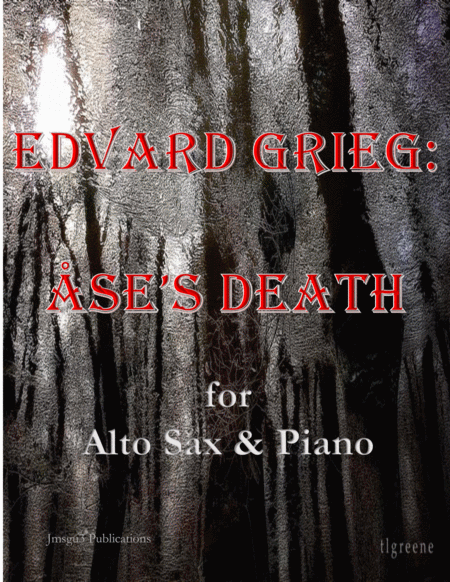
Grieg: Ase's Death from Peer Gynt Suite for Alto Sax & Piano
Saxophone Alto et Piano

$24.95 21.03 € Saxophone Alto et Piano PDF SheetMusicPlus

Piano,Tenor Saxophone - Level 3 - Digital Download SKU: A0.549577 Composed by Edvard Grieg. Arranged by James M. Guthrie, ASCAP. Concert,Instructional,Romantic Period,Standards,World. Score and part. 18 pages. Jmsgu3 #3509379. Published by jmsgu3 (A0.549577). Duration: ca. 2:17 Score: 10 pages, solo part: 2 pages, piano part: 5 pages. A proven audience pleaser - perfect for a recital encore! Grieg Background In the first place, Edvard Grieg (1843 –1907) was a Norwegian composer as well as a concert pianist. As a matter of fact, most music historians consider him one of the foremost Romantic era composers. Consequently, his music is part of the international standard classical repertoire. Grieg moreover used Norwegian folk music in his own compositions.  Consequently, he ushered Norwegian music to transnational consciousness. Furthermore, he forged a national musical identity for Norway. It is important to realize that he did this in a manner similar to Jean Sibelius in Finland, and BedÅ™ich Smetana in Bohemia. Legacy Grieg is especially celebrated in the city of Bergen. For example, the city has erected numerous statues depicting Grieg. Specifically, the city has named a concert hall (Grieg Hall), a music school (Grieg Academy) and a professional choir (Edvard Grieg Kor) after him. As a matter of fact, there is also a museum located at his former home in Troldhaugen. Peer Gynt Suite No. 1 (Op. 46) Grieg wrote incidental music for the purpose of illustrating a play by Ibsen known as Peer Gynt. The play includes, in particular, the famous selection entitled, In the Hall of the Mountain King. In this composition, Grieg indeed depicts the exploits of the scoundrel, Peer Gynt. In one famous episode, for example, Peer steals a bride at her wedding. For this reason, the people chase him, but soon Peer falls, thereupon striking his skull on a boulder. He wakens forthwith in a highland bounded by angry gnomes. Consequently, the music of In the Hall of the Mountain King represents the mad gnomes taunting Peer. Therefore, each time the theme repeats it gets louder and faster. In the end, Peer surprisingly escapes from the mountain. Holberg Suite and Misc. Summary It must be remembered that Grieg originally wrote his Holberg Suite for the piano. In other words, he only later arranged it for strings. Further, Grieg composed by and large many songs with lyrics by famous writers such as Heine, Goethe, Ibsen, Hans Christian Andersen, Rudyard Kipling, and others. On balance, Norwegian pianist Eva Knardahl recorded altogether Grieg’s whole piano catalog on LP in 1980. These recordings were released again on CD in 2006. In any event, Grieg himself performed and recorded the bulk of these pieces toward the end of his life.  
Grieg: Hall of the Mountain King from Peer Gynt Suite for Tenor Sax & Piano
Saxophone Tenor et Piano

$24.95 21.03 € Saxophone Tenor et Piano PDF SheetMusicPlus

Flute,Piano - Level 3 - Digital Download SKU: A0.549552 Composed by Edvard Grieg. Arranged by James M. Guthrie, ASCAP. Concert,Instructional,Romantic Period,Standards,World. Score and part. 16 pages. Jmsgu3 #3507521. Published by jmsgu3 (A0.549552). Duration: ca. 3:20, Score: 10 pages, solo part: 2 pages, piano part: 3 pages. A delicate masterpiece, not very difficult - suitable for a recital encore. Grieg Background In the first place, Edvard Grieg (1843 –1907) was a Norwegian composer as well as a concert pianist. As a matter of fact, most music historians consider him one of the foremost Romantic era composers. Consequently, his music is part of the international standard classical repertoire. Grieg moreover used Norwegian folk music in his own compositions.  Consequently, he ushered Norwegian music to transnational consciousness. Furthermore, he forged a national musical identity for Norway. It is important to realize that he did this in a manner similar to Jean Sibelius in Finland, and BedÅ™ich Smetana in Bohemia. Legacy Grieg is especially celebrated in the city of Bergen. For example, the city has erected numerous statues depicting Grieg. Specifically, the city has named a concert hall (Grieg Hall), a music school (Grieg Academy) and a professional choir (Edvard Grieg Kor) after him. As a matter of fact, there is also a museum located at his former home in Troldhaugen. Peer Gynt Suite No. 1 (Op. 46) Grieg wrote incidental music for the purpose of illustrating a play by Ibsen known as Peer Gynt. The play includes, in particular, the famous selection entitled, In the Hall of the Mountain King. In this composition, Grieg indeed depicts the exploits of the scoundrel, Peer Gynt. In one famous episode, for example, Peer steals a bride at her wedding. For this reason, the people chase him, but soon Peer falls, thereupon striking his skull on a boulder. He wakens forthwith in a highland bounded by angry gnomes. Consequently, the music of In the Hall of the Mountain King represents the mad gnomes taunting Peer. Therefore, each time the theme repeats it gets louder and faster. In the end, Peer surprisingly escapes from the mountain. Holberg Suite and Misc. Summary It must be remembered that Grieg originally wrote his Holberg Suite for the piano. In other words, he only later arranged it for strings. Further, Grieg composed by and large many songs with lyrics by famous writers such as Heine, Goethe, Ibsen, Hans Christian Andersen, Rudyard Kipling, and others. On balance, Norwegian pianist Eva Knardahl recorded altogether Grieg’s whole piano catalog on LP in 1980. These recordings were released again on CD in 2006. In any event, Grieg himself performed and recorded the bulk of these pieces toward the end of his life.Register for free lifetime revisions and updates at www.jamesguthrie.com
Grieg: Anitra's Dance from Peer Gynt Suite for Flute & Piano
Flûte traversière et Piano

$24.95 21.03 € Flûte traversière et Piano PDF SheetMusicPlus

E-Flat Clarinet,Piano - Level 3 - Digital Download SKU: A0.549561 Composed by Edvard Grieg. Arranged by James M. Guthrie, ASCAP. Concert,Instructional,Romantic Period,Standards,World. Score and part. 16 pages. Jmsgu3 #3508011. Published by jmsgu3 (A0.549561). Duration: ca. 3:20, Score: 10 pages, solo part: 2 pages, piano part: 3 pages. Delicate, not very difficult - suitable for a recital encore. Grieg Background In the first place, Edvard Grieg (1843 –1907) was a Norwegian composer as well as a concert pianist. As a matter of fact, most music historians consider him one of the foremost Romantic era composers. Consequently, his music is part of the international standard classical repertoire. Grieg moreover used Norwegian folk music in his own compositions.  Consequently, he ushered Norwegian music to transnational consciousness. Furthermore, he forged a national musical identity for Norway. It is important to realize that he did this in a manner similar to Jean Sibelius in Finland, and BedÅ™ich Smetana in Bohemia. Legacy Grieg is especially celebrated in the city of Bergen. For example, the city has erected numerous statues depicting Grieg. Specifically, the city has named a concert hall (Grieg Hall), a music school (Grieg Academy) and a professional choir (Edvard Grieg Kor) after him. As a matter of fact, there is also a museum located at his former home in Troldhaugen. Peer Gynt Suite No. 1 (Op. 46) Grieg wrote incidental music for the purpose of illustrating a play by Ibsen known as Peer Gynt. The play includes, in particular, the famous selection entitled, In the Hall of the Mountain King. In this composition, Grieg indeed depicts the exploits of the scoundrel, Peer Gynt. In one famous episode, for example, Peer steals a bride at her wedding. For this reason, the people chase him, but soon Peer falls, thereupon striking his skull on a boulder. He wakens forthwith in a highland bounded by angry gnomes. Consequently, the music of In the Hall of the Mountain King represents the mad gnomes taunting Peer. Therefore, each time the theme repeats it gets louder and faster. In the end, Peer surprisingly escapes from the mountain. Holberg Suite and Misc. Summary It must be remembered that Grieg originally wrote his Holberg Suite for the piano. In other words, he only later arranged it for strings. Further, Grieg composed by and large many songs with lyrics by famous writers such as Heine, Goethe, Ibsen, Hans Christian Andersen, Rudyard Kipling, and others. On balance, Norwegian pianist Eva Knardahl recorded altogether Grieg’s whole piano catalog on LP in 1980. These recordings were released again on CD in 2006. In any event, Grieg himself performed and recorded the bulk of these pieces toward the end of his life.Register for free lifetime revisions and updates at www.jamesguthrie.com

Grieg: Anitra's Dance from Peer Gynt Suite for Alto Clarinet & Piano
Clarinette et Piano

$24.95 21.03 € Clarinette et Piano PDF SheetMusicPlus

Alto Saxophone,Piano - Level 3 - Digital Download SKU: A0.549511 Composed by Edvard Grieg. Arranged by James M. Guthrie, ASCAP. Instructional,Romantic Period,Sacred,Standards. Score and part. 17 pages. Jmsgu3 #3502277. Published by jmsgu3 (A0.549511). Duration: ca. 4:00, Score: 9 pages, solo prt: 3 pages, piano part: 4 pages. Super-famous Instantly recognizable tune, not very difficult - suitable for a recital or church meditation.   Grieg Background In the first place, Edvard Grieg (1843 –1907) was a Norwegian composer as well as a concert pianist. As a matter of fact, most music historians consider him one of the foremost Romantic-era composers. Consequently, his music is part of the international standard classical repertoire. Grieg moreover used Norwegian folk music in his own compositions.  Consequently, he ushered Norwegian music to transnational consciousness. Furthermore, he forged a national musical identity for Norway. It is important to realize that he did this in a manner similar to Jean Sibelius in Finland, and Bedřich Smetana in Bohemia. Legacy Grieg is especially celebrated in the city of Bergen. For example, the city has erected numerous statues depicting Grieg. Specifically, the city has named a concert hall (Grieg Hall), a music school (Grieg Academy), and a professional choir (Edvard Grieg Kor) after him. As a matter of fact, there is also a museum located at his former home in Troldhaugen. Peer Gynt Suite No. 1 (Op. 46) Grieg wrote incidental music for the purpose of illustrating a play by Ibsen known as Peer Gynt. The play includes, in particular, the famous selection entitled, In the Hall of the Mountain King. In this composition, Grieg depicts the exploits of the scoundrel, Peer Gynt. In one famous episode, for example, Peer steals a bride at her wedding. For this reason, the people chase him, but soon Peer falls, striking his skull on a boulder. He wakens forthwith in a highland bounded by angry gnomes. Consequently, the music of In the Hall of the Mountain King represents the mad gnomes taunting Peer. Therefore, each time the theme repeats it gets louder and faster. In the end, Peer surprisingly escapes from the mountain. Holberg Suite and Misc. Summary It must be remembered that Grieg originally wrote his Holberg Suite for the piano. In other words, he only later arranged it for strings. Further, Grieg composed many songs with lyrics by famous writers such as Heine, Goethe, Ibsen, Hans Christian Andersen, Rudyard Kipling, and others. On balance, Norwegian pianist Eva Knardahl recorded altogether Grieg’s whole piano catalog on LP in 1980. These recordings were released again on CD in 2006. In any event, Grieg himself performed and recorded the bulk of these pieces toward the end of his life.  
Grieg: Morning Mood from Peer Gynt Suite for Alto Sax & Piano
Saxophone Alto et Piano

$32.95 27.78 € Saxophone Alto et Piano PDF SheetMusicPlus

Piano,Violin - Level 3 - Digital Download SKU: A0.549527 Composed by Edvard Grieg. Arranged by James M. Guthrie, ASCAP. Contemporary,Romantic Period,Sacred,Standards. 11 pages. Jmsgu3 #3505751. Published by jmsgu3 (A0.549527). Duration: ca. 3:40, Score: 5 pages, solo part: 2 pages, piano part: 3 pages. Super-famous instantly recognizable tune, not very difficult - suitable for a recital, funeral or church meditation. Grieg Background In the first place, Edvard Grieg (1843 –1907) was a Norwegian composer as well as a concert pianist. As a matter of fact, most music historians consider him one of the foremost Romantic era composers. Consequently, his music is part of the international standard classical repertoire. Grieg moreover used Norwegian folk music in his own compositions.  Consequently, he ushered Norwegian music to transnational consciousness. Furthermore, he forged a national musical identity for Norway. It is important to realize that he did this in a manner similar to Jean Sibelius in Finland, and BedÅ™ich Smetana in Bohemia. Legacy Grieg is especially celebrated in the city of Bergen. For example, the city has erected numerous statues depicting Grieg. Specifically, the city has named a concert hall (Grieg Hall), a music school (Grieg Academy) and a professional choir (Edvard Grieg Kor) after him. As a matter of fact, there is also a museum located at his former home in Troldhaugen. Peer Gynt Suite No. 1 (Op. 46) Grieg wrote incidental music for the purpose of illustrating a play by Ibsen known as Peer Gynt. The play includes, in particular, the famous selection entitled, In the Hall of the Mountain King. In this composition, Grieg indeed depicts the exploits of the scoundrel, Peer Gynt. In one famous episode, for example, Peer steals a bride at her wedding. For this reason, the people chase him, but soon Peer falls, thereupon striking his skull on a boulder. He wakens forthwith in a highland bounded by angry gnomes. Consequently, the music of In the Hall of the Mountain King represents the mad gnomes taunting Peer. Therefore, each time the theme repeats it gets louder and faster. In the end, Peer surprisingly escapes from the mountain. Holberg Suite and Misc. Summary It must be remembered that Grieg originally wrote his Holberg Suite for the piano. In other words, he only later arranged it for strings. Further, Grieg composed by and large many songs with lyrics by famous writers such as Heine, Goethe, Ibsen, Hans Christian Andersen, Rudyard Kipling, and others. On balance, Norwegian pianist Eva Knardahl recorded altogether Grieg’s whole piano catalog on LP in 1980. These recordings were released again on CD in 2006. In any event, Grieg himself performed and recorded the bulk of these pieces toward the end of his life.Register for free lifetime revisions and updates at www.jamesguthrie.com

Grieg: Ase's Death from Peer Gynt Suite for Violin & Piano
Violon et Piano

$28.95 24.41 € Violon et Piano PDF SheetMusicPlus

Piano,Violin - Level 4 - Digital Download SKU: A0.551512 Composed by Edvard Grieg. Arranged by James Guthrie, ASCAP. Concert,Halloween,Instructional,Romantic Period,Standards. 62 pages. Jmsgu3 #5306359. Published by jmsgu3 (A0.551512). 1. Morning Mood, 2. Ase's Death, 3. Anitra's Dance, 4. In the Hall of the Mountain KingGrieg BackgroundIn the first place, Edvard Grieg (1843 –1907) was a Norwegian composer as well as a concert pianist. As a matter of fact, most music historians consider him one of the foremost Romantic era composers. Consequently, his music is part of the international standard classical repertoire. Grieg moreover used Norwegian folk music in his own compositions.  Consequently, he ushered Norwegian music to transnational consciousness. Furthermore, he forged a national musical identity for Norway. It is important to realize that he did this in a manner similar to Jean Sibelius in Finland, and BedÅ™ich Smetana in Bohemia.LegacyGrieg is celebrated in the city of Bergen. For example, the city has erected numerous statues depicting Grieg. Specifically, the city has named a concert hall (Grieg Hall), a music school (Grieg Academy) and a professional choir (Edvard Grieg Kor) after him. As a matter of fact, there is also a museum located at his former home in Troldhaugen.Peer Gynt Suite No. 1 (Op. 46)Grieg wrote incidental music for the purpose of illustrating a play by Ibsen known as Peer Gynt. The play includes, in particular, the famous selection entitled, In the Hall of the Mountain King. In this composition, Grieg indeed depicts the exploits of the scoundrel, Peer Gynt. In one famous episode, for example, Peer steals a bride at her wedding. For this reason, the people chase him, but soon Peer falls, thereupon striking his skull on a boulder. He wakens forthwith in a highland bounded by angry gnomes. Consequently, the music of In the Hall of the Mountain King represents the mad gnomes taunting Peer. Therefore, each time the theme repeats it gets louder and faster. In the end, Peer surprisingly escapes from the mountain.Holberg Suite and Misc. SummaryIt must be remembered that Grieg originally wrote his Holberg Suite for the piano. In other words, he only later arranged it for strings. Further, Grieg composed by and large many songs with lyrics by famous writers such as Heine, Goethe, Ibsen, Hans Christian Andersen, Rudyard Kipling, and others. On balance, Norwegian pianist Eva Knardahl recorded altogether Grieg’s whole piano catalog on LP in 1980. These recordings were released again on CD in 2006. In any event, Grieg himself performed and recorded the bulk of these pieces toward the end of his life.
Grieg: Peer Gynt Suite Complete for Violin & Piano
Violon et Piano

$59.95 50.54 € Violon et Piano PDF SheetMusicPlus

Piano,Tenor Saxophone - Level 3 - Digital Download SKU: A0.549557 Composed by Edvard Grieg. Arranged by James M. Guthrie, ASCAP. Concert,Instructional,Romantic Period,Standards,World. Score and part. 16 pages. Jmsgu3 #3507671. Published by jmsgu3 (A0.549557). Duration: ca. 3:20, Score: 10 pages, solo part: 2 pages, piano part: 3 pages. A delicate masterpiece, not very difficult - suitable for a recital encore.Grieg Background In the first place, Edvard Grieg (1843 –1907) was a Norwegian composer as well as a concert pianist. As a matter of fact, most music historians consider him one of the foremost Romantic era composers. Consequently, his music is part of the international standard classical repertoire. Grieg moreover used Norwegian folk music in his own compositions.  Consequently, he ushered Norwegian music to transnational consciousness. Furthermore, he forged a national musical identity for Norway. It is important to realize that he did this in a manner similar to Jean Sibelius in Finland, and BedÅ™ich Smetana in Bohemia. Legacy Grieg is especially celebrated in the city of Bergen. For example, the city has erected numerous statues depicting Grieg. Specifically, the city has named a concert hall (Grieg Hall), a music school (Grieg Academy) and a professional choir (Edvard Grieg Kor) after him. As a matter of fact, there is also a museum located at his former home in Troldhaugen. Peer Gynt Suite No. 1 (Op. 46) Grieg wrote incidental music for the purpose of illustrating a play by Ibsen known as Peer Gynt. The play includes, in particular, the famous selection entitled, In the Hall of the Mountain King. In this composition, Grieg indeed depicts the exploits of the scoundrel, Peer Gynt. In one famous episode, for example, Peer steals a bride at her wedding. For this reason, the people chase him, but soon Peer falls, thereupon striking his skull on a boulder. He wakens forthwith in a highland bounded by angry gnomes. Consequently, the music of In the Hall of the Mountain King represents the mad gnomes taunting Peer. Therefore, each time the theme repeats it gets louder and faster. In the end, Peer surprisingly escapes from the mountain. Holberg Suite and Misc. Summary It must be remembered that Grieg originally wrote his Holberg Suite for the piano. In other words, he only later arranged it for strings. Further, Grieg composed by and large many songs with lyrics by famous writers such as Heine, Goethe, Ibsen, Hans Christian Andersen, Rudyard Kipling, and others. On balance, Norwegian pianist Eva Knardahl recorded altogether Grieg’s whole piano catalog on LP in 1980. These recordings were released again on CD in 2006. In any event, Grieg himself performed and recorded the bulk of these pieces toward the end of his life. Register for free lifetime revisions and updates at www.jamesguthrie.com  
Grieg: Anitra's Dance from Peer Gynt Suite for Tenor Sax & Piano
Saxophone Tenor et Piano

$24.95 21.03 € Saxophone Tenor et Piano PDF SheetMusicPlus

English Horn,Piano - Level 3 - Digital Download SKU: A0.549543 Composed by Edvard Grieg. Arranged by James M. Guthrie, ASCAP. Concert,Contemporary,Romantic Period,Sacred,Standards. Score and part. 11 pages. Jmsgu3 #3506325. Published by jmsgu3 (A0.549543). Duration: ca. 4:00, Score: 9 pages, solo part: 3 pages, piano part: 4 pages. Super-famous instantly recognizable tune, not very difficult - suitable for a recital or church meditation. Grieg Background In the first place, Edvard Grieg (1843 –1907) was a Norwegian composer as well as a concert pianist. As a matter of fact, most music historians consider him one of the foremost Romantic era composers. Consequently, his music is part of the international standard classical repertoire. Grieg moreover used Norwegian folk music in his own compositions.  Consequently, he ushered Norwegian music to transnational consciousness. Furthermore, he forged a national musical identity for Norway. It is important to realize that he did this in a manner similar to Jean Sibelius in Finland, and BedÅ™ich Smetana in Bohemia. Legacy Grieg is especially celebrated in the city of Bergen. For example, the city has erected numerous statues depicting Grieg. Specifically, the city has named a concert hall (Grieg Hall), a music school (Grieg Academy) and a professional choir (Edvard Grieg Kor) after him. As a matter of fact, there is also a museum located at his former home in Troldhaugen. Peer Gynt Suite No. 1 (Op. 46) Grieg wrote incidental music for the purpose of illustrating a play by Ibsen known as Peer Gynt. The play includes, in particular, the famous selection entitled, In the Hall of the Mountain King. In this composition, Grieg indeed depicts the exploits of the scoundrel, Peer Gynt. In one famous episode, for example, Peer steals a bride at her wedding. For this reason, the people chase him, but soon Peer falls, thereupon striking his skull on a boulder. He wakens forthwith in a highland bounded by angry gnomes. Consequently, the music of In the Hall of the Mountain King represents the mad gnomes taunting Peer. Therefore, each time the theme repeats it gets louder and faster. In the end, Peer surprisingly escapes from the mountain. Holberg Suite and Misc. Summary It must be remembered that Grieg originally wrote his Holberg Suite for the piano. In other words, he only later arranged it for strings. Further, Grieg composed by and large many songs with lyrics by famous writers such as Heine, Goethe, Ibsen, Hans Christian Andersen, Rudyard Kipling, and others. On balance, Norwegian pianist Eva Knardahl recorded altogether Grieg’s whole piano catalog on LP in 1980. These recordings were released again on CD in 2006. In any event, Grieg himself performed and recorded the bulk of these pieces toward the end of his life.Register for free lifetime revisions and updates at www.jamesguthrie.com

Grieg: Ase's Death from Peer Gynt Suite for English Horn & Piano
Cor anglais, Piano

$24.95 21.03 € Cor anglais, Piano PDF SheetMusicPlus

E-Flat Clarinet,Piano - Level 3 - Digital Download SKU: A0.549582 Composed by Edvard Grieg. Arranged by James M. Guthrie, ASCAP. Concert,Instructional,Romantic Period,Standards,World. Score and part. 18 pages. Jmsgu3 #3509567. Published by jmsgu3 (A0.549582). Duration: ca. 2:17 Score: 10 pages, solo part: 2 pages, piano part: 5 pages. A proven audience pleaser - perfect for a recital encore! Grieg Background In the first place, Edvard Grieg (1843 –1907) was a Norwegian composer as well as a concert pianist. As a matter of fact, most music historians consider him one of the foremost Romantic era composers. Consequently, his music is part of the international standard classical repertoire. Grieg moreover used Norwegian folk music in his own compositions.  Consequently, he ushered Norwegian music to transnational consciousness. Furthermore, he forged a national musical identity for Norway. It is important to realize that he did this in a manner similar to Jean Sibelius in Finland, and BedÅ™ich Smetana in Bohemia. Legacy Grieg is especially celebrated in the city of Bergen. For example, the city has erected numerous statues depicting Grieg. Specifically, the city has named a concert hall (Grieg Hall), a music school (Grieg Academy) and a professional choir (Edvard Grieg Kor) after him. As a matter of fact, there is also a museum located at his former home in Troldhaugen. Peer Gynt Suite No. 1 (Op. 46) Grieg wrote incidental music for the purpose of illustrating a play by Ibsen known as Peer Gynt. The play includes, in particular, the famous selection entitled, In the Hall of the Mountain King. In this composition, Grieg indeed depicts the exploits of the scoundrel, Peer Gynt. In one famous episode, for example, Peer steals a bride at her wedding. For this reason, the people chase him, but soon Peer falls, thereupon striking his skull on a boulder. He wakens forthwith in a highland bounded by angry gnomes. Consequently, the music of In the Hall of the Mountain King represents the mad gnomes taunting Peer. Therefore, each time the theme repeats it gets louder and faster. In the end, Peer surprisingly escapes from the mountain. Holberg Suite and Misc. Summary It must be remembered that Grieg originally wrote his Holberg Suite for the piano. In other words, he only later arranged it for strings. Further, Grieg composed by and large many songs with lyrics by famous writers such as Heine, Goethe, Ibsen, Hans Christian Andersen, Rudyard Kipling, and others. On balance, Norwegian pianist Eva Knardahl recorded altogether Grieg’s whole piano catalog on LP in 1980. These recordings were released again on CD in 2006. In any event, Grieg himself performed and recorded the bulk of these pieces toward the end of his life. Register for free lifetime revisions and updates at www.jamesguthrie.com.
Grieg: Hall of the Mountain King from Peer Gynt Suite for Alto Clarinet & Piano
Clarinette

$24.95 21.03 € Clarinette PDF SheetMusicPlus

Bass Clarinet,Piano - Level 3 - Digital Download SKU: A0.549562 Composed by Edvard Grieg. Arranged by James M. Guthrie, ASCAP. Concert,Instructional,Romantic Period,Standards,World. Score and part. 16 pages. Jmsgu3 #3508013. Published by jmsgu3 (A0.549562). Duration: ca. 3:20, Score: 10 pages, solo part: 2 pages, piano part: 3 pages. Delicate, not very difficult - suitable for a recital encore. Grieg Background In the first place, Edvard Grieg (1843 –1907) was a Norwegian composer as well as a concert pianist. As a matter of fact, most music historians consider him one of the foremost Romantic era composers. Consequently, his music is part of the international standard classical repertoire. Grieg moreover used Norwegian folk music in his own compositions.  Consequently, he ushered Norwegian music to transnational consciousness. Furthermore, he forged a national musical identity for Norway. It is important to realize that he did this in a manner similar to Jean Sibelius in Finland, and BedÅ™ich Smetana in Bohemia. Legacy Grieg is especially celebrated in the city of Bergen. For example, the city has erected numerous statues depicting Grieg. Specifically, the city has named a concert hall (Grieg Hall), a music school (Grieg Academy) and a professional choir (Edvard Grieg Kor) after him. As a matter of fact, there is also a museum located at his former home in Troldhaugen. Peer Gynt Suite No. 1 (Op. 46) Grieg wrote incidental music for the purpose of illustrating a play by Ibsen known as Peer Gynt. The play includes, in particular, the famous selection entitled, In the Hall of the Mountain King. In this composition, Grieg indeed depicts the exploits of the scoundrel, Peer Gynt. In one famous episode, for example, Peer steals a bride at her wedding. For this reason, the people chase him, but soon Peer falls, thereupon striking his skull on a boulder. He wakens forthwith in a highland bounded by angry gnomes. Consequently, the music of In the Hall of the Mountain King represents the mad gnomes taunting Peer. Therefore, each time the theme repeats it gets louder and faster. In the end, Peer surprisingly escapes from the mountain. Holberg Suite and Misc. Summary It must be remembered that Grieg originally wrote his Holberg Suite for the piano. In other words, he only later arranged it for strings. Further, Grieg composed by and large many songs with lyrics by famous writers such as Heine, Goethe, Ibsen, Hans Christian Andersen, Rudyard Kipling, and others. On balance, Norwegian pianist Eva Knardahl recorded altogether Grieg’s whole piano catalog on LP in 1980. These recordings were released again on CD in 2006. In any event, Grieg himself performed and recorded the bulk of these pieces toward the end of his life.Register for free lifetime revisions and updates at www.jamesguthrie.com

Grieg: Anitra's Dance from Peer Gynt Suite for Bass Clarinet & Piano
Clarinette Basse, Piano

$24.95 21.03 € Clarinette Basse, Piano PDF SheetMusicPlus

Piano,Violin - Level 3 - Digital Download SKU: A0.549549 Composed by Edvard Grieg. Arranged by James M. Guthrie, ASCAP. Concert,Instructional,Romantic Period,Standards,World. 16 pages. Jmsgu3 #3507483. Published by jmsgu3 (A0.549549). Duration: ca. 3:20, Score: 10 pages, solo part: 2 pages, piano part: 3 pages. A delicate masterpiece, not very difficult - suitable for a recital encore. Grieg Background In the first place, Edvard Grieg (1843 –1907) was a Norwegian composer as well as a concert pianist. As a matter of fact, most music historians consider him one of the foremost Romantic era composers. Consequently, his music is part of the international standard classical repertoire. Grieg moreover used Norwegian folk music in his own compositions.  Consequently, he ushered Norwegian music to transnational consciousness. Furthermore, he forged a national musical identity for Norway. It is important to realize that he did this in a manner similar to Jean Sibelius in Finland, and BedÅ™ich Smetana in Bohemia. Legacy Grieg is especially celebrated in the city of Bergen. For example, the city has erected numerous statues depicting Grieg. Specifically, the city has named a concert hall (Grieg Hall), a music school (Grieg Academy) and a professional choir (Edvard Grieg Kor) after him. As a matter of fact, there is also a museum located at his former home in Troldhaugen. Peer Gynt Suite No. 1 (Op. 46) Grieg wrote incidental music for the purpose of illustrating a play by Ibsen known as Peer Gynt. The play includes, in particular, the famous selection entitled, In the Hall of the Mountain King. In this composition, Grieg indeed depicts the exploits of the scoundrel, Peer Gynt. In one famous episode, for example, Peer steals a bride at her wedding. For this reason, the people chase him, but soon Peer falls, thereupon striking his skull on a boulder. He wakens forthwith in a highland bounded by angry gnomes. Consequently, the music of In the Hall of the Mountain King represents the mad gnomes taunting Peer. Therefore, each time the theme repeats it gets louder and faster. In the end, Peer surprisingly escapes from the mountain. Holberg Suite and Misc. Summary It must be remembered that Grieg originally wrote his Holberg Suite for the piano. In other words, he only later arranged it for strings. Further, Grieg composed by and large many songs with lyrics by famous writers such as Heine, Goethe, Ibsen, Hans Christian Andersen, Rudyard Kipling, and others. On balance, Norwegian pianist Eva Knardahl recorded altogether Grieg’s whole piano catalog on LP in 1980. These recordings were released again on CD in 2006. In any event, Grieg himself performed and recorded the bulk of these pieces toward the end of his life.Register for free lifetime revisions and updates at www.jamesguthrie.com

Grieg: Anitra's Dance from Peer Gynt Suite for Violin & Piano
Violon et Piano

$24.95 21.03 € Violon et Piano PDF SheetMusicPlus


1 ....31 46 61 76 91 ....6481


Partitions Gratuites
Acheter des Partitions Musicales
Acheter des Partitions Digitales à Imprimer
Acheter des Instruments de Musique

© 2000 - 2026

Accueil - Version intégrale
