EUROPE
1113 articles
USA
0 articles
DIGITAL
4101 articles (à imprimer)
Partitions Digitales
Partitions à imprimer
4101 partitions trouvées


Saxophone Quartet,Woodwind Ensemble Alto Saxophone,Baritone Saxophone,Soprano Saxophone,Tenor Saxophone - Level 4 - Digital Download SKU: A0.1095150 By The Chordettes. By Pat Ballard. Arranged by James Pybus. Barbershop,Jazz,Pop,Standards. 18 pages. James Pybus #699207. Published by James Pybus (A0.1095150). Mr. Sandman (or Mister Sandman) is a popular song written by Pat Ballard and published in 1954. It was first recorded in May of that year by Vaughn Monroe & His Orchestra and later that year by the Chordettes and the Four Aces. It has been covered by many other artists as well. In December 1954, the song reached No. 1 on the Cash Box Top 50, in a tandem ranking of the versions by the Chordettes, the Four Aces, Buddy Morrow, Vaughn Monroe, Les Elgart, the Lancers, and the Song Singers, with the Chordettes and the Four Aces' versions marked as bestsellers. The style stems from the barbershop quartet tradition. This arrangement for SATB or AATB Saxophone Quartet will appeal to a wide variety of audiences in many concert and performance settings. Duration is 2:07. Contact me at james.pybus56@gmail.com.
Mister Sandman
Quatuor de Saxophones: 4 saxophones
The Chordettes
$20.00 17.31 € Quatuor de Saxophones: 4 saxophones PDF SheetMusicPlus

Woodwind Ensemble,Woodwind Quartet Bass Clarinet,E-Flat Clarinet - Level 4 - Digital Download SKU: A0.1100383 By The Chordettes. By Pat Ballard. Arranged by James Pybus. Barbershop,Jazz,Pop,Standards. 18 pages. James Pybus #704213. Published by James Pybus (A0.1100383). Mr. Sandman (or Mister Sandman) is a popular song written by Pat Ballard and published in 1954. It was first recorded in May of that year by Vaughn Monroe & His Orchestra and later that year by the Chordettes and the Four Aces. It has been covered by many other artists as well. In December 1954, the song reached No. 1 on the Cash Box Top 50, in a tandem ranking of the versions by the Chordettes, the Four Aces, Buddy Morrow, Vaughn Monroe, Les Elgart, the Lancers, and the Song Singers, with the Chordettes and the Four Aces' versions marked as bestsellers. The style stems from the barbershop quartet tradition. This arrangement for SSAB or SSSB Clarinet Quartet will appeal to a wide variety of audiences in many concert and performance settings. Duration is 2:07. Contact me at james.pybus56@gmail.com.
Mister Sandman
The Chordettes
$20.00 17.31 € PDF SheetMusicPlus

Jazz Ensemble Jazz Ensemble - Level 4 - Digital Download SKU: A0.1008462 By Dawn Featuring Tony Orlando. By Irwin Levine and L. Russell Brown. Arranged by Kirk Schmidt. Contemporary. Score and parts. 46 pages. Kirk Schmidt #4822019. Published by Kirk Schmidt (A0.1008462). This is a big band chart of the hit made famous by Tony Orlando and Dawn. It was written for and played by the Larry Elgart Orchestra. It has been expanded to 4 trombones with piano added to the rhythm section. The first 3 choruses are in a 2-beat feel for the dancin' crowd, followed by 3 choruses for the band in a swingin' 4/4 feel, ending with a Buddy Rich type shuffle. The 2nd trumpet has the ad lib solo. It's a fun chart for the audience AND the band.
Tie A Yellow Ribbon Round The Ole Oak Tree
Ensemble Jazz
Dawn Featuring Tony Orlando
$55.00 47.6 € Ensemble Jazz PDF SheetMusicPlus

Brass Ensemble Trombone - Level 5 - Digital Download SKU: A0.811207 Composed by Georg Frideric Handel. Arranged by Ralph Sauer. Baroque,Classical,Renaissance,Sacred. Score and parts. 16 pages. Gordon Cherry #6234073. Published by Gordon Cherry (A0.811207). Handel's Messiah is possibly the most performed work in the world of music and has become an annual tradition at Christmas and Easter since its premier in 1742. Since that time, many great versions have appeared including ones by Mozart and Sir Thomas Beecham (using 'Elgarian' instrumentation). In the past 60 years, the world of brass has joined the party and many new and exciting arrangements have come to life.Ralph Sauer recently found this wonderful transcription of the Sinfonia (Overture) for 4-part Trombone Ensemble he had done as a student at the Eastman School and we are proud to present it for the first time in over 50 years.
Overture (Sinfonia) from the Messiah for Trombone Quartet
Quatuor de cuivres: 4 trombones

$25.00 21.64 € Quatuor de cuivres: 4 trombones PDF SheetMusicPlus

Brass Ensemble Horn,Trombone,Trumpet,Tuba - Level 3 - Digital Download SKU: A0.1038764 Composed by Edward Elgar. Arranged by James Symington. 20th Century,Classical,Film/TV,Patriotic,Romantic Period. Score and parts. 9 pages. James Edward Ernest Symington #643742. Published by James Edward Ernest Symington (A0.1038764). The name of the variation refers to Augustus J. Jaeger, who was employed as music editor by the London publisher Novello & Co. He was a close friend of Elgar's, giving him useful advice but also severe criticism, something Elgar greatly appreciated. Elgar later related how Jaeger had encouraged him as an artist and had stimulated him to continue composing despite setbacks. Nimrod is described in the Old Testament as a mighty hunter before the Lord, Jäger being German for hunter. In 1904 Elgar told Dora Penny (Dorabella) that this variation is not really a portrait, but the story of something that happened. Once, when Elgar had been very depressed and was about to give it all up and write no more music, Jaeger had visited him and encouraged him to continue composing. He referred to Ludwig van Beethoven, who had a lot of worries, but wrote more and more beautiful music. And that is what you must do, Jaeger said, and he sang the theme of the second movement of Beethoven's Piano Sonata No. 8 Pathétique. Elgar disclosed to Dora that the opening bars of Nimrod were made to suggest that theme. Can't you hear it at the beginning? Only a hint, not a quotation. This variation has become popular in its own right and is sometimes used at British funerals, memorial services, and other solemn occasions. It is always played at the Cenotaph, Whitehall in London at the National Service of Remembrance. A version was also played during the Hong Kong handover ceremony in 1997 and at the opening ceremony of the London 2012 Olympic Games. The “Nimrod†variation was the final orchestral composition (before the national anthem) played by the Greek National Orchestra in a televised June 2013 concert, before the 75-year-old Athenian ensemble was dissolved in the wake of severe government cutbacks. An adaptation of the piece appears at the ending of the 2017 film Dunkirk in the score by Hans Zimmer. This arrangement for Brass Quintet has been adapted to suit the instrumentalists. The key has changed and this makes it much more playable and more secure.
Nimrod for Brass Quintet
Quatuor de Cuivres : 2 trompettes, trombone, tuba

$12.99 11.24 € Quatuor de Cuivres : 2 trompettes, trombone, tuba PDF SheetMusicPlus

Concert Band - Level 2 - Digital Download SKU: A0.1518069 Composed by Edward Elgar. Arranged by James Symington. 20th Century,Classical,Film/TV,Historic,Patriotic. 29 pages. James Edward Ernest Symington #1092231. Published by James Edward Ernest Symington (A0.1518069). The name of the variation refers to Augustus J. Jaeger, who was employed as music editor by the London publisher Novello & Co. He was a close friend of Elgar's, giving him useful advice but also severe criticism, something Elgar greatly appreciated. Elgar later related how Jaeger had encouraged him as an artist and had stimulated him to continue composing despite setbacks. Nimrod is described in the Old Testament as a mighty hunter before the Lord, Jäger being German for hunter. In 1904 Elgar told Dora Penny (Dorabella) that this variation is not really a portrait, but the story of something that happened. Once, when Elgar had been very depressed and was about to give it all up and write no more music, Jaeger had visited him and encouraged him to continue composing. He referred to Ludwig van Beethoven, who had a lot of worries, but wrote more and more beautiful music. And that is what you must do, Jaeger said, and he sang the theme of the second movement of Beethoven's Piano Sonata No. 8 Pathétique. Elgar disclosed to Dora that the opening bars of Nimrod were made to suggest that theme. Can't you hear it at the beginning? Only a hint, not a quotation. This variation has become popular in its own right and is sometimes used at British funerals, memorial services, and other solemn occasions. It is always played at the Cenotaph, Whitehall in London at the National Service of Remembrance. A version was also played during the Hong Kong handover ceremony in 1997 and at the opening ceremony of the London 2012 Olympic Games. The “Nimrod” variation was the final orchestral composition (before the national anthem) played by the Greek National Orchestra in a televised June 2013 concert, before the 75-year-old Athenian ensemble was dissolved in the wake of severe government cutbacks. An adaptation of the piece appears at the ending of the 2017 film Dunkirk in the score by Hans Zimmer. This arrangement for Flex-Band has been adapted to suit the instrumentalists. The key has changed and this makes it much more playable and more secure.
Nimrod (Flex-Band)
Orchestre d'harmonie

$49.99 43.26 € Orchestre d'harmonie PDF SheetMusicPlus

Saxophone Quartet,Woodwind Ensemble Alto Saxophone,Baritone Saxophone,Soprano Saxophone,Tenor Saxophone - Level 3 - Digital Download SKU: A0.1124310 Composed by Edward Elgar. Arranged by Robert Luke Thompson. 19th Century,Chamber,Classical,Film/TV,Patriotic. 10 pages. Monkspath Music #725064. Published by Monkspath Music (A0.1124310). Sir Edward Elgar’s compositional output was prolific, with many well-known pieces, including the Pomp & Circumstance marches, Dream of Gerontius, and of course, the Engima Variations. Elgar’s legacy has been widely debated, but there is no doubt of his influence on ‘English’ music and composers such as Ralph Vaughan Williams, but also further afield, on composers as diverse as Richard Strauss, Jean Sibelius, and Igor Stravinsky. Along with a central theme woven and varied throughout the work, each movement of Engima Variations is also a musical illustration, based on a family member or close friend of Elgar, and indeed Elgar himself. He dedicated the work “to my friends pictured withinâ€. “Nimrod†is the name given to the ninth movement, based on Elgar’s editor and publisher, Augustus J, Jaeger. Musically, there is an obvious hint at the 2nd movement of Beethoven’s Piano Sonata Pathetique, but beyond this there are beautiful legato lines spread across the whole ensemble and a wide variety of timbral, dynamic, and tempo colourations. “Nimrod†has become a popular piece as a standalone item – often featuring in funerals, memorial services, and other solemn events such as Remembrance Sunday. Hans Zimmer also adapts the piece for use in the score for the 2017 film Dunkirk, and has become a standard tune to represent stoic ‘Britishness’. For further pieces, view the Monkspath Music catalogue and click here!
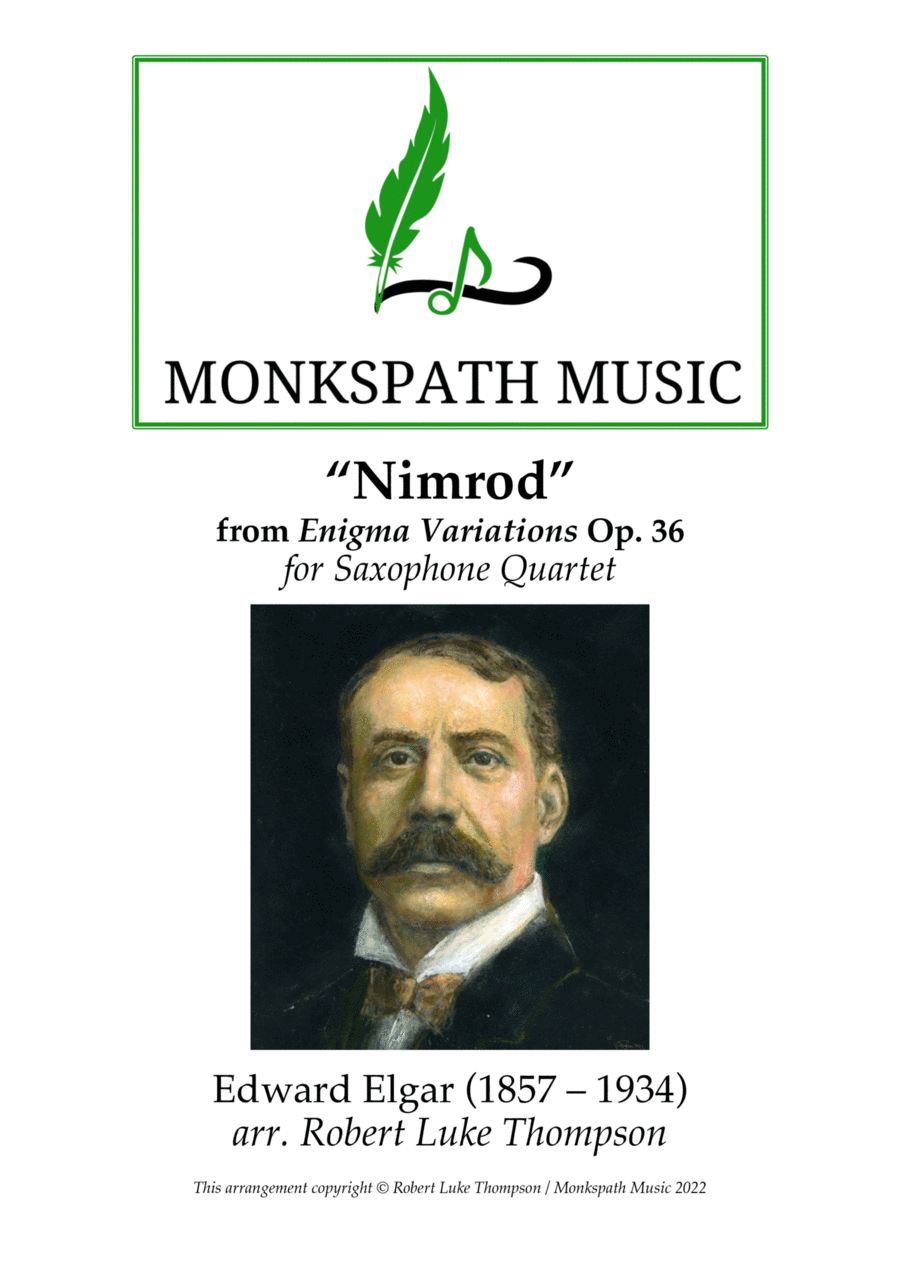
Nimrod from Enigma Variations Op. 36 for Saxophone Quartet
Quatuor de Saxophones: 4 saxophones

$12.99 11.24 € Quatuor de Saxophones: 4 saxophones PDF SheetMusicPlus

String Quartet Cello,String Quartet,Viola,Violin - Level 3 - Digital Download SKU: A0.1117904 Composed by Edward Elgar. Arranged by Robert Luke Thompson. 19th Century,Chamber,Classical,Film/TV,Patriotic. 8 pages. Monkspath Music #719410. Published by Monkspath Music (A0.1117904). Sir Edward Elgar’s compositional output was prolific, with many well-known pieces, including the Pomp & Circumstance marches, Dream of Gerontius, and of course, the Engima Variations. Elgar’s legacy has been widely debated, but there is no doubt of his influence on ‘English’ music and composers such as Ralph Vaughan Williams, but also further afield, on composers as diverse as Richard Strauss, Jean Sibelius, and Igor Stravinsky. Along with a central theme woven and varied throughout the work, each movement of Engima Variations is also a musical illustration, based on a family member or close friend of Elgar, and indeed Elgar himself. He dedicated the work “to my friends pictured withinâ€. “Nimrod†is the name given to the ninth movement, based on Elgar’s editor and publisher, Augustus J, Jaeger. Musically, there is an obvious hint at the 2nd movement of Beethoven’s Piano Sonata Pathetique, but beyond this there are beautiful legato lines spread across the whole ensemble and a wide variety of timbral, dynamic, and tempo colourations. “Nimrod†has become a popular piece as a standalone item – often featuring in funerals, memorial services, and other solemn events such as Remembrance Sunday. Hans Zimmer also adapts the piece for use in the score for the 2017 film Dunkirk, and has become a standard tune to represent stoic ‘Britishness’. For further pieces, view the Monkspath Music catalogue and click here!
Nimrod from Enigma Variations Op. 36 for String Quartet
Quatuor à cordes: 2 violons, alto, violoncelle

$12.99 11.24 € Quatuor à cordes: 2 violons, alto, violoncelle PDF SheetMusicPlus

Piano,Trombone - Level 3 - Digital Download SKU: A0.1043239 Composed by Edward Elgar. Arranged by Diego Marani. Classical,Instructional,Patriotic,Romantic Period,Standards. Score and part. 18 pages. Diego Marani #647927. Published by Diego Marani (A0.1043239). The best known March of the set, it had its premiere in Liverpool on 19 October 1901, with Elgar conducting the Liverpool Orchestral Society. The Trio contains the tune known as Land of Hope and Glory. In 1902 the tune was re-used, in modified form, for the Land of hope and glory section of his Coronation Ode for King Edward VII. The words were further modified to fit the original tune, and the result has since become a fixture at the Last Night of the Proms, and an English sporting anthem. In the United States, the Trio section Land of Hope and Glory of March No. 1 is often known simply as Pomp and Circumstance or as The Graduation March and is played as the processional tune at virtually all high school and some college graduation ceremonies. It was first played at such a ceremony on 28 June 1905, at Yale University, where the Professor of Music Samuel Sanford had invited his friend Elgar to attend commencement and receive an honorary doctorate of music. Elgar accepted, and Sanford made certain he was the star of the proceedings, engaging the New Haven Symphony Orchestra, the College Choir, the Glee Club, the music faculty members, and New York musicians to perform two parts from Elgar's oratorio The Light of Life and, as the graduates and officials marched out, Pomp and Circumstance March No. 1. Elgar repaid the compliment by dedicating his Introduction and Allegro to Sanford later that year. The tune soon became de rigueur at American graduations, used primarily as a processional at the opening of the ceremony. This arrangement for trombone or euphonium (C and Bb) with piano is suitable for classroom, repertoire and recital.
Pomp and Circumstance March No. 1 for Trombone (Euphonium) and Piano
Trombone et Piano

$9.99 8.65 € Trombone et Piano PDF SheetMusicPlus

Cello,Piano - Level 3 - Digital Download SKU: A0.1037970 Composed by Edward Elgar. Arranged by Diego Marani. Classical,Instructional,Patriotic,Romantic Period,Standards. Score and part. 15 pages. Diego Marani #642890. Published by Diego Marani (A0.1037970). The best known March of the set, it had its premiere in Liverpool on 19 October 1901, with Elgar conducting the Liverpool Orchestral Society. The Trio contains the tune known as Land of Hope and Glory. In 1902 the tune was re-used, in modified form, for the Land of hope and glory section of his Coronation Ode for King Edward VII. The words were further modified to fit the original tune, and the result has since become a fixture at the Last Night of the Proms, and an English sporting anthem. In the United States, the Trio section Land of Hope and Glory of March No. 1 is often known simply as Pomp and Circumstance or as The Graduation March and is played as the processional tune at virtually all high school and some college graduation ceremonies. It was first played at such a ceremony on 28 June 1905, at Yale University, where the Professor of Music Samuel Sanford had invited his friend Elgar to attend commencement and receive an honorary doctorate of music. Elgar accepted, and Sanford made certain he was the star of the proceedings, engaging the New Haven Symphony Orchestra, the College Choir, the Glee Club, the music faculty members, and New York musicians to perform two parts from Elgar's oratorio The Light of Life and, as the graduates and officials marched out, Pomp and Circumstance March No. 1. Elgar repaid the compliment by dedicating his Introduction and Allegro to Sanford later that year. The tune soon became de rigueur at American graduations, used primarily as a processional at the opening of the ceremony. This arrangement for cello with piano is suitable for classroom, repertoire and recital.
Pomp and Circumstance March No. 1 for Cello and Piano
Violoncelle, Piano

$9.99 8.65 € Violoncelle, Piano PDF SheetMusicPlus

Bassoon,Piano - Level 3 - Digital Download SKU: A0.1039918 Composed by Edward Elgar. Arranged by Diego Marani. Classical,Instructional,Patriotic,Romantic Period,Standards. Score and part. 15 pages. Diego Marani #644792. Published by Diego Marani (A0.1039918). The best known March of the set, it had its premiere in Liverpool on 19 October 1901, with Elgar conducting the Liverpool Orchestral Society. The Trio contains the tune known as Land of Hope and Glory. In 1902 the tune was re-used, in modified form, for the Land of hope and glory section of his Coronation Ode for King Edward VII. The words were further modified to fit the original tune, and the result has since become a fixture at the Last Night of the Proms, and an English sporting anthem. In the United States, the Trio section Land of Hope and Glory of March No. 1 is often known simply as Pomp and Circumstance or as The Graduation March and is played as the processional tune at virtually all high school and some college graduation ceremonies. It was first played at such a ceremony on 28 June 1905, at Yale University, where the Professor of Music Samuel Sanford had invited his friend Elgar to attend commencement and receive an honorary doctorate of music. Elgar accepted, and Sanford made certain he was the star of the proceedings, engaging the New Haven Symphony Orchestra, the College Choir, the Glee Club, the music faculty members, and New York musicians to perform two parts from Elgar's oratorio The Light of Life and, as the graduates and officials marched out, Pomp and Circumstance March No. 1. Elgar repaid the compliment by dedicating his Introduction and Allegro to Sanford later that year. The tune soon became de rigueur at American graduations, used primarily as a processional at the opening of the ceremony. This arrangement for bassoon with piano is suitable for classroom, repertoire and recital.
Pomp and Circumstance March No. 1 for Bassoon and Piano
Basson, Piano (duo)

$9.99 8.65 € Basson, Piano (duo) PDF SheetMusicPlus

French Horn,Piano - Level 3 - Digital Download SKU: A0.1043236 Composed by Edward Elgar. Arranged by Diego Marani. Classical,Instructional,Patriotic,Romantic Period,Standards. Score and part. 15 pages. Diego Marani #647924. Published by Diego Marani (A0.1043236). The best known March of the set, it had its premiere in Liverpool on 19 October 1901, with Elgar conducting the Liverpool Orchestral Society. The Trio contains the tune known as Land of Hope and Glory. In 1902 the tune was re-used, in modified form, for the Land of hope and glory section of his Coronation Ode for King Edward VII. The words were further modified to fit the original tune, and the result has since become a fixture at the Last Night of the Proms, and an English sporting anthem. In the United States, the Trio section Land of Hope and Glory of March No. 1 is often known simply as Pomp and Circumstance or as The Graduation March and is played as the processional tune at virtually all high school and some college graduation ceremonies. It was first played at such a ceremony on 28 June 1905, at Yale University, where the Professor of Music Samuel Sanford had invited his friend Elgar to attend commencement and receive an honorary doctorate of music. Elgar accepted, and Sanford made certain he was the star of the proceedings, engaging the New Haven Symphony Orchestra, the College Choir, the Glee Club, the music faculty members, and New York musicians to perform two parts from Elgar's oratorio The Light of Life and, as the graduates and officials marched out, Pomp and Circumstance March No. 1. Elgar repaid the compliment by dedicating his Introduction and Allegro to Sanford later that year. The tune soon became de rigueur at American graduations, used primarily as a processional at the opening of the ceremony. This arrangement for F horn with piano is suitable for classroom, repertoire and recital.
Pomp and Circumstance March No. 1 for Horn and Piano
Cor et Piano

$9.99 8.65 € Cor et Piano PDF SheetMusicPlus


Partitions Gratuites
Acheter des Partitions Musicales
Acheter des Partitions Digitales à Imprimer
Acheter des Instruments de Musique

© 2000 - 2026

Accueil - Version intégrale





