EUROPE
826 articles
USA
1913 articles
DIGITAL
3402 articles (à imprimer)
Partitions Digitales
Partitions à imprimer
3402 partitions trouvées


SAB choir and piano - Medium - Digital Download SKU: MQ.8703-E Composed by Sasha Johnson Manning. Lent, Funeral. Instrument parts. 11 pages. Duration 4 minutes, 35 seconds. E. C. Schirmer Music Company - Digital #8703-E. Published by E. C. Schirmer Music Company - Digital (MQ.8703-E). English. Psalms 130.This tonal setting of Psalm 130 follows the strophic translation created by the Elizabethan poet and composer Thomas Campion. Each verse follows an original melody, which is elaborated upon progressively throughout the different verses. The piano part is constructed independently of the four voice parts and is equal to them in the overall construction of the piece. The piece is rooted thoroughly in the minor and supports the pleading nature of the words throughout. It is ideally suited to the season of Lent but would also complement any penitential service or memorial. It was created for the English-born conductor Philip Barnes, and his singers at the Third Baptist Church, which is in Grand Center, St. Louis, Missouri. Duration: 4:35.
Out of My Soul's Depths (De profundis) (Downloadable)
Chorale 3 parties

$2.65 2.24 € Chorale 3 parties PDF SheetMusicPlus

Brass Ensemble - Level 4 - Digital Download SKU: A0.927944 Composed by Orlando Gibbons. Arranged by Tim Brooke. Classical,Concert,Renaissance,Standards. Score and parts. 6 pages. Castleroyan Press #4980703. Published by Castleroyan Press (A0.927944). Orlando Gibbons (1583-1625) was an English composer, organist and virginalist of the Elizabethan and late Jacobean periods.  Despite his early death he nevertheless produced a number of the most celebrated vocal, choral, instrumental and keyboard works of that rich period in English music. This Pavan (later included in The Fitzwilliam Virginal Book) is the first part of the famous Pavan and Galliard (The Lord Salisbury), which has become one of his best-known compositions to have entered the present-day repertory. It has been performed and recorded many times, most notably perhaps by Glenn Gould in 1970.
Pavan (The Lord Salisbury) - brass quintet (score)
Quintette de Cuivres: 2 trompettes, Cor, trombone, tuba

$4.99 4.21 € Quintette de Cuivres: 2 trompettes, Cor, trombone, tuba PDF SheetMusicPlus

Brass Ensemble Horn,Trombone,Trumpet,Tuba - Level 3 - Digital Download SKU: A0.782098 Composed by Clement Woodcock. Arranged by Mike Allsen. Renaissance,Traditional. Score and parts. 18 pages. Aaron Hettinga #6708327. Published by Aaron Hettinga (A0.782098). The English organist, singer, and composer Clement Woodcock spent most of his career at Canterbury Cathedral, and, after 1570, at Chichester Cathedral. His only surviving works are five pieces for viol consort, including the fine Browning My Dear. Browning was one of several melodies that Elizabethan composers used as the basis for instrumental works. The form of his Browning My Dear is simple but effective: the eight-measure Browning tune is always present, migrating from line to line, as the other parts weave increasingly elaborate counterpoint around it. In performing this, the ensemble should take care that the Browning melody (marked mf), is always clearly audible. This arrangement was written in 1990 for the Glenwood Moravian Trombone Choir (Madison, WI), and revised in 2022.
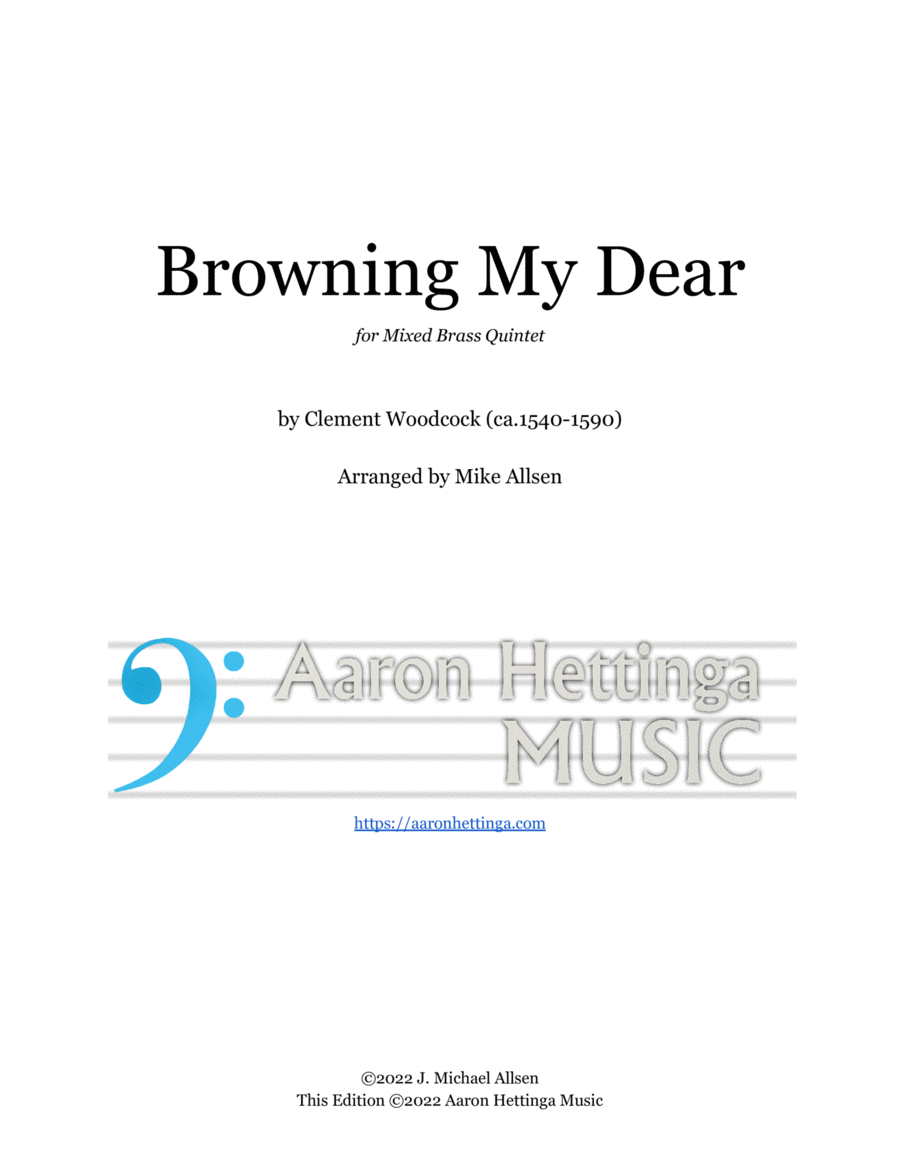
Browning My Dear - for Brass Quintet
Quatuor de Cuivres : 2 trompettes, trombone, tuba

$19.99 16.86 € Quatuor de Cuivres : 2 trompettes, trombone, tuba PDF SheetMusicPlus

Bass Trombone,Cornet,Horn - Level 3 - Digital Download SKU: A0.1327383 Composed by Traditional. Arranged by James M. Guthrie. Chamber,Christian,Christmas,Historic,Traditional. 6 pages. Jmsgu3 #915417. Published by jmsgu3 (A0.1327383). Greensleeves is a traditional English folk song that has several interesting facts associated with it:Origin: The song's origin is uncertain, and there is no consensus on who composed it. It has been attributed to Henry VIII, the King of England, but this association is considered erroneous, and the song is more likely to be Elizabethan in origin.Christmas Carol: The tune of Greensleeves is used for the classic Christmas carol What Child Is This?Lyrics: The song's lyrics are about a painful romantic problem and include what some historians view as subtly salacious content. The lyrics deal with a spurned lover accusing Lady Greensleeves of casting him off discourteously despite his love for her. The song's scandalous twist is hidden in its title, and its exact meaning has been debated for centuries.Cultural References: The tune was used as the slow march of the London Trained Bands in the 16th and 17th centuries. It was adopted as the quick march of the 7th (City of London) Battalion London Regiment during World War I. Additionally, the tune has been referenced in literature, such as in Shakespeare's The Merry Wives of Windsor.Popularity: In some parts of the world, the Greensleeves tune is famous as a standard chime for ice cream vans.These facts make Greensleeves a fascinating and culturally significant piece of music with a rich history and diverse interpretations.
What Child is This? for Brass Trio

$24.95 21.05 € PDF SheetMusicPlus

Violin Solo - Level 1 - Digital Download SKU: A0.1446386 Composed by English Folk Song. Arranged by Sandy McIntire. Celtic,Contest,Festival,Folk,Instructional,Irish,Multicultural,World. 3 pages. Sandy McIntire #1026194. Published by Sandy McIntire (A0.1446386). The Girl I Left Behind Me is an English folk song from the Elizabethan era derived from a traditional Irish melody and said to have been played when soldiers left for war or as sailors set sail. Today, it is a popular tune often played in the U.S. at old-time jams, dances and festivals.  A basic version is arranged here as an Easy/Beginner Violin Solo, also appropropriate for mandolin.  It an excellent choice for students to play for fun or for performance in recitals.
The Girl I Left Behind Me
Violon

$3.99 3.37 € Violon PDF SheetMusicPlus

Choral Choir (SATB) - Level 3 - Digital Download SKU: A0.575998 Composed by Traditional. Arranged by David Warin Solomons. 20th Century,Contemporary,Renaissance. Octavo. 8 pages. David Warin Solomons #2029291. Published by David Warin Solomons (A0.575998). The traditional anonymous Elizabethan song welcoming Lord Willoughby back home from the wars was turned into a lute duet by John Dowland. I have merged the two ideas and created a double choir version singing some of the verses of the original song, divided in a way similar to John Dowlands duet. Versions are also available for ATBarB-ATBarB (men's voices) and for woodwind and brass. The sound sample is my own performance of the ATBarB-ATBarB version. I have also added timpani in the recording, but these are not scored and are optional.
My Lord Willoughby's Welcome home (SATB-SATB version)
Chorale SATB

$2.99 2.52 € Chorale SATB PDF SheetMusicPlus

Woodwind Ensemble,Woodwind Trio Bass Clarinet,Flute,Oboe - Level 3 - Digital Download SKU: A0.1329070 Composed by Traditional. Arranged by James M. Guthrie. Chamber,Christian,Christmas,Historic,Traditional. 6 pages. Jmsgu3 #917038. Published by jmsgu3 (A0.1329070). Greensleeves is a traditional English folk song that has several interesting facts associated with it:Origin: The song's origin is uncertain, and there is no consensus on who composed it. It has been attributed to Henry VIII, the King of England, but this association is considered erroneous, and the song is more likely to be Elizabethan in origin.Christmas Carol: The tune of Greensleeves is used for the classic Christmas carol What Child Is This?Lyrics: The song's lyrics are about a painful romantic problem and include what some historians view as subtly salacious content. The lyrics deal with a spurned lover accusing Lady Greensleeves of casting him off discourteously despite his love for her. The song's scandalous twist is hidden in its title, and its exact meaning has been debated for centuries.Cultural References: The tune was used as the slow march of the London Trained Bands in the 16th and 17th centuries. It was adopted as the quick march of the 7th (City of London) Battalion London Regiment during World War I. Additionally, the tune has been referenced in literature, such as in Shakespeare's The Merry Wives of Windsor.Popularity: In some parts of the world, the Greensleeves tune is famous as a standard chime for ice cream vans.These facts make Greensleeves a fascinating and culturally significant piece of music with a rich history and diverse interpretations.
What Child is This? for Woodwind Trio

$24.95 21.05 € PDF SheetMusicPlus


Partitions Gratuites
Acheter des Partitions Musicales
Acheter des Partitions Digitales à Imprimer
Acheter des Instruments de Musique

© 2000 - 2026

Accueil - Version intégrale





