EUROPE
7979 articles
USA
54679 articles
DIGITAL
36619 articles (à imprimer)
Partitions Digitales
Partitions à imprimer
36619 partitions trouvées


English Horn,Piano - Level 4 - Digital Download SKU: A0.534590 Composed by Clémence de Grandval. Concert,Romantic Period,Standards. Score and part. 45 pages. Musik Fabrik Music Publishing #4736819. Published by Musik Fabrik Music Publishing (A0.534590). Clémence de Grandval was an important French female composer of the 19th century, especially prasied by Saint-Saens, with whom she studied. Only two of the four pieces were published during Grandval's lifetime and the other two aresourced  from a copyist's copy given by Gillet to an oboeist who emigranted to the United States. The four movements are Lamento, Valse, Andante Espressivo (Air d'Atala) and Finale.
Clémenace de Grandval: Quatre Pièces (Four Pieces) for English Horn and PIano
Cor anglais, Piano

$19.95 16.76 € Cor anglais, Piano PDF SheetMusicPlus

English Horn,Piano - Level 4 - Digital Download SKU: A0.551501 Composed by Edvard Grieg. Arranged by James Guthrie, ASCAP. Concert,Halloween,Instructional,Romantic Period,Standards. Score and part. 62 pages. Jmsgu3 #5306323. Published by jmsgu3 (A0.551501). 1. Morning Mood, 2. Ase's Death, 3. Anitra's Dance, 4. In the Hall of the Mountain KingGrieg BackgroundIn the first place, Edvard Grieg (1843 –1907) was a Norwegian composer as well as a concert pianist. As a matter of fact, most music historians consider him one of the foremost Romantic era composers. Consequently, his music is part of the international standard classical repertoire. Grieg moreover used Norwegian folk music in his own compositions.  Consequently, he ushered Norwegian music to transnational consciousness. Furthermore, he forged a national musical identity for Norway. It is important to realize that he did this in a manner similar to Jean Sibelius in Finland, and BedÅ™ich Smetana in Bohemia.LegacyGrieg is celebrated in the city of Bergen. For example, the city has erected numerous statues depicting Grieg. Specifically, the city has named a concert hall (Grieg Hall), a music school (Grieg Academy) and a professional choir (Edvard Grieg Kor) after him. As a matter of fact, there is also a museum located at his former home in Troldhaugen.Peer Gynt Suite No. 1 (Op. 46)Grieg wrote incidental music for the purpose of illustrating a play by Ibsen known as Peer Gynt. The play includes, in particular, the famous selection entitled, In the Hall of the Mountain King. In this composition, Grieg indeed depicts the exploits of the scoundrel, Peer Gynt. In one famous episode, for example, Peer steals a bride at her wedding. For this reason, the people chase him, but soon Peer falls, thereupon striking his skull on a boulder. He wakens forthwith in a highland bounded by angry gnomes. Consequently, the music of In the Hall of the Mountain King represents the mad gnomes taunting Peer. Therefore, each time the theme repeats it gets louder and faster. In the end, Peer surprisingly escapes from the mountain.Holberg Suite and Misc. SummaryIt must be remembered that Grieg originally wrote his Holberg Suite for the piano. In other words, he only later arranged it for strings. Further, Grieg composed by and large many songs with lyrics by famous writers such as Heine, Goethe, Ibsen, Hans Christian Andersen, Rudyard Kipling, and others. On balance, Norwegian pianist Eva Knardahl recorded altogether Grieg’s whole piano catalog on LP in 1980. These recordings were released again on CD in 2006. In any event, Grieg himself performed and recorded the bulk of these pieces toward the end of his life.
Grieg: Peer Gynt Suite Complete for English Horn & Piano
Cor anglais, Piano

$59.95 50.38 € Cor anglais, Piano PDF SheetMusicPlus

Small Ensemble Alto Flute,English Horn,Piano - Level 3 - Digital Download SKU: A0.844603 Composed by Phil Beaman. 20th Century,Sacred. Score and parts. 11 pages. Phil Beaman #4274743. Published by Phil Beaman (A0.844603). This original Instrumental Trio is in the Early 20th Century style, reminiscent of the French composers known as Les Six (Poulenc, Milhaud, Honneger, Durey, Tailleferre, and Auric.) The instrument parts often stagger their entries and overlap in canonic and fugal ways reflecting each other. There are gentle dissonances between the instrument parts and the piano.   Marked expressive and fervent this piece is full of emotions both beautiful and powerful. A unique addition to your concert repertoire. 7 pages score, 2 pages parts
Reflexion-Alto Flute-English Horn-Piano
Cor anglais, Piano

$7.99 6.71 € Cor anglais, Piano PDF SheetMusicPlus

Instrumental Duet English Horn,Instrumental Duet - Level 2 - Digital Download SKU: A0.844707 Composed by H Wieniawski. Arranged by Phil Beaman. Concert,Romantic Period,Standards. Score and parts. 7 pages. Phil Beaman #5312005. Published by Phil Beaman (A0.844707). Wieniawski's Legende is a repertoire standard that was originally written for Violin solo and Orchestra. I have greatly abridged and simplified the piece into a 2 part instrumental duet without losing any of the character of the Romantic piece. I have arranged themes from each of the three sections, keeping the original structure, but taking liberties such as changing phrasing, dynamics, adding my own markings, and even changing the Time Signature in certain passages. I begin with each instrument taking solo turns on the melody and end with a similar cadenza style set of solos for each instrument. The two parts are of equal importance and much of the character is in the interplay between the two instruments. This is a beautiful concert arrangement of a beloved classic.  
Legende-Wieniawski-English Horn duet
2 Cors Anglais Et Pianoforte

$5.99 5.03 € 2 Cors Anglais Et Pianoforte PDF SheetMusicPlus

English Horn,Piano - Level 2 - Digital Download SKU: A0.549228 Composed by Johann Sebastian Bach. Arranged by James M. Guthrie, ASCAP. Baroque,Easter,Standards,Wedding. Score and part. 9 pages. Jmsgu3 #3468366. Published by jmsgu3 (A0.549228). J. S. Bach BWV 508. Bist du bei mir Bach adapted this aria from a lost Stölzel opera called Diomedes. He changed the original orchestral instrumentation to soprano, strings, and continuo.  He also modified the voice-leading making it sound more like a Bach composition. The work appears as BWV 508 No. 25 in the Anna Magdalena Notebook No. 2.   Source Only a few remnants of the original opera have survived. Historians speculate that Anna Magdalena got the song from the Leipzig Opera after the bankruptcy of 1720. Chances are good, though, that the tune was a favorite of everyone in Leipzig at the time.   Lyrics When thou art near, I go with joyTo death and to my rest.O how joyous would my end be,If your fair hands            Would close my faithful eyes. - Unknown Bach Overview First of all, Johann Sebastian Bach is maybe the greatest composer in music history. Certainly, he was prolific. As a result, everyone has heard of his works. Furthermore, these works number well over a thousand. It seems like people are probably most familiar with instrumental works such as the Brandenburg Concertos, and the Goldberg Variations. But, similarly famous are such noteworthy works as the Well-Tempered Clavier, the Musical Offering, and indeed the Art of Fugue. Seems like his most famous vocal works include the most noteworthy Mass in B Minor. Also, most noteworthy are the St. John Passion, and certainly the Christmas Oratorio.  History Bach came from a long line of musicians and above all, composers. Consequently, he, first of all, pursued a career as a church organist. So as a result, he gained employment in various Protestant churches in Germany. For a while, he worked as a court musician in Weimar and Köthen. Here he probably developed his organ style and likewise his chamber music style. Eventually, he therefore, gained an appointment as Cantor of St. Thomas in Leipzig. Here he worked until difficulties with his employer ultimately drove him away. The King of Poland finally appointed him as court composer.  Style It seems like Bach created a fascinating new international style. He synthesized elements of the most noteworthy European music ideas into his new style. Even more, this new style was probably his synthesis of European musical rhythm and form. Furthermore, he demonstrated a complete mastery of counterpoint and motivic development. His sense of harmonic organization probably propelled him to the top. Revival                Mendelssohn conducted a Bach revival in the nineteenth century. His effort probably helped to re-familiarize the public with the magnitude of Bach’s works. During this period, scholars published many noteworthy Bach biographies. Moreover, Wolfgang Schmieder published the BWV (Bach Werke Verzeichnis). As a result, this is now the official catalog of his entire artistic output. The BWV number allows us to locate a work in the catalog. Sometimes scholars will simply use an S (Schmieder) as an abbreviation for BWV.  Voyager NASA launched two Voyager spacecraft in 1977. Onboard are phonograph records with sounds, music, and images of life on Earth. The purpose of the launch was to inform intelligent extraterrestrial life forms about conditions on Earth. The music on the disc is varied. There is Bach, Mozart, Beethoven, and Stravinsky among others. However, because Bach is so important in our music history, it contains three times more Bach than all the others combined.
Bach: Bist du bei mir BWV 508 for English Horn & Piano
Cor anglais, Piano

$32.95 27.69 € Cor anglais, Piano PDF SheetMusicPlus

English Horn,Piano - Level 1 - Digital Download SKU: A0.1160382 Composed by Ludwig van Beethoven. Arranged by Ander. Classical,Instructional,March,Opera,Romantic Period. Score and part. 6 pages. Woods Only, Arrangements #760665. Published by Woods Only, Arrangements (A0.1160382). This arrangement adapted for cor anglais and piano was written keeping the characteristics of the original work, that is, inspiring and significant to the already known choral symphony by Beethoven, indicated to be performed by young music students, who want to enter the symphonic music, moreover, it can also be used by professional musicians, for recitals, repertoire, academic presentations and didactic material. As much as it is a funeral march, it is well suited for any musical performance occasion. The transcription is faithful to the structure, with only one change in key, so that it is comfortable for all instruments in the formation, thus maintaining the essence of the striking melody, as well as using it for ensemble practice among musicians of different traditions.Beethoven's Ninth Symphony Op. 125 incorporates part of the poem An die Freude (To Joy), a hymn written by Friedrich Schiller, with the text sung by soloists and a choir in its last movement. It was the first example of a major composer using the human voice as prominently as the instruments in a symphony, thus creating a far-reaching work that set the tone for the symphonic form that was to be adopted by Romantic composers. This is the last complete symphony composed by Ludwig van Beethoven. The choral symphony, better known as the Ninth Symphony or The Ninth, is one of the best known works in the Western repertoire, considered both an icon and predecessor of Romantic music, and one of Beethoven's great masterpieces, where it was first performed on May 7, 1824, the same year it was completed, at the Kärntnertortheater in Vienna, Austria. The conductor was Michael Umlauf, the theater's music director, and Beethoven - dissuaded from conducting by the advanced stage of his deafness - was given a special place on the stage next to the conductor. It was later rearranged by Herbert von Karajan to become the anthem of the European Union in 1972, the national anthem of Rhodesia from 1974 until 1979, Rise, O Voices of Rhodesia, used the tune Ode to Joy..
Ode to Joy by Beethoven for English Horn
Cor anglais, Piano

$1.99 1.67 € Cor anglais, Piano PDF SheetMusicPlus

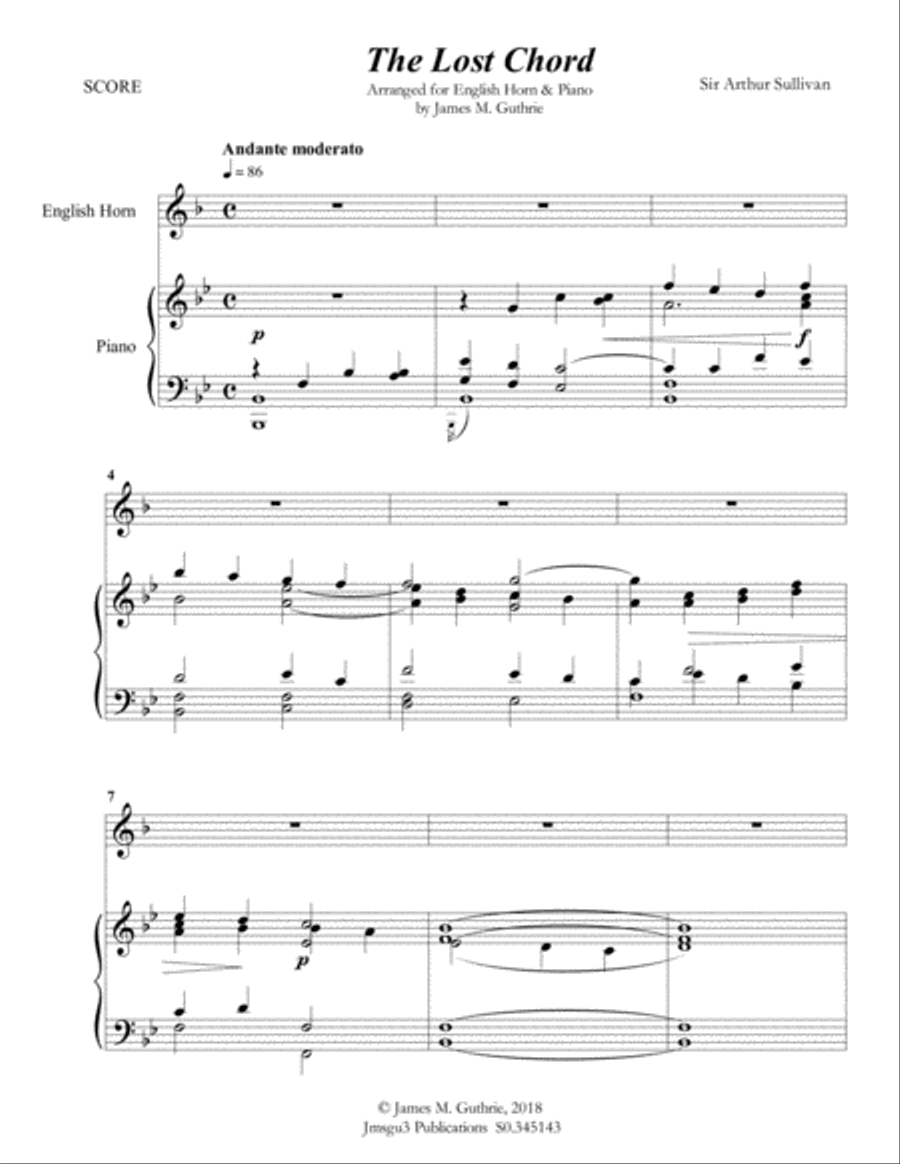
English Horn,Piano - Level 4 - Digital Download SKU: A0.549455 Composed by Sir Arthur Seymour Sullivan. Arranged by James M. Guthrie, ASCAP. Instructional,Romantic Period,Sacred,Standards. Score and part. 15 pages. Jmsgu3 #3497229. Published by jmsgu3 (A0.549455). Score: 10 pages, solo part: 2 pages, piano part: 3 pages. Duration: 4:25. Not difficult, but requires sensitivity & dynamic control. Suitable for recitals, church meditations, or school programs. School Years First of all, Sullivan attended music school at the Royal Academy of Music. Because Sullivan was so talented, the Academy awarded him the Mendelssohn Scholarship for two years in a row. He, therefore, studied with John Goss, who studied with Thomas Atwood, who in turn studied with Mozart. Sullivan similarly studied the piano at the Academy with Arthur O’Leary. Study Abroad During his first year, he also earned money by singing solos in the Chapel Royal. At the end of his second year, the Academy consequently continued his scholarship and sent him to study at the Leipzig Conservatoire. He certainly studied composition, and likewise counterpoint and piano. Hence, during his final year in Leipzig, Sullivan finally completed his graduation composition project: Incidental Music for Shakespeare’s The Tempest. Association with Gilbert It seems like Sullivan built the bulk of his composing career largely in the 1860s. As a result, he became famous for his incidental music for the Tempest and his Irish Symphony. He, therefore, began collaborating with the poet W. S. Gilbert in the 1870s. Rather than focus on serious opera, Gilbert and Sullivan, in contrast, concentrated on comic opera such as H. M. S. Pinafore, the Pirates of Penzance, and the Mikado. Therefore, certainly as a result of his education and experience, Sullivan composed a total of 24 operas, 11 symphonic works, 10 choral pieces. Even more, he wrote a large number of noteworthy hymns such as Onward Christian Soldiers. Lost Chord The general style of his music is maybe similar to Mendelssohn, Schumann, and perhaps Liszt. It seems like Sullivan was fond of writing distinct melodies for each character in his operettas. His melodies combine together as the characters did. Furthermore, he was a master orchestrator, and therefore played the flute, clarinet, trumpet, and trombone fluently. The Lost Chord Sullivan wrote his most noteworthy song the Lost Chord in 1877. As a result, it was a great success and was certainly performed all over the world by a variety of singers such as Enrico Caruso. Because Sullivan was the most famous composer in England, the Lost Chord became the most famous of all British or American songs of the 1870s and 1890s. Consequently, in 1888 Thomas Edison recorded The Lost Chord for the phonograph. It was one of the first songs ever recorded. Furthermore, Queen Victoria knighted Sullivan in 1883.  
Sullivan: The Lost Chord for English Horn & Piano
Cor anglais, Piano

$26.95 22.65 € Cor anglais, Piano PDF SheetMusicPlus

English Horn,Piano - Level 2 - Digital Download SKU: A0.1155639 Composed by Ludwig van Beethoven. Arranged by Ander. Classical,Folk,March,Opera,Romantic Period. Score and part. 4 pages. Woods Only, Arrangements #755943. Published by Woods Only, Arrangements (A0.1155639). This arrangement adapted for cor anglais and piano was written keeping the characteristics of the original work, in order to be performed by young music students who want to enter the symphonic music. Besides, it can also be used by professional musicians for recitals, repertoire, academic presentations and didactic material. The transcription remains faithful to the structure, with only one change in tone, so that it is comfortable for all the instruments in the formation, as well as being used as an activity in ensemble practice among musicians of different traditions. Beethoven's Turkish March (Op. 113) is the 4th movement of the operatic work: The Ruins of Athens, a set of incidental pieces written in 1812 by Ludwig van Beethoven, where the melody was originally written in 1809 as Theme with Six Variations for Piano, Op. 76. The work was written to accompany the play of the same name by August von Kotzebue, for the dedication of a new theater in Pest. Perhaps the best known part of the composition is the Marcia alla turca, In Latin America, this movement became known in Jean-Jacques Perrey's version (who titled it The Elephant never Forgets) since it was used as the opening theme of the successful Mexican TV comedy El Chavo del Ocho. The opening and the turkish march are often performed separately, and the other pieces in this set are not often heard.
Turkish March by Beethoven for English Horn
Cor anglais, Piano

$1.99 1.67 € Cor anglais, Piano PDF SheetMusicPlus


Partitions Gratuites
Acheter des Partitions Musicales
Acheter des Partitions Digitales à Imprimer
Acheter des Instruments de Musique

© 2000 - 2026

Accueil - Version intégrale