EUROPE
7979 articles
USA
54679 articles
DIGITAL
36620 articles (à imprimer)
Partitions Digitales
Partitions à imprimer
36620 partitions trouvées


English Horn Solo - Level 3 - Digital Download SKU: A0.784328 Composed by Joshua Hauser. Instructional. Individual part. 38 pages. Slide Ride #5288645. Published by Slide Ride (A0.784328). 1 Octave Scale Studies in 15+ keys for 4-part ensembles of like or mixed instruments If this is your first exposure to these scale studies, you are in for a treat! Donuts, if you make a mistake!The initial incarnation of these studies were written for trombone quartet and we would play them in the Tennessee Tech Trombone Choir with the challenge that whomever made the first mistake had to buy donuts for the rest of the ensemble. Since then I have brought that version to several clinics and warm up sessions. One time before I got to explain the title, a fellow trombone professor said, Oh, I get it! Don’t step in the holes!I only wish I had thought of that myself... Since we have one of the best donut shops in TN here in Cookeville, treating the studio to sugar coated goodies was always my intent.As with those initial exercises, you can vary these as much as you’d like.·     Choose a tempo.·     Choose a dynamic.·     Choose an articulation/style.One way I like to play these is to have one person be the model, playing the entire scale over and over while everyone else plays the fragmented versions. That helps everyone to keep on track and stay in time. Double or triple up the parts for ensemble cohesion with a larger group.Practice one key, gradually speeding it up to improve fluidity, or choose a variation and take it through all keys, playing version A, B, C, or D then skipping to play the same set in a new key.If you want an additional challenge, play them in different octaves or change the key. Play the F Major set in f minor (all forms), different modes, etc. Players really have to be on their toes to remember if they are playing melodic minor in the ascending or descending form! For jazz players, try swinging them in dorian or mixolydian modes.The variations are endless!If you are using these with transposing instruments, 1) is F Major in Concert Pitch, 2) is Bb Major in Concert pitch, and so on. When you reach a scale that is enharmonic for another key (Db/C#, Gb/F#, or Cb/B), they are presented in both keys for each instrument so Trumpets can play in Eb while the Flutes are playing in C# with similar examples for all keys.All Donut Etudes with the same volume number are compatible so you can play them in mixed quartets or large ensembles with one or more instruments/people on part 1 and a different instrument on part 2, etc. Since the quartets are all identical, conductors/coaches can use any of the scores to tell which part should be playing at what time. Once you have played a scale with one set of parts, everyone can rotate to a different part and play the same scales again!Enjoy!
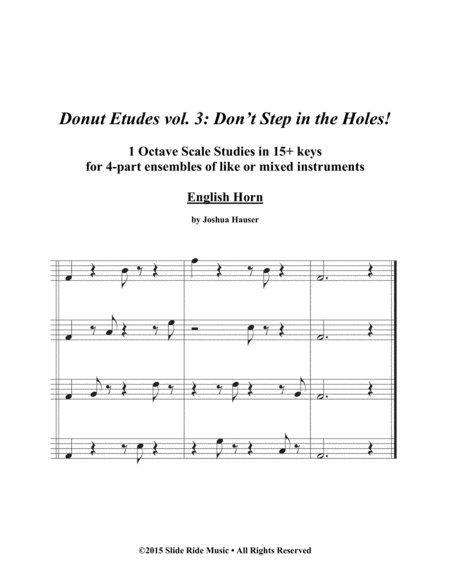
Donut Etudes vol. 3: Don’t Step in the Holes! – English Horn Quartet
Cor Anglais

$5.00 4.21 € Cor Anglais PDF SheetMusicPlus

English Horn,Piano - Level 4 - Digital Download SKU: A0.1236982 Composed by Charles Colin. Arranged by Paul Wehage. 19th Century,Classical,Contest,Festival,Romantic Period. Score and part. 19 pages. Musik Fabrik Music Publishing #832519. Published by Musik Fabrik Music Publishing (A0.1236982). Charles Colin was born in Cherbourg, France on June 2, 1862.  He entered the Paris Conservatory  and won a First Prize in Oboe in 1852 and then studied composition, winning the Second First Grand Prix de Rome in 1857 (Bizet won the First Grand Prix the same year).  In 1868, he became the Professor of Oboe at the Paris Conservatory.  His series of eight Solos were written for the exams of his class.  He died on July 26, 1881 in Paris.
Solo de Concours, Opus 52 arranged for english horn and piano
Cor anglais, Piano

$11.35 9.56 € Cor anglais, Piano PDF SheetMusicPlus

English Horn,Piano - Digital Download SKU: A0.549711 Composed by Peter Ilyich Tchaikovsky. Arranged by James M. Guthrie, ASCAP. Children,Christmas,Romantic Period,Standards. Score and part. 15 pages. Jmsgu3 #3530299. Published by jmsgu3 (A0.549711). Duration: ca. 58, score: 9 pages, solo part: 2 pages, piano part: 3 pages.This piece would be a perfect recital encore - short, energetic - leave your audience wanting more. Also, program this for your Christmas pageant. Pyotr Ilyich Tchaikovsky Tchaikovsky is probably the most popular of the great composers in America. His music certainly appeals to musicians. Likewise, it appeals even to folks who don’t normally listen to serious music. This is probably because of his most noteworthy melodies. Above all, he writes with great emotion. This certainly makes a most noteworthy if not an unforgettable impact. Education First of all, He attended classes at the Russian Musical Society. Even more, He also attended the St. Petersburg Conservatory. There he studied music theory with Nikolai Zaremba. He also consequently studied composition with Anton Rubenstein. It seems like Rubenstein came under criticism from a group of Russian composers known as the Five. The Five The Five certainly rejected Western musical influences. They rather sought to use elements from Russian music. They furthermore wanted to use more exotic musical materials. Western Techniques More than other Russian composers, Tchaikovsky studied modern Western music. He certainly develops his music like the European masters. So, rather than repeating a motive, he moves to a new key. He then introduces a different theme in the new key. Hence, he maintained his independence from the Five. Even more, he became the first Russian composer of international stature. Influences Tchaikovsky was probably influenced in his ballet scoring by Léo Delibes. Richard Wagner influenced his symphonic writing. Tchaikovsky’s most famous works include the 1812 Overture, The Nutcracker Suite, and Swan Lake. Also famous are the Violin Concerto in D and the six symphonies. The greatest of the six symphonies may be No. 6, the Pathétique. Nutcracker Suite, Op. 71a The Nutcracker Suite is a ballet that was performed for the first time in December 1892 in St. Petersburg. To begin with, the original ballet failed to attract a positive reception. However, the ballet suite became probably one of the most popular of all of Tchaikovsky’s works. The ballet suite became even more famous in the 1960s. It is now performed all over the world, particularly during the Christmas season.
Tchaikovsky: Russian Dance from Nutcracker Suite for English Horn & Piano
Cor anglais, Piano

$32.95 27.75 € Cor anglais, Piano PDF SheetMusicPlus


Partitions Gratuites
Acheter des Partitions Musicales
Acheter des Partitions Digitales à Imprimer
Acheter des Instruments de Musique

© 2000 - 2026

Accueil - Version intégrale





