EUROPE
3296 articles
USA
0 articles
DIGITAL
18774 articles (à imprimer)
Partitions Digitales
Partitions à imprimer
18774 partitions trouvées


Euphonium,Piano - Level 5 - Digital Download SKU: A0.792403 Composed by Richard Wagner. Arranged by Sauer, Ralph. 20th Century,Classical,Opera,Romantic Period. Score and part. 12 pages. Gordon Cherry #4820393. Published by Gordon Cherry (A0.792403). Album Leaves are minor compositions, often for Piano that composers originally used to dedicate to friends or admirers to be inserted into music albums or autograph books, not necessarily intended for publication. They tend to be short and not too demanding technically. Ralph Sauer has arranged Wagner's two Leaves for Euphonum and Piano in bass clef. Number 1 is a piano work from 1875 dedicated to Frau Betty Schott the wife of music publisher Franz Schott. Number 2, also a piano work, is an early opus from 1840 and is dedicated to the Paris based German painter Ernst Benedikt Kietz, a big fan of Wagner, who helped support the young composer during his lean years in Paris. Both leaves are lyrical, giving the performer a true taste of the master.
Two Album Leaves for Euphonium & Piano
Euphonium, Piano (duo)

$20.00 17.42 € Euphonium, Piano (duo) PDF SheetMusicPlus

Euphonium,Piano - Level 5 - Digital Download SKU: A0.1385698 Composed by James M. Guthrie. 21st Century,Chamber,Contemporary,Contest,Festival,Wedding. Score and part. 13 pages. Jmsgu3 #969635. Published by jmsgu3 (A0.1385698). A concert solo or encore with piano accompaniment. A good encore is essential for a concert as it can be the show's highlight and leave a lasting impression on the audience. While encores were traditionally spontaneous, they have become a customary part of a concert's script, with performers often planning them. Encores allow artists to play fan favorites, respond to audience enthusiasm, and create a memorable conclusion to the show. They can also provide a break for the performers. However, some artists and concertgoers have disapproved of encores becoming a routine part of the show, as they can feel disingenuous when expected rather than spontaneous. Despite this, encores remain an expected and significant element of many live performances.
Guthrie: Toccata Agitato for Euphonium & Piano
Euphonium, Piano (duo)

$32.95 28.71 € Euphonium, Piano (duo) PDF SheetMusicPlus

Euphonium,Piano - Level 2 - Digital Download SKU: A0.1461948 Composed by Franz Schubert. Arranged by Diego Marani. Classical,Film/TV,Instructional,Romantic Period,Wedding. Score and part. 13 pages. Diego Marani #1040697. Published by Diego Marani (A0.1461948). The Impromptus, Op. 90, D. 899, are a set of four impromptus for solo piano composed by Franz Schubert in 1827. They were written in the same year as the Impromptus, Op. 142, though only the first two pieces were published during Schubert's lifetime. Together with the latter set, they have become a cornerstone of the piano repertoire. The third Impromptu (Andante) is an wonderful epitome of slow-moving Schubert melody over a flowing arpeggiated accompaniment. This lyrical and meditative work remains unified in mood and texture throughout. The piece is a classic example of Schubert's penchant for long melodic lines.This easy arrangement for baritone (B.C. and Bb T.C.) with piano accompaniment is suitable for classroom, repertoire, recital, wedding or for an emotional encore.
Impromptu Op. 90, No. 3 for Euphonium and Piano
Euphonium, Piano (duo)

$8.99 7.83 € Euphonium, Piano (duo) PDF SheetMusicPlus

Euphonium,Piano - Level 2 - Digital Download SKU: A0.549697 Composed by Peter Ilyich Tchaikovsky. Arranged by James M. Guthrie, ASCAP. Children,Christmas,Romantic Period,Standards. Score and part. 14 pages. Jmsgu3 #3525273. Published by jmsgu3 (A0.549697). Duration: ca. 1:42, 52 measures, Score: 7 pages, solo part: 2 pages, piano part: 4 pages. A popular Christmas favorite from Tchaikovsky's Nutcracker Suite. Pyotr Ilyich Tchaikovsky Tchaikovsky is probably the most popular of the great composers in America. His music certainly appeals to musicians. Likewise, it appeals even to folks who don’t normally listen to serious music. This is probably because of his most noteworthy melodies. Above all, he writes with great emotion. This certainly makes a most noteworthy if not an unforgettable impact. Education First of all, He attended classes at the Russian Musical Society. Even more, He also attended the St. Petersburg Conservatory. There he studied music theory with Nikolai Zaremba. He also consequently studied composition with Anton Rubenstein. It seems like Rubenstein came under criticism from a group of Russian composers known as the Five. The Five The Five certainly rejected Western musical influences. They rather sought to use elements from Russian music. They furthermore wanted to use more exotic musical materials. Western Techniques More than other Russian composers, Tchaikovsky studied modern Western music. He certainly develops his music like the European masters. So, rather than repeating a motive, he moves to a new key. He then introduces a different theme in the new key. Hence, he maintained his independence from the Five. Even more, he became the first Russian composer of international stature. Influences Tchaikovsky was probably influenced in his ballet scoring by Léo Delibes. Richard Wagner influenced his symphonic writing. Tchaikovsky’s most famous works include the 1812 Overture, The Nutcracker Suite, and Swan Lake. Also famous are the Violin Concerto in D and the six symphonies. The greatest of the six symphonies may be No. 6, the Pathétique. Nutcracker Suite, Op. 71a The Nutcracker Suite is a ballet that was performed for the first time in December 1892 in St. Petersburg. To begin with, the original ballet failed to attract a positive reception. However, the ballet suite became probably one of the most popular of all of Tchaikovsky’s works. The ballet suite became even more famous in the 1960s. It is now performed all over the world, particularly during the Christmas season.
Tchaikovsky: Dance of the Sugar-Plum Fairy from Nutcracker Suite for Euphonium & Piano
Euphonium, Piano (duo)

$32.95 28.71 € Euphonium, Piano (duo) PDF SheetMusicPlus

Euphonium,Piano - Level 2 - Digital Download SKU: A0.550927 Composed by J. S. Bach - Gounod. Arranged by James M. Guthrie, ASCAP. Christmas,Easter,Standards. Score and part. 12 pages. Jmsgu3 #4888357. Published by jmsgu3 (A0.550927). This arrangement features the controversial Schwencke measure (ms. 27) that was originally introduced in 1783 by Christian Friedrich Gottlieb Schwencke. The convenient 1st & 2nd endings provide an option for extended performance. Duration with repeat - 4:50. Score: 7 pages. Solo part: 1 page, piano part: 4 pages. Based on Prelude #1 in C Major from the Well-Tempered Clavier, Book 1. Well suited for church meditations or school programs or recital encores.  Ave Maria Ave Maria is a Catholic prayer that consequently asks for the mother of Jesus (Mary) to intercede. Charles Gounod composed a famous version of the Ave Maria. He was a French Romantic composer who overlaid a new melody on an existing Bach chord progression. The progression is from Bach’s Prelude No. 1 from Well-Tempered Clavier I. This version, as well as Schubert’s version, have become essential items at weddings, masses, and funerals. Bach Overview First of all, Johann Sebastian Bach is maybe the greatest composer in music history. Certainly, he was prolific. As a result, everyone has heard of his works. Furthermore, these works number well over a thousand. It seems like people are probably most familiar with instrumental works such as the Brandenburg Concertos, and the Goldberg Variations. But, similarly famous are such noteworthy works as the Well-Tempered Clavier, the Musical Offering, and the Art of Fugue. Seems like his most famous vocal works include the most noteworthy Mass in B Minor. Also, most noteworthy, though, are the St. John Passion, and certainly the Christmas Oratorio.  History Bach came from a long line of musicians and above all, composers. Consequently, he, first of all, pursued a career as a church organist. So as a result, he gained employment in various Protestant churches in Germany. For a while, he worked as a court musician in Weimar and Köthen. Here he probably developed his organ style and likewise his chamber music style. Eventually, he, therefore, gained an appointment as Cantor of St. Thomas in Leipzig. Here he worked until difficulties with his employer ultimately drove him away. The King of Poland finally appointed him as a court composer.  Style It seems like Bach created an engaging new international style. He synthesized elements of the most noteworthy European music ideas into his new style. Even more, this new style was probably his synthesis of European musical rhythm and form. Furthermore, he demonstrated a complete mastery of counterpoint and motivic development. His sense of harmonic organization probably propelled him to the top. Revival               Mendelssohn conducted a Bach revival in the nineteenth century. His effort probably helped to re-familiarize the public with the magnitude of Bach’s works. During this period, scholars published many noteworthy Bach biographies. Moreover, Wolfgang Schmieder published the BWV (Bach Werke Verzeichnis). As a result, this is now the official catalog of his entire artistic output. The BWV number allows us to locate a work in the catalog. Sometimes scholars will simply use an S (Schmieder) as an abbreviation for BWV.
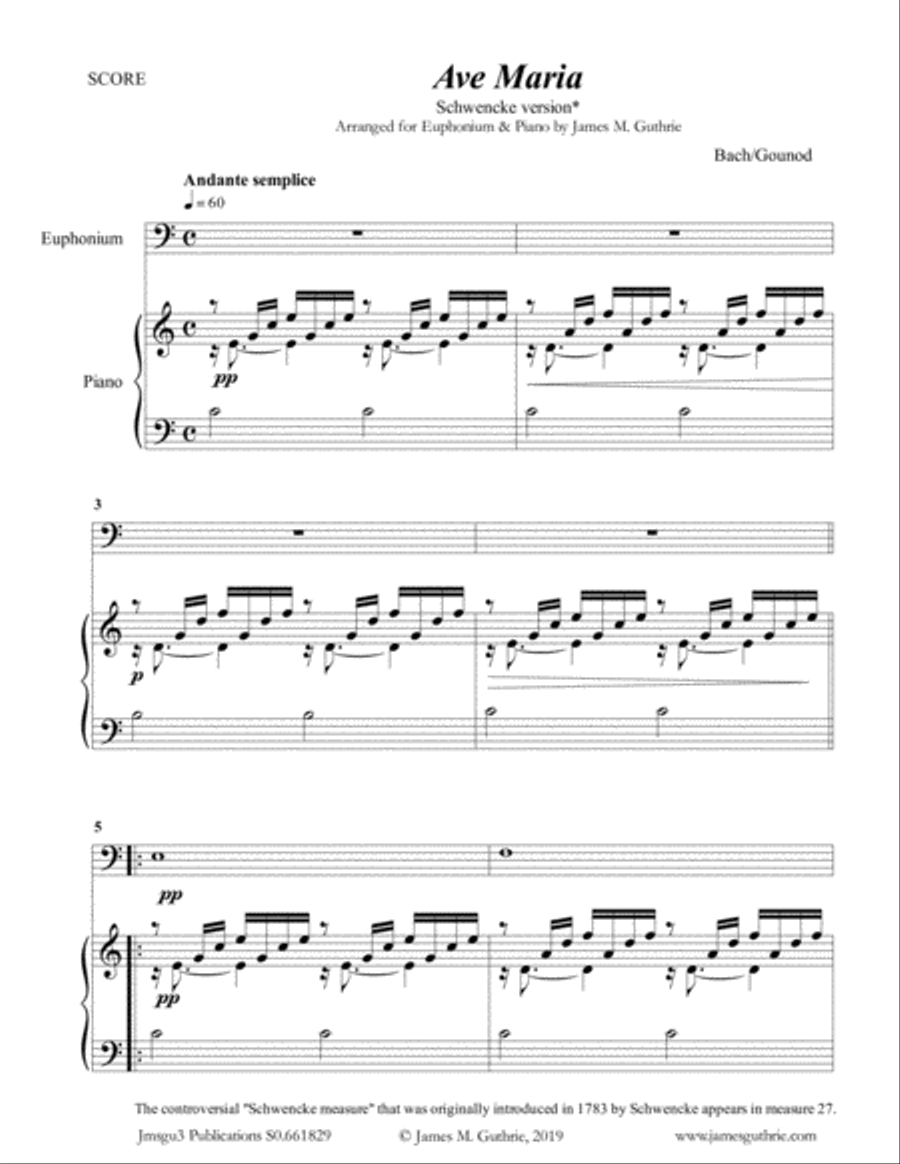
Bach-Gounod: Ave Maria, Schwencke version for Euphonium & Piano
Euphonium, Piano (duo)

$32.95 28.71 € Euphonium, Piano (duo) PDF SheetMusicPlus


Partitions Gratuites
Acheter des Partitions Musicales
Acheter des Partitions Digitales à Imprimer
Acheter des Instruments de Musique

© 2000 - 2026

Accueil - Version intégrale





