EUROPE
462 articles
USA
1792 articles
DIGITAL
3728 articles (à imprimer)
Partitions Digitales
Partitions à imprimer
3728 partitions trouvées


Alto Flute,Instrumental Duet - Level 3 - Digital Download SKU: A0.551180 Composed by Wilhelm Friedemann Bach. Arranged by James M. Guthrie, ASCAP. Classical,Instructional,Standards,Wedding. 24 pages. Jmsgu3 #5002715. Published by jmsgu3 (A0.551180). Duet No. 1 - F. 54 Duration ca. 11:15 Contents: I. Allegro II. Larghetto III. VivaceThe history of W. F. Bach's Duets F. 54 is rooted in the 18th century and is part of a collection of six duets for two flutes, including F. 55–59. These duets are considered among the finest examples of the genre from the 18th century and are significant as they showcase the composer's talent and contribution to chamber music. The exact dates of composition for these duets are not definitively known, but there is strong evidence that the last two duets, including F. 54, were composed in the last decade of W.F. Bach's life when he lived in Berlin. The duets are characterized by refined nuances, interwoven two-part writing, and rapid outer movements, demonstrating a range of musical expression and technical proficiency. Wilhelm Friedemann Bach (1710–1784) was a German composer, organist, harpsichordist, and Johann Sebastian Bach's eldest son.
WF Bach: Duet No. 1 for Alto Flute Duo
2 Flûtes traversières (duo)

$24.95 21.07 € 2 Flûtes traversières (duo) PDF SheetMusicPlus

Easy Piano - Level 2 - Digital Download SKU: A0.984687 Composed by Allen. Arranged by John M. Honeycutt. Children,Jazz,Romantic Period,Traditional. Score. 8 pages. Music Innovators Workshop #4356241. Published by Music Innovators Workshop (A0.984687). This famous piece is arranged in two versions for piano - early intermediate and intermediate. The arrangements are notated as key map tablatures - which are very easy to learn and read. Standard chord symbols are included.Key maps are intended to SHOW you (visually) which keys to play by matching (mapping) the locations of the keys on the keyboard. >>> The group of 12 keys from Middle C up to B form what we call the green Octave Group (There are 7 of these identical groups on the piano distinguished by their colors and locations.) The key map staff is based on an octave group of the keyboard. For each key map octave group, the 5 vertical lines of the staff stand for the 5 matching black KEYS. >>> Staff lines ARE SPACED to match the horizontal spacing of the black keys on the keyboard The notes for black keys are placed ON these staff lines. The notes for the white keys are placed BETWEEN the lines. >>> The notes of a key map move to the left and right to indicate change in PITCH and down the page to indicate the passing of TIME (rhythm). The vertical length of each note is proportional to the time (in beats) that the sound requires.If you want to know more about this beautiful key map notation, you might consider reviewing our article describing how this notation works, entitled: Getting Started With Key Maps for the Piano. It contains an explanation of how key maps work and includes a number of examples. 16 pages. It is promotionally priced at only $1.99. (Actually, you can read the fist few pages simply by going to the look inside pages of the article.)
Chopsticks - (Key Map Tablature)
Piano Facile

$2.00 1.69 € Piano Facile PDF SheetMusicPlus

E-Flat Clarinet,Instrumental Duet - Level 4 - Digital Download SKU: A0.551171 Composed by Wilhelm Friedemann Bach. Arranged by James M. Guthrie, ASCAP. Classical,Instructional,Standards,Wedding. 24 pages. Jmsgu3 #5002643. Published by jmsgu3 (A0.551171). Duet No. 1 - F.54 Duration ca. 11:15 Contents: I. Allegro II. Larghetto III. VivaceThe history of W. F. Bach's Duets F. 54 is rooted in the 18th century and is part of a collection of six duets for two flutes, including F. 55–59. These duets are considered among the finest examples of the genre from the 18th century and are significant as they showcase the composer's talent and contribution to chamber music. The exact dates of composition for these duets are not definitively known, but there is strong evidence that the last two duets, including F. 54, were composed in the last decade of W.F. Bach's life when he lived in Berlin. The duets are characterized by refined nuances, interwoven two-part writing, and rapid outer movements, demonstrating a range of musical expression and technical proficiency. Wilhelm Friedemann Bach (1710–1784) was a German composer, organist, harpsichordist, and Johann Sebastian Bach's eldest son.
WF Bach: Duet No. 1 for Alto Clarinet Duo
2 Clarinettes (duo)

$24.95 21.07 € 2 Clarinettes (duo) PDF SheetMusicPlus

Drum Set,Drums - Level 4 - Digital Download SKU: A0.1259991 By Matt Murphy. By Matt Murphy. Arranged by Matt Murphy. Instructional,Jazz,Latin. Score. 44 pages. Matt Murphy #853225. Published by Matt Murphy (A0.1259991). Hey y'all!  I've been inspired by this music for as long as I can remember. It all started in college and has remained to this day. I lived it. Breathed it. Ate it. And, slept with it (literally). And through listening and experimenting, perhaps the music will inspire you, too. There's a lot to digest. So, it's very important to take the time to enjoy it.Keep practicing these examples. Create some of your own. This book should be used as a springboard to your success! It's just a blueprint. Make these grooves and exercises YOURS! Use a metronome. Look, metronomes don't lie. They will keep you in line and will ensure your accuracy as you traverse through the different styles.Y'all inspire me! I remember in college, when I was just thirsty for knowledge. I wanted as much as I could get, as quickly as I could get it. I listened to music. I went out to check out live shows. I played in more than my fair share of bands. And, have performed around the world with TONS of great musicians and people, as a result!The sky's the limit, folks! Keep pushing and keep reaching. You'll do it! Thanks a million!Thank You To: All of the companies for their years of support and belief in me and in my career choice! Don, Chris & Garrison at Drum Workshop; Chris at SABIAN; Joe & Ben at Vic Firth; Angie & Roger at Remo; Mike at Humes and Berg; Jay at Gruv Gear; Ben at Big Fat Snare Drum; Audix Microphones; 64 Audio; Cympad, X-Percussion.Mom & Dad; Dr. Dean Gronemeier & Sherell; Horacio 'el Negro' Hernandez; Tomasito Cruz; Michito Sanchez; Dom Famularo; Chris Patterson; Stan Sykes; Tony Lasorsa; Matt Daly; Barry Applewhite; Derek Jones; Stephen Kummer; Ryan Rose; Blaise Sison; Alex Jackson.Take care,Matt Murphy.
A Drummer’s Guide to Afro-Caribbean & South American Grooves for Drumset
Batterie
Matt Murphy
$24.99 21.11 € Batterie PDF SheetMusicPlus

Woodwind Ensemble,Woodwind Quartet Alto Saxophone,Baritone Saxophone,Soprano Saxophone,Tenor Saxophone - Level 4 - Digital Download SKU: A0.850011 Composed by Vic Mizzy. Arranged by Michael Dotterer. Chamber,Contemporary,Film/TV,Halloween. 15 pages. Michael Dotterer #6571755. Published by Michael Dotterer (A0.850011). Great for Halloween. Scored for Soprano, Alto, Tenor, and Bari saxophones.This is Gomez's theme which was often played during the original show. Features an optional improv solo or played as written for Tenor. I gave it a bit of a higher rating due to the solo and for the key that arrangement starts in.The audio and video examples are based on a version with 2 saxes and 2 trombones. It is the same arrangement though.
Addams Family Theme
Quatuor de Saxophones: 4 saxophones

$17.00 14.36 € Quatuor de Saxophones: 4 saxophones PDF SheetMusicPlus

Instrumental Duet Instrumental Duet,Soprano Saxophone,Tenor Saxophone - Level 3 - Digital Download SKU: A0.784332 Composed by Joshua Hauser. Instructional. Score and parts. 38 pages. Slide Ride #5288655. Published by Slide Ride (A0.784332). 1 Octave Scale Studies in 15+ keys for 4-part ensembles of like or mixed instruments If this is your first exposure to these scale studies, you are in for a treat! Donuts, if you make a mistake!The initial incarnation of these studies were written for trombone quartet and we would play them in the Tennessee Tech Trombone Choir with the challenge that whomever made the first mistake had to buy donuts for the rest of the ensemble. Since then I have brought that version to several clinics and warm up sessions. One time before I got to explain the title, a fellow trombone professor said, Oh, I get it! Don’t step in the holes!I only wish I had thought of that myself... Since we have one of the best donut shops in TN here in Cookeville, treating the studio to sugar coated goodies was always my intent.As with those initial exercises, you can vary these as much as you’d like.·     Choose a tempo.·     Choose a dynamic.·     Choose an articulation/style.One way I like to play these is to have one person be the model, playing the entire scale over and over while everyone else plays the fragmented versions. That helps everyone to keep on track and stay in time. Double or triple up the parts for ensemble cohesion with a larger group.Practice one key, gradually speeding it up to improve fluidity, or choose a variation and take it through all keys, playing version A, B, C, or D then skipping to play the same set in a new key.If you want an additional challenge, play them in different octaves or change the key. Play the F Major set in f minor (all forms), different modes, etc. Players really have to be on their toes to remember if they are playing melodic minor in the ascending or descending form! For jazz players, try swinging them in dorian or mixolydian modes.The variations are endless!If you are using these with transposing instruments, 1) is F Major in Concert Pitch, 2) is Bb Major in Concert pitch, and so on. When you reach a scale that is enharmonic for another key (Db/C#, Gb/F#, or Cb/B), they are presented in both keys for each instrument so Trumpets can play in Eb while the Flutes are playing in C# with similar examples for all keys.All Donut Etudes with the same volume number are compatible so you can play them in mixed quartets or large ensembles with one or more instruments/people on part 1 and a different instrument on part 2, etc. Since the quartets are all identical, conductors/coaches can use any of the scores to tell which part should be playing at what time. Once you have played a scale with one set of parts, everyone can rotate to a different part and play the same scales again!Enjoy!
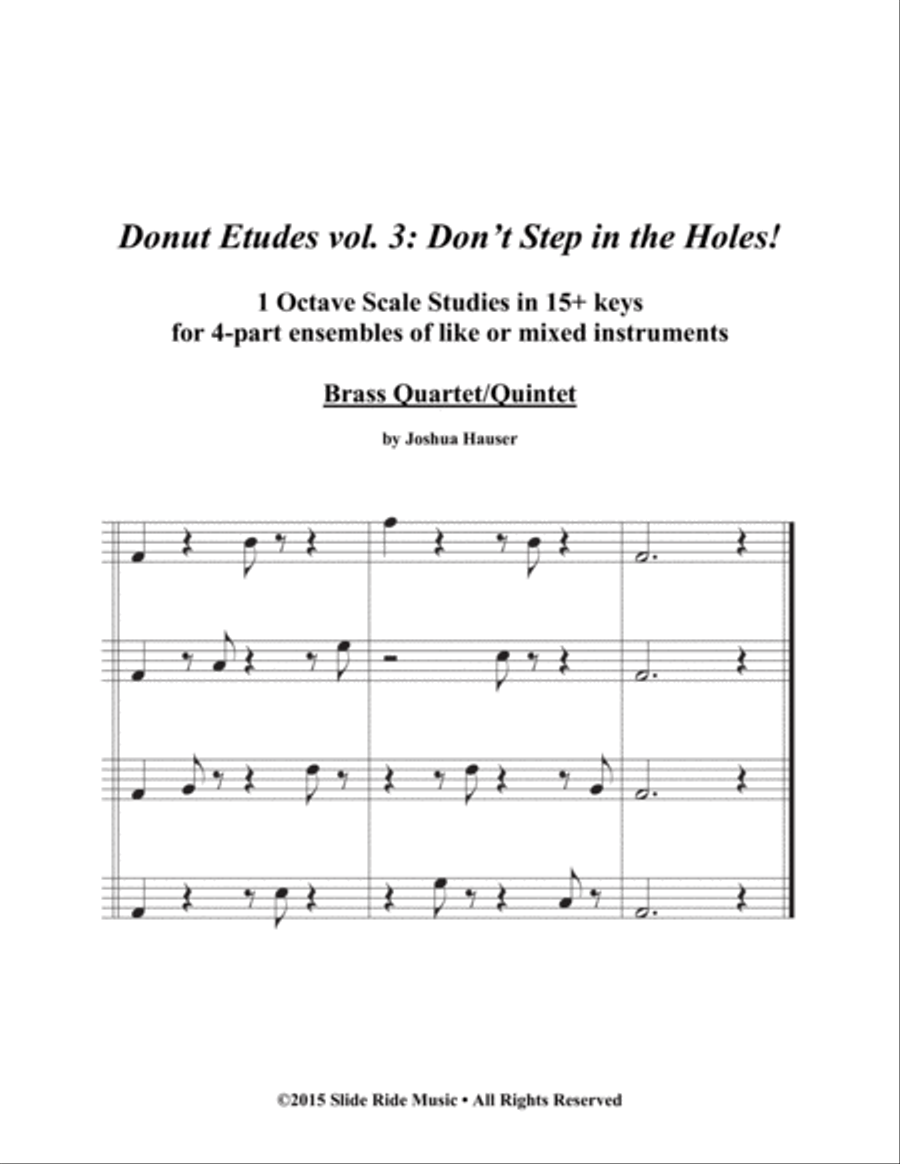
Donut Etudes vol. 3: Don’t Step in the Holes! – Soprano or Tenor Saxophone Quartet
2 Saxophones (duo)

$5.00 4.22 € 2 Saxophones (duo) PDF SheetMusicPlus

Brass Quintet Horn,Trombone,Trumpet,Tuba - Digital Download SKU: A0.1461101 Composed by Porter Steele and Walter Melrose. Arranged by Will Corbin. Jazz,Standards. 22 pages. Will Corbin #1040011. Published by Will Corbin (A0.1461101). This 1901 Dixieland standard was a favorite of my father's, so I arranged it for him to hear our brass quintet perform it. This chart is based on an old stock that had some pretty crazy licks, particularly for the horn part. It's one of the earliest examples of New Orleans-style Dixieland, famous for a pioneering clarinet solo in its earliest days.If you prefer alternative instrumentation, I'm happy to accommodate. Contact me at wilcor@aol.com.
High Society
Quintette de Cuivres: 2 trompettes, Cor, trombone, tuba

$15.00 12.67 € Quintette de Cuivres: 2 trompettes, Cor, trombone, tuba PDF SheetMusicPlus

Flute Solo - Level 3 - Digital Download SKU: A0.784325 Composed by Joshua Hauser. Instructional. Individual part. 38 pages. Slide Ride #5288633. Published by Slide Ride (A0.784325). Donut Etudes vol. 3: Don’t Step in the Holes!1 Octave Scale Studies in 15+ keys for 4-part ensembles of like or mixed instruments If this is your first exposure to these scale studies, you are in for a treat! Donuts, if you make a mistake!The initial incarnation of these studies were written for trombone quartet and we would play them in the Tennessee Tech Trombone Choir with the challenge that whomever made the first mistake had to buy donuts for the rest of the ensemble. Since then I have brought that version to several clinics and warm up sessions. One time before I got to explain the title, a fellow trombone professor said, Oh, I get it! Don’t step in the holes!I only wish I had thought of that myself... Since we have one of the best donut shops in TN here in Cookeville, treating the studio to sugar coated goodies was always my intent.As with those initial exercises, you can vary these as much as you’d like.·      Choose a tempo.·      Choose a dynamic.·      Choose an articulation/style.One way I like to play these is to have one person be the model, playing the entire scale over and over while everyone else plays the fragmented versions. That helps everyone to keep on track and stay in time. Double or triple up the parts for ensemble cohesion with a larger group.Practice one key, gradually speeding it up to improve fluidity, or choose a variation and take it through all keys, playing version A, B, C, or D then skipping to play the same set in a new key.If you want an additional challenge, play them in different octaves or change the key. Play the F Major set in f minor (all forms), different modes, etc. Players really have to be on their toes to remember if they are playing melodic minor in the ascending or descending form! For jazz players, try swinging them in dorian or mixolydian modes.The variations are endless!If you are using these with transposing instruments, 1) is F Major in Concert Pitch, 2) is Bb Major in Concert pitch, and so on. When you reach a scale that is enharmonic for another key (Db/C#, Gb/F#, or Cb/B), they are presented in both keys for each instrument so Trumpets can play in Eb while the Flutes are playing in C# with similar examples for all keys.All Donut Etudes with the same volume number are compatible so you can play them in mixed quartets or large ensembles with one or more instruments/people on part 1 and a different instrument on part 2, etc. Since the quartets are all identical, conductors/coaches can use any of the scores to tell which part should be playing at what time. Once you have played a scale with one set of parts, everyone can rotate to a different part and play the same scales again!Enjoy!
Donut Etudes vol. 3: Don’t Step in the Holes! - Flute Quartet
Quatuor de Flûtes : 4 flûtes

$5.00 4.22 € Quatuor de Flûtes : 4 flûtes PDF SheetMusicPlus

Piano Solo - Level 4 - Digital Download SKU: A0.1216178 By Brian Golden. By Brian Golden. Arranged by Brian Golden. Classical,Contemporary. Score. 2 pages. Brian Golden #812790. Published by Brian Golden (A0.1216178). Prelude 7 in Eb Ionian from 24 Preludes for the Piano in Major and Minor Modes by composer Brian Golden   The creative concept in writing these preludes is to provide a link to past preludes written for the keyboard, and in particular to the works of J.S. Bach and Frederic Chopin, whose works stand as essential repertoire for any student of the piano.  Using Bach’s and Chopin’s examples, my goal was to compose in all twenty-four keys, yet offer my own variation on the progression of key signatures – Bach’s being a pattern of major to parallel minor progressing chromatically through all keys, and Chopin’s a pattern of major to relative minor keys progressing clockwise through the circle of fifths.  In order to expand my harmonic and melodic possibilities, I have included the modal keys rather than only the major and harmonic minor keys, and have chosen to work counterclockwise through the circle of fifths, which is a more natural harmonic progression.  Therefore, all major preludes resolve from one to another V-I, as well as do all the minor preludes.    While there are seven modal scales, I decided to leave out the locrian modes for the following reasons.  First, due to the diminished fifth, the locrian mode cannot be thought of as either major nor minor.  Second, the locrian mode did not have a relative key to pair with, since there were no other keys with the identical characteristic notes.    In creating the key architecture, I determined that there was only one solution to pairing major and relative minor scales based on a shared parent key and characteristic note - ionian/aolian, mixolydian/phrygian and lydian/dorian.  This specific order of modal scales is the only order that would enable composing in all twelve key signatures.  Finally, the inspiration for each prelude came from playing through several other preludes in the same keys - mostly by Bach and Chopin - and letting their themes and styles influence me in the writing of my own.YouTube.
Prelude 7 in Eb Ionian
Piano seul
Brian Golden
$5.99 5.06 € Piano seul PDF SheetMusicPlus

Saxophone SKU: HL.4470200 A Follow Up Course for Individual or Like-Instrument Class Instruction. Edited by Joseph E. Skornicka. Concert Band Method. Hal Leonard Instrumental Methods. Learn To Play. Instructional book. With instructional text, musical examples, standard notation and pull-out fingering chart. 48 pages. Rubank Publications #RUBL68. Published by Rubank Publications (HL.4470200). ISBN 9781423444213. UPC: 073999702002. 9x12 inches. Edited by Joseph E. Skornicka.One of the most widely used series of methods for individual or like-instrument class instruction. Using a very well-rounded approach including scales, arpeggios, technical studies, studies for musicianship, articulation studies, solos, duets, and studies devoted to the special needs of each instrument, this series provides a fantastic wealth of material for all student musicians.
Rubank Intermediate Method (Saxophone)

$7.99 6.75 € PDF SheetMusicPlus


Partitions Gratuites
Acheter des Partitions Musicales
Acheter des Partitions Digitales à Imprimer
Acheter des Instruments de Musique

© 2000 - 2026

Accueil - Version intégrale





