EUROPE
388 articles
USA
840 articles
DIGITAL
394 articles (ą imprimer)
Partitions Digitales
Partitions à imprimer
394 partitions trouvées

1 ....31 46 61 76 91 ....391

Flute Solo - Digital Download SKU: A0.1336501 Composed by Leonard E. Lopatin. 21st Century,Chamber,Classical,Instructional. Individual part. 9 pages. Leonard E. Lopatin #922268. Published by Leonard E. Lopatin (A0.1336501). Composed in 2021 and revised in December 2023, these tiny etudes (TinyTudes, Op.1) are designed to be challenging and instructive, as well as fun and amusing.Ā They are not designed with building virtuosic technique in mind specifically, and there is no need to take the fastest possible tempos. If you want to ā€œshow offā€ with these pieces, try showing off your ability to bring out the contrasting styles. Show off your ability to be expressive without sacrificing accuracy, and vice versa.Nos. 1 and 3 don’t have loads of detailed expressive nuances indicated. Some composers leave that to the performer more than others, and these give you the opportunity to practice shaping each phrase. In the other two, I’ve been more specific about the ups and downs, the pushes and pulls. In these, be as faithful as you can to each direction while finding the way to ā€œmake it yoursā€.These TinyTudes are great for students and professionals alike.
TinyTudes, opus no. 1
Flūte traversičre

$12.95 10.95 € Flūte traversičre PDF SheetMusicPlus

Large Ensemble Voice - Level 4 - Digital Download SKU: A0.869357 Composed by Thomas Oboe Lee. 20th Century,Baroque,Classical,Contemporary,Romantic Period. Score and parts. 95 pages. Thomas Oboe Lee #15877. Published by Thomas Oboe Lee (A0.869357). Instrumentation: 2222-4231-timp-2perc-hp-pf-strings. Program note: First of all, a huge embrace for Max Hobart who has been so very supportive by promoting and premiering new works for the orchestra. Since 1991, I have written three works for Max and the Civic Symphony Orchestra of Boston. Symphony No. 4 ... War and Peace is my fourth contribution and this work is dedicated to Max. A year ago, John Finney and the University Chorale of Boston College premiered my Mass for the Holy Year 2000. It was a millennial commission by the Jesuit Institution for the community of Boston College. For that occasion I had originally planned to write a Mass whose texts would include both the Latin from the Ordinary of the Mass - Kyrie, Gloria, Credo, Sanctus & Agnus Dei - and poems concerning the atrocities and senseless killing in warfare during the last century.However, as it turned out, the poems I chose ended up reflecting the Latin text, which is all about faith and redemption. But I still wanted to write an anti-war symphony. When I approached Max with this idea, he was very excited. Initially he was a little concerned that I might want to use the Tolstoy novel as my inspiration. I assured him that it would not be a four-hour symphony. In order to convey a political message through a symphonic work, texts set as songs are the most direct way. For this symphony, I have narrowed my focus to poems written by veterans of the First World War - some euphemistically call it the Great War. The first poem by Rupert Brooke, The Soldier, has an uneasy, patriotic cheerfulness to its message. The second poem by Wilfred Owen, Dulce et decorum est, is a more realistic view of warfare. Dying for one's own country is not so cool when the dead and the dying are staring at your face!!! The third and last poem by Ivor Gurney, To his love, reflects on the aftermath of war: peace, but at what cost!!! Rupert Brooke (1887 - 1915) died on a naval expedition near the Greek island of Gallipoli. He died of blood poisoning. Wilfred Owen (1893 - 1918) was wounded three times in France in the spring of 1917 and was sent back to England to recuperate. He returned to the Front, and was killed on November 4, 1918, just a few days before the Armistice was signed. Ivor Gurney (1890 - 1937), a composer as well, was acutely sensitive to the horrors of the war and, after being wounded and gassed in 1917, he was sent back home to a mental hospital. He died twenty years later without ever recovering from the traumas of war.Audio link: https://thomasoboelee.bandcamp.com/album/symphony-no-4-war-and-peace-2001
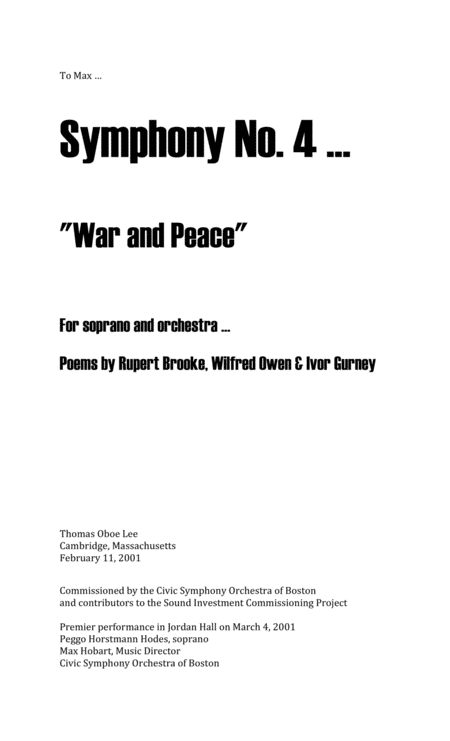
Symphony No. 4 ... War and Peace (2001) for soprano and orchestra

$9.99 8.45 € PDF SheetMusicPlus

Brass Quartet - Level 3 - Digital Download SKU: A0.1261834 Composed by Ludwig van Beethoven. Arranged by Ander. 19th Century,Classical,Film/TV,March,Romantic Period. 13 pages. Woods Only, Arrangements #854917. Published by Woods Only, Arrangements (A0.1261834). This arrangement adapted for brass quartet was written keeping the characteristics of the original work, in order to be performed by young music students who want to enter the symphonic music. Besides, it can also be used by professional musicians, for recitals, repertoire, academic presentations and didactic material. As much as it is a funeral march, it is well suited for any musical performance occasion. The transcription is faithful to the structure, with only one change of key, so that it is comfortable for all the instruments in the formation, as well as for use in ensemble practice between musicians of different traditions. Ludwig van Beethoven began concentrated work on his Symphony No. 7 in A major Op. 92 in 1811, it was completed in 1812, and was dedicated to Count Moritz von Fries, and premiered in Vienna on December 8, 1813. It is considered a remarkable example of the more ebullient side of Beethoven's compositional personality and evidence that even after the onset of deafness, he still found cause for musical optimism. The second movement Allegretto is a funeral march in everything but name. Often several contrasting melodic ideas are made to coexist, as if Beethoven were imagining several processions converging on the cemetery at the same time. As he was working on this symphony during the years of the Napoleonic Wars, this experience was probably within his experience. It was also used as the soundtrack to the film Knowing, by director Alex Proyas and starring Nicolas Cage, where it is used in the final scene of the film. Beethoven called Symphony No. 7 his most excellent symphony, and a music critic of the time reported, this symphony is the most melodically rich and the most pleasing and comprehensible of all Beethoven's symphonies..
Symphony No. 7 by Beethoven for Brass Quartet
Quatuor de Cuivres : 2 trompettes, trombone, tuba

$7.99 6.76 € Quatuor de Cuivres : 2 trompettes, trombone, tuba PDF SheetMusicPlus

Trombone Quartet - Level 3 - Digital Download SKU: A0.1261845 Composed by Ludwig van Beethoven. Arranged by Ander. 19th Century,Classical,Film/TV,March,Romantic Period. 13 pages. Woods Only, Arrangements #854928. Published by Woods Only, Arrangements (A0.1261845). This arrangement adapted for trombone quartet was written keeping the characteristics of the original work, in order to be performed by young music students who want to enter the symphonic music. Besides, it can also be used by professional musicians, for recitals, repertoire, academic presentations and didactic material. As much as it is a funeral march, it is well suited for any musical performance occasion. The transcription is faithful to the structure, with only one change of key, so that it is comfortable for all the instruments in the formation, as well as for use in ensemble practice between musicians of different traditions. Ludwig van Beethoven began concentrated work on his Symphony No. 7 in A major Op. 92 in 1811, it was completed in 1812, and was dedicated to Count Moritz von Fries, and premiered in Vienna on December 8, 1813. It is considered a remarkable example of the more ebullient side of Beethoven's compositional personality and evidence that even after the onset of deafness, he still found cause for musical optimism. The second movement Allegretto is a funeral march in everything but name. Often several contrasting melodic ideas are made to coexist, as if Beethoven were imagining several processions converging on the cemetery at the same time. As he was working on this symphony during the years of the Napoleonic Wars, this experience was probably within his experience. It was also used as the soundtrack to the film Knowing, by director Alex Proyas and starring Nicolas Cage, where it is used in the final scene of the film. Beethoven called Symphony No. 7 his most excellent symphony, and a music critic of the time reported, this symphony is the most melodically rich and the most pleasing and comprehensible of all Beethoven's symphonies..
Symphony No. 7 by Beethoven for Trombone Quartet
Quatuor de cuivres: 4 trombones

$7.99 6.76 € Quatuor de cuivres: 4 trombones PDF SheetMusicPlus

Woodwind Ensemble,Woodwind Quartet - Level 2 - Digital Download SKU: A0.1137244 Composed by Ludwig van Beethoven. Arranged by Ander. Classical,Film/TV,Instructional,March,Romantic Period. 14 pages. Woods Only, Arrangements #737444. Published by Woods Only, Arrangements (A0.1137244). This arrangement adapted for woodwind quartet was written keeping the characteristics of the original work, in order to be performed by young music students who want to enter the symphonic music. Besides, it can also be used by professional musicians, for recitals, repertoire, academic presentations and didactic material. As much as it is a funeral march, it is well suited for any musical performance occasion. The transcription is faithful to the structure, with only one change of key, so that it is comfortable for all the instruments in the formation, as well as for use in ensemble practice between musicians of different traditions. Ludwig van Beethoven began concentrated work on his Symphony No. 7 in A major Op. 92 in 1811, it was completed in 1812, and was dedicated to Count Moritz von Fries, and premiered in Vienna on December 8, 1813. It is considered a remarkable example of the more ebullient side of Beethoven's compositional personality and evidence that even after the onset of deafness, he still found cause for musical optimism. The second movement Allegretto is a funeral march in everything but name. Often several contrasting melodic ideas are made to coexist, as if Beethoven were imagining several processions converging on the cemetery at the same time. As he was working on this symphony during the years of the Napoleonic Wars, this experience was probably within his experience. It was also used as the soundtrack to the film Knowing, by director Alex Proyas and starring Nicolas Cage, where it is used in the final scene of the film. Beethoven called Symphony No. 7 his most excellent symphony, and a music critic of the time reported, this symphony is the most melodically rich and the most pleasing and comprehensible of all Beethoven's symphonies..
Symphony No. 7 by Beethoven for Woodwind Quartet
Flūte, Hautbois, Clarinette, Basson

$7.99 6.76 € Flūte, Hautbois, Clarinette, Basson PDF SheetMusicPlus

Alto Saxophone,Tenor Saxophone - Level 2 - Digital Download SKU: A0.1150653 Composed by Ludwig van Beethoven. Arranged by Ander. Classical,Film/TV,Instructional,Romantic Period,Traditional. Saxophone Duet. 8 pages. Woods Only, Arrangements #750831. Published by Woods Only, Arrangements (A0.1150653). This arrangement adapted for sax duo was written keeping the characteristics of the original work, in order to be performed by young music students who want to enter the symphonic music. Besides, it can also be used by professional musicians, for recitals, repertoire, academic presentations and didactic material. As much as it is a funeral march, it is well suited for any musical performance occasion. The transcription is faithful to the structure, with only one change of key, so that it is comfortable for all the instruments in the formation, as well as for use in ensemble practice between musicians of different traditions. Ludwig van Beethoven began concentrated work on his Symphony No. 7 in A major Op. 92 in 1811, it was completed in 1812, and was dedicated to Count Moritz von Fries, and premiered in Vienna on December 8, 1813. It is considered a remarkable example of the more ebullient side of Beethoven's compositional personality and evidence that even after the onset of deafness, he still found cause for musical optimism. The second movement Allegretto is a funeral march in everything but name. Often several contrasting melodic ideas are made to coexist, as if Beethoven were imagining several processions converging on the cemetery at the same time. As he was working on this symphony during the years of the Napoleonic Wars, this experience was probably within his experience. It was also used as the soundtrack to the film Knowing, by director Alex Proyas and starring Nicolas Cage, where it is used in the final scene of the film. Beethoven called Symphony No. 7 his most excellent symphony, and a music critic of the time reported, this symphony is the most melodically rich and the most pleasing and comprehensible of all Beethoven's symphonies..
Symphony No. 7 by Beethoven for Saxophone Duet
2 Saxophones (duo)

$3.99 3.37 € 2 Saxophones (duo) PDF SheetMusicPlus

B-Flat Clarinet,Piano - Level 1 - Digital Download SKU: A0.1158449 Composed by Ludwig van Beethoven. Arranged by Ander. Classical,Film/TV,Instructional,Romantic Period,Traditional. Score and part. 7 pages. Woods Only, Arrangements #758735. Published by Woods Only, Arrangements (A0.1158449). This arrangement adapted for clarinet e piano was written keeping the characteristics of the original work, in order to be performed by young music students who want to enter the symphonic music. Besides, it can also be used by professional musicians, for recitals, repertoire, academic presentations and didactic material. As much as it is a funeral march, it is well suited for any musical performance occasion. The transcription is faithful to the structure, with only one change of key, so that it is comfortable for all the instruments in the formation, as well as for use in ensemble practice between musicians of different traditions. Ludwig van Beethoven began concentrated work on his Symphony No. 7 in A major Op. 92 in 1811, it was completed in 1812, and was dedicated to Count Moritz von Fries, and premiered in Vienna on December 8, 1813. It is considered a remarkable example of the more ebullient side of Beethoven's compositional personality and evidence that even after the onset of deafness, he still found cause for musical optimism. The second movement Allegretto is a funeral march in everything but name. Often several contrasting melodic ideas are made to coexist, as if Beethoven were imagining several processions converging on the cemetery at the same time. As he was working on this symphony during the years of the Napoleonic Wars, this experience was probably within his experience. It was also used as the soundtrack to the film Knowing, by director Alex Proyas and starring Nicolas Cage, where it is used in the final scene of the film. Beethoven called Symphony No. 7 his most excellent symphony, and a music critic of the time reported, this symphony is the most melodically rich and the most pleasing and comprehensible of all Beethoven's symphonies..
Symphony No. 7 by Beethoven for Clarinet
Clarinette et Piano

$1.99 1.68 € Clarinette et Piano PDF SheetMusicPlus

Horn Quintet - Level 2 - Digital Download SKU: A0.1247200 Composed by Ludwig van Beethoven. Arranged by Ander. 19th Century,Classical,Film/TV,March,Romantic Period. 15 pages. Woods Only, Arrangements #841745. Published by Woods Only, Arrangements (A0.1247200). This arrangement adapted for horn in F quintet was written keeping the characteristics of the original work, in order to be performed by young music students who want to enter the symphonic music. Besides, it can also be used by professional musicians, for recitals, repertoire, academic presentations and didactic material. As much as it is a funeral march, it is well suited for any musical performance occasion. The transcription is faithful to the structure, with only one change of key, so that it is comfortable for all the instruments in the formation, as well as for use in ensemble practice between musicians of different traditions.Ludwig van Beethoven began concentrated work on his Symphony No. 7 in A major Op. 92 in 1811, it was completed in 1812, and was dedicated to Count Moritz von Fries, and premiered in Vienna on December 8, 1813. It is considered a remarkable example of the more ebullient side of Beethoven's compositional personality and evidence that even after the onset of deafness, he still found cause for musical optimism. The second movement Allegretto is a funeral march in everything but name. Often several contrasting melodic ideas are made to coexist, as if Beethoven were imagining several processions converging on the cemetery at the same time. As he was working on this symphony during the years of the Napoleonic Wars, this experience was probably within his experience. It was also used as the soundtrack to the film Knowing, by director Alex Proyas and starring Nicolas Cage, where it is used in the final scene of the film. Beethoven called Symphony No. 7 his most excellent symphony, and a music critic of the time reported, this symphony is the most melodically rich and the most pleasing and comprehensible of all Beethoven's symphonies..
Symphony No. 7 by Beethoven for French Horn Quintet
Ensemble de Cors

$9.99 8.45 € Ensemble de Cors PDF SheetMusicPlus

Low Brass Quintet,Tuba - Level 2 - Digital Download SKU: A0.1247202 Composed by Ludwig van Beethoven. Arranged by Ander. 19th Century,Classical,Film/TV,March,Romantic Period. 15 pages. Woods Only, Arrangements #841747. Published by Woods Only, Arrangements (A0.1247202). This arrangement adapted for tuba quintet was written keeping the characteristics of the original work, in order to be performed by young music students who want to enter the symphonic music. Besides, it can also be used by professional musicians, for recitals, repertoire, academic presentations and didactic material. As much as it is a funeral march, it is well suited for any musical performance occasion. The transcription is faithful to the structure, with only one change of key, so that it is comfortable for all the instruments in the formation, as well as for use in ensemble practice between musicians of different traditions.Ludwig van Beethoven began concentrated work on his Symphony No. 7 in A major Op. 92 in 1811, it was completed in 1812, and was dedicated to Count Moritz von Fries, and premiered in Vienna on December 8, 1813. It is considered a remarkable example of the more ebullient side of Beethoven's compositional personality and evidence that even after the onset of deafness, he still found cause for musical optimism. The second movement Allegretto is a funeral march in everything but name. Often several contrasting melodic ideas are made to coexist, as if Beethoven were imagining several processions converging on the cemetery at the same time. As he was working on this symphony during the years of the Napoleonic Wars, this experience was probably within his experience. It was also used as the soundtrack to the film Knowing, by director Alex Proyas and starring Nicolas Cage, where it is used in the final scene of the film. Beethoven called Symphony No. 7 his most excellent symphony, and a music critic of the time reported, this symphony is the most melodically rich and the most pleasing and comprehensible of all Beethoven's symphonies..
Symphony No. 7 by Beethoven for Tuba Quintet

$9.99 8.45 € PDF SheetMusicPlus

Saxophone Quartet,Woodwind Ensemble Tenor Saxophone - Level 2 - Digital Download SKU: A0.1137255 Composed by Ludwig van Beethoven. Arranged by Ander. Classical,Film/TV,Instructional,March,Romantic Period. 14 pages. Woods Only, Arrangements #737456. Published by Woods Only, Arrangements (A0.1137255). This arrangement adapted for tenor sax quartet was written keeping the characteristics of the original work, in order to be performed by young music students who want to enter the symphonic music. Besides, it can also be used by professional musicians, for recitals, repertoire, academic presentations and didactic material. As much as it is a funeral march, it is well suited for any musical performance occasion. The transcription is faithful to the structure, with only one change of key, so that it is comfortable for all the instruments in the formation, as well as for use in ensemble practice between musicians of different traditions. Ludwig van Beethoven began concentrated work on his Symphony No. 7 in A major Op. 92 in 1811, it was completed in 1812, and was dedicated to Count Moritz von Fries, and premiered in Vienna on December 8, 1813. It is considered a remarkable example of the more ebullient side of Beethoven's compositional personality and evidence that even after the onset of deafness, he still found cause for musical optimism. The second movement Allegretto is a funeral march in everything but name. Often several contrasting melodic ideas are made to coexist, as if Beethoven were imagining several processions converging on the cemetery at the same time. As he was working on this symphony during the years of the Napoleonic Wars, this experience was probably within his experience. It was also used as the soundtrack to the film Knowing, by director Alex Proyas and starring Nicolas Cage, where it is used in the final scene of the film. Beethoven called Symphony No. 7 his most excellent symphony, and a music critic of the time reported, this symphony is the most melodically rich and the most pleasing and comprehensible of all Beethoven's symphonies..
Symphony No. 7 by Beethoven for Tenor Sax Quartet
Quatuor de Saxophones: 4 saxophones

$7.99 6.76 € Quatuor de Saxophones: 4 saxophones PDF SheetMusicPlus

Instrumental Duet,Viola,Violin - Level 2 - Digital Download SKU: A0.1189417 Composed by Ludwig van Beethoven. Arranged by Ander. Classical,Film/TV,Instructional,March,Romantic Period. 8 pages. Woods Only, Arrangements #789053. Published by Woods Only, Arrangements (A0.1189417). This arrangement adapted for violin and viola duet was written keeping the characteristics of the original work, in order to be performed by young music students who want to enter the symphonic music. Besides, it can also be used by professional musicians, for recitals, repertoire, academic presentations and didactic material. As much as it is a funeral march, it is well suited for any musical performance occasion. The transcription is faithful to the structure, with only one change of key, so that it is comfortable for all the instruments in the formation, as well as for use in ensemble practice between musicians of different traditions.Ludwig van Beethoven began concentrated work on his Symphony No. 7 in A major Op. 92 in 1811, it was completed in 1812, and was dedicated to Count Moritz von Fries, and premiered in Vienna on December 8, 1813. It is considered a remarkable example of the more ebullient side of Beethoven's compositional personality and evidence that even after the onset of deafness, he still found cause for musical optimism. The second movement Allegretto is a funeral march in everything but name. Often several contrasting melodic ideas are made to coexist, as if Beethoven were imagining several processions converging on the cemetery at the same time. As he was working on this symphony during the years of the Napoleonic Wars, this experience was probably within his experience. It was also used as the soundtrack to the film Knowing, by director Alex Proyas and starring Nicolas Cage, where it is used in the final scene of the film. Beethoven called Symphony No. 7 his most excellent symphony, and a music critic of the time reported, this symphony is the most melodically rich and the most pleasing and comprehensible of all Beethoven's symphonies..
Symphony No. 7 by Beethoven for Violin and Viola
Violon, Alto (duo)

$3.99 3.37 € Violon, Alto (duo) PDF SheetMusicPlus

Woodwind Ensemble,Woodwind Quintet Tenor Saxophone - Level 1 - Digital Download SKU: A0.1128496 Composed by Ludwig van Beethoven. Arranged by Ander. Classical,Film/TV,Instructional,March,Romantic Period. 16 pages. Woods Only, Arrangements #729119. Published by Woods Only, Arrangements (A0.1128496). This arrangement adapted for tenor sax quintet was written keeping the characteristics of the original work, in order to be performed by young music students who want to enter the symphonic music. Besides, it can also be used by professional musicians, for recitals, repertoire, academic presentations and didactic material. As much as it is a funeral march, it is well suited for any musical performance occasion. The transcription is faithful to the structure, with only one change of key, so that it is comfortable for all the instruments in the formation, as well as for use in ensemble practice between musicians of different traditions. Ludwig van Beethoven began concentrated work on his Symphony No. 7 in A major Op. 92 in 1811, it was completed in 1812, and was dedicated to Count Moritz von Fries, and premiered in Vienna on December 8, 1813. It is considered a remarkable example of the more ebullient side of Beethoven's compositional personality and evidence that even after the onset of deafness, he still found cause for musical optimism. The second movement Allegretto is a funeral march in everything but name. Often several contrasting melodic ideas are made to coexist, as if Beethoven were imagining several processions converging on the cemetery at the same time. As he was working on this symphony during the years of the Napoleonic Wars, this experience was probably within his experience. It was also used as the soundtrack to the film Knowing, by director Alex Proyas and starring Nicolas Cage, where it is used in the final scene of the film. Beethoven called Symphony No. 7 his most excellent symphony, and a music critic of the time reported, this symphony is the most melodically rich and the most pleasing and comprehensible of all Beethoven's symphonies..
Symphony No. 7 by Beethoven for Tenor Sax Quintet
Quintette de Saxophone: 5 saxophones

$9.99 8.45 € Quintette de Saxophone: 5 saxophones PDF SheetMusicPlus

Recorder - Level 3 - Digital Download SKU: A0.1128492 Composed by Ludwig van Beethoven. Arranged by Ander. Classical,Film/TV,Instructional,March,Romantic Period. Recorder Ensemble. 16 pages. Woods Only, Arrangements #729115. Published by Woods Only, Arrangements (A0.1128492). This arrangement adapted for recorder quintet was written keeping the characteristics of the original work, in order to be performed by young music students who want to enter the symphonic music. Besides, it can also be used by professional musicians, for recitals, repertoire, academic presentations and didactic material. As much as it is a funeral march, it is well suited for any musical performance occasion. The transcription is faithful to the structure, with only one change of key, so that it is comfortable for all the instruments in the formation, as well as for use in ensemble practice between musicians of different traditions. Ludwig van Beethoven began concentrated work on his Symphony No. 7 in A major Op. 92 in 1811, it was completed in 1812, and was dedicated to Count Moritz von Fries, and premiered in Vienna on December 8, 1813. It is considered a remarkable example of the more ebullient side of Beethoven's compositional personality and evidence that even after the onset of deafness, he still found cause for musical optimism. The second movement Allegretto is a funeral march in everything but name. Often several contrasting melodic ideas are made to coexist, as if Beethoven were imagining several processions converging on the cemetery at the same time. As he was working on this symphony during the years of the Napoleonic Wars, this experience was probably within his experience. It was also used as the soundtrack to the film Knowing, by director Alex Proyas and starring Nicolas Cage, where it is used in the final scene of the film. Beethoven called Symphony No. 7 his most excellent symphony, and a music critic of the time reported, this symphony is the most melodically rich and the most pleasing and comprehensible of all Beethoven's symphonies..
Symphony No. 7 by Beethoven for Recorder Quintet
5 Flūtes ą bec

$9.99 8.45 € 5 Flūtes ą bec PDF SheetMusicPlus


1 ....31 46 61 76 91 ....391


Partitions Gratuites
Acheter des Partitions Musicales
Acheter des Partitions Digitales à Imprimer
Acheter des Instruments de Musique

© 2000 - 2026

Accueil - Version intégrale





