EUROPE
37 articles
USA
32 articles
DIGITAL
96 articles (ŕ imprimer)
Partitions Digitales
Partitions à imprimer
96 partitions trouvées

1 16 31 46 61 ....91

Flute,Piano - Level 1 - Digital Download SKU: A0.548672 Composed by Adam. Arranged by James M. Guthrie, ASCAP. Christmas. Score and part. 10 pages. Jmsgu3 #3410429. Published by jmsgu3 (A0.548672). Duration: 4:56. Score 5 pg. 44 ms. Solo part: 2 pg. Piano part: 3 pg. Cantique de Noël The French composer Adolphe Adam was already famous as a composer of many successful ballets and operas. Then, in the 1840’s he wrote his most famous work - O Holy Night. The original song title was Minuit Chretiens or Cantique de Noël.  Placide Cappeau provided the original song lyrics. The song was first performed in Roquemaure by the opera singer Emily Laurey at midnight mass in 1847. It became very popular among the French, much the way that Silent Night was famous elsewhere. In the 1850’s John S. Dwight, a Unitarian minister and music teacher translated the song into English.   Adolphe Adam In his younger years, Adam studied organ and composition at the Paris Conservatoire. He also played the timpani in the Conservatoire orchestra. Adam used his savings and borrowed money to open a new opera house - the fourth opera house in Paris in 1847. Unfortunately, the Revolution of 1848 forced him to close. He taught composition at the Paris Conservatoire from 1849 until his death in 1856. Placide Cappeau The poet Cappeau was an advocate of the French Enlightenment philosopher Voltaire.  Voltaire was renowned for criticizing the Catholic church, religious intolerance, and dogma in general. Consequently, Cappeau made the Redeemer figure in his song a kind of reformer of injustices, in particular, the problem of original sin. To begin with, people recognized Cappeau’s theology as eccentric, probably even doubtful. Theology In the earlier form of Minuit, the Christ figure descends to intervene with His Father’s plan to punish mankind.  Traditional doctrine pronounces that Christ came from love, not to intervene. This version also declares that Christ appeared to expunge the original sin of Adam. Cappeau removed this part from his poem years later, because he just didn’t believe it.  He preferred to portray Christ as the reformer of disparity and unfairness. Before long, the writer/politician Alphonse de Lamartine referred to the Minuit as the the Marseillaise of religion. Most French churchmen agreed with this idea but certainly did not consider it a tribute.    
Cantique de Noël for Flute & Piano
Flűte traversičre et Piano

$24.95 21.34 € Flűte traversičre et Piano PDF SheetMusicPlus

Cello,Piano,Viola,Violin - Level 2 - Digital Download SKU: A0.548706 Composed by Adam. Arranged by James M. Guthrie, ASCAP. Christmas,Standards. 18 pages. Jmsgu3 #3411563. Published by jmsgu3 (A0.548706). Cantique de Noël The French composer Adolphe Adam was already famous as a composer of many successful ballets and operas. Then, in the 1840s, he wrote his most famous work - O Holy Night. The original song title was Minuit Chretiens or Cantique de Noël.  Placide Cappeau provided the original song lyrics. The song was first performed in Roquemaure by the opera singer Emily Laurey at midnight mass in 1847. It became trendy among the French, much like Silent Night was famous elsewhere. In 1850, John S. Dwight, a Unitarian minister and music teacher, translated the song into English.   Adolphe Adam Adam studied organ and composition at the Paris Conservatoire in his younger years. He also played the timpani in the Conservatoire orchestra. Adam used his savings and borrowed money to open a new opera house - the fourth opera house in Paris in 1847. Unfortunately, the Revolution of 1848 forced him to close. He taught composition at the Paris Conservatoire from 1849 until he died in 1856. Placide Cappeau The poet Cappeau was an advocate of the French Enlightenment philosopher Voltaire. Voltaire was renowned for criticizing the Catholic church, religious intolerance, and dogma in general. Consequently, Cappeau made the Redeemer figure in his song a kind of reformer of injustices, particularly the problem of original sin. To begin with, people recognized Cappeau's theology as eccentric, probably even doubtful. Theology In the earlier form of Minuit, the Christ figure descends to intervene with His Father's plan to punish humanity. Traditional doctrine pronounces that Christ came from love, not to intervene. This version also declares that Christ appeared to delete the original sin of Adam. Cappeau removed this part from his poem years later because he didn't believe it. He preferred to portray Christ as the reformer of disparity and unfairness. Before long, the writer/politician Alphonse de Lamartine called the Minuit the Marseillaise of religion. Most French churchmen agreed with this idea but did not consider it a tribute.    
O Holy Night for Piano Quartet
Piano Quatuor: piano, violon, alto, violoncelle

$39.95 34.17 € Piano Quatuor: piano, violon, alto, violoncelle PDF SheetMusicPlus

Baritone Saxophone,Piano - Level 1 - Digital Download SKU: A0.548670 Composed by Adam. Arranged by James M. Guthrie, ASCAP. Christian,Christmas. Score and part. 10 pages. Jmsgu3 #3410425. Published by jmsgu3 (A0.548670). Duration: 4:56 Score 5 pg. 44 ms. Solo part: 2 pg. Piano part: 3 pg. Cantique de NoĂ«l The French composer Adolphe Adam was already famous as a composer of many successful ballets and operas. Then, in the 1840’s he wrote his most famous work - O Holy Night. The original song title was Minuit Chretiens or Cantique de NoĂ«l.  Placide Cappeau provided the original song lyrics. The song was first performed in Roquemaure by the opera singer Emily Laurey at midnight mass in 1847. It became very popular among the French, much the way that Silent Night was famous elsewhere. In the 1850’s John S. Dwight, a Unitarian minister and music teacher translated the song into English.   Adolphe Adam In his younger years, Adam studied organ and composition at the Paris Conservatoire. He also played the timpani in the Conservatoire orchestra. Adam used his savings and borrowed money to open a new opera house - the fourth opera house in Paris in 1847. Unfortunately, the Revolution of 1848 forced him to close. He taught composition at the Paris Conservatoire from 1849 until his death in 1856. Placide Cappeau The poet Cappeau was an advocate of the French Enlightenment philosopher Voltaire.  Voltaire was renowned for criticizing the Catholic church, religious intolerance, and dogma in general. Consequently, Cappeau made the Redeemer figure in his song a kind of reformer of injustices, in particular, the problem of original sin. To begin with, people recognized Cappeau’s theology as eccentric, probably even doubtful. Theology In the earlier form of Minuit, the Christ figure descends to intervene with His Father’s plan to punish mankind.  Traditional doctrine pronounces that Christ came from love, not to intervene. This version also declares that Christ appeared to expunge the original sin of Adam. Cappeau removed this part from his poem years later, because he just didn’t believe it.  He preferred to portray Christ as the reformer of disparity and unfairness. Before long, the writer/politician Alphonse de Lamartine referred to the Minuit as the the Marseillaise of religion. Most French churchmen agreed with this idea but certainly did not consider it a tribute.  Register for free lifetime updates and revisions at www.jamesguthrie.com
O Holy Night for Baritone Sax & Piano
Saxophone Baryton, Piano

$24.95 21.34 € Saxophone Baryton, Piano PDF SheetMusicPlus

E-Flat Clarinet,Piano - Level 1 - Digital Download SKU: A0.548683 Composed by Adam. Arranged by James M. Guthrie, ASCAP. Christian,Christmas. Score and part. 10 pages. Jmsgu3 #3410473. Published by jmsgu3 (A0.548683). Duration: 4:56. Score 5 pg. 44 ms. Solo part: 2 pg. Piano part: 3 pg.Cantique de NoĂ«l The French composer Adolphe Adam was already famous as a composer of many successful ballets and operas. Then, in the 1840’s he wrote his most famous work - O Holy Night. The original song title was Minuit Chretiens or Cantique de NoĂ«l.  Placide Cappeau provided the original song lyrics. The song was first performed in Roquemaure by the opera singer Emily Laurey at midnight mass in 1847. It became very popular among the French, much the way that Silent Night was famous elsewhere. In the 1850’s John S. Dwight, a Unitarian minister and music teacher translated the song into English.   Adolphe Adam In his younger years, Adam studied organ and composition at the Paris Conservatoire. He also played the timpani in the Conservatoire orchestra. Adam used his savings and borrowed money to open a new opera house - the fourth opera house in Paris in 1847. Unfortunately, the Revolution of 1848 forced him to close. He taught composition at the Paris Conservatoire from 1849 until his death in 1856. Placide Cappeau The poet Cappeau was an advocate of the French Enlightenment philosopher Voltaire.  Voltaire was renowned for criticizing the Catholic church, religious intolerance, and dogma in general. Consequently, Cappeau made the Redeemer figure in his song a kind of reformer of injustices, in particular, the problem of original sin. To begin with, people recognized Cappeau’s theology as eccentric, probably even doubtful. Theology In the earlier form of Minuit, the Christ figure descends to intervene with His Father’s plan to punish mankind.  Traditional doctrine pronounces that Christ came from love, not to intervene. This version also declares that Christ appeared to expunge the original sin of Adam. Cappeau removed this part from him poem years later, because he just didn’t believe it.  He preferred to portray Christ as the reformer of disparity and unfairness. Before long, the writer/politician Alphonse de Lamartine referred to the Minuit as the the Marseillaise of religion. Most French churchmen agreed with this idea but certainly did not consider it a tribute.  Register for free lifetime updates and revisions at www.jamesguthrie.com
O Holy Night for Alto Clarinet & Piano
Clarinette

$24.95 21.34 € Clarinette PDF SheetMusicPlus

Cello,Piano - Level 2 - Digital Download SKU: A0.548673 Composed by Adam. Arranged by James M. Guthrie, ASCAP. Christmas. Score and part. 10 pages. Jmsgu3 #3410433. Published by jmsgu3 (A0.548673). Cantique de Noël The French composer Adolphe Adam was already famous as a composer of many successful ballets and operas. Then, in the 1840s, he wrote his most famous work - O Holy Night. The original song title was Minuit Chretiens or Cantique de Noël.  Placide Cappeau provided the original song lyrics. The song was first performed in Roquemaure by the opera singer Emily Laurey at midnight mass in 1847. It became very popular among the French, much like Silent Night was famous elsewhere. In 1850, John S. Dwight, a Unitarian minister and music teacher, translated the song into English.   Adolphe Adam Adam studied organ and composition at the Paris Conservatoire in his younger years. He also played the timpani in the Conservatoire orchestra. Adam used his savings and borrowed money to open a new opera house - the fourth opera house in Paris in 1847. Unfortunately, the Revolution of 1848 forced him to close. He taught composition at the Paris Conservatoire from 1849 until he died in 1856. Placide Cappeau The poet Cappeau was an advocate of the French Enlightenment philosopher Voltaire. Voltaire was renowned for criticizing the Catholic church, religious intolerance, and dogma in general. Consequently, Cappeau made the Redeemer figure in his song a kind of reformer of injustices, particularly the problem of original sin. To begin with, people recognized Cappeau's theology as eccentric, probably even doubtful. Theology In the earlier form of Minuit, the Christ figure descends to intervene with His Father's plan to punish humanity. Traditional doctrine pronounces that Christ came from love, not to intervene. This version also declares that Christ appeared to delete the original sin of Adam. Cappeau removed this part from his poem years later because he didn't believe it. He preferred to portray Christ as the reformer of disparity and unfairness. Before long, the writer/politician Alphonse de Lamartine called the Minuit the Marseillaise of religion. Most French churchmen agreed with this idea but did not consider it a tribute.    
O Holy Night for Cello & Piano
Violoncelle, Piano

$26.95 23.05 € Violoncelle, Piano PDF SheetMusicPlus

Piano,Tenor Saxophone - Level 1 - Digital Download SKU: A0.548677 Composed by Adam. Arranged by James M. Guthrie, ASCAP. Christian,Christmas. Score and part. 10 pages. Jmsgu3 #3410441. Published by jmsgu3 (A0.548677). Duration: 4:56. Score 5 pg. 44 ms. Solo part: 2 pg. Piano part: 3 pg.Cantique de NoĂ«l The French composer Adolphe Adam was already famous as a composer of many successful ballets and operas. Then, in the 1840’s he wrote his most famous work - O Holy Night. The original song title was Minuit Chretiens or Cantique de NoĂ«l.  Placide Cappeau provided the original song lyrics. The song was first performed in Roquemaure by the opera singer Emily Laurey at midnight mass in 1847. It became very popular among the French, much the way that Silent Night was famous elsewhere. In the 1850’s John S. Dwight, a Unitarian minister and music teacher translated the song into English.   Adolphe Adam In his younger years, Adam studied organ and composition at the Paris Conservatoire. He also played the timpani in the Conservatoire orchestra. Adam used his savings and borrowed money to open a new opera house - the fourth opera house in Paris in 1847. Unfortunately, the Revolution of 1848 forced him to close. He taught composition at the Paris Conservatoire from 1849 until his death in 1856. Placide Cappeau The poet Cappeau was an advocate of the French Enlightenment philosopher Voltaire.  Voltaire was renowned for criticizing the Catholic church, religious intolerance, and dogma in general. Consequently, Cappeau made the Redeemer figure in his song a kind of reformer of injustices, in particular, the problem of original sin. To begin with, people recognized Cappeau’s theology as eccentric, probably even doubtful. Theology In the earlier form of Minuit, the Christ figure descends to intervene with His Father’s plan to punish mankind.  Traditional doctrine pronounces that Christ came from love, not to intervene. This version also declares that Christ appeared to expunge the original sin of Adam. Cappeau removed this part from his poem years later, because he just didn’t believe it.  He preferred to portray Christ as the reformer of disparity and unfairness. Before long, the writer/politician Alphonse de Lamartine referred to the Minuit as the the Marseillaise of religion. Most French churchmen agreed with this idea but certainly did not consider it a tribute.  Register for free lifetime updates and revisions at www.jamesguthrie.com
O Holy Night for Tenor Sax & Piano
Saxophone Tenor et Piano

$24.95 21.34 € Saxophone Tenor et Piano PDF SheetMusicPlus

French Horn,Piano - Level 1 - Digital Download SKU: A0.548674 Composed by Adam. Arranged by James M. Guthrie, ASCAP. Christmas. Score and part. 10 pages. Jmsgu3 #3410435. Published by jmsgu3 (A0.548674). Duration: 4:56. Score 5 pg. 44 ms. Solo part: 2 pg. Piano part: 3 pg. Cantique de Noël The French composer Adolphe Adam was already famous as a composer of many successful ballets and operas. Then, in the 1840’s he wrote his most famous work - O Holy Night. The original song title was Minuit Chretiens or Cantique de Noël.  Placide Cappeau provided the original song lyrics. The song was first performed in Roquemaure by the opera singer Emily Laurey at midnight mass in 1847. It became very popular among the French, much the way that Silent Night was famous elsewhere. In the 1850’s John S. Dwight, a Unitarian minister and music teacher translated the song into English.   Adolphe Adam In his younger years, Adam studied organ and composition at the Paris Conservatoire. He also played the timpani in the Conservatoire orchestra. Adam used his savings and borrowed money to open a new opera house - the fourth opera house in Paris in 1847. Unfortunately, the Revolution of 1848 forced him to close. He taught composition at the Paris Conservatoire from 1849 until his death in 1856. Placide Cappeau The poet Cappeau was an advocate of the French Enlightenment philosopher Voltaire.  Voltaire was renowned for criticizing the Catholic church, religious intolerance, and dogma in general. Consequently, Cappeau made the Redeemer figure in his song a kind of reformer of injustices, in particular, the problem of original sin. To begin with, people recognized Cappeau’s theology as eccentric, probably even doubtful. Theology In the earlier form of Minuit, the Christ figure descends to intervene with His Father’s plan to punish mankind.  Traditional doctrine pronounces that Christ came from love, not to intervene. This version also declares that Christ appeared to expunge the original sin of Adam. Cappeau removed this part from his poem years later, because he just didn’t believe it.  He preferred to portray Christ as the reformer of disparity and unfairness. Before long, the writer/politician Alphonse de Lamartine referred to the Minuit as the the Marseillaise of religion. Most French churchmen agreed with this idea but certainly did not consider it a tribute.    
Cantique de Noël for French Horn & Piano
Cor et Piano

$28.95 24.76 € Cor et Piano PDF SheetMusicPlus

Instrumental Duet Bassoon,Instrumental Duet,Piano - Level 1 - Digital Download SKU: A0.548686 Composed by Adam. Arranged by James M. Guthrie, ASCAP. Christian,Christmas. Score and parts. 10 pages. Jmsgu3 #3410489. Published by jmsgu3 (A0.548686). Duration: 4:56. Score 5 pg. 44 ms. Solo part: 2 pg. Piano part: 3 pg.Cantique de NoĂ«l The French composer Adolphe Adam was already famous as a composer of many successful ballets and operas. Then, in the 1840’s he wrote his most famous work - O Holy Night. The original song title was Minuit Chretiens or Cantique de NoĂ«l.  Placide Cappeau provided the original song lyrics. The song was first performed in Roquemaure by the opera singer Emily Laurey at midnight mass in 1847. It became very popular among the French, much the way that Silent Night was famous elsewhere. In the 1850’s John S. Dwight, a Unitarian minister and music teacher translated the song into English.   Adolphe Adam In his younger years, Adam studied organ and composition at the Paris Conservatoire. He also played the timpani in the Conservatoire orchestra. Adam used his savings and borrowed money to open a new opera house - the fourth opera house in Paris in 1847. Unfortunately, the Revolution of 1848 forced him to close. He taught composition at the Paris Conservatoire from 1849 until his death in 1856. Placide Cappeau The poet Cappeau was an advocate of the French Enlightenment philosopher Voltaire.  Voltaire was renowned for criticizing the Catholic church, religious intolerance, and dogma in general. Consequently, Cappeau made the Redeemer figure in his song a kind of reformer of injustices, in particular, the problem of original sin. To begin with, people recognized Cappeau’s theology as eccentric, probably even doubtful. Theology In the earlier form of Minuit, the Christ figure descends to intervene with His Father’s plan to punish mankind.  Traditional doctrine pronounces that Christ came from love, not to intervene. This version also declares that Christ appeared to expunge the original sin of Adam. Cappeau removed this part from his poem years later, because he just didn’t believe it.  He preferred to portray Christ as the reformer of disparity and unfairness. Before long, the writer/politician Alphonse de Lamartine referred to the Minuit as the the Marseillaise of religion. Most French churchmen agreed with this idea but certainly did not consider it a tribute.  Register for free lifetime updates and revisions at www.jamesguthrie.com
O Holy Night for Bassoon & Piano
Basson, Piano (duo)

$24.95 21.34 € Basson, Piano (duo) PDF SheetMusicPlus

Baritone Horn TC,Euphonium,Piano - Level 1 - Digital Download SKU: A0.552827 Composed by Adam. Arranged by James M. Guthrie, ASCAP. Christian,Christmas. Score and part. 10 pages. Jmsgu3 #3410423. Published by jmsgu3 (A0.552827). O Holy Night arranged for Baritone Horn & Piano. Duration: 4:56 Score: 5 pg, 44 ms. Solo part: 2 pg. Piano part: 3 pg.Cantique de NoĂ«l The French composer Adolphe Adam was already famous as a composer of many successful ballets and operas. Then, in the 1840’s he wrote his most famous work - O Holy Night. The original song title was Minuit Chretiens or Cantique de NoĂ«l.  Placide Cappeau provided the original song lyrics. The song was first performed in Roquemaure by the opera singer Emily Laurey at midnight mass in 1847. It became very popular among the French, much the way that Silent Night was famous elsewhere. In the 1850’s John S. Dwight, a Unitarian minister and music teacher translated the song into English.   Adolphe Adam In his younger years, Adam studied organ and composition at the Paris Conservatoire. He also played the timpani in the Conservatoire orchestra. Adam used his savings and borrowed money to open a new opera house - the fourth opera house in Paris in 1847. Unfortunately, the Revolution of 1848 forced him to close. He taught composition at the Paris Conservatoire from 1849 until his death in 1856. Placide Cappeau The poet Cappeau was an advocate of the French Enlightenment philosopher Voltaire.  Voltaire was renowned for criticizing the Catholic church, religious intolerance, and dogma in general. Consequently, Cappeau made the Redeemer figure in his song a kind of reformer of injustices, in particular, the problem of original sin. To begin with, people recognized Cappeau’s theology as eccentric, probably even doubtful. Theology In the earlier form of Minuit, the Christ figure descends to intervene with His Father’s plan to punish mankind.  Traditional doctrine pronounces that Christ came from love, not to intervene. This version also declares that Christ appeared to expunge the original sin of Adam. Cappeau removed this part from his poem years later, because he just didn’t believe it.  He preferred to portray Christ as the reformer of disparity and unfairness. Before long, the writer/politician Alphonse de Lamartine referred to the Minuit as the the Marseillaise of religion. Most French churchmen agreed with this idea but certainly did not consider it a tribute.  Register for free lifetime updates and revisions at www.jamesguthrie.com
O Holy Night for Baritone Horn & Piano

$24.95 21.34 € PDF SheetMusicPlus

Piano,Viola - Level 2 - Digital Download SKU: A0.548681 Composed by Adam. Arranged by James M. Guthrie, ASCAP. Christian,Christmas. Score and part. 10 pages. Jmsgu3 #3410447. Published by jmsgu3 (A0.548681). Duration: 4:56. Score 5 pg. 44 ms. Solo part: 2 pg. Piano part: 3 pg.Cantique de NoĂ«l The French composer Adolphe Adam was already famous as a composer of many successful ballets and operas. Then, in the 1840’s he wrote his most famous work - O Holy Night. The original song title was Minuit Chretiens or Cantique de NoĂ«l.  Placide Cappeau provided the original song lyrics. The song was first performed in Roquemaure by the opera singer Emily Laurey at midnight mass in 1847. It became very popular among the French, much the way that Silent Night was famous elsewhere. In the 1850’s John S. Dwight, a Unitarian minister and music teacher translated the song into English.   Adolphe Adam In his younger years, Adam studied organ and composition at the Paris Conservatoire. He also played the timpani in the Conservatoire orchestra. Adam used his savings and borrowed money to open a new opera house - the fourth opera house in Paris in 1847. Unfortunately, the Revolution of 1848 forced him to close. He taught composition at the Paris Conservatoire from 1849 until his death in 1856. Placide Cappeau The poet Cappeau was an advocate of the French Enlightenment philosopher Voltaire.  Voltaire was renowned for criticizing the Catholic church, religious intolerance, and dogma in general. Consequently, Cappeau made the Redeemer figure in his song a kind of reformer of injustices, in particular, the problem of original sin. To begin with, people recognized Cappeau’s theology as eccentric, probably even doubtful. Theology In the earlier form of Minuit, the Christ figure descends to intervene with His Father’s plan to punish mankind.  Traditional doctrine pronounces that Christ came from love, not to intervene. This version also declares that Christ appeared to expunge the original sin of Adam. Cappeau removed this part from his poem years later, because he just didn’t believe it.  He preferred to portray Christ as the reformer of disparity and unfairness. Before long, the writer/politician Alphonse de Lamartine referred to the Minuit as the the Marseillaise of religion. Most French churchmen agreed with this idea but certainly did not consider it a tribute.  Register for free lifetime updates and revisions at www.jamesguthrie.com
O Holy Night for Viola & Piano
Alto, Piano

$24.95 21.34 € Alto, Piano PDF SheetMusicPlus

Piano,Trombone - Level 1 - Digital Download SKU: A0.548678 Composed by Adam. Arranged by James M. Guthrie, ASCAP. Christian,Christmas. Score and part. 10 pages. Jmsgu3 #3410439. Published by jmsgu3 (A0.548678). Duration: 4:56. Score 5 pg. 44 ms. Solo part: 2 pg. Piano part: 3 pg. Cantique de NoĂ«l The French composer Adolphe Adam was already famous as a composer of many successful ballets and operas. Then, in the 1840’s he wrote his most famous work - O Holy Night. The original song title was Minuit Chretiens or Cantique de NoĂ«l.  Placide Cappeau provided the original song lyrics. The song was first performed in Roquemaure by the opera singer Emily Laurey at midnight mass in 1847. It became very popular among the French, much the way that Silent Night was famous elsewhere. In the 1850’s John S. Dwight, a Unitarian minister and music teacher translated the song into English.   Adolphe Adam In his younger years, Adam studied organ and composition at the Paris Conservatoire. He also played the timpani in the Conservatoire orchestra. Adam used his savings and borrowed money to open a new opera house - the fourth opera house in Paris in 1847. Unfortunately, the Revolution of 1848 forced him to close. He taught composition at the Paris Conservatoire from 1849 until his death in 1856. Placide Cappeau The poet Cappeau was an advocate of the French Enlightenment philosopher Voltaire.  Voltaire was renowned for criticizing the Catholic church, religious intolerance, and dogma in general. Consequently, Cappeau made the Redeemer figure in his song a kind of reformer of injustices, in particular, the problem of original sin. To begin with, people recognized Cappeau’s theology as eccentric, probably even doubtful. Theology In the earlier form of Minuit, the Christ figure descends to intervene with His Father’s plan to punish mankind.  Traditional doctrine pronounces that Christ came from love, not to intervene. This version also declares that Christ appeared to expunge the original sin of Adam. Cappeau removed this part from his poem years later, because he just didn’t believe it.  He preferred to portray Christ as the reformer of disparity and unfairness. Before long, the writer/politician Alphonse de Lamartine referred to the Minuit as the the Marseillaise of religion. Most French churchmen agreed with this idea but certainly did not consider it a tribute.  Register for free lifetime updates and revisions at www.jamesguthrie.com
O Holy Night for Trombone & Piano
Trombone et Piano

$24.95 21.34 € Trombone et Piano PDF SheetMusicPlus

Alto Saxophone,Piano - Level 5 - Digital Download SKU: A0.549254 Composed by Nikolay Andreyevich Rimsky-Korsakov. Arranged by James M. Guthrie, ASCAP. Instructional,Romantic Period,Standards. Score and part. 15 pages. Jmsgu3 #3473685. Published by jmsgu3 (A0.549254). Flight of the Bumblebee Flight of the Bumblebee is, to be sure, an orchestral interlude composed by Nikolai Rimsky-Korsakov for his opera The Tale of Tsar Saltan. Of course, Korsakov intended to portray a bumblebee's chaotic flying pattern musically. Nowadays, this piece is one of the comparatively more famous classical works because it frequently appears occasionally in popular culture. The piece appears notably in the opera at the close of Act III, Tableau 1. This is when the magic Swan-Bird changes the Prince (the son of the Tsar) into a bee so he can fly away to visit his father. Interestingly, at this point in the drama, his father, in effect, does not know that he is alive. Korsakov Background Nikolai Rimsky-Korsakov (1844 –1908) was a uniquely famous composer from Russia. He was likewise a member of an infamous assembly of composers called The Five. Korsakov was furthermore an expert in orchestration. His correspondingly most famous orchestral compositions- Capriccio Espagnol, the Russian Easter Festival Overture, and the Scheherazade suite- are essential monuments of the standard music repertoire.  Also comparatively very important are his suites and excerpts from his 15 operas. Korsakov used Russian folklore and fairy tales, such as Scheherazade, in his music.  Nationalistic Style Like fellow outspoken composer Balakirev, Korsakov believed in creating a nationalistic, Russia-centric style of classical music. The new style was called Orientalism. It similarly relied on native Russian materials, exotic scales, and experimental harmonic, melodic, and rhythmic procedures. This practice, conversely, ran counter to the developments in Western musical culture. Musical Developments Nevertheless, Korsakov developed an appreciation of Western musical techniques after he became a professor of musical composition, harmony, and orchestration at the Saint Petersburg Conservatory in 1871. Moreover, he undertook a rigorous three-year program of self-education. He mastered Western methods, incorporating them with the influences of Mikhail Glinka and other members of The Five. His techniques of composition and orchestration were additionally enriched by his exposure to the works of Richard Wagner. Naval Service Korsakov combined his music career accordingly with a career in the Russian military. He was in the first place an officer in the Russian Navy. In due time, he was appointed a civilian Inspector of Naval Bands. As a result, Korsakov expanded his knowledge of woodwind and brass playing, which heightened his orchestration capabilities. Legacy In due time, Korsakov contributed a significant number of Russian nationalist works. He also prepared, occasionally, compositions by The Five for presentation. This brought their works straightaway into the active classical repertoire as well. He also shaped an entire generation of younger composers as a music educator. Therefore, music historians consider Korsakov the foremost engineer of what the public considers the Russian composition style. He served as a transitional figure between The Five and the classically trained composers who became the norm over time. In addition to the Russians, he influenced non-Russian composers such as Ravel, Debussy, Dukas, and Respighi.  
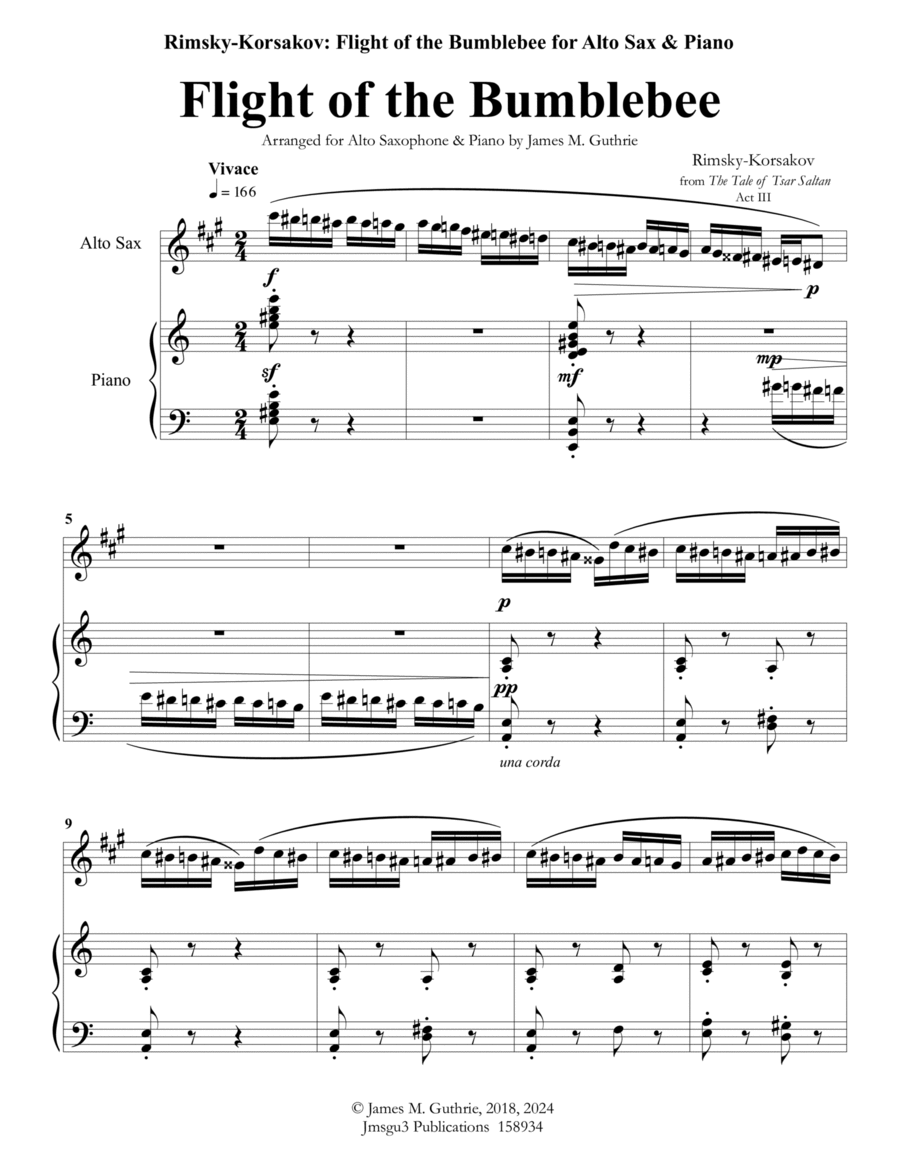
Korsakov: Flight of the Bumblebee for Alto Sax & Piano
Saxophone Alto et Piano

$32.95 28.18 € Saxophone Alto et Piano PDF SheetMusicPlus

Piano,Vocal,Voice - Level 5 - Digital Download SKU: A0.1324262 Composed by Amos Elkana. 21st Century,Contemporary. Score. 10 pages. Amos Elkana #912460. Published by Amos Elkana (A0.1324262). In this composition, we delve into the enigmatic world of Ikkyu Sojun, a 15th-century Zen Buddhist monk renowned for his poetry that defies conventional boundaries. Ikkyu's work often reflects Zen principles, blending deep philosophical insights with a stark, often provocative simplicity. Among his most striking poems is Crow with No Mouth, a piece that captures the essence of Zen’s emphasis on the ineffable nature of reality and the limits of language.Crow With No Mouth Hearing a crow with no mouthCry in the deepDarkness of the night,I feel a longing forMy father before he was born. In these lines, Ikkyu conjures an image that is as perplexing as it is profound. The crow, a traditional symbol of mystery and the unknown, is rendered even more inscrutable by its lack of a mouth - a paradoxical figure that seems to transcend ordinary existence. This poem encapsulates the Zen concept of mu, or the negation of fixed concepts, challenging the listener to embrace the boundless nature of understanding.In my composition, I have strived to translate this philosophical depth into music. The interplay between the piano and the voice is crafted to reflect the paradoxical imagery of the poem. The music moves through moments of tension and release, mirroring the poem’s journey from perplexity to a serene acceptance of the unknown.This piece is an invitation to explore the spaces between notes, between words, where the essence of understanding might lie.The emotional core of this composition is also deeply personal. It resonates with my own longing for my father, who passed away seven years prior to the creation of this work. Just as Ikkyu's poem reflects a yearning for a connection with the past, this music embodies my own journey of grief, memory, and the search for peace in the echoes of loss. The intertwining of my personal narrative with Ikkyu’s profound words aims to offer a universal contemplation on the themes of absence, longing, and the ephemeral nature of existence.In creating this work, my aim has been to offer not just a musical experience, but a doorway into the profound simplicity of Zen thought. Through the synthesis of voice, piano, and Ikkyu's evocative poetry, we embark on a journey that transcends the mere act of listening, inviting contemplation, and perhaps, a glimpse into the boundless sky of our own perception.
Crow with no mouth
Piano, Voix

$8.00 6.84 € Piano, Voix PDF SheetMusicPlus


1 16 31 46 61 ....91


Partitions Gratuites
Acheter des Partitions Musicales
Acheter des Partitions Digitales à Imprimer
Acheter des Instruments de Musique

© 2000 - 2026

Accueil - Version intégrale





